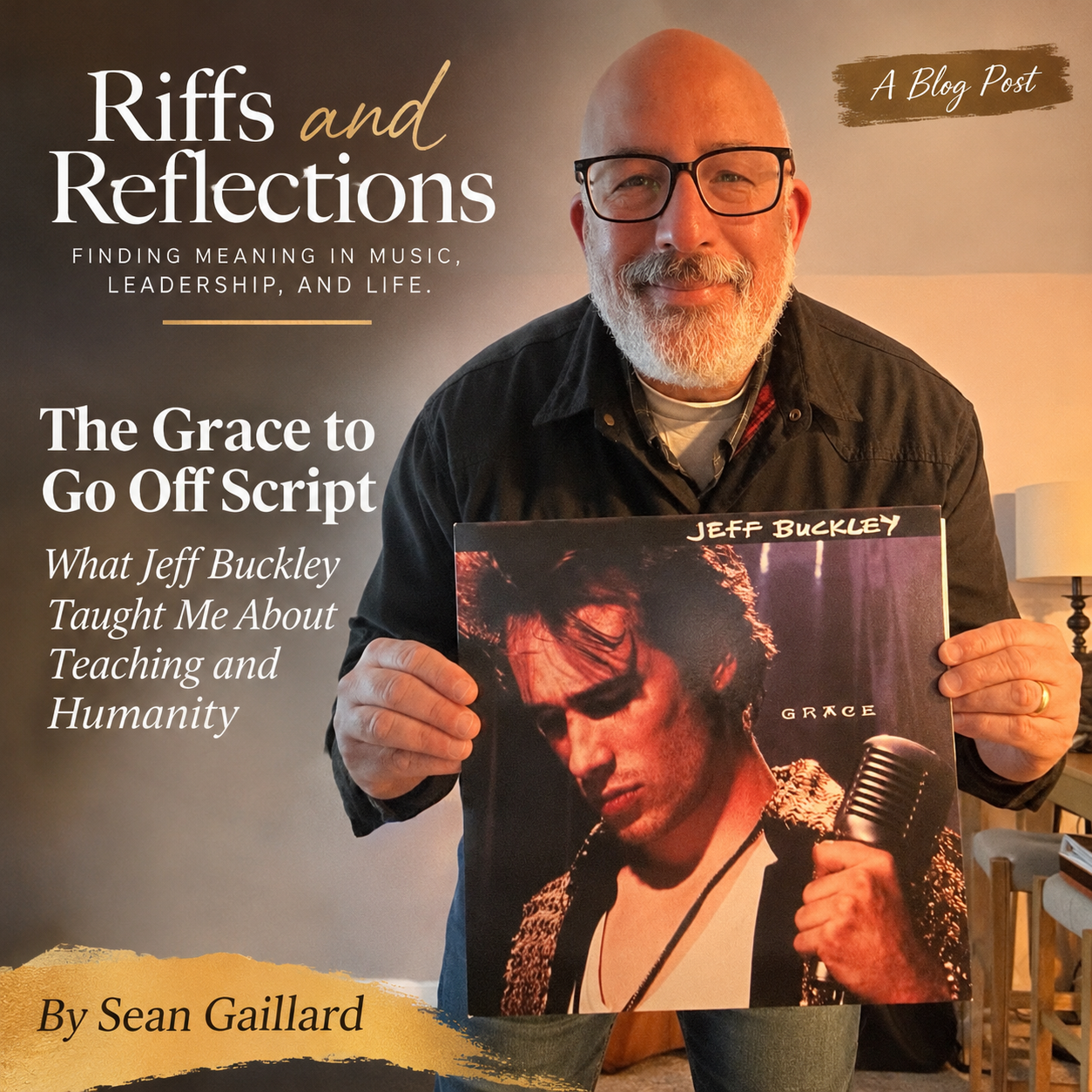
Music has a remarkable way of transporting us through time. A song can take us back to a particular place, a moment, or a person who made a difference in our lives. Sometimes those memories arrive unexpectedly and remind us of something meaningful about ourselves and our connection to others. That happened to me recently while listening to Jeff Buckley’s magnificent album Grace. One song in particular, “Lover, You Should’ve Come Over,” transported me back to my days teaching English at R.J. Reynolds High School in Winston-Salem, North Carolina.
Music was always part of the atmosphere in my classroom. I had a boom box that seemed to be constantly playing something from my ever-growing CD collection. My students were accustomed to hearing everything from Classic Rock and Jazz to Soul and Classical music. I believed then, as I do now, that music could create an atmosphere of connection, curiosity, and belonging. I also believed that some of the most meaningful moments in teaching happened when we allowed ourselves to venture beyond the boundaries of a lesson plan.
During that particular period of my teaching career, I was immersed in Jeff Buckley’s Grace. I have always gone through periods of deep listening when a particular song or album becomes part of the soundtrack of my life. I will return to the same recording repeatedly, discovering something new with each listen. Grace was one of those albums, and “Lover, You Should’ve Come Over” had become something of a personal anthem during that time. There was something about Buckley’s voice, the emotional depth of his songwriting, and the extraordinary beauty of the arrangements that continued to draw me into the music.
My appreciation for Jeff Buckley also had roots in my admiration for his father, the legendary singer and songwriter Tim Buckley. I had discovered Tim through his appearance on the final episode of The Monkees television series, where he performed the haunting “Song to the Siren.” That performance introduced me to an artist whose music seemed to exist beyond conventional boundaries. Years later, hearing Jeff Buckley’s voice brought a different dimension to that musical connection. Here was another extraordinary artist carrying a remarkable musical inheritance while establishing a voice and identity entirely his own.
At the time, I was teaching an elective course on Shakespeare, and we were studying Henry IV, Part 1. We were exploring the complicated relationship between Prince Hal and his father, King Henry IV. Their relationship is filled with expectations, disappointment, questions of identity, and the struggle of a young man attempting to define himself in the shadow of his father’s authority. These were themes that resonated with my students, even if the language and historical setting sometimes seemed distant from their everyday experiences.
As I was explaining the relationship between Hal and his father, I happened to glance at the Grace CD sitting on my desk. Suddenly, a connection emerged. I began riffing on Jeff Buckley and the complicated story of his relationship with Tim Buckley. Jeff had grown up with very little contact with his father, who died when Jeff was still a child. Despite that distance, Jeff would spend much of his musical life being compared to a father whose artistic legacy carried enormous weight. Their respective early deaths added another tragic dimension to a story already filled with questions of identity, absence, and unrealized connection.
What began as a discussion of Shakespeare had unexpectedly become a conversation about music, fathers, sons, expectations, and the complicated process of discovering our own identities. I could see my students becoming increasingly interested in the story. One student eventually asked if I could play something from the album.
Of course, I was more than happy to oblige.
I reached for the CD and played the song that had been occupying so much of my own listening time, “Lover, You Should’ve Come Over.” I remember watching my students as the music filled the classroom. The song begins with a sense of quiet longing before gradually unfolding into something almost overwhelming in its emotional intensity. Buckley’s shimmering, soulful, almost operatic voice seemed to reach into every corner of the room. There was a vulnerability in his singing that demanded nothing from the listener except a willingness to listen.
As the song continued, I could see something happening among my students. Their attention was no longer divided between the clock, their assignments, or whatever else might have been occupying their minds that day. They were listening. They were experiencing something together, even as each student was undoubtedly hearing and feeling something different.
When the song ended, there was a palpable silence in the classroom. Nobody immediately spoke or reached for a distraction. I remember seeing one student with tears in their eyes. Another student was looking solemnly out the window, seemingly lost in thought. I stood there for a moment, taking in the atmosphere and recognizing that something meaningful had just happened.
I finally broke the silence and asked whether they wanted to hear the entire album. A few students smiled, and others nodded their agreement. I placed the CD back into the boom box and allowed Grace to play from beginning to end.
We listened to the entire album without interruption.
I am certain that I had a lesson plan waiting for me that day. There were probably papers to grade, deadlines to meet, and instructional objectives that needed attention. None of those responsibilities had suddenly disappeared. What mattered in that moment, however, was the opportunity unfolding before us. My students were engaged in a shared experience that had nothing to do with completing an assignment and everything to do with discovering something about themselves and one another.
There was something extraordinary about the silence in that classroom. We were not simply listening to a collection of songs. We were participating in a shared experience that allowed each of us to encounter the music through our own memories, emotions, and personal journeys. The classroom had become a community of listeners, connected through the voice of an artist who had poured so much of his humanity into his work.
When the album concluded, I invited my students to share their reactions. What followed was one of those organic classroom conversations that no lesson plan could ever fully anticipate or replicate. The students spoke thoughtfully and openly about the music, the emotions it stirred, and the stories they heard within the songs. Their observations were insightful, personal, and wonderfully honest.
What amazed me most was how naturally they began making connections to Shakespeare. Without prompting, students started discussing Prince Hal, his father, and the complicated relationships that shape our identities. They recognized parallels between the characters in Henry IV, Part 1 and the story of Jeff Buckley. Some students connected the songs to their own relationships, family experiences, and struggles to understand themselves. The literature had suddenly become more accessible because the music had opened a door to their own humanity.
I had not abandoned Shakespeare that day. In many ways, we had discovered another pathway into his work. My students were making connections that reached beyond the text and into their own lives. They were engaging in the kind of thoughtful reflection, interpretation, and discussion that I had hoped to inspire when I first entered the teaching profession.
Jeff Buckley had become an unexpected companion in our classroom that day. His music had created an opportunity for my students to see themselves, one another, and the literature through a different lens. I was simply the person fortunate enough to make the introduction. Sometimes being a teacher means recognizing when our greatest contribution is not delivering information but creating the conditions for something meaningful to happen.
I have thought about that classroom experience many times over the years. The memory returned so vividly as I listened to “Lover, You Should’ve Come Over” recently. I could almost see the faces of those students and feel the stillness of that room. I wonder whether any of them remember that day or whether Grace became part of the soundtrack of their own lives. I hope the experience stayed with at least a few of them because it certainly stayed with me.
That memory also reminds me of something I believe we sometimes lose sight of in education and leadership. We become so focused on schedules, objectives, deadlines, assessments, and expectations that we can overlook the human beings sitting right before us. We convince ourselves that success depends upon following the agenda precisely, even when an unexpected opportunity for connection is unfolding in plain sight.
The lesson plan matters. Preparation matters. Accountability matters. Those responsibilities are essential to the work we do as educators and leaders. Our humanity matters just as much, and sometimes the most important learning happens when we recognize that the people in our care need something different from what we originally planned.
Music has always helped me understand that truth. A great song does not simply communicate information or tell a story. It invites us into an experience that can deepen our understanding of ourselves and others. Music builds connection and community because it allows us to recognize emotions and experiences that we might otherwise struggle to articulate. It reminds us that beneath our titles, responsibilities, and expectations, we are human beings searching for meaning and belonging.
I think about how often we miss those opportunities because we are afraid to deviate from the script. We become so committed to completing the agenda that we forget to notice the people gathered around the table. We become so concerned about reaching the next objective that we overlook the relationships that make the work meaningful. There is a difference between managing an agenda and being fully present with the people we serve.
That day in my classroom taught me something about the courage to trust the moment. I had no way of knowing that a spontaneous riff about Jeff Buckley would lead to an entire class listening to an album together. I certainly had no way of predicting the thoughtful conversations that would follow. I simply recognized an opportunity to connect and allowed the experience to unfold naturally.
Perhaps that is one of the most important lessons we can carry into our classrooms, workplaces, and relationships. We need to remain open to the unexpected moments that invite us to listen more deeply, connect more authentically, and recognize the humanity of those around us. Sometimes the most meaningful experiences cannot be measured by an assessment, captured in a report, or anticipated in a carefully constructed plan.
I am grateful that I followed that musical riff all those years ago. I am grateful for the students who listened so openly and allowed themselves to be moved by an album that meant so much to me. I am grateful for Jeff Buckley and the extraordinary gift of Grace, an album that continues to reveal new layers of beauty, vulnerability, and humanity with every listen.
Sometimes we have to turn away from the agenda and follow the music. Sometimes we have to trust that the most meaningful connections happen when we are willing to go off script.
Sometimes we have to allow ourselves the grace to do that.