A song in The Beatles’ remarkable catalog that deserves more love is “Flying.” It is one of the few Beatles recordings credited to all four members and one of their rare instrumental tracks. Tucked away on Magical Mystery Tour, it is a little gem that has always captivated me.
“Flying” does not sound like a typical Beatles song, yet there is something unmistakably Beatles about its dreamy atmosphere and irresistible groove. It reminds me of just how tight these four musicians were as a band. They knew how to listen to one another and how to give a song exactly what it needed.
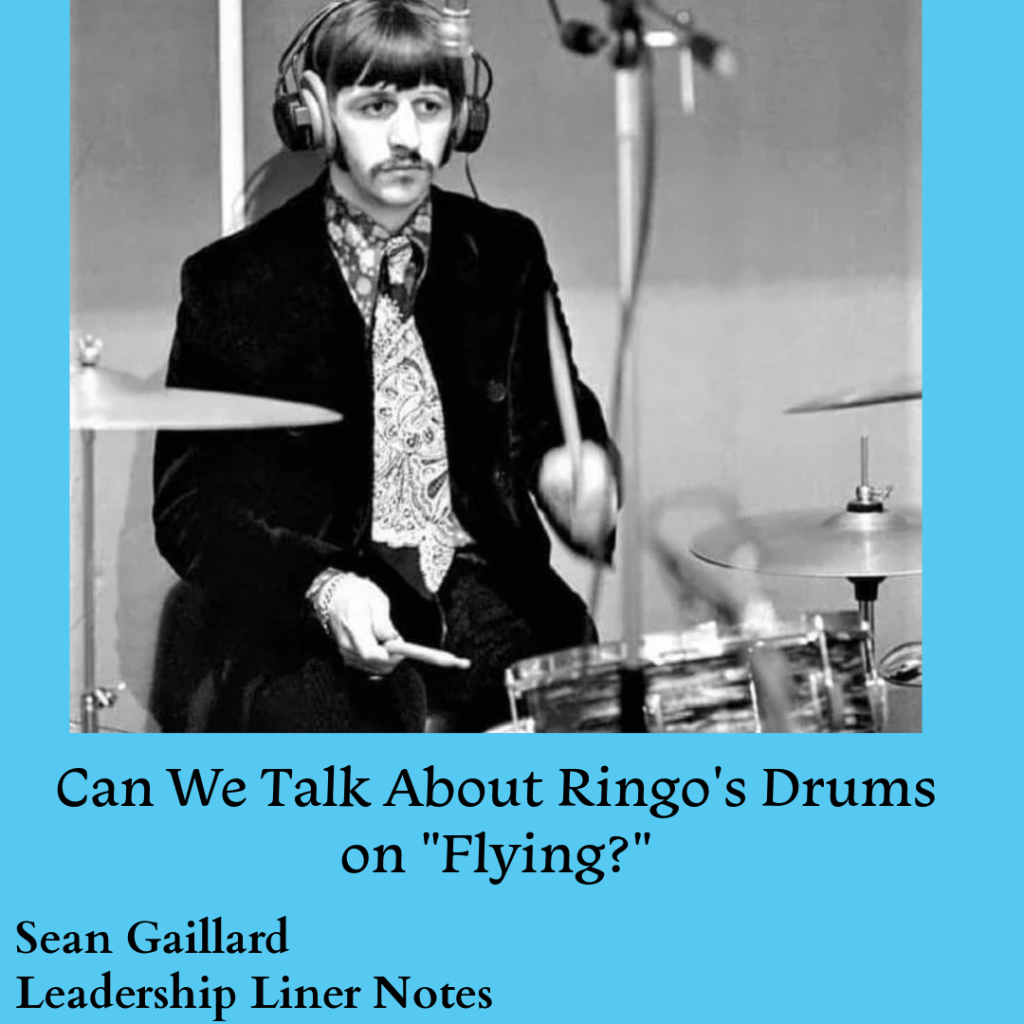
What really gets me every time is Ringo Starr’s drumming.
There is a wonderful little drum break just before the Mellotron takes flight. It interrupts the gentle, hypnotic groove with a few perfectly placed taps on the snare. I have always imagined that moment as a transmission from air traffic control announcing, “You are cleared for takeoff.”
It is subtle, gentle, and beautifully timed. Ringo does not overwhelm the moment. He simply gives the music a little nudge, and suddenly we are soaring.
Then comes another drum break, just before those glorious wordless vocals enter. I imagine another transmission from the cockpit announcing, “We are going to ascend even higher.” Ringo’s playing is steady, assured, and wonderfully precise. Those few beats help carry the song into another dimension as the voices echo the Mellotron melody.
I absolutely love these moments. They are small details in a recording that lasts just over two minutes, yet they reveal so much about Ringo’s musical instincts. His drumming is never about showing off. It is about listening, feeling the groove, and knowing exactly when to make his presence felt.
That is part of Ringo’s genius. He understood that serving the song mattered more than filling every available space with another drumbeat.
Every time I listen to “Flying,” I find myself waiting for those little drum breaks. They never fail to bring a smile to my face. Ringo’s playing reminds me that sometimes the smallest musical moments can leave the biggest impression.
What a drummer. What a band. What a wonderful little Beatles song.
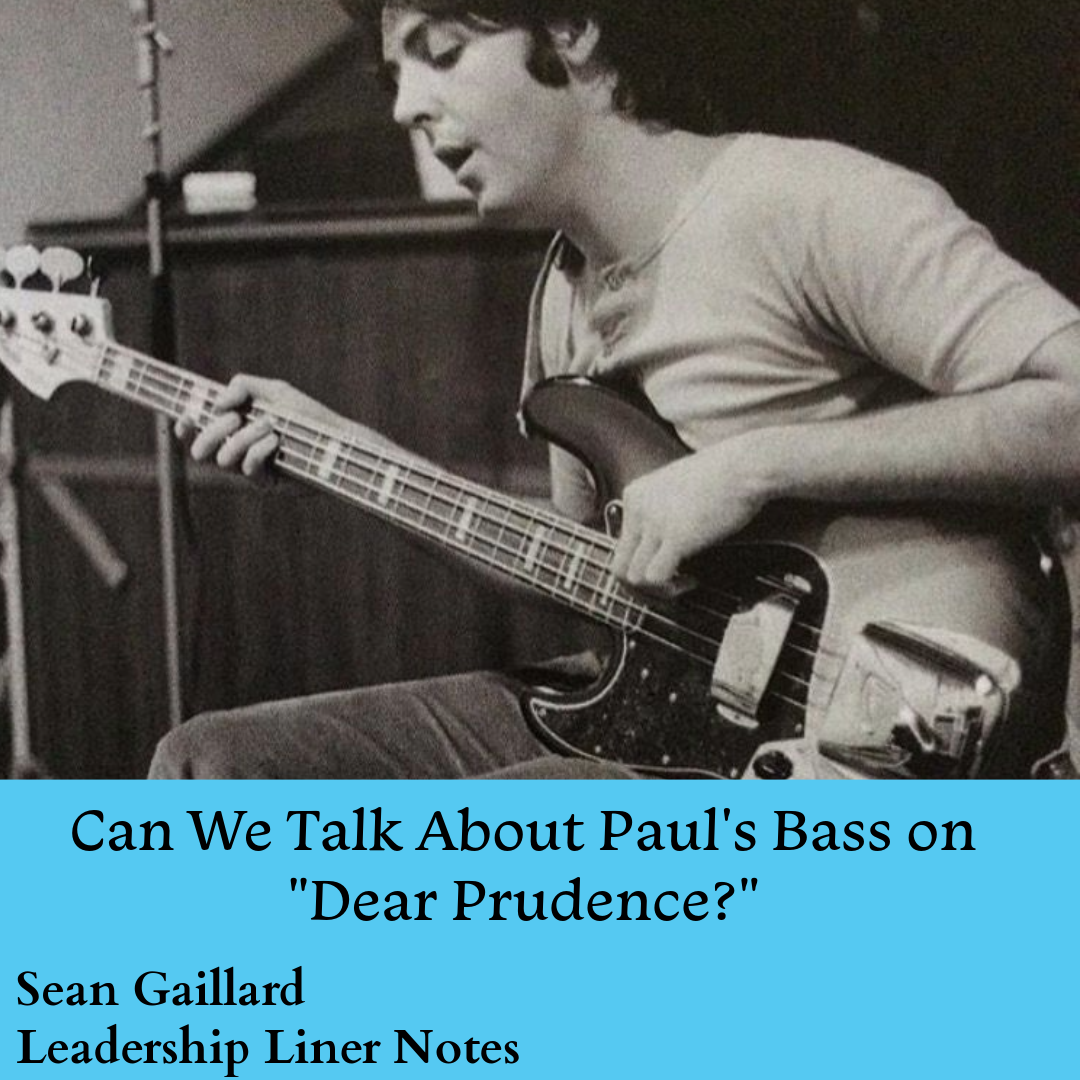
There are certain moments in music that move me on a visceral level, no matter how many times I have heard them. Paul McCartney’s bass playing on The Beatles’ “Dear Prudence” is one of those moments. The song is a highlight of the band’s eponymously titled 1968 double album, The Beatles, affectionately known as The White Album because of its stark, nearly all-white cover. From the instant Paul’s bass enters the song to that magnificent final crescendo, I find myself immersed in the sheer beauty and joy of his musicianship.
Some bass lines hold a song together. Others take a song somewhere entirely new. Paul’s bass on “Dear Prudence” does both. Every time I hear it, I am reminded why I love music so much.
Yes, “Dear Prudence” is a John Lennon song, but Paul’s bass is an essential part of its magic. I love discovering those particular moments in a recording when one instrument elevates everything around it. Paul’s bass grounds the song in a groove that dances, soars, and transcends. His playing is both a melodic voice and an empathetic anchor to the emotional beauty of the song.
There is something deeply renewing about hearing that bass line unfold. It brings me joy, peace, and a reassuring sense that somehow, we are going to be okay. That is the transcendent power of music, and Paul captures it beautifully.
I invite you to listen to “Dear Prudence” again. Follow Paul’s bass from its first entrance to that glorious final crescendo. Lose yourself in the groove and experience the magic.
A simple riff in music can be unforgettable. Consider Keith Richards’ iconic guitar hook on The Rolling Stones’ “(I Can’t Get No) Satisfaction.” A handful of notes became one of the most recognizable sounds in rock and roll history. Sometimes a simple musical idea can leave a lasting impression.
There is another kind of riff that I find equally fascinating. It is the free flow of ideas, thoughts, and questions that happens when we feel comfortable enough to explore unfinished thoughts with someone else. There is no script or predetermined destination. There is simply the freedom to think aloud, listen, respond, and see where the conversation takes us.
When people listen and respond without judgment or competition, something magical happens. There is synergy, connection, and trust. I think of jazz musicians like Miles Davis and John Coltrane, listening and responding to each other through their instruments. One musician introduces an idea. Another builds upon it. Someone takes it somewhere unexpected. Together, they create something that might never have emerged independently.
I love those moments when a conversation becomes a genuine riff. There is no pressure to have the perfect answer or even the right words. We can stumble, explore, laugh, reconsider, and discover something new together. A great riff is not always about having the right notes. Sometimes it is about finding the right people who are willing to listen, respond, and create something alongside us.
Those connections matter. The people who give us the freedom to think aloud and make us feel that our voices matter are worth celebrating. They remind us that some of our most meaningful discoveries happen when we are willing to listen as much as we contribute.
Who are the people in your life who make it safe to riff, explore, stumble, and discover something new? Have you told them lately how much their voices matter?
Thirty days. Thirty consecutive days of blogging and creating reels. What began as my Four Weeks to Rubber Soul creative challenge has become a rhythm that I want to continue.
There is something deeply satisfying about sitting down, gathering my thoughts, finding the words, and pressing publish. Writing has become a source of peace and meaning for me. It gives me an opportunity to reflect, create, and share a little piece of myself with the world.
Not every blog post will be a masterpiece. Not every idea will resonate or find an audience. I am learning to be at peace with that reality because the satisfaction comes from the act of creating and the courage to share it.
I may not blog every single day moving forward, and that is perfectly fine. What matters is keeping the rhythm alive and giving myself the space to write without turning something I love into another obligation.
There is another purpose behind this daily practice. Every post helps keep my writing muscles limber as I continue working toward finishing my book, Leadership Riffs. The more I write, the more I discover about my voice, my ideas, and the stories I still want to tell.
The Beatles found an extraordinary creative groove during the recording of Rubber Soul. My own little creative journey has reminded me how much joy comes from showing up and doing the work.
Thirty days later, I still want to keep going. There are more words to write, more ideas to explore, and more stories to share.
I am finding peace in the process, and I want to keep that groove going.
There is something that always brings a smile to my face when I look at my calendar and see the words Record with Donya. Our monthly conversations on Real Riffs with Donya Ball have become one of the most rewarding and enriching creative collaborations I have experienced. We have now recorded six episodes, and I genuinely look forward to each opportunity to connect, reflect, and explore the realities of educational leadership.
What I especially appreciate is how naturally our conversations unfold. We have reached the point where there is no elaborate preparation, no scripted questions, and no predetermined agenda. We simply hit record and start riffing. There is something refreshing about allowing a conversation to develop organically, particularly when both participants bring trust, mutual respect, and a willingness to listen.
The Art of Riffing
I often think about the similarities between our conversations and a jazz jam session. Great improvisation requires more than individual talent. It requires deep listening, trust, and an understanding of what another musician brings to the performance. One musician introduces an idea, another builds upon it, and something new emerges through the collaboration.
That is the dynamic I value in working with Donya. We challenge and expand each other’s thinking in a supportive and trusting environment. Donya brings thoughtful perspectives and a wealth of leadership experience to our conversations, and I appreciate how our exchanges often lead me to consider ideas from a different angle. We are not competing for the spotlight. We are simply having meaningful conversations and learning from one another.
The Sixth Riff: Getting Into the Real Stuff
Our latest episode, The Sixth Riff: Educelebrity Culture, Brokenness, and the Courage to Lead, explores some challenging realities of educational leadership.
We examine the educelebrity phenomenon and the tension between visibility, recognition, and authentic leadership. We also discuss the brokenness that leaders sometimes experience in education, including disappointment, isolation, and the challenge of maintaining a sense of purpose when the work becomes difficult.
These are conversations that deserve more attention. We approach them with honesty, reflection, and a willingness to acknowledge that neither of us has all the answers. That is the spirit of Real Riffs. We are unflinchingly real about the profession we care deeply about and the human experiences that accompany leadership.
Looking Ahead
I am excited that our next episode in November will be recorded in person! After six virtual conversations, it will be a welcome opportunity to continue our discussions in the same room. We will maintain the approach that has worked so well for us: no script, no agenda, and plenty of room for spontaneous conversation.
I am grateful for this collaboration and for everyone who has listened and supported Real Riffs. This experience continues to reinforce something I believe deeply about leadership and creativity. Meaningful collaboration grows through trust, reciprocity, and the willingness to make room for another person’s voice.
Sometimes the best ideas emerge when we stop trying to control every moment and simply listen to one another. That is what makes a good jazz session, a good conversation, and a good collaboration.
Listen to The Sixth Riff
The Sixth Riff: Educelebrity Culture, Brokenness, and the Courage to Lead
We appreciate every listen, share, review, and subscription. Please subscribe so you do not miss our November episode, when we will be recording together in person!
Thank you for supporting Real Riffs and being part of these conversations!
Twenty-eight days ago, I began a creative journey inspired by an album that The Beatles recorded over approximately four weeks during the fall of 1965. I wanted to explore the lessons of creativity, collaboration, experimentation, and commitment found within the making of Rubber Soul. More importantly, I wanted to challenge myself to create something meaningful every single day while encouraging others to embrace their own creative possibilities.
Today, October 11, 2026, I reach the finish line of this journey. For twenty-eight consecutive days, I have written a blog post and recorded a reel inspired by four musicians whose creativity continues to shape my life. I have researched, reflected, listened, experimented, and shared ideas that have challenged me to think differently about my own creative process. What began as a celebration of an extraordinary album gradually became something much more personal.
Somewhere along the way, I discovered that I needed this experience as much as anyone who might have been reading or watching. I began with the hope of inspiring others, but I am finishing with a renewed understanding of what creativity means in my own life.
I began this journey hoping to build community and connection. I wanted to encourage others who might be struggling to find their creative voices or searching for their own bandmates. After all, one of the greatest lessons of The Beatles is that remarkable things can happen when people bring their individual talents together in pursuit of something meaningful. I hoped this series might create opportunities for conversation, encouragement, and perhaps even collaboration.
The experience did not always unfold as I imagined. There were days when the engagement was quiet and the response was less than I had hoped. I sometimes wondered whether these reflections were reaching anyone or whether the ideas I was sharing were making a difference. Those moments were difficult because the desire for connection was a genuine part of why I began this journey.
At times, I felt as though I was standing alone on a stage in an empty auditorium, sharing my voice with rows of unoccupied seats. There is a certain vulnerability in putting something personal into the world and wondering whether anyone is listening. I have experienced that feeling more than once throughout these four weeks.
Still, I kept showing up. I kept writing, recording, learning, and sharing. Even when the auditorium seemed empty, I continued to fill the space with my voice. I began to understand that the absence of applause did not mean the absence of purpose. The courage to create could not depend entirely upon whether someone was there to acknowledge the work.
I also want to recognize that the auditorium was never entirely empty. There were people who took the time to read these reflections, watch the daily reels, leave thoughtful comments, and offer words of encouragement. Some followed the journey quietly, while others shared their thoughts along the way. Every expression of support mattered, and I am genuinely grateful to everyone who made room for this creative journey in their lives.
That gratitude is important to me because I never wanted this experience to be simply about producing content. I wanted it to be about sharing ideas that might encourage someone else to begin creating, take a risk, or rediscover something meaningful in their own life. I may never know how these reflections resonated with everyone who encountered them, but I am grateful for every opportunity to make a connection.
The four words that guided this journey were Begin, Collaborate, Experiment, and Finish. Looking back, each one carries a deeper meaning than it did when I started.
I began with an idea and the willingness to take a creative risk. I explored collaboration by studying the extraordinary chemistry of The Beatles and reflecting on the importance of finding people who encourage and challenge one another. Although I did not discover the band of collaborators I had hoped to find, the experience reminded me why those connections matter and why I want to remain open to them.
I experimented with my writing, my voice, and the daily practice of recording and sharing reflections. I became more comfortable putting my ideas into the world without knowing how they would be received. The discipline of creating something every day gradually became less intimidating and more natural. I discovered that the simple act of showing up consistently could strengthen my confidence and give me the courage to explore new possibilities.
Now, I have finished something I promised myself I would complete. I have twenty-eight days of creative work to show for that commitment, along with lessons that I could never have anticipated when I began. I have learned that creativity requires discipline, but it also requires trust in ourselves and a willingness to keep going when the response is uncertain.
The Beatles offer a remarkable example of what finishing can make possible. When Rubber Soul was released on December 3, 1965, it represented a significant creative achievement. The Beatles had expanded their musical vocabulary, explored new approaches to songwriting, and demonstrated an increasing willingness to challenge their own artistic boundaries.
They could have continued repeating that successful formula, but their curiosity and creative ambitions carried them forward. Within months, they were recording Revolver, an album that would take their experimentation into even more adventurous territory. Their journey continued through Sgt. Pepper’s Lonely Hearts Club Band and beyond, with each completed project opening possibilities that had not existed before.
That example has stayed with me as I have approached the conclusion of this challenge. Finishing something meaningful does not require us to remain in the same creative space. The accomplishment deserves to be celebrated, but it can also become the foundation for another beginning.
Finish is not the opposite of Begin. Finish is what makes Next possible.
There is something particularly meaningful about the timing of this final reflection. Today is October 11, and tomorrow marks the sixty-first anniversary of the beginning of The Beatles’ Rubber Soul recording sessions at EMI Studios in London. On October 12, 1965, they began recording music that would eventually become one of the most influential albums of their career.
I find something beautiful in that connection. As I finish this journey inspired by Rubber Soul, I am standing on the eve of the anniversary of its beginning. More than six decades separate these two creative experiences, yet the lessons of curiosity, commitment, and courage continue to resonate. An album created in 1965 inspired me to begin something in 2026, and finishing that experience has given me the courage to consider what comes next.
For much of my life, I have believed in the power of community, collaboration, and finding people who share a common purpose. I still believe in those things, and I still hope to find more bandmates who want to create, encourage, and build something meaningful together. That hope has not disappeared simply because this experience was sometimes quieter than I anticipated.
What has changed is my understanding of what I can do while those connections have yet to develop. I do not have to wait for a full auditorium to share my voice. I do not have to wait for someone to invite me into a creative space or measure the worth of an idea by the number of people who respond to it. I can begin where I am, create with what I have, and trust that the work itself has meaning.
Perhaps that is the true lesson I have discovered through Rubber Soul. The album is certainly a testament to the extraordinary possibilities of collaboration, but it is also a reminder that creativity requires curiosity, courage, and the willingness to move beyond what we already know. The Beatles continued to grow because they remained open to what might come next.
I want to carry that same spirit forward. I want to continue creating, learning, exploring, and sharing ideas that might make a difference in someone’s life. I want to remain open to the possibility of finding new bandmates while recognizing that I already have the ability to create something meaningful on my own.
I am grateful for everyone who followed this journey, read the daily reflections, watched the reels, shared a comment, or offered encouragement. Your presence and support have meant more than you may realize. I hope that somewhere along the way, something I shared encouraged you to consider your own creative possibilities.
Most of all, I am grateful that I did not abandon this journey when it became difficult or when the response was not what I had imagined. I gave myself the opportunity to discover something about my own creativity, discipline, and courage. I found a renewed sense of purpose in the simple act of showing up each day and creating something meaningful.
I do not want this journey to end. The daily rhythm of creating has become something I genuinely value, and I hope to continue nurturing it. I do not know exactly what the next creative chapter will look like, but I am no longer waiting for every detail to fall into place before I begin.
There is still music to discover, stories to tell, ideas to explore, and meaningful work to create. There are still people I hope to meet and bandmates I hope to find. There are possibilities I cannot yet imagine, and I want to remain open to discovering them.
Twenty-eight days ago, I stepped onto a stage with an idea and the hope that someone might listen. Today, I may still be standing on that same stage, but something has changed. I have filled that space with my voice, my creativity, and the courage to keep going. The auditorium may not be full, but I am no longer waiting for an audience before I begin.
I began. I explored the possibilities of collaboration. I experimented. I finished. The journey did not unfold exactly as I had imagined, but it gave me something I needed and reminded me that there is still so much more to discover.
As I finish this journey, I am grateful for everyone who shared even a small part of it. I am grateful for the music of The Beatles, for the lessons of Rubber Soul, and for the courage I have discovered through these twenty-eight days.
I may not know exactly what comes next, but I know that I am ready to begin.
Thank you for being part of Four Weeks to Rubber Soul.
Special Acknowledgements:
A very special thanks to Nicole Michael of 910 Public Relations and Dave Burgess of Dave Burgess Consulting, Inc. for their generosity in promoting this series on their respective platforms. Both have always been in corner for years and I grateful for their sincere support. Their belief in my work means the world to me.
Stay tuned for my next book with Dave Burgess Consulting, Inc: Leadership Riffs.
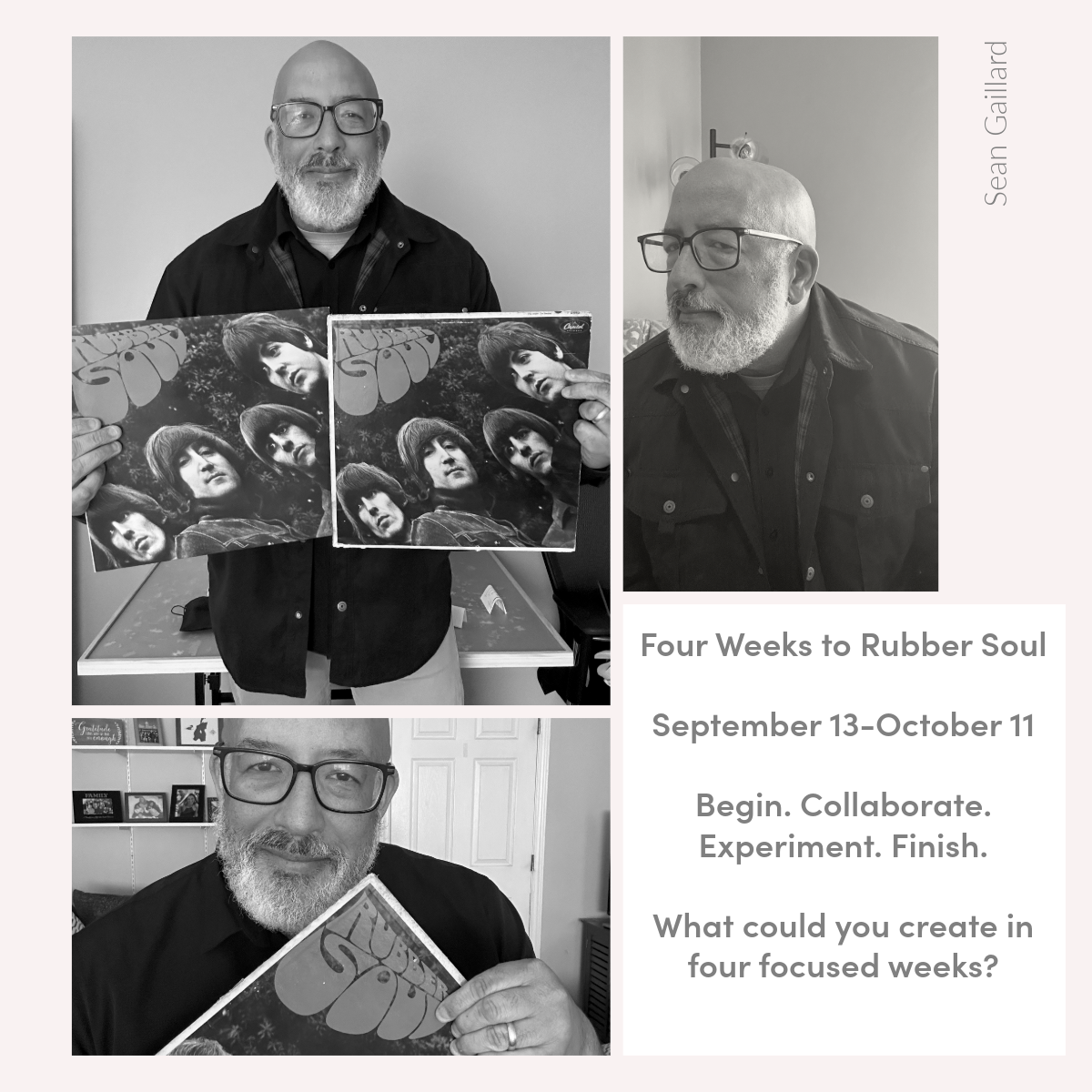
There is something magical about release day, especially when it involves The Beatles. For the past several years, I have made it a personal tradition to purchase new Beatles releases and reissues on the very day they become available. There is an excitement that comes with holding the finished product, opening the packaging, exploring the liner notes, and listening to familiar music in an entirely new way. I recently experienced that excitement again with the Super Deluxe Edition of Rubber Soul, an album that has been the inspiration for this four week creative journey.
As I listened to the recordings and explored the evolution of these remarkable songs, I began thinking about the word “Release” and what it means beyond the arrival of a new album. Release is about sharing something we have created with the world, but it is also about having the courage to let go.
On December 3, 1965, The Beatles released Rubber Soul in the United Kingdom. After approximately four weeks of intense recording sessions, they had completed an album that represented a remarkable evolution in their songwriting, musicianship, and creativity. They had experimented with new sounds, explored more introspective themes, and challenged themselves to move beyond what had previously worked so successfully.
Then came release day. The music that had occupied their days and nights at EMI Studios was now available for the world to experience. The Beatles had given their creativity, collaboration, and commitment to the recording process. What happened next was no longer entirely within their control. Listeners would discover the songs, interpret their meanings, and make the music part of their own lives. There was the possibility that the album could be a critical and commercial flop.
I wonder whether John, Paul, George, and Ringo could have imagined the impact that Rubber Soul would continue to have more than six decades later. I certainly doubt they could have envisioned an educator and lifelong Beatles fan in North Carolina finding enough inspiration in that album to undertake a daily creative challenge in 2026.
Over sixty years later, here we are.or nearly four weeks, I have written a blog post and recorded a reel every single day. I have explored the creative lessons found within the making of Rubber Soul and considered how those lessons might apply to our own lives. Along the way, I have discovered that the daily practice of creating and releasing something has become easier. What initially required a conscious effort has gradually become part of my daily rhythm.
I would be less than truthful if I suggested that the response to this journey has always been what I had hoped. There have been moments when I wondered whether anyone was reading, watching, or finding encouragement in these reflections. I began this challenge hoping to inspire others to embrace their own creativity, and I would still love to know that these ideas have resonated with someone.
However, I am learning something important about the act of releasing creative work. We cannot control the reception of our creativity, but we can control the courage it takes to release it.
Release also means letting go of the expectations we attach to our work. We cannot determine whether something will become a bestseller, reach a large audience, or generate the recognition we might hope to receive. Those possibilities should never become the measure of whether our creativity was worth pursuing in the first place.
There is a certain freedom in recognizing that distinction. We can give our best effort to something, refine it with intention, and share it with the world without allowing the response to determine its value. We can also release the anxiety, doubt, and fear that sometimes accompany the vulnerability of sharing something personal.
Perhaps the most meaningful discovery of these past four weeks is that the daily act of releasing my work has also given me greater courage to create. I have become more willing to explore an idea, trust my voice, and share something without waiting for permission, an invitation, or the assurance that someone will respond. That is a lesson I hope to carry well beyond this challenge.
When The Beatles released Rubber Soul in December 1965, they could not have known all the lives their music would touch or the creative journeys it would inspire. More than sixty years later, their work continues to find new listeners and inspire new possibilities. I find something deeply encouraging in that thought.
As I approach the conclusion of Four Weeks to Rubber Soul, I am beginning to understand that release is not simply the final step in the creative process. It is an act of courage and trust. We create something meaningful, give it our best effort, and find the courage to let it go.
Release is not the moment when the world decides our work matters. Release is the moment when we decide our work is worth sharing.
Tomorrow brings the final day of this journey. Today, I am grateful for the courage to create, the freedom to release, and the possibilities that emerge when we allow our work to find its own way into the world.
There comes a moment in every creative journey when we have to stop revising, stop second-guessing, and trust the work we have created. We have to declare it complete. For The Beatles, that moment arrived in November 1965 as they finished recording Rubber Soul. For me, that moment arrives every morning when I press Publish on another blog post or reel, sending a small piece of my creativity into the world with the hope that it will find its way to someone who needs it.
It is not always easy to declare something complete. There may be doubts, fears, and uncertainties behind placing that final period at the end of the final sentence. There may even be a flaw or two in the finished work, and that is perfectly fine. We have to honor our humanity, embrace the imperfections that come with the creative process, and believe that our vision is worthy of being shared with others. Completion does not necessarily mean perfection. Sometimes, it simply means having the courage to trust the work.
Think about the remarkable journey of Rubber Soul. The Beatles had spent weeks recording, experimenting, rewriting, refining, and pushing themselves into new creative territory. They were working against a deadline while discovering new dimensions of their artistic identities. Each recording session brought them closer to completing an album that would mark an important turning point in their creative evolution.
Their final recording session for the album took place on November 11, 1965, extending into the early hours of November 12. Among the final songs recorded was “Girl,” a John Lennon composition that beautifully demonstrates the increasingly introspective direction of his songwriting. I often wonder what that final session must have felt like for John, Paul, George, and Ringo. Was there exhaustion mixed with relief? Did they feel a sense of pride in what they had accomplished? Were they uncertain about how their latest collection of songs would be received? I would have loved to have been a part of that final recording session, simply to experience the atmosphere in the studio and witness the band reaching the finish line. We cannot know exactly what they were feeling, but I find myself drawn to imagining that moment when the work was finally complete.
For the past 26 days, I have published a daily blog and reel as part of this personal creative challenge. Each morning, I have stepped into the unknown by sharing my ideas, reflections, and creativity with the world. My passion for The Beatles and Rubber Soul is certainly nothing new. Their music has always been a comfortable and familiar place for me to dwell, reflect, and find inspiration. Through this series, however, I have attempted to move beyond simply celebrating the music by connecting the album to new ideas about creativity, collaboration, leadership, and the importance of doing the work.
There have been mornings when I have felt a quiet sense of pride in what I have completed. There have also been moments when I have wondered whether my work has resonated with anyone or whether anyone has even taken the time to read or watch. Some posts and reels have generated meaningful responses and connections, while others have received far less engagement than I had hoped. I would be less than truthful if I said that those quieter moments did not occasionally leave me questioning myself. Yet, through all those moments of uncertainty, I have continued to create, reflect, and share. I have honored the commitment I made to myself when this journey began.
As I approach the conclusion of this month-long series, I am beginning to look back and marinate on what I have learned. There is much to ponder about the discipline of creating something every day, the courage of sharing personal reflections, and the unexpected discoveries that emerge when we give ourselves permission to explore our creativity. One particular lesson resonates with me today as I consider the word “Complete.”
Completion is the moment when we stop measuring our work by what we might still change and begin trusting what we have already created.
I cannot control who reads my blog or watches my reels. I cannot determine whether friends, family, colleagues, or complete strangers will take the time to engage with what I have shared. I can only control the care, intention, authenticity, and effort I bring to the creative process. Once I press Publish, the work begins a journey beyond my control. It may resonate with someone today, tomorrow, or perhaps years from now. It may reach only a handful of people. None of those possibilities diminishes the value of the work or the personal growth that came from creating it.
As I reflect upon my discoveries during Four Weeks to Rubber Soul, I realize that I am not simply writing about The Beatles. I am using their creative journey to better understand my own. The daily discipline of writing, recording, revising, and publishing has reminded me of the importance of trusting my voice, embracing the creative process, and finding fulfillment in the work itself. There is something liberating about recognizing that the act of creating has its own rewards, even when the response from the outside world is quieter than we might hope.
Complete is a powerful word because it asks us to trust ourselves. It invites us to recognize the effort we have invested, the lessons we have learned, and the creativity we have shared. There will always be another sentence to revise, another recording to improve, or another idea to explore. At some point, we have to believe that what we have created is worthy of being shared. We press Publish, release our work into the world, and hope it lands where it needs to land. The act of completion becomes an act of faith in our creativity and in ourselves.
Today also carries a special significance as we remember John Lennon on what would have been his 86th birthday. When I listen to Rubber Soul, I hear an artist becoming increasingly willing to explore new dimensions of his creative voice. Songs such as “Norwegian Wood,” “Nowhere Man,” and “In My Life” reveal a songwriter moving into more personal, introspective, and imaginative territory. John was willing to explore new possibilities in his songwriting, and that creative courage continues to inspire me.
John and his fellow Beatles completed Rubber Soul without knowing the lasting impact their work would have on generations of listeners. They had created something meaningful, trusted their creative instincts, and released their music into the world. Perhaps that is one of the most beautiful lessons we can take from their journey. We do the work, give it the care and attention it deserves, and trust that it will find its place in the world.
As I press Publish on Day 26, I am learning to embrace that same sense of trust. I am grateful for the journey, the discoveries, and the opportunity to share a little piece of myself each morning through the music that has meant so much to me throughout my life. My work for today is complete, even as my creative journey continues.
As we move closer to finishing any creative work, there comes a moment when we need to look again at what we have made. We are not looking to tear it apart or chase perfection. We look again because there may be an element that needs attention, an idea that needs sharpening, or a small adjustment that brings the original vision more fully into focus.
That is the work of refinement, and it requires intention. Refining asks us to listen closely and pay attention to the details that matter. The challenge is knowing when those details strengthen the work and when we are simply getting lost in minutiae. Refinement should move the work closer to its purpose, not further away from the excitement that inspired us to begin.
You can hear that process throughout the Rubber Soul sessions. The recordings included on the Super Deluxe Edition allow us to hear songs taking shape through experimentation, performance, revision, and discovery. Early ideas become increasingly focused as The Beatles continue working with the material and discovering what each song needs.
“Day Tripper” and “We Can Work It Out,” the double A sided single recorded during these sessions, offer wonderful examples. In the early versions, you can hear John Lennon and Paul McCartney planting the seeds of ideas that eventually grow into the finished recordings we know today. Performances become stronger, arrangements take shape, and musical elements are added with purpose. The songs gradually become clearer versions of themselves.
That distinction matters because refinement does not necessarily mean changing the vision. Sometimes refinement means seeing the vision more clearly and removing whatever keeps us from realizing it.
I have experienced that during Four Weeks to Rubber Soul. I began this series with a rough outline and an idea of where I wanted the journey to go. As I started writing and recording each day, some of the words changed, some ideas shifted, and new connections emerged that I could not have anticipated when I created the original outline.
The framework gave me somewhere to begin, while the daily work helped me refine where I was going. I needed enough structure to keep moving and enough openness to listen when the work seemed to be pointing somewhere unexpected.
That may be the most important lesson for me today. Stay true to the vision while remaining open to what the work is teaching you. Refine what needs attention, but do not polish away the energy that made you excited about the idea in the first place.
The goal is not perfection. The goal is to make the work more fully what you hoped it could become. As you move closer to the finish, refine the work while protecting the spark that made you want to begin.
As the finish line approaches, starting is no longer the challenge. We have committed. We have focused. Now we have to sustain the momentum long enough to finish what we started.
The final stretch of Rubber Soul fascinates me because of the pace The Beatles maintained. During the last week of recording, they were still creating new songs, returning to unfinished ones, adding overdubs, and working increasingly long sessions. On November 11, with the deadline closing in, they worked for 13 hours. “You Won’t See Me” and “Girl” were recorded, while “Wait” and “I’m Looking Through You” received the additional work they needed. This was not a quick burst of inspiration. They had to sustain their energy, concentration, and creativity until the work was finished.
Sustain means more than keeping busy. It means carrying something forward after the initial excitement has faded. A new idea can give us energy. A deadline can give us urgency. Neither guarantees that we will stay with the work. Sustaining momentum requires us to keep showing up when the work becomes difficult, repetitive, or uncertain.
I also wonder whether something besides the deadline was sustaining The Beatles. They were discovering new possibilities in the studio. They were stretching their songwriting, experimenting with instruments and sounds, and beginning to understand that the recording studio could become part of the creative process itself. Imagine realizing, together, that you are onto something. That feeling must have been difficult to leave behind.
Maybe that is why the momentum did not end with Rubber Soul. Only a few months later, The Beatles returned to the studio and began recording Revolver, pushing many of those creative possibilities even further. The finish line for one project became the starting line for another.
I feel some of that through Four Weeks to Rubber Soul. Showing up every day has created momentum of its own. Some days have come easily. Others have required more effort. Each day has reminded me that creative momentum deserves care if we want it to last.
Today’s word is Sustain. Keep showing up. Protect the energy around the work. Stay curious about where it might lead.
Momentum gets us moving. Sustaining it helps us discover how far we can go.