A simple riff in music can be unforgettable. Consider Keith Richards’ iconic guitar hook on The Rolling Stones’ “(I Can’t Get No) Satisfaction.” A handful of notes became one of the most recognizable sounds in rock and roll history. Sometimes a simple musical idea can leave a lasting impression.
There is another kind of riff that I find equally fascinating. It is the free flow of ideas, thoughts, and questions that happens when we feel comfortable enough to explore unfinished thoughts with someone else. There is no script or predetermined destination. There is simply the freedom to think aloud, listen, respond, and see where the conversation takes us.
When people listen and respond without judgment or competition, something magical happens. There is synergy, connection, and trust. I think of jazz musicians like Miles Davis and John Coltrane, listening and responding to each other through their instruments. One musician introduces an idea. Another builds upon it. Someone takes it somewhere unexpected. Together, they create something that might never have emerged independently.
I love those moments when a conversation becomes a genuine riff. There is no pressure to have the perfect answer or even the right words. We can stumble, explore, laugh, reconsider, and discover something new together. A great riff is not always about having the right notes. Sometimes it is about finding the right people who are willing to listen, respond, and create something alongside us.
Those connections matter. The people who give us the freedom to think aloud and make us feel that our voices matter are worth celebrating. They remind us that some of our most meaningful discoveries happen when we are willing to listen as much as we contribute.
Who are the people in your life who make it safe to riff, explore, stumble, and discover something new? Have you told them lately how much their voices matter?
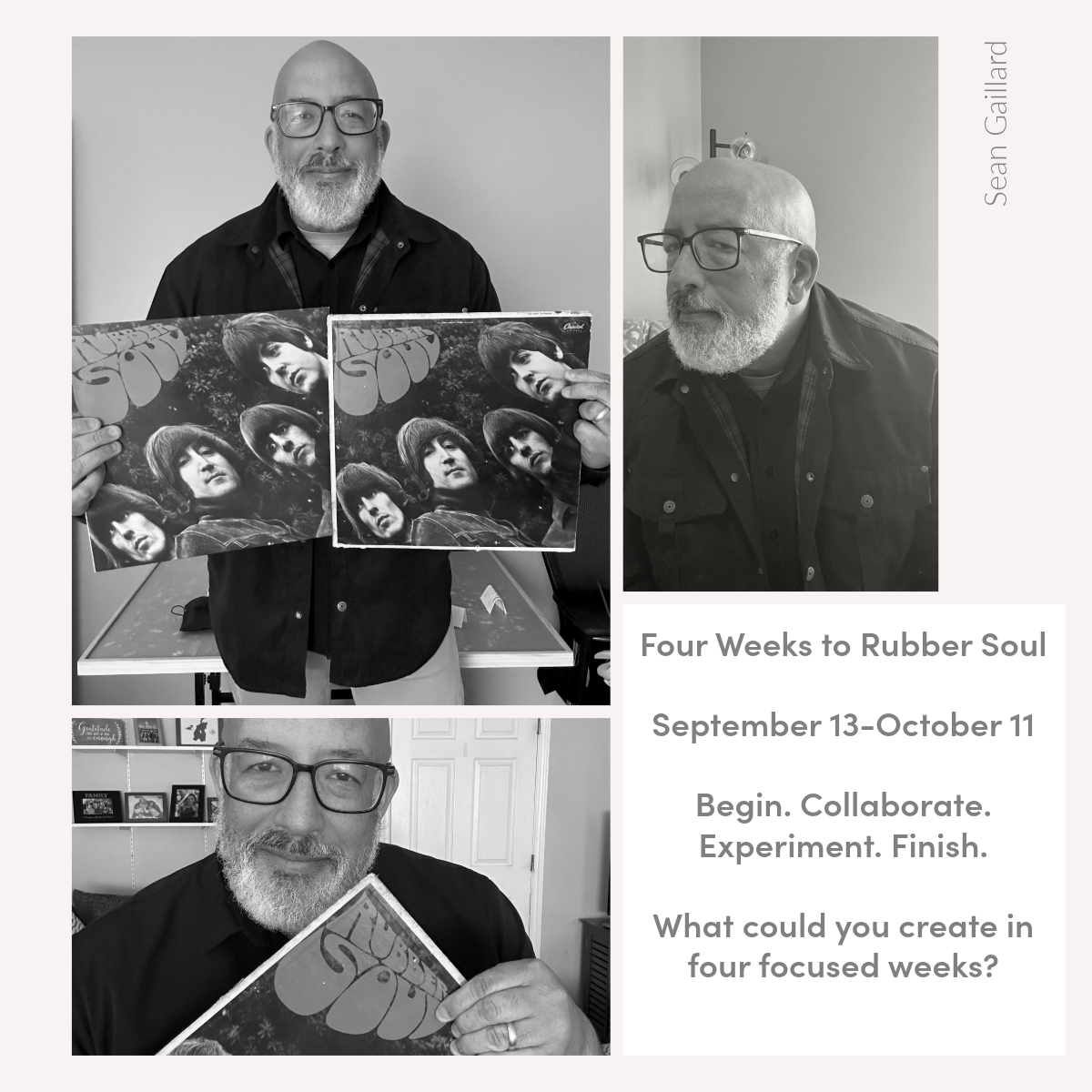
Today is Day 10 of Four Weeks to Rubber Soul, and the word is Blend.
This week is centered on the theme of collaboration. We have already explored the importance of bandmates and the power of invitation. Today moves us into what happens when different voices, ideas, influences, and perspectives actually come together. When we have the combination of contributing gifts from the hands of others, beautiful synergy happens.
One of the clearest examples of “Blend” on Rubber Soul is the album’s vocal harmony. John, Paul, and George each had distinctive voices. They did not sound alike. That difference was part of the magic. Once those disparate voices blended on any given track, a new sound emerged. Songs like “Nowhere Man,” “If I Needed Someone,” “You Won’t See Me,” and “The Word” show how those individual voices could come together and create something richer.
“Rubber Soul” is an album where vocal harmony flows throughout the grooves. None of The Beatles were formally trained in crafting harmony, but the album is rife with pristine harmonies which add to the depth and humanity of the album. Just listen those wordless “Ahhhs” in the middle part of “If I Needed Someone” to get sense of their vocal artistry.
Blend does not mean sameness. Harmony actually depends on difference. Different notes, different voices, and different perspectives come together to create something fuller than any one of them could create alone. You can hear that all across Rubber Soul. Nearly every song carries some beautiful blend of voices, whether it is a harmony tucked into the background or a full vocal arrangement moving the song forward. John, Paul, George, and Ringo each sounded different, yet those differences became part of the album’s identity. Decades later, that blend still resonates. The goal is not sameness. The goal is harmony.
As you create today, think about what you might be willing to blend into your work. Whose voice might strengthen what you are creating? What different perspective could make the work richer? Keep your voice and make room for someone else’s. Bring what only you can bring, but remain open to what another person can add. Rubber Soul reminds us that when distinct voices find a way to work together, the result can become something lasting. You never know what kind of harmony might emerge when different voices meet.
Years ago, I remember reading about a hallowed single featuring members of the Wrecking Crew. The song was “My World Fell Down,” credited to a group called Sagittarius. The truth is that Sagittarius was never really a group. It was something more elusive and, in many ways, more meaningful.
Released in 1967, “My World Fell Down” felt like it existed in the same sonic universe as what Brian Wilson was building with The Beach Boys. Think about “Good Vibrations” and the unfolding ambition of SMiLE. The form was shifting. The rules were dissolving. Pop music was becoming something expansive, layered, and deeply expressive.
That single led me, years later in the late 1990s, to track down a CD reissue of Present Tense. That is when I learned that the architect behind Sagittarius was Gary Usher, a collaborator with Brian Wilson of The Beach Boys who co-wrote “In My Room” and produced The Notorious Byrd Brothers. Alongside him was another studio visionary, Curt Boettcher.
What they created together on Present Tense was not just an album. It was a sanctuary.
A Studio Project That Became Something More
Sagittarius was never built for the stage. It was built in the studio, piece by piece, with contributions from elite session musicians and collaborators. It was a collective before that word became fashionable. It was a shared space where ideas could breathe.
At the time, Gary Usher was an in-demand producer at Columbia Records. The expectations were constant. The pressure to deliver was real. The work never stopped.
He created something outside of that system.
Sagittarius became his creative outlet. It became a place to experiment, to reconnect with meaning, and to create without the weight of constant expectation.
There is a story that has stayed with me from those liner notes I read years ago. Usher was hesitant to fully reveal himself as the force behind Sagittarius. He feared that doing so would only bring more demands from the label. More work would follow. More pressure would build. Less space would remain.
He recorded during off hours. Nights and weekends became the canvas.
That tells you everything you need to know about this album.
The Sound of Freedom and Trust
Released in 1968, Present Tense moves across genres with ease:
Baroque pop
Sunshine pop
Psychedelia
It is unified not by category, but by feeling.
You hear it immediately in the opening track, “Another Time.” The harp enters. The harmonies follow. The song feels warm, sublime, and almost otherworldly. It sounds like something beyond the everyday. It sounds like possibility.
Curt Boettcher’s songwriting and arranging shine throughout the record. His work here would extend into The Millennium, another project that stretched the boundaries of what pop music could be.
Across the album, the listener hears:
Layered vocal harmonies that feel choral and immersive
Studio experimentation including phasing and multi-track recording
Orchestral textures that elevate each arrangement
There are also moments of bold experimentation. Usher and Boettcher explored musique concrète, early synthesizer textures, and even incorporated elements connected to The Firesign Theatre. These were not safe choices. They were necessary ones.
This was not about chasing a hit.
This was about making something that mattered.
The Return of Present Tense
That is why this reissue matters so much.
Music On Vinyl has brought Present Tense back into the world with care and intention. This Netherlands-based label is known for its commitment to quality, and it shows here.
This limited reissue of 1000 copies is pressed on 180-gram vinyl. The packaging is thoughtfully reproduced on high-quality cardstock. The sound is pristine.
Every detail comes through:
The depth of the harmonies
The nuance of the arrangements
The studio innovations that defined the original sessions
When I drop the needle on “Another Time,” I hear something that still stops me in my tracks. Those opening notes feel like the sound of heaven.
There is love in this reissue. The same kind of love that went into creating the album in the first place.
What compels me most about Present Tense is not just how it sounds. It is why it exists.
Gary Usher needed an outlet.
He needed space to create without expectation. He needed room to experiment without judgment. He needed to reconnect with the part of himself that made the work meaningful.
That resonates deeply.
In leadership, in music, and in life, the demands can take over. Expectations can define the work. Output can overshadow purpose.
Present Tense is a reminder that:
Space to create is essential
Trust in collaborators elevates the work
Courage to explore leads to meaning
This album is the sound of freedom. It is the sound of collaboration. It is the sound of quiet courage.
It is the sound of someone protecting their creative soul in a world that kept asking for more.
Take Your Present Tense for Present Tense
Every time I return to this album, I am reminded to be present in the work that matters.
To create. To collaborate. To trust.
To make space for something meaningful, even if it does not fit the mold.
I would love to hear how this album resonates with you. What do you hear when you listen to Present Tense? What does it bring out in you?
Listen and Subscribe: Vinyl Riffs with Sean Gaillard
This album will be featured in an upcoming episode of Vinyl Riffs with Sean Gaillard. If this resonates with you, I invite you to listen, subscribe, and share the journey.
A collaborative reflection by Meghan Lawson & Sean Gaillard on leadership, belonging, and bright spots inspired by Season 4 of The Bear
Special Note: Big thanks to my good friend, Meghan Lawson, for collaboration and thought partnership on this joint blog post! Meghan is a dream to collaborate with and I am honored that we joined writing forces on this shared piece. Thank you, Chef!
Lessons from Season 4 of The Bear
So, if you haven’t watched, SPOILER ALERT.
I told my good friend, Sean Gaillard, this week that his friendship not only makes me a better leader, it helps me to listen more deeply and appreciate more fully. This includes music which won’t surprise those of you who know Sean. Over the past couple of years, Sean and I have bonded over our love of the show, The Bear, a show filled with beautiful messy people who love imperfectly but love deeply. We cannot help but see many connections to education and hope you enjoy our six lessons from season 4 below.
Meghan 1: Less is More
Prior to this season, Carmy wanted to put out a new menu every day. He claimed to have many reasons for this. Fresh ingredients, novelty, the possibility of a Michilin star, but this proved to be both taxing on his team and expensive and unsustainable long-term. If The Bear wanted to stay in business, they would have to simplify. They would have to do less well. So, they started to minimize ingredients, focused on making simplified but exquisite meals consistently, and they worked to optimize the customer experience. As a result, things start to turn around for their restaurant.
I couldn’t help but see the inevitable parallel between this restaurant story and our work in schools. Too often, well-intentioned educational leaders learn of the latest and greatest in education and push those initiatives out to the staff in the hopes that this will be the year that they reach their school goals and see swift improvements in their data. We all know how the story ends. Some teachers burnout and others become disengaged figuring that “this too shall pass” so why bother with some of these “flavor of the month” strategies.
There is such a thing as too much of a good thing. When I need reminding of this, life humbles me with little missteps. I’ve put too much salt on my food to the point it’s become inedible. I’ve used too much blush or too much hair product and spent the day looking like a Broadway stage wannabe. And I’ve tried to do too much at one time with my team and had it backfire. So, I’m not writing this as some leadership expert. I’m writing this as someone who seems to learn lessons over and over again and only one way: the hard way.
We’ve been working on growing the capacity of our building leadership teams in my school district. I presented a plan for the work to principals for feedback in the spring. Then, when the hustle of the school year subsided, and we shifted gears to summer planning and learning, after digging into some learning together, it was clear. Parts of my plan were too much, and we needed to pivot. So, we did.
And this is why you need to listen to and trust your team.
Meghan 2: You Need a Team More than You Think
I read something powerful. I believe I found it in The Culture Code by Daniel Coyle. Essentially, in a study of teams, the team of high achievers who didn’t work closely together did not perform as well as the average performers on a high-functioning team. In The Bear, members of the team fully embrace their special role on the team. Ebraheim focuses on The Beef sandwich shop where it all started for this family owned restaurant. Turns out, this simple sandwich window is single-handedly keeping The Bear afloat. Syd focuses on her scallops. Tina (man, I just love her) focuses on making her pasta dish in under 3 minutes. Marcus focuses on being the best pastry chef he can be and even earns recognition in Food & Wine magazine. Richie, perhaps my favorite character, focuses on service. Nat on finances. They all do their part and do it well, and when another person is in some kind of trouble, they offer to help. They are in constant communication throughout the night. They have to be. They have to know when someone is walking behind them or when someone has a hot plate in their hands and or how much time remains before service. As they say, “Every Second Counts.” For the most part, they all have enough basic knowledge required to execute on various basic functions of the restaurants as needed. But they don’t have to do it all.
And yet, here we are. Often expecting ourselves to be the master of all things in our classrooms and schools. We want to be able to do it all and do it all at a high level. But what if we shifted our energy to identify how to leverage the strengths of our team? It’s not that we aren’t going to meet and won’t be collaborating. The Bear has a team meeting every day as do most restaurants. Some even break bread together before they begin service. But are we being strategic about the way we utilize the gifts of our teammates in a way that is equitable and advances our mission? I’m not a whiz at spreadsheets, but I know how to facilitate a meeting that moves us from point A to point B and ensures equity of voice. Can I learn how to be better at spreadsheet work? Sure, I can. We are all learners. Learning is our business. Is becoming a spreadsheet master, something I hate by the way, the best use of my time and energy when I have teammates who thrive in spreadsheets? Probably not. Planning an impactful meeting, using those sheets, gives me energy and is also needed.
Meghan 3: You Are Not Your Job
Throughout this season of The Bear, it’s clear that Carmy is having an existential crisis. He’s spent his adult life hyper-focused on his work. So much so, that this work became all he knew of the world and himself. For those of us, myself included, with childhood and adult trauma, this is a coping mechanism that I know all too well. It’s easier to compartmentalize the hard stuff and throw ourselves fully into our work than it is to confront painful realities. Natalie forces Carmy to hold her baby for a moment. He’s meeting her baby for the first time, and you can tell he is uncomfortable holding the baby at first but with time, he eases into it and himself in the moment with her. There’s a split second where Richie catches a glimpse of them, uncle and niece together, and smiles to himself realizing how special this moment truly is for Carmy. Carmy has countless moments of awakening outside of the kitchen this season and explains in the final season that he doesn’t know who he is outside of the kitchen.
I love our profession. I believe deeply in the work we do. And I worry about us. For too many of us, myself included, we’ve centered our lives and identities on success in education. I worry about this so much that I wrote about it in Legacy of Learning, “You are giving others the strength to move forward, the strength to believe in themselves, the strength to try to make this world a better place. Knowing this makes being an educator so meaningful. But we don’t have to suffer while we make this kind of impact. In fact, the more we can live well and be well, the more our impact will grow.”
If our well-being and self-esteem is solely predicated on how well we are believe we are performing in our work, that is a very fragile ecosystem. We don’t have to earn love or earn self-worth. We already have it. Everything we have is everything we need. So, let’s start paying attention to how we talk to ourselves. Let’s talk to ourselves like we talk to people we love. The most important work is the work we do on ourselves. Everything else is secondary.
Sean: Collaborating with Meghan Lawson is always a bright spot. Her lens on leadership sharpens mine. What’s even better is that her friendship always makes be better. Her reflections on The Bear Season 4 kick open the door for all of us to pause, reflect, and notice the extraordinary in the everyday. I’m grateful to add to this conversation not just as a fan of the show, but as a school leader who believes deeply in the power of culture, connection, and care just as Meghan exemplifies.
This summer, Meghan and I had the chance to hear Dan Heath speak live at the ISTE + ASCD Annual Conference in San Antonio. His keynote, inspired by his book Reset: How To Change What’s Not Working, challenged us to “study the bright spots.” His words weren’t just memorable; they were actionable. That idea has stayed with me, echoing in my heart and practice.
Bright spots can be found in great TV, too. And The Bear is brimming with them—tiny, powerful moments that show what leadership, belonging, and humanity look like under pressure. Here are a few that have stuck with me and how they’ve nudged me to lead better:
Sean: 1. The Art of Delight
In one of the standout scenes, Richie makes sure a guest gets an authentic Chicago Beef sandwich. That alone would’ve been enough. But then? The restaurant team makes it snow. A surprise. A moment of joy. An act of intentional delight.
Great leaders do the same. They listen for delight opportunities. They tune into what others need even if they don’t say it out loud. Delight isn’t about flashy gestures; it’s about showing people they matter.
For me, this takes the form of Positive Principal Phone Calls Home. I call families not because something went wrong—but because something went right. A student showed kindness. A kid made growth. A teacher created magic. It’s the equivalent of snow falling indoors. And it always lands.
Sean: 2. You Are Never Alone
Carmy, fractured and guarded, prepares lunch for his estranged mother. Syd chooses to show up for Richie even though the wedding they’re attending is for his ex-wife. These moments speak volumes. In the kitchen or in the chaos, someone chooses to be there.
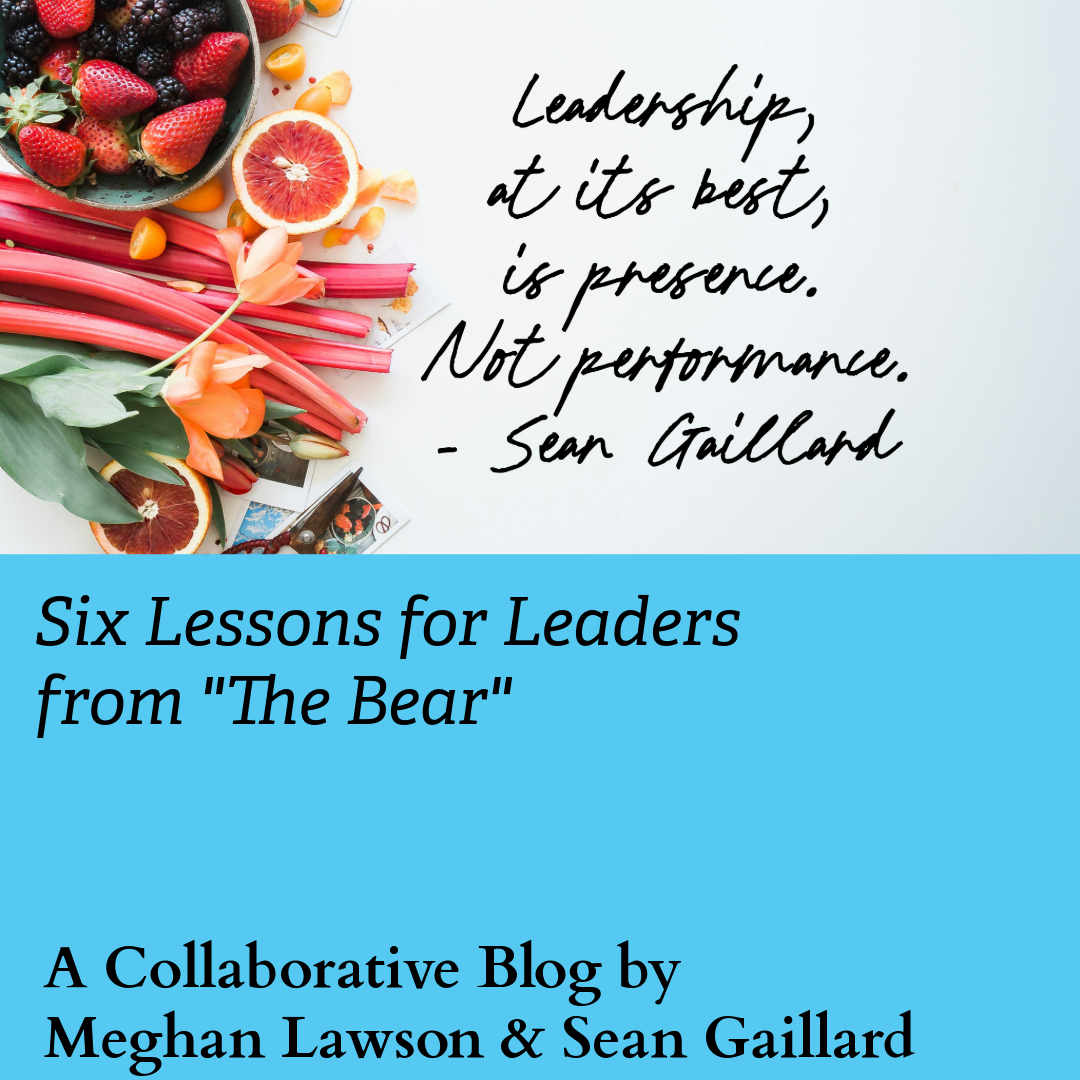
Leadership, at its best, is presence. Not performance.
On a recent flight home, I noticed a fellow passenger battling flight anxiety. No fanfare. Just a quiet offer to talk, sit, and be. We shared the journey—sky and fear alike. That moment reminded me of school. We often say the principal’s office can be a lonely place. But it doesn’t have to be. Leaders must extend that reminder: you are not alone to students, staff, and families. And sometimes, to ourselves.
Sean: 3. Belonging Matters
There’s a powerful scene where Richie’s daughter is too afraid to dance at a wedding. What do the adults do? They crawl under the table and share their own fears. It’s tender, honest, and unforgettable.
Leadership is often loud. But sometimes, it’s quiet courage: the willingness to go under the table with someone else’s fear and stay there with them until they’re ready to rise.
This summer, I wrote handwritten letters to my staff. Simple notes of gratitude and anticipation. No big speech. Just connection. It’s how belonging begins by saying: I see you. I’m glad you’re here. I can’t wait for what’s ahead.
The Bear isn’t just entertainment. It’s a mirror. A reminder. A bright spot. And as we get ready for a new school year, there’s no better time to slow down, reflect, and carry these lessons into our leadership.
-Here’s to delight. -Here’s to presence. – Here’s to belonging. – Here’s to the bright spots.