A simple riff in music can be unforgettable. Consider Keith Richards’ iconic guitar hook on The Rolling Stones’ “(I Can’t Get No) Satisfaction.” A handful of notes became one of the most recognizable sounds in rock and roll history. Sometimes a simple musical idea can leave a lasting impression.
There is another kind of riff that I find equally fascinating. It is the free flow of ideas, thoughts, and questions that happens when we feel comfortable enough to explore unfinished thoughts with someone else. There is no script or predetermined destination. There is simply the freedom to think aloud, listen, respond, and see where the conversation takes us.
When people listen and respond without judgment or competition, something magical happens. There is synergy, connection, and trust. I think of jazz musicians like Miles Davis and John Coltrane, listening and responding to each other through their instruments. One musician introduces an idea. Another builds upon it. Someone takes it somewhere unexpected. Together, they create something that might never have emerged independently.
I love those moments when a conversation becomes a genuine riff. There is no pressure to have the perfect answer or even the right words. We can stumble, explore, laugh, reconsider, and discover something new together. A great riff is not always about having the right notes. Sometimes it is about finding the right people who are willing to listen, respond, and create something alongside us.
Those connections matter. The people who give us the freedom to think aloud and make us feel that our voices matter are worth celebrating. They remind us that some of our most meaningful discoveries happen when we are willing to listen as much as we contribute.
Who are the people in your life who make it safe to riff, explore, stumble, and discover something new? Have you told them lately how much their voices matter?
Twenty-eight days ago, I began a creative journey inspired by an album that The Beatles recorded over approximately four weeks during the fall of 1965. I wanted to explore the lessons of creativity, collaboration, experimentation, and commitment found within the making of Rubber Soul. More importantly, I wanted to challenge myself to create something meaningful every single day while encouraging others to embrace their own creative possibilities.
Today, October 11, 2026, I reach the finish line of this journey. For twenty-eight consecutive days, I have written a blog post and recorded a reel inspired by four musicians whose creativity continues to shape my life. I have researched, reflected, listened, experimented, and shared ideas that have challenged me to think differently about my own creative process. What began as a celebration of an extraordinary album gradually became something much more personal.
Somewhere along the way, I discovered that I needed this experience as much as anyone who might have been reading or watching. I began with the hope of inspiring others, but I am finishing with a renewed understanding of what creativity means in my own life.
I began this journey hoping to build community and connection. I wanted to encourage others who might be struggling to find their creative voices or searching for their own bandmates. After all, one of the greatest lessons of The Beatles is that remarkable things can happen when people bring their individual talents together in pursuit of something meaningful. I hoped this series might create opportunities for conversation, encouragement, and perhaps even collaboration.
The experience did not always unfold as I imagined. There were days when the engagement was quiet and the response was less than I had hoped. I sometimes wondered whether these reflections were reaching anyone or whether the ideas I was sharing were making a difference. Those moments were difficult because the desire for connection was a genuine part of why I began this journey.
At times, I felt as though I was standing alone on a stage in an empty auditorium, sharing my voice with rows of unoccupied seats. There is a certain vulnerability in putting something personal into the world and wondering whether anyone is listening. I have experienced that feeling more than once throughout these four weeks.
Still, I kept showing up. I kept writing, recording, learning, and sharing. Even when the auditorium seemed empty, I continued to fill the space with my voice. I began to understand that the absence of applause did not mean the absence of purpose. The courage to create could not depend entirely upon whether someone was there to acknowledge the work.
I also want to recognize that the auditorium was never entirely empty. There were people who took the time to read these reflections, watch the daily reels, leave thoughtful comments, and offer words of encouragement. Some followed the journey quietly, while others shared their thoughts along the way. Every expression of support mattered, and I am genuinely grateful to everyone who made room for this creative journey in their lives.
That gratitude is important to me because I never wanted this experience to be simply about producing content. I wanted it to be about sharing ideas that might encourage someone else to begin creating, take a risk, or rediscover something meaningful in their own life. I may never know how these reflections resonated with everyone who encountered them, but I am grateful for every opportunity to make a connection.
The four words that guided this journey were Begin, Collaborate, Experiment, and Finish. Looking back, each one carries a deeper meaning than it did when I started.
I began with an idea and the willingness to take a creative risk. I explored collaboration by studying the extraordinary chemistry of The Beatles and reflecting on the importance of finding people who encourage and challenge one another. Although I did not discover the band of collaborators I had hoped to find, the experience reminded me why those connections matter and why I want to remain open to them.
I experimented with my writing, my voice, and the daily practice of recording and sharing reflections. I became more comfortable putting my ideas into the world without knowing how they would be received. The discipline of creating something every day gradually became less intimidating and more natural. I discovered that the simple act of showing up consistently could strengthen my confidence and give me the courage to explore new possibilities.
Now, I have finished something I promised myself I would complete. I have twenty-eight days of creative work to show for that commitment, along with lessons that I could never have anticipated when I began. I have learned that creativity requires discipline, but it also requires trust in ourselves and a willingness to keep going when the response is uncertain.
The Beatles offer a remarkable example of what finishing can make possible. When Rubber Soul was released on December 3, 1965, it represented a significant creative achievement. The Beatles had expanded their musical vocabulary, explored new approaches to songwriting, and demonstrated an increasing willingness to challenge their own artistic boundaries.
They could have continued repeating that successful formula, but their curiosity and creative ambitions carried them forward. Within months, they were recording Revolver, an album that would take their experimentation into even more adventurous territory. Their journey continued through Sgt. Pepper’s Lonely Hearts Club Band and beyond, with each completed project opening possibilities that had not existed before.
That example has stayed with me as I have approached the conclusion of this challenge. Finishing something meaningful does not require us to remain in the same creative space. The accomplishment deserves to be celebrated, but it can also become the foundation for another beginning.
Finish is not the opposite of Begin. Finish is what makes Next possible.
There is something particularly meaningful about the timing of this final reflection. Today is October 11, and tomorrow marks the sixty-first anniversary of the beginning of The Beatles’ Rubber Soul recording sessions at EMI Studios in London. On October 12, 1965, they began recording music that would eventually become one of the most influential albums of their career.
I find something beautiful in that connection. As I finish this journey inspired by Rubber Soul, I am standing on the eve of the anniversary of its beginning. More than six decades separate these two creative experiences, yet the lessons of curiosity, commitment, and courage continue to resonate. An album created in 1965 inspired me to begin something in 2026, and finishing that experience has given me the courage to consider what comes next.
For much of my life, I have believed in the power of community, collaboration, and finding people who share a common purpose. I still believe in those things, and I still hope to find more bandmates who want to create, encourage, and build something meaningful together. That hope has not disappeared simply because this experience was sometimes quieter than I anticipated.
What has changed is my understanding of what I can do while those connections have yet to develop. I do not have to wait for a full auditorium to share my voice. I do not have to wait for someone to invite me into a creative space or measure the worth of an idea by the number of people who respond to it. I can begin where I am, create with what I have, and trust that the work itself has meaning.
Perhaps that is the true lesson I have discovered through Rubber Soul. The album is certainly a testament to the extraordinary possibilities of collaboration, but it is also a reminder that creativity requires curiosity, courage, and the willingness to move beyond what we already know. The Beatles continued to grow because they remained open to what might come next.
I want to carry that same spirit forward. I want to continue creating, learning, exploring, and sharing ideas that might make a difference in someone’s life. I want to remain open to the possibility of finding new bandmates while recognizing that I already have the ability to create something meaningful on my own.
I am grateful for everyone who followed this journey, read the daily reflections, watched the reels, shared a comment, or offered encouragement. Your presence and support have meant more than you may realize. I hope that somewhere along the way, something I shared encouraged you to consider your own creative possibilities.
Most of all, I am grateful that I did not abandon this journey when it became difficult or when the response was not what I had imagined. I gave myself the opportunity to discover something about my own creativity, discipline, and courage. I found a renewed sense of purpose in the simple act of showing up each day and creating something meaningful.
I do not want this journey to end. The daily rhythm of creating has become something I genuinely value, and I hope to continue nurturing it. I do not know exactly what the next creative chapter will look like, but I am no longer waiting for every detail to fall into place before I begin.
There is still music to discover, stories to tell, ideas to explore, and meaningful work to create. There are still people I hope to meet and bandmates I hope to find. There are possibilities I cannot yet imagine, and I want to remain open to discovering them.
Twenty-eight days ago, I stepped onto a stage with an idea and the hope that someone might listen. Today, I may still be standing on that same stage, but something has changed. I have filled that space with my voice, my creativity, and the courage to keep going. The auditorium may not be full, but I am no longer waiting for an audience before I begin.
I began. I explored the possibilities of collaboration. I experimented. I finished. The journey did not unfold exactly as I had imagined, but it gave me something I needed and reminded me that there is still so much more to discover.
As I finish this journey, I am grateful for everyone who shared even a small part of it. I am grateful for the music of The Beatles, for the lessons of Rubber Soul, and for the courage I have discovered through these twenty-eight days.
I may not know exactly what comes next, but I know that I am ready to begin.
Thank you for being part of Four Weeks to Rubber Soul.
Special Acknowledgements:
A very special thanks to Nicole Michael of 910 Public Relations and Dave Burgess of Dave Burgess Consulting, Inc. for their generosity in promoting this series on their respective platforms. Both have always been in corner for years and I grateful for their sincere support. Their belief in my work means the world to me.
Stay tuned for my next book with Dave Burgess Consulting, Inc: Leadership Riffs.
I keep coming back to the focus it took for The Beatles to finish Rubber Soul. They were working against an immovable deadline, with EMI needing a new album ready for the Christmas market. A deadline can certainly sharpen our attention, but I wonder if something else was driving them. Maybe they knew they were onto something. Maybe they could feel the music changing and did not want to lose the momentum.
Consider “I’m Looking Through You.” The Beatles first worked on the song on October 24, spending hours developing a version that ultimately did not make the album. They returned to it on November 6 and tried again. They still were not satisfied. Four days later, with the deadline looming, they started over once more and finally found the arrangement we know from Rubber Soul. The song was completed with additional vocals and handclaps during their marathon final recording session on November 11.
That is focus. Focus is not always sitting down, locking in, and getting everything right on the first attempt. Sometimes focus means returning to something that is not working. It means staying with an idea long enough to discover what it can become. The Beatles could have settled for one of the earlier versions. Instead, they kept listening, adjusting, and returning to the work.
Focus is not always easy for me, either. My own creative work has plenty of starts and stops. Doubt creeps into the process. Confidence disappears. Other responsibilities compete for attention, and sometimes the easiest response is to put the work aside and promise myself that I will return later.
This daily series has taught me something about focus. Showing up every day for Four Weeks to Rubber Soul has required me to keep returning to an idea, writing about it, recording a reel, and putting it into the world. The discipline has helped me focus, but it has also helped me appreciate what focus actually requires.
Today’s word is Focus, but focus cannot simply be something we practice for one ephemeral day. It is something we choose again tomorrow. We return to the song. We return to the page. We return to the idea that still needs our attention.
The deadline may get us into the room. Focus keeps us there long enough to finish something that matters.
Welcome to the fourth and final week of Four Weeks to Rubber Soul. For the past three weeks, we have explored what it means to begin, collaborate, and experiment. Now we arrive at our final theme: Finish.
Our word for Day 22 is Commit because finishing begins with a decision. At some point, the experiment needs a commitment. Ideas become work when we commit to finishing them.
The Beatles understood that reality during the making of Rubber Soul. For all the creativity surrounding those sessions, there was also an immovable deadline. The Beatles needed to deliver a new album in time for the Christmas market. They could experiment with unusual sounds, rewrite songs, abandon takes, work through long sessions, and chase new ideas, but eventually they had to finish the record.
That deadline did not stop experimentation. It gave the experimentation somewhere to go. The ideas had to become songs, the songs had to become an album, and the album had to be finished.
I am thinking about commitment quite a bit these days. I am finishing my second book, Leadership Riffs, after months of writing, revising, questioning, discovering, and trying again. There comes a point in any creative project when the question has to change. We stop asking whether the idea could become something and start doing the work necessary to make it something.
The same is true for Four Weeks to Rubber Soul. I have made it through three weeks of daily blog posts and reels. The novelty and excitement of beginning have faded. I have experimented publicly, shared ideas that were still developing, and kept showing up even when the engagement sometimes disappointed me.
Now there are seven days remaining. This final week is less about asking, “Can I do this?” and more about saying, “I am going to see this through.”
Commitment matters because beginnings are exciting and experiments are full of possibility. Finishing asks something different from us. It asks us to keep showing up after the novelty disappears, continue when the response is quieter than we hoped, and stay with the work long enough to complete what we started.
The Beatles had a record to finish. I have a book to finish and seven more days of this creative journey to complete. You may have something waiting for your commitment too.
As we begin this final week, think about the unfinished work in your own life. What idea, project, dream, or creative pursuit deserves more than another someday? What would happen if you decided that now is the time to see it through?
That is where Finish begins. It begins with a commitment to the work and a decision to keep going until the work is complete.
This is Day 7 of Four Weeks to Rubber Soul, and today’s word is Reflect. We are also closing out Week 1, which has centered on the theme of Begin. The Beatles’ creative growth, so evident on Rubber Soul, came from entering the room with songs, fragments, influences, ideas, and a willingness to work. The lesson is not to achieve perfection before starting. The lesson is to begin the work, knowing that it is completely acceptable if the beginning is rough and raw. What matters is that you enter the room and that the room is the right one, aligned with your creativity and ready to support the gifts you are bringing.
An important part of the creative process is reflection. Creative growth becomes visible when we stop long enough to notice what has changed since we began. Reflection asks us to pause, look back at what we created, and listen again. There is an art to that pause because we do not want to become so immersed in reflection that we lose momentum. Sometimes we need a trusted thought partner or bandmate who can help us listen, notice, and keep our creative work moving in the groove.
That brings me back to Rubber Soul. One reason I am looking forward to the multiple takes and alternate versions included with the forthcoming Rubber Soul Super Deluxe Edition is the opportunity to hear that creative evolution. The Beatles, along with producer George Martin, continually shaped these songs by changing harmonies, sounds, spaces, arrangements, and instrumentation. Reflection does not mean doubting what you created. Reflection means giving yourself enough space to hear what the work still needs.
Sometimes we need to return to what we made and ask three simple questions: What is working? What is missing? What could make this better? On Rubber Soul, a song could enter the studio one way and leave sounding very different on the finished master. That transformation happened because the band was willing to listen to the work as it developed and respond to what the song needed.
For example on “Norwegian Wood,” George Harrison felt that the song needed something different. His growing interest in Indian music led him toward the sitar, and he worked out a part that became one of the defining sounds of the song. That decision helped give the recording its distinctive character and introduced many listeners to a sound they may not have expected to hear on a Beatles record.
“In My Life” offers another beautiful example of reflection in action. The basic track had already been recorded, but the instrumental middle still needed something. George Martin experimented with ideas, including Hammond organ, before developing the Baroque inspired piano passage we now know so well. Since the part was difficult to play at the required speed, he recorded it more slowly and sped the tape up afterward. The result became an essential part of the song and a reminder that sometimes the creative breakthrough comes after we are willing to listen again.
As we close Week 1, take some time to reflect on something you have created. Do not judge it too quickly. Listen to it and ask yourself: What is working? What is missing? What could make this better? Consider bringing a trusted thought partner or bandmate into that reflection because sometimes another set of ears helps us hear possibilities we cannot hear alone.
Reflection is not about doubting your work. It is about asking what the work still needs and then having the courage to make the adjustment. I would love to hear how reflection fits into your creative process as we continue this journey through Four Weeks to Rubber Soul.
Check out today’s daily reel. Thanks to Starbucks for serving as my own Abbey Road Studios!
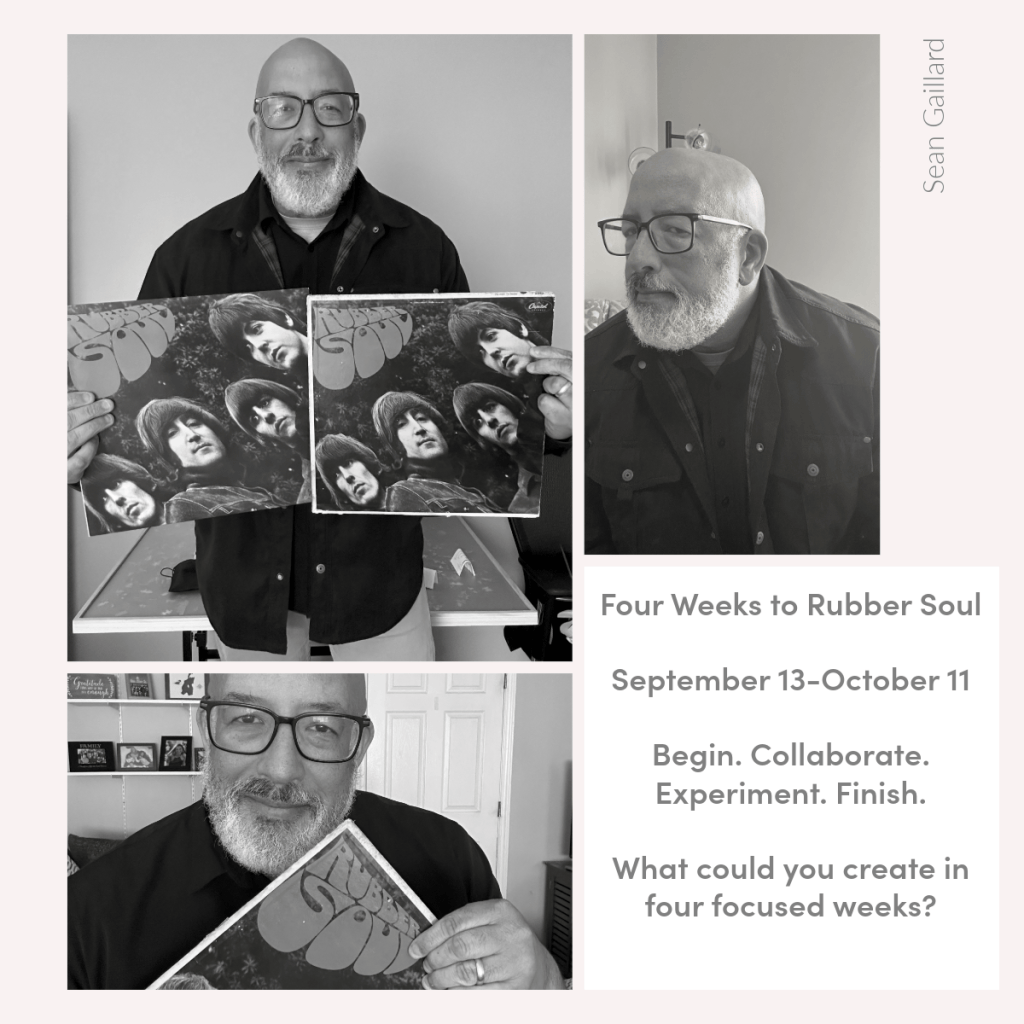
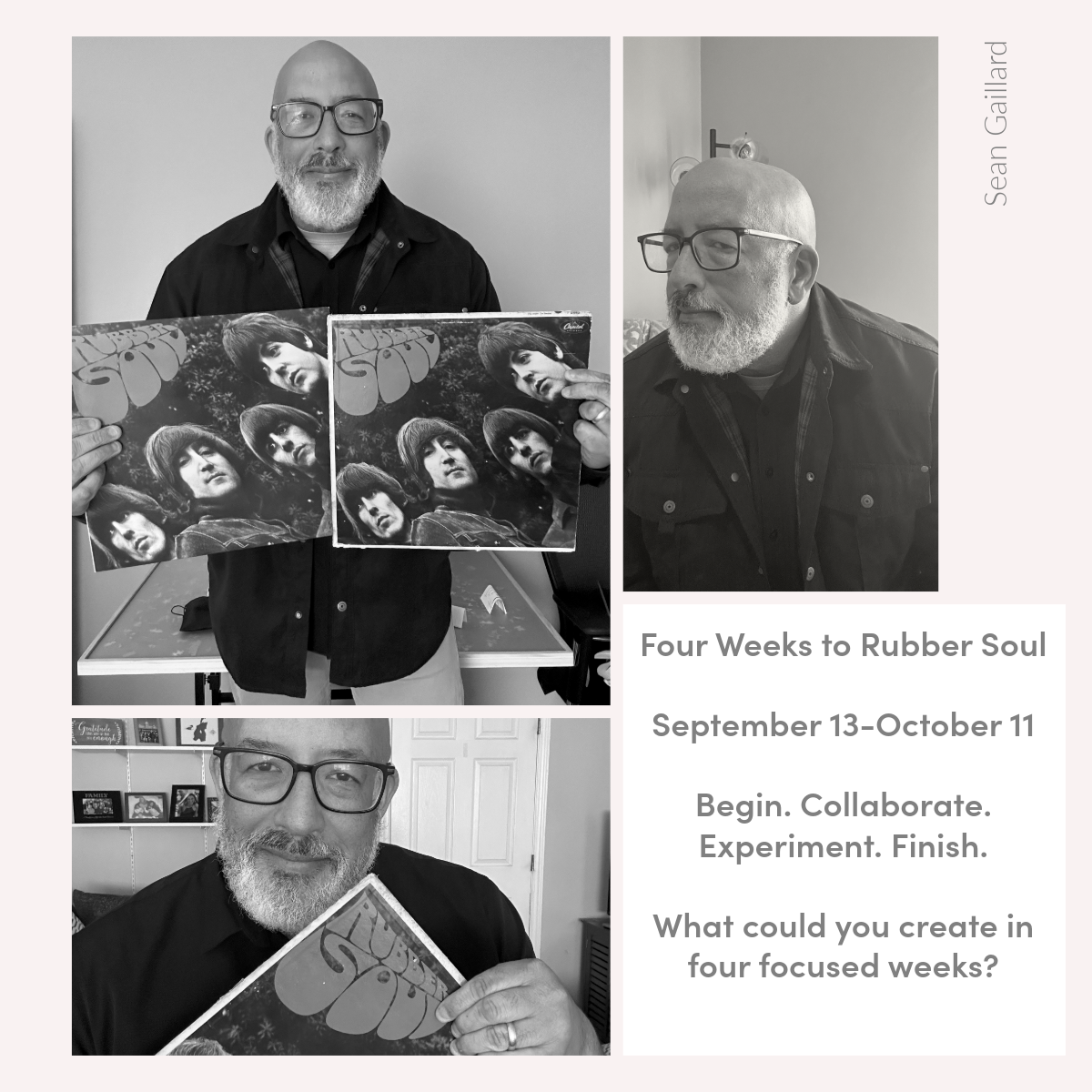
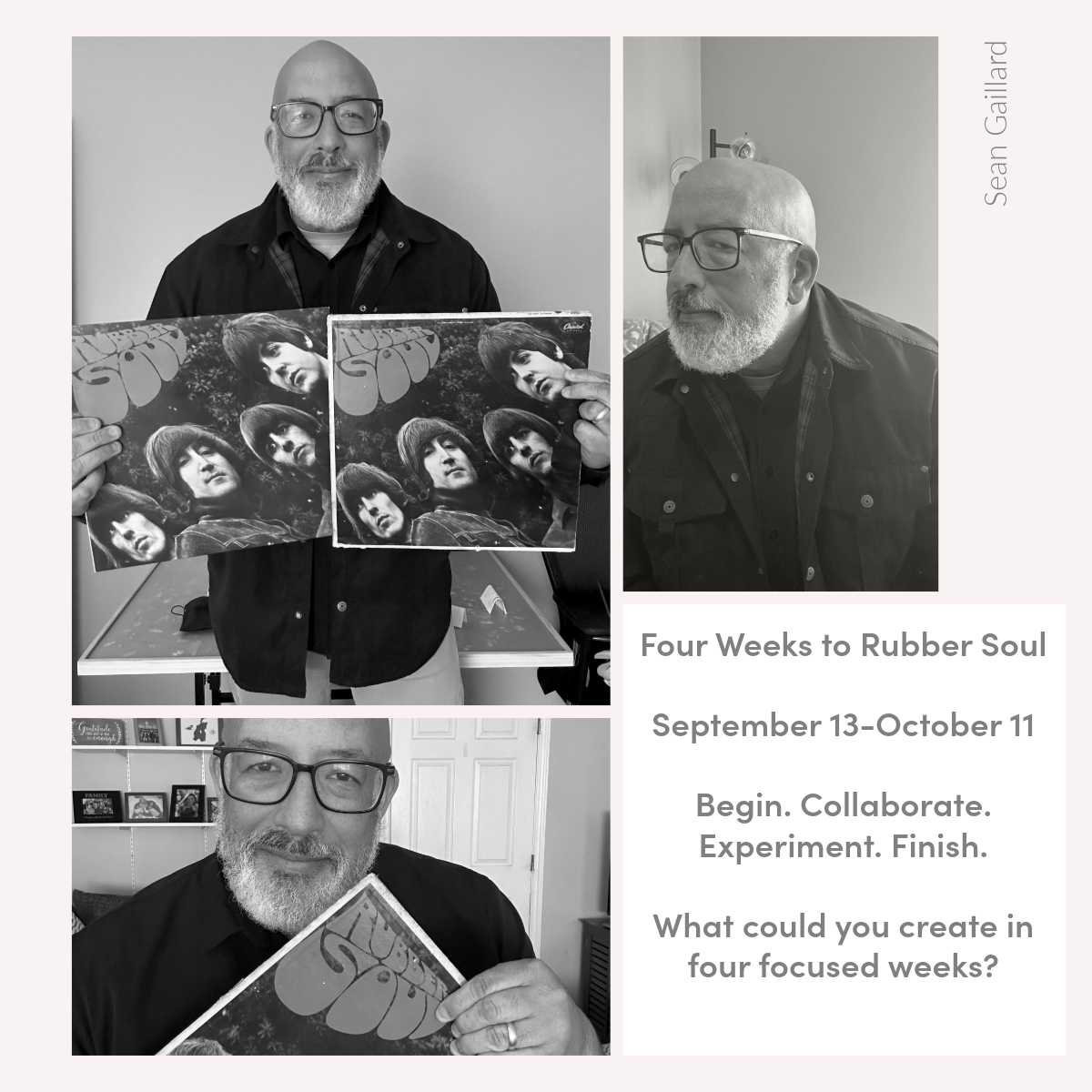
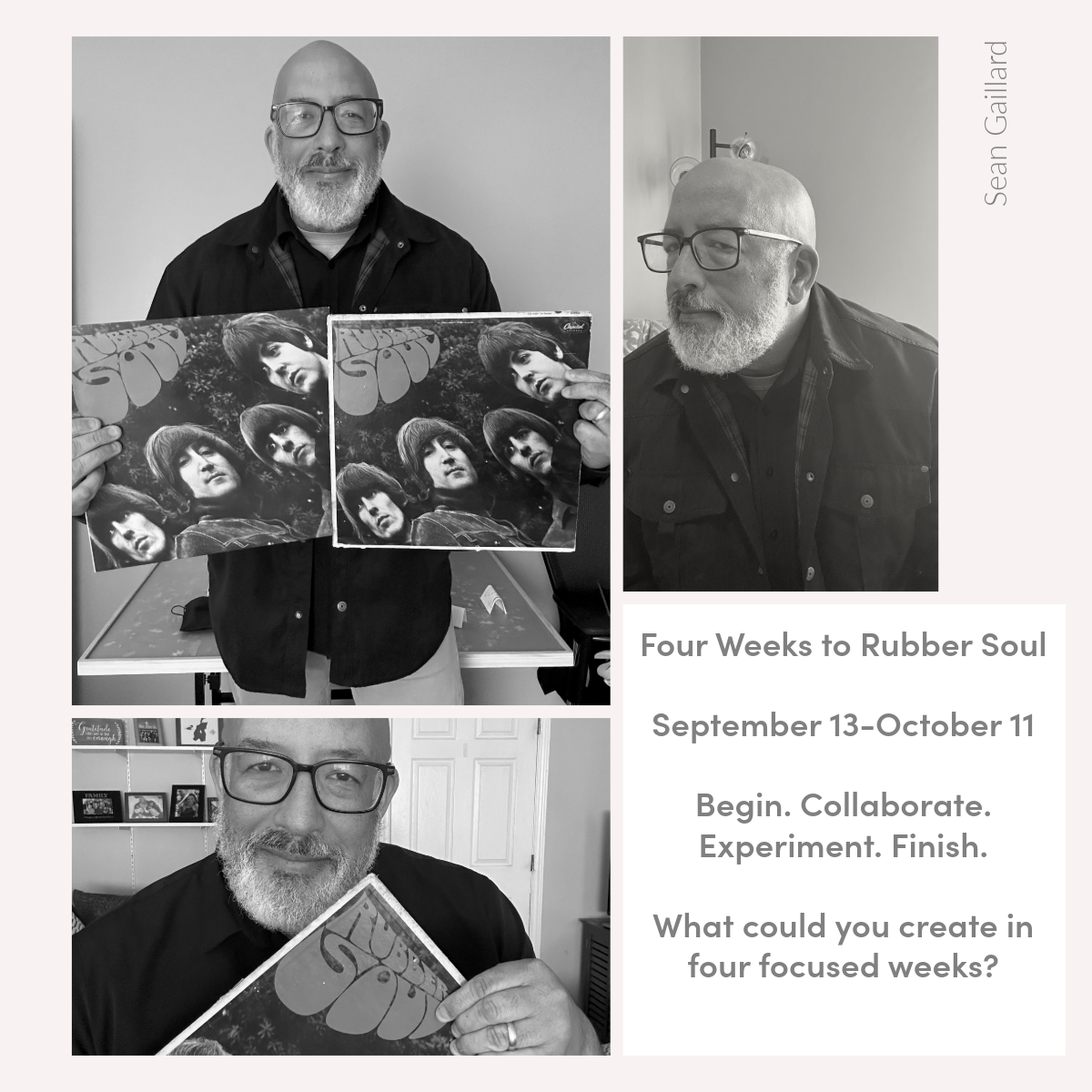
On September 14, I am starting a four week creative experiment and countdown inspired by one of my favorite albums and one of the most important records in popular music history. I am getting ready for the upcoming Super Deluxe Edition of Rubber Soul, arriving October 2, and I wanted to do more than simply count the days. I want to use that time to create.
The Beatles recorded Rubber Soul in roughly a month during the fall of 1965. That still amazes me. In that brief stretch of time, they created an album that included “Drive My Car,” “Norwegian Wood,” “Nowhere Man,” “Michelle,” “Girl,” “If I Needed Someone,” and “In My Life.” During that same period, they also recorded “Day Tripper” and “We Can Work It Out.” In a matter of weeks, they created a classic that would help change the direction of popular music.
Rubber Soul marked a turning point for The Beatles. The writing became deeper. The sound became broader. The studio became part of the creative process in new ways. The band was stretching beyond what had worked before and exploring what might come next.
The impact traveled far beyond The Beatles. Brian Wilson heard Rubber Soul and was inspired to create Pet Sounds. The album also influenced bands such as The Kinks and The Rolling Stones. Decades later, its legacy remains strong. Rubber Soul entered the Grammy Hall of Fame in 2000, and “Michelle” won the Grammy for Song of the Year. It continues to appear on lists of the most important albums ever recorded.
What stays with me most is the process. Four people walked into a studio with ideas, songs, curiosity, tension, trust, and a willingness to try something different. They worked with George Martin and the Abbey Road team. They collaborated, experimented, changed direction, and kept moving.
That process is the inspiration behind Four Weeks to Rubber Soul. For the next four weeks, I am going to focus on four creative moves: Begin, Collaborate, Experiment, and Finish. Begin is about giving an idea permission to exist before it is fully formed. Collaborate is about recognizing that our work can become stronger when we allow other voices, perspectives, and gifts into the process. Experiment is about following curiosity, trying something unfamiliar, and accepting that not everything has to work the first time. Finish is about carrying the work across the line and releasing it rather than keeping it trapped in our heads, notebooks, or hard drives.
I want to see what happens when I commit to those four moves for four focused weeks. Starting September 14, I will share something every day inspired by Rubber Soul and the creative process behind it as I count down to October 2. Some days it will be a reel. Some days it will be a blog post. There will also be special riffs on Why The Beatles Matter. The goal is not simply to talk about an album I love. The goal is to use the album as a catalyst for making something.
The question I will carry through these four weeks is simple: What can we create when we trust the process, work with intention, and keep moving forward?
The first reel drops September 14. Follow along, create something of your own, tag me, and use #FourWeeksToRubberSoul so we can encourage one another through the process.
I have been thinking a great deal about noticing lately.
My current morning reading is The Power of Mattering by Zach Mercurio, and one chapter in particular has stayed with me. The chapter explores noticing as the first step toward helping people feel they matter. That idea has lingered with me long after I closed the book.
Two recent experiences reinforced that lesson. Both of them occurred in close proximity to each other and I believe the timing of the impact is of significance. Recently, I have been recalibrating my approach and taking proactive steps to reach out to others. I have been in the occasional doldrums of wondering why the phone wasn’t ringing for me or why my shoulder wasn’t being tapped for invitations. I decided to just simply outreach and share.
In each instance, I reached out to someone. In each instance, my outreach was met with silence. Neither situation was catastrophic. Neither involved ill intent, at least as far as I know. Both, however, reminded me of something deeply human. We notice when we are not noticed. It can sting and it does leave a mark.
That realization could have easily led me toward disappointment or resentment. Instead, it led me toward reflection. I decided to flip my own paradigm of giving into the weight of those doldrums. I stepped back and took a pause to reflect.
As I looked inward, I reflected on the times that I may have missed noticing someone else. I thought about the times that I failed to really see someone. How often have I unintentionally done the same thing to someone else?
Leadership has taught me many lessons over the years, but this one reaches beyond leadership. Every one of us wants to know that our presence matters. Every one of us wants to know that someone saw us, heard us, and cared enough to respond. We crave to be valued and validated. Those connections sustain and inspire. We feel connection and belonging with others. Human connection is universal and is an essential component for our well-being.
Noticing is never just about acknowledgement. It is about communicating, “I see you. You matter.”
The opposite carries weight as well. Silence often says more than we intend.
My recent experiences became unexpected gifts. They reminded me to respond. They reminded me to follow up. They reminded me that connection rarely happens by accident. It happens because someone makes the intentional choice to notice another person.
The more I read Mercurio’s work, the more I believe that noticing is not simply a leadership competency. It is a human practice. Leaders certainly need it, but so do neighbors, friends, colleagues, spouses, teachers, and strangers.
Recently, I have also been immersed in the music of the Bill Evans Trio. Listening closely to those recordings reveals something remarkable. Three musicians are not simply playing at the same time. They are listening to one another. Every phrase is met with another phrase. Every musical idea is acknowledged, expanded, or gently redirected. Space is given. Responses matter. The music exists because each musician notices the others.
Leadership works much the same way.
Organizations become healthier when people feel noticed. Relationships deepen when people feel heard. Cultures of mattering begin with small moments of intentional attention.
Noticing is the first note.
Connection is the melody.
Mattering is what people remember long after the conversation ends.
Here’s to continuing the conversation.
Want to Continue the Conversation?
I am available to serve as a thought partner, speaker, and leadership coach for individuals, teams, and organizations seeking to build more human centered cultures. My work focuses on helping leaders create spaces where people feel seen, valued, supported, and empowered to succeed.
I would be honored to connect, listen, and explore how we might work together. Please feel free to drop me a line at sgaillard84@gmail.com and check out the links below here:
Sean Gaillard Founder & CEO | The Gaillard Group Author • Speaker • Leadership Coach
Two years ago, I probably would have said no. I would have found an excuse. I would have allowed fear, discomfort, or uncertainty to talk me out of the moment. My eyes would have remained fixed on an email, a text, or a document. I would have been determined to beat the clock or conquer another deadline.
This time, I said yes.
My daughter Rachel suggested that we ride bikes together at Sunset Beach. She had mentioned the idea to my wife, Deb, before, but I had been noncommittal. I had not ridden a bike in years, and Rachel gently reminded me of something that stopped me in my tracks.
“Dad, we’ve never ridden bikes together.”
She was right. We borrowed a few bikes stored at the house we were renting, and I wondered whether I would remember how to ride. I did.
Before long, I was smiling, laughing, and waving to people as we passed them. I wished strangers a good morning. I rode between Deb and Rachel, overwhelmed by the beauty and simplicity of the moment.
I could hear Mike Nesmith’s “Rio” playing in my mind. A lyric from the song found its way to my lips, and I softly sang, “I feel such a sense of well being. The problems have come to be solved.”
No, the problems had not disappeared. The professional disappointments were still there. The questions about purpose, belonging, and what comes next had not suddenly been answered. The pangs of imposter syndrome and professional loneliness still gnawed at me. For that moment, though, none of them controlled me. All I cared about was mattering to my wife and daughter and helping them feel that they mattered to me.
Deb, riding behind me, softly said, “This wouldn’t have happened two years ago.”
She was right. Two years ago, I would have found a way out of the ride. I would have stayed behind, protected by what felt familiar and safe. This time, I got on the bike.
As I rode through the streets of Sunset Beach, tears rolled down my face and a smile formed. For that moment, I was free.
At the end of our ride, I hugged Rachel. I felt proud of the strong woman she has become. I also felt proud that I had stepped outside my comfort zone and modeled something important for her.
We are never too old to try again. We are never too far gone to rediscover joy. We are never too broken to experience a moment of healing.
People want to matter. People want to belong. Sometimes the most meaningful way we communicate that is not through a speech, a program, or a grand gesture. Sometimes we simply say yes. I said yes to someone I love.
Healing does not always announce itself with fireworks, applause, professional recognition, or social media likes. Sometimes it arrives on an old bicycle, riding between the people you love, with the sun on your face and a song playing quietly in your soul. Sometimes healing looks like a bicycle ride.
That ride reminded me to remain close to my core. Our core is made up of the people, values, and moments that remind us who we are. We must stay close to the people who need our love, the people who remind us where we came from, and the people who knew us before the title, the position, or the accomplishments. We must stay close to the people who know our name and not merely our role.
For too many years, I made the mistake of prioritizing position over presence. It took two trips to the emergency room for me to begin understanding the cost of that choice. I learned it the hard way, and I would not wish that lesson on anyone.
We are called to be human centered in our work as leaders. Before we can do that authentically, we must be human centered at home. We must be intentionally present for the people who love us without a title, an agenda, or an expectation attached. They do not see us as a data point, and they do not need us to carry another deadline. They simply want us there. Rachel did not need me to solve a problem, answer an email, or accomplish something impressive. She wanted to ride bikes with her dad. This time, I said yes, and I am grateful I did.
Here’s to continuing the conversation.
Want to Continue the Conversation?
I am available to serve as a thought partner, speaker, and leadership coach for individuals, teams, and organizations seeking to build more human centered cultures. My work focuses on helping leaders create spaces where people feel seen, valued, supported, and empowered to succeed.
I would be honored to connect, listen, and explore how we might work together. Please feel free to drop me a line at sgaillard84@gmail.com and check out the links below here:
Sean Gaillard Founder & CEO | The Gaillard Group Author • Speaker • Leadership Coach
Here’s an old post from the archive that I am re-blogging. In leadership, we often times downplay dreams. Sometimes dreams are viewed as impractical and wasteful when it comes to the daily grind. I still maintain a dream as an unabashed fan of The Beatles that Paul McCartney and Ringo Starr are going to visit my schoolhouse.
Now that may seem impossible and you may dismiss me as a pitiful dreamer. Why not? Why not have a dream? Why not share that dream with others? As leaders, we are called to be human-centered. Dreams are what make us human. We must support conditions where others feel safe to share their dreams as well.
Here’s my dream that I am re-sharing with you. I hope you enjoy it. I would love to hear your dreams, too. Please feel free to leave something in the comments or share this blog on your social media channels and tag me.
That number feels both impossible and deeply humbling.
As I write these words after several weeks of traveling from Charlotte to Maine, then to Orlando, and finally to Chicago, I cannot help but wonder what the person who wrote Blog Post Number One would think of the person writing Blog Post Number Two Hundred.
I imagine he would be surprised that the blog is still here.
He would marvel at watching three little girls grow into remarkable young women. He would be grateful for the unwavering love of an incredible wife who has stood beside him through seasons of joy, uncertainty, challenge, and hope. He would probably smile knowing that so much of life unfolded differently than he expected.
If I could sit across the table from that younger version of myself, I would not spend much time talking about titles, resumés, or accomplishments. I would encourage him to breathe more deeply, pray more often, trust his faith, and care for his nervous system as faithfully as he cares for everyone else. I would remind him that family always comes before work and that meaningful relationships will outlast recognition every single time.
Most of all, I would tell him to become more human-centered.
Two hundred blog posts later, I am still learning what that means.
My recent travels became an unexpected classroom.
Before heading to Orlando for the ISTE+ASCD Conference, Deb and I spent several peaceful days with family in Maine. Every morning, I found myself sitting quietly beside the lake, watching sunlight shimmer across the water. After a year filled with transition, those moments of stillness restored something within me. The lake reminded me that clarity often arrives when we finally become quiet enough to receive it.
Orlando continued the lesson.
One afternoon, I wandered into Park Ave CDs, a record store I had wanted to visit after doing some pre-trip research. A listening party for Madonna’s upcoming album filled the store with music, laughter, conversation, and people from every walk of life. I spent hours browsing records, discovering books, talking with strangers, and simply enjoying being present.
Before leaving, I thanked one of the employees for creating such a welcoming place.
The response has stayed with me ever since.
“We work to make this a safe space for everyone. We want everyone to belong.”
That simple sentence became one of the defining leadership lessons of my trip.
As the conference unfolded, I realized the moments that stayed with me had very little to do with keynote stages or crowded expo halls. They happened around dinner tables, over cups of coffee, during hallway conversations, and in those unplanned moments that never appear on a conference schedule.
One evening, I shared dinner with Matt Miller and Eric Nelson. Our conversation drifted toward teachers, leadership, AI, and one simple question that refuses to leave me: “How do we help teachers love teaching again?”
That conversation had very little to do with technology. It had everything to do with people.
Another morning, I shared coffee with Mandy Froehlich and Todd Whitaker. We laughed. We told stories. We talked about life more than the conference itself. Sometimes the best professional learning happens when nobody is trying to be professional.
I found myself reflecting in a crowded hallway with Chaunté Garrett and Craig Aarons-Martin about belonging in spaces like ISTE+ASCD. Conferences can be energizing, but they can also leave people wondering where they fit. Our conversation reminded me that belonging does not happen automatically. It happens because someone chooses to create space for another person.
During my virtual presentation on leadership in the age of AI, I found myself struggling with technology and timing. Right in the middle of it, Tamara Letter offered words of encouragement in the chat. It was a small gesture that made a tremendous difference. One voice reminding another person, “I’m with you,” can change everything.
Before my in-person presentation on #InstantPD, Natasha Nurse, Erik Francis, and Lindsey Cannon each offered encouragement in their own way. They reminded me that leadership is often quiet. Sometimes leadership is simply helping another person believe in themselves before they step into the room.
When it came time to facilitate my #InstantPD session, I found myself walking around the room before we even began. I wanted to greet people personally, thank them for coming, and learn their names. I cared less about how many people attended than I did about the people who had chosen to be there. Every educator deserved to know they mattered.
One of the greatest gifts of the conference came during an impromptu conversation with Angela Maiers. Sitting across from someone whose life’s work has centered on mattering felt less like meeting a renowned educator and more like sitting with someone who has spent years exploring many of the same questions that continue to shape my own journey. Our conversation reminded me that human centered leadership is not another initiative. It is a way of seeing people.
I experienced that same lesson while interviewing Jessica Garner. Somewhere along the way, our interview quietly transformed into a conversation. We explored artificial intelligence, differentiation, and learning, but what I remember most is the humanity that emerged when two people became curious together.
On the final day of the conference, I was wandering around looking for a place to rest. I ran into Greg Bagby and Cindy Gaston. After the warm words and welcoming, I asked what was on their respective turntables. That conversation became a communal sharing of music where we grooved, hummed, smiled, and connected to the beats being shared.
A few days later, Deb, my brother, my sister-in-law, and I visited the newly-opened Obama Presidential Center in Chicago.
Throughout the experience, one word kept appearing.
We.
It quietly echoed throughout the exhibits and invited every visitor to think beyond themselves. The recurring invitation to “Bring Change Home” reminded me that meaningful change begins in our families, our schools, our neighborhoods, and our communities. Lasting change has never belonged to one person. It grows wherever people choose to listen, encourage, and build something together.
As I reflected on Maine, Orlando, and Chicago, I realized they had all been teaching me the same lesson.
The lake.
The record store.
The dinner conversations.
The coffee.
The hallway encounters.
The encouraging text.
The shared laughter.
The presentation.
The interview.
The museum.
None of those moments were really about places.
They were about people.
After thousands of miles, countless conversations, and two hundred blog posts, I keep returning to the same simple truth:
People want to matter. People want to belong.
Connection is how we remind one another that we matter. Belonging is what makes us stay.
As I reflect on these travels and experiences, I remain grateful for YOU. Thanks for being sharing common ground with me and being such an essential part of the human journey.