There are moments when something you read does more than inform you. It meets you where you are. It names what you have been carrying. It invites you forward.
Lately, I have been intentionally seeking out readings that inspire and compel me as I navigate this liminal season. I am looking for connection. I am looking for meaning. I am looking for something that reminds me of what it means to belong. That search led me to this powerful reflection from Karen Eber: https://www.kareneber.com/blog/copy-moon-joy
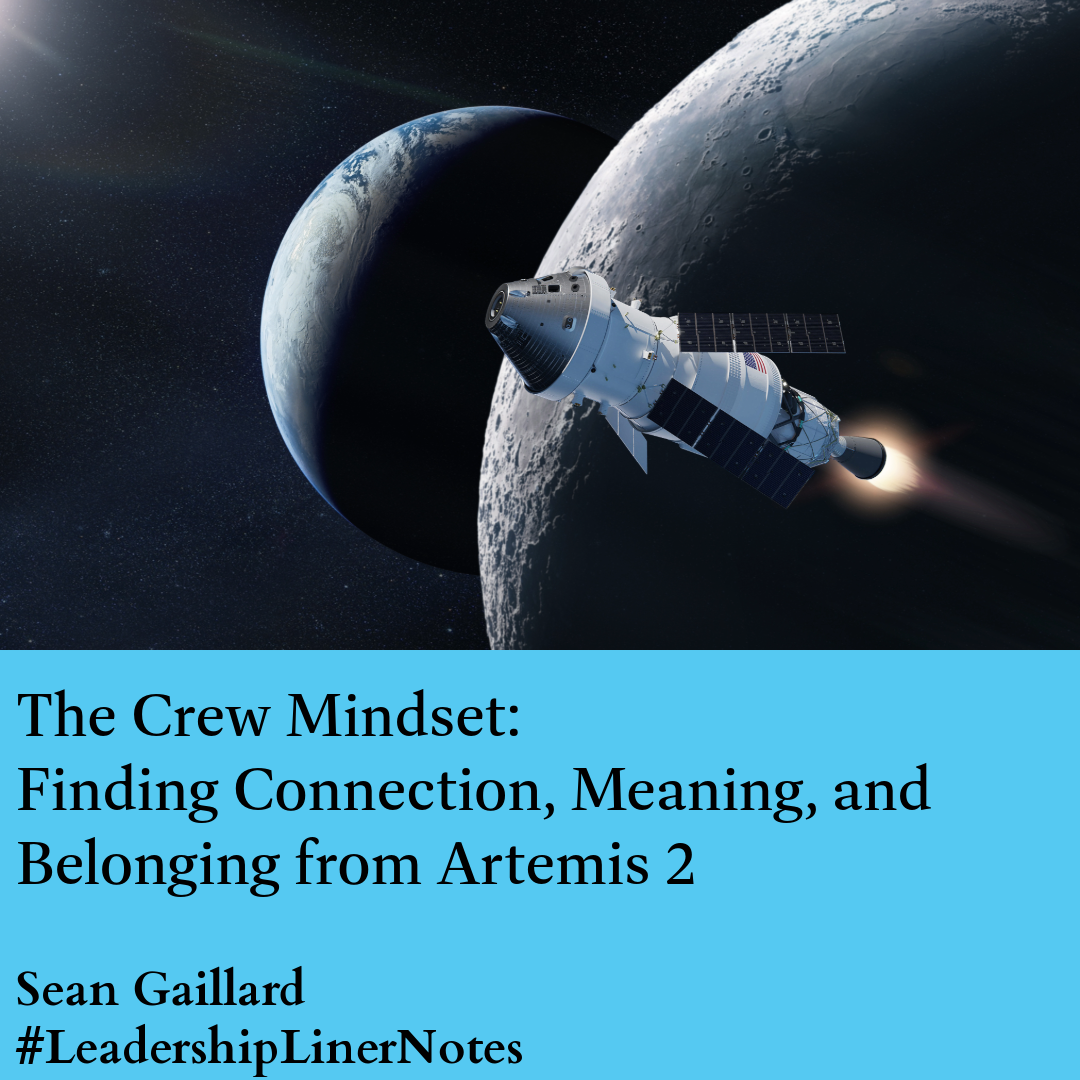
In her piece, she explores the idea of “moon joy,” a term she draws from the experience of astronauts who describe the awe, wonder, and deep sense of connection that comes from seeing Earth from space. She connects that feeling to the story of the Artemis II crew and what it means to be part of something larger than yourself. That idea stayed with me long after I finished reading. I am grateful for her words and the way they opened something up in me.
I find myself in a liminal season. It is a space between what was and what is next. It is a space where I am searching for connection, meaning, and belonging. This kind of season can feel uncertain. It can feel isolating. It can also be a place where something new begins to take shape if I am willing to listen and remain open.
As I reflected on the Artemis II crew, I began to feel something unexpected. I felt like I was part of the crew. I felt like a fifth member. The feeling reminded me of being a fifth Beatle, close enough to the music to feel it, to learn from it, and to be changed by it.
That feeling stayed with me.
It led me to think more deeply about what it means to be part of a crew.
Over the course of my career in education, I have worked alongside incredible educators who care deeply about students and about each other. I have also seen how difficult it can be to move from a group of committed individuals to a truly aligned team. We often say we are collaborative. The reality is that we are not always moving together.
The Artemis II crew offers us something different. It offers us a model.
As Christina Koch describes it, a crew is “in it all the time, no matter what.” A crew is “stroking together every minute with the same purpose.” A crew is “willing to sacrifice for each other.” A crew “gives grace and holds accountable.”
That is not just a description of a space mission. It is a blueprint for human connection. It is a blueprint for human centered leadership. It is a blueprint for how we might choose to show up for one another.
As I sit with these ideas, I realize that this is what I have been searching for. I have been searching for a place where the work is shared. I have been searching for people who understand that belonging is not something we talk about but something we build together through how we show up each day. Karen Eber’s reflection on moon joy reminded me that awe and connection are not distant ideas. They are available to us when we pause long enough to notice and when we choose to move toward one another. The Artemis II crew reminded me that those moments are not accidental. They are built on trust, purpose, and a deep commitment to one another. This is the kind of leadership and humanity I want to be part of and help create.
We can build this.
If we are serious about developing a Crew Mindset in our schools and in our leadership, then it has to move beyond inspiration and into intentional action. The Artemis II crew does not simply talk about these ideas. They live them in preparation, in training, and in every moment they share responsibility for the mission. Their example gives us something concrete to learn from and apply.
1. Establish communication routines that create clarity and safety
Astronaut crews train through constant communication. They rehearse scenarios, speak with precision, and practice how to respond when things do not go as planned. Communication is not left to chance because the mission depends on shared understanding.
In our work, we can mirror this by creating consistent structures for communication that go beyond updates. Weekly team check ins can focus on priorities, challenges, and collective problem solving. Norms for listening can ensure that every voice is heard. Feedback can be specific, timely, and rooted in growth.
When communication is clear and safe, teams begin to move with confidence. People know where they stand and how they contribute to the mission.
2. Intentionally design for belonging in daily practice
The Artemis II crew represents more than individual excellence. Each astronaut brings a unique background, perspective, and skill set. That diversity is not incidental. It is essential to the success of the mission.
In schools, belonging must be designed with that same intention. Every team member should have a role that matters within collaborative structures. Leaders can rotate facilitation roles, invite input before decisions are made, and recognize contributions publicly and consistently.
Belonging is strengthened when people are known. Taking time to understand the people behind the roles creates connections that sustain teams through challenges.
When people feel that they belong, they invest more deeply in the work and in one another.
3. Normalize support and encouragement as a shared responsibility
Astronauts do not prepare alone. They rely on one another during simulations, debriefs, and high pressure training. They step in for each other and learn together because no one can carry the mission alone.
In our context, support must be proactive. Peer observation cycles can create opportunities for teachers to learn from one another. Teams can be given time to problem solve together rather than in isolation. Leaders can model encouragement by noticing effort and naming growth in real time.
Support and encouragement build resilience. They remind people that they are part of something larger than themselves.
4. Build trust through consistent accountability and follow through
The Artemis II mission depends on trust. Each crew member must believe that the others will do what they are trained to do. That trust is built through repetition, preparation, and shared accountability.
In schools, trust grows when expectations are clear and when commitments are honored. Teams can align around shared goals and revisit them regularly. Data conversations can focus on growth and collective responsibility. Leaders can follow through on what they say they will do.
Accountability must be paired with grace. When challenges arise, the response should be to support and adjust rather than to assign blame.
When trust is present, teams become capable of doing work that once felt out of reach.
This is not easy work. It is necessary work. It is human work.
It is crew work.
I invite you to reflect on your own crew. Who are the people you are moving with each day? How are you building communication, belonging, support, and trust together? Where is there an opportunity to lean in more deeply and to show up more fully?
We are in this together.
You matter in this crew.

