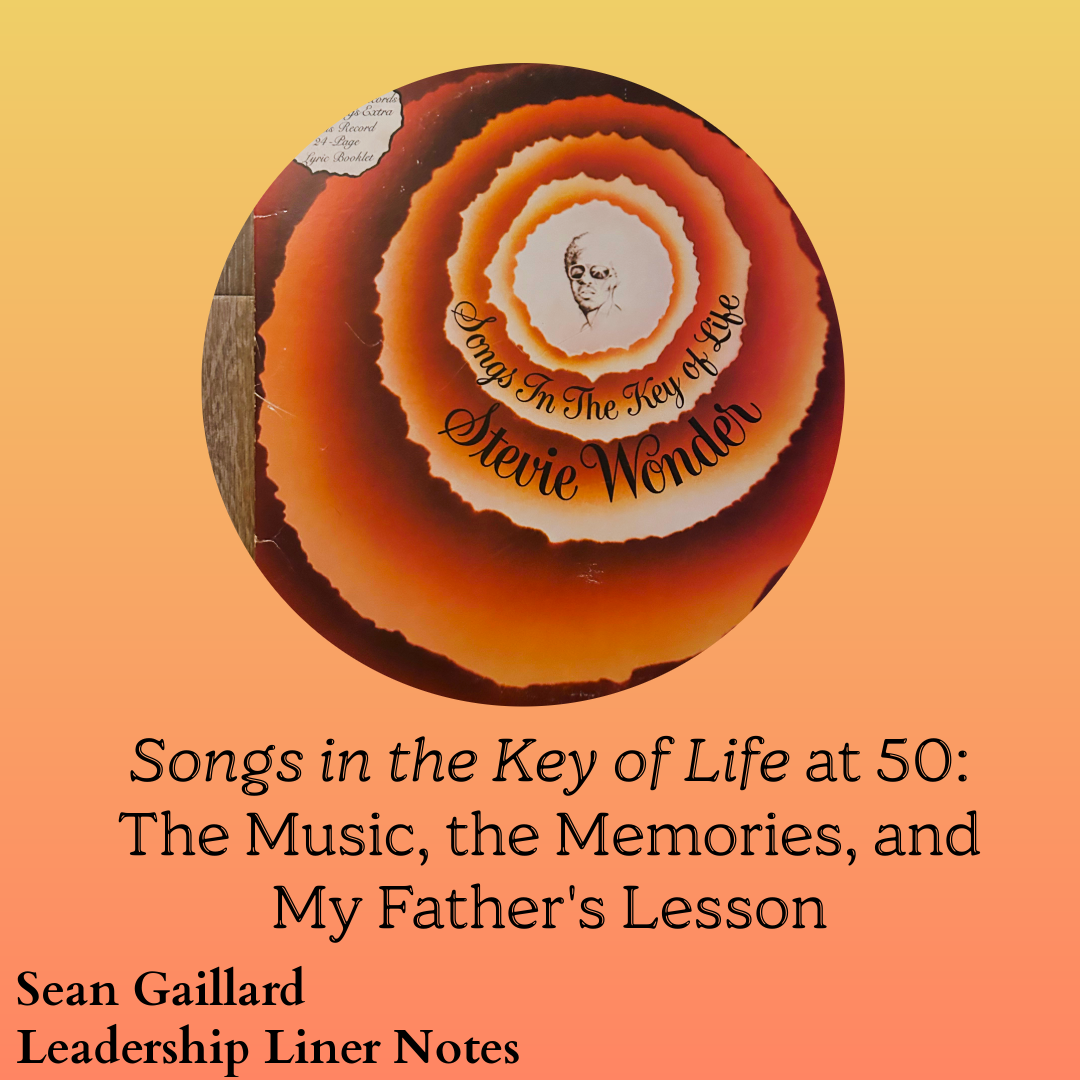
Some albums become part of our lives in ways that transcend the music itself. They become connected to the places we have called home, the people who shaped us, and the experiences that continue to influence our journey. For me, Stevie Wonder’s “Songs in the Key of Life” is one of those albums.
Today marks the 50th anniversary of this extraordinary masterpiece, originally released on September 28, 1976. As I reflect on this milestone, I find myself traveling back to my early childhood in Carson, California, where my love of music, family, and faith began taking shape.
The Soundtrack of My Childhood
I remember my dear father playing “Songs in the Key of Life” on our old stereo hi fi shortly after its release. Those songs filled our home, and I can still hear them today as vividly as I did fifty years ago. At the time, I had no idea that the music coming through those speakers would become such an important part of my life.
Carson holds a special place in my heart. Our home on Radlett Avenue provided the setting for so many memories that helped shape the person I am today. Every time I hear this album, I am transported back to those wonderful days of childhood, when life seemed filled with endless possibilities.
I remember running and dancing through the neighborhood, chasing ice cream trucks on my Big Wheel, enjoying story time with my mother, and playing catch with my father at the park. I remember dreaming about growing up to become a Jedi Knight or the Six Million Dollar Man. I was very much a product of a 1970s childhood, surrounded by the music, television, imagination, and cultural experiences of that remarkable decade.
Those memories remain precious to me. They are reminders of the love that surrounded me and the people who helped me discover the world. Whenever I return to “Songs in the Key of Life,” those feelings come rushing back.
A Remarkable Period of Creativity
Of course, “Songs in the Key of Life” represents something extraordinary beyond my personal memories. It stands as one of the defining artistic achievements of Stevie Wonder’s career and an incredible period of musical creativity.
Consider the remarkable sequence of albums he released between 1972 and 1976. There was “Music of My Mind” and “Talking Book” in 1972, followed by “Innervisions” in 1973 and “Fulfillingness’ First Finale” in 1974. Each album expanded his artistic possibilities, ultimately leading to the double album release of “Songs in the Key of Life” in 1976.
What an extraordinary creative journey! Stevie Wonder was willing to explore new sounds, embrace different musical influences, and push the boundaries of his songwriting. His music reflected the complexities of the human experience, from joy and celebration to struggle, injustice, spirituality, and love.
The result was an album filled with songs that continue to speak across generations. From the celebration of musical greatness in “Sir Duke” to the tenderness of “Isn’t She Lovely,” the social commentary of “Village Ghetto Land,” and the enduring message of love in “As,” the album offers a remarkable portrait of life itself.
There is a reason this music continues to resonate fifty years later. Stevie Wonder created something that speaks to our shared humanity while also allowing each listener to discover a deeply personal connection.
My Father’s Lesson About Love
Of all the memories associated with this album, one remains especially meaningful. It involves my father, a classroom at St. Philomena Catholic Church in Carson, and the song “As.”
My father was teaching a CCD class at our parish, and he decided to bring his copy of “Songs in the Key of Life” to share with the students. Rather than relying solely on a traditional lesson, he used music to communicate something profound about faith and the nature of God’s love.
He played “As” for the class. I remember my father in deep voice annotating the song and connecting the song to Scripture. Even though my father was teaching the class, I felt like he was talking directly to me. He was imparting the infinite nature of God’s love to me. He was giving me the gift of Faith. He was embedding a lesson in me that I would carry with me all my life and then pass on to my three daughters.
If you know the song, you understand its extraordinary message about the enduring and seemingly limitless nature of love. My father used that message to help his students understand the infinite love that God has for each of us. He connected a contemporary song to a timeless spiritual truth, making that lesson relevant, accessible, and meaningful I have carried that memory throughout my life.
My father could have taught that lesson in any number of ways. He chose to bring something familiar and beautiful into the classroom to help his students make a connection. He understood that music could communicate an idea in ways that ordinary explanations sometimes cannot.
Looking back, I recognize just how influential that experience became for me. My father was doing something that I would eventually embrace in my own professional journey. He was using music to build understanding, create connections, and make learning come alive.
The Lesson That Became Part of My Leadership
Years later, when I became an English teacher, I frequently incorporated music into my classroom. Songs became opportunities to explore language, poetry, history, culture, and the human experience. I wanted my students to discover connections between the literature we studied and the world they inhabited. I wanted learning to be something they could feel as well as understand.
That philosophy continued to shape my work when I became a school leader. Music has remained an important part of how I communicate, connect with others, and think about leadership. It has helped me consider how creativity, collaboration, belonging, and human connection can transform our schools and organizations.
There is something powerful about recognizing that a single childhood experience can influence an entire professional journey. My father probably never imagined that bringing a Stevie Wonder album into his CCD classroom would help shape the educator and leader his son would eventually become.
Yet, that is exactly what happened. I am a better father, husband, and teacher because of that event.
His lesson reminds me that meaningful teaching is not always about following a prescribed approach. Sometimes the most lasting learning happens when we connect with people through something they already love. Sometimes a song can help us understand an idea that might otherwise remain abstract.
The best educators and leaders recognize the importance of making those connections. They understand that people remember how an experience made them feel, especially when it brings them closer to something meaningful.
Fifty Years Later, the Music Plays On
Today, the celebration of Songs in the Key of Life includes an additional gift. Stevie Wonder has released a new four song EP featuring previously unreleased recordings from the original album sessions. It is wonderful to know that fifty years later, there is still more music to discover from this remarkable creative period.
For me, though, the greatest gift of this anniversary is the opportunity to revisit the memories and people connected to the album. I think about my father and mother, our home on Radlett Avenue, the joy of growing up in Carson, and the music that accompanied those formative years.
I think about the little boy who listened to Stevie Wonder through the family stereo without realizing how deeply those songs would become woven into his life. I also think about the father who understood that music could teach us something about love, faith, and our responsibilities to one another.
Fifty years later, I am still learning from that example. As spin the album today, the learning continues and my gratitude for what my father taught me grows.
Perhaps that is one of the greatest gifts of music. It allows us to return to places and moments that continue to live within us. A familiar melody can reconnect us with the people who loved us, the lessons that shaped us, and the dreams that helped us become who we are today.
As I listen to “Songs in the Key of Life” on this anniversary, I am filled with gratitude for Stevie Wonder’s artistry and for the family that introduced me to his music. I am equally grateful for the lasting influence of my father’s example, which continues to guide my work as an educator, leader, and lifelong learner.
The album may be fifty years old, but its music continues to inspire new connections, memories, and possibilities. For this boy from Carson, California, the songs will always be connected to the life I have been fortunate enough to experience.
Thank you, Stevie Wonder, for the music. Thank you, Dad, for the lessons and the love.
The music plays on, and so does the love.
Check out more in the reel right below here: