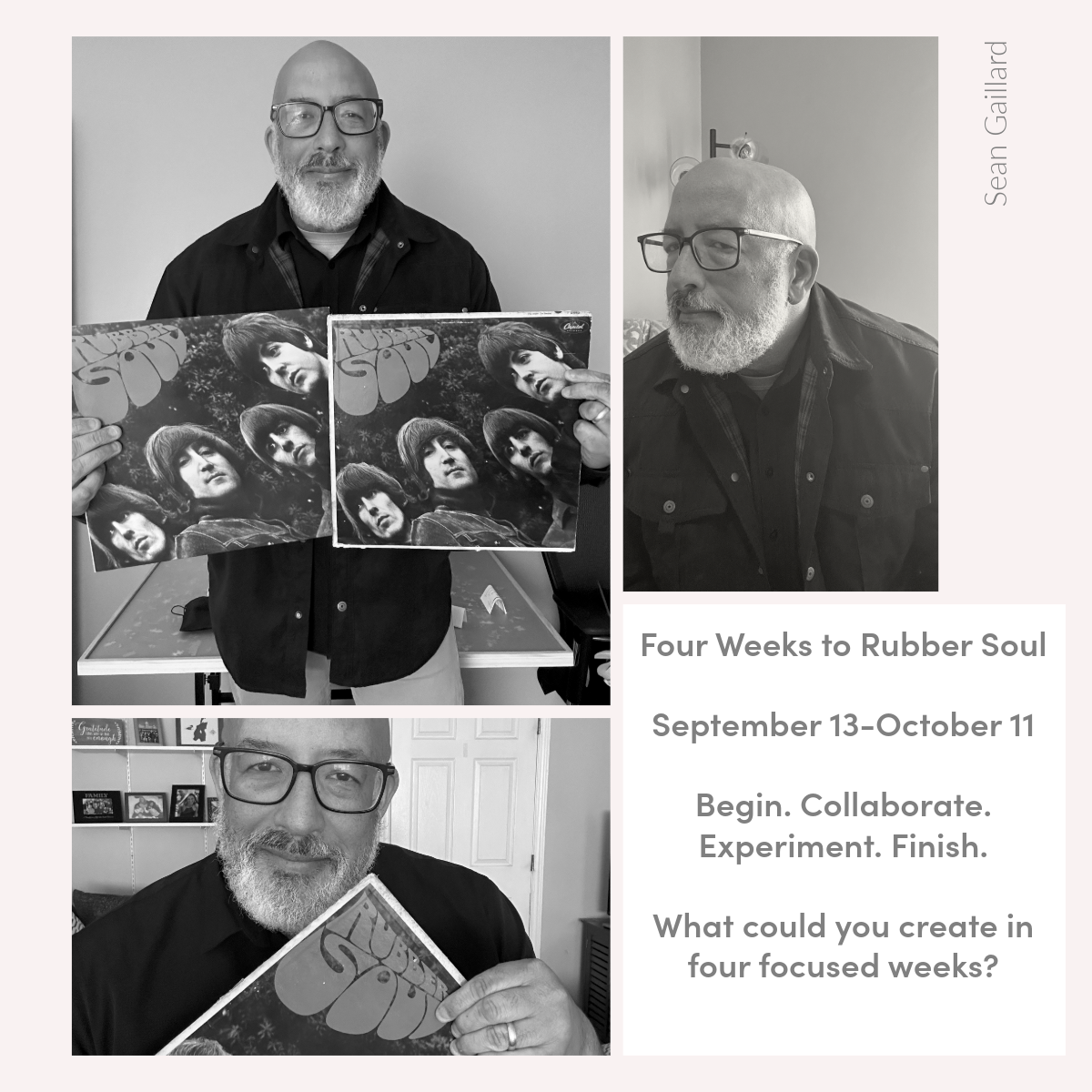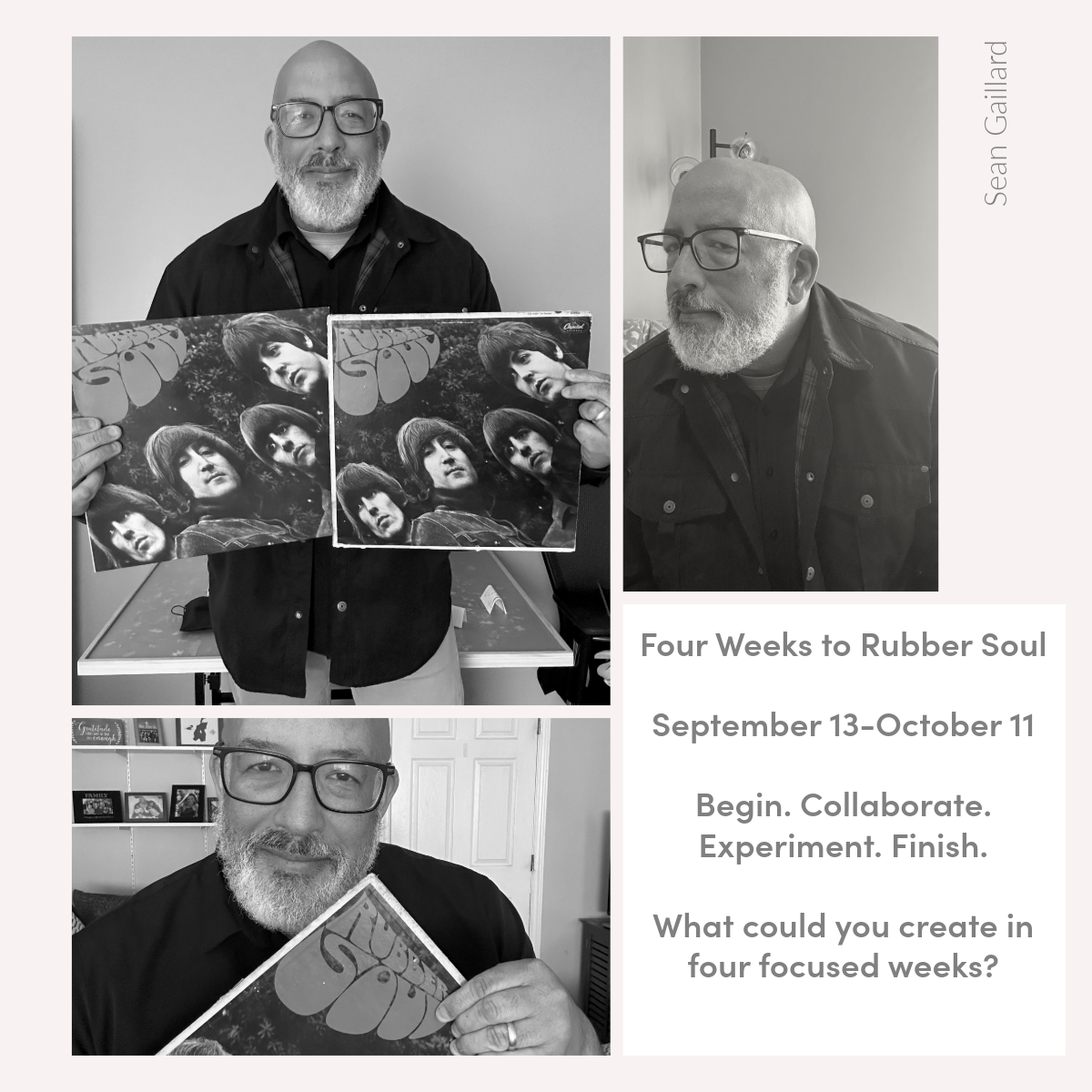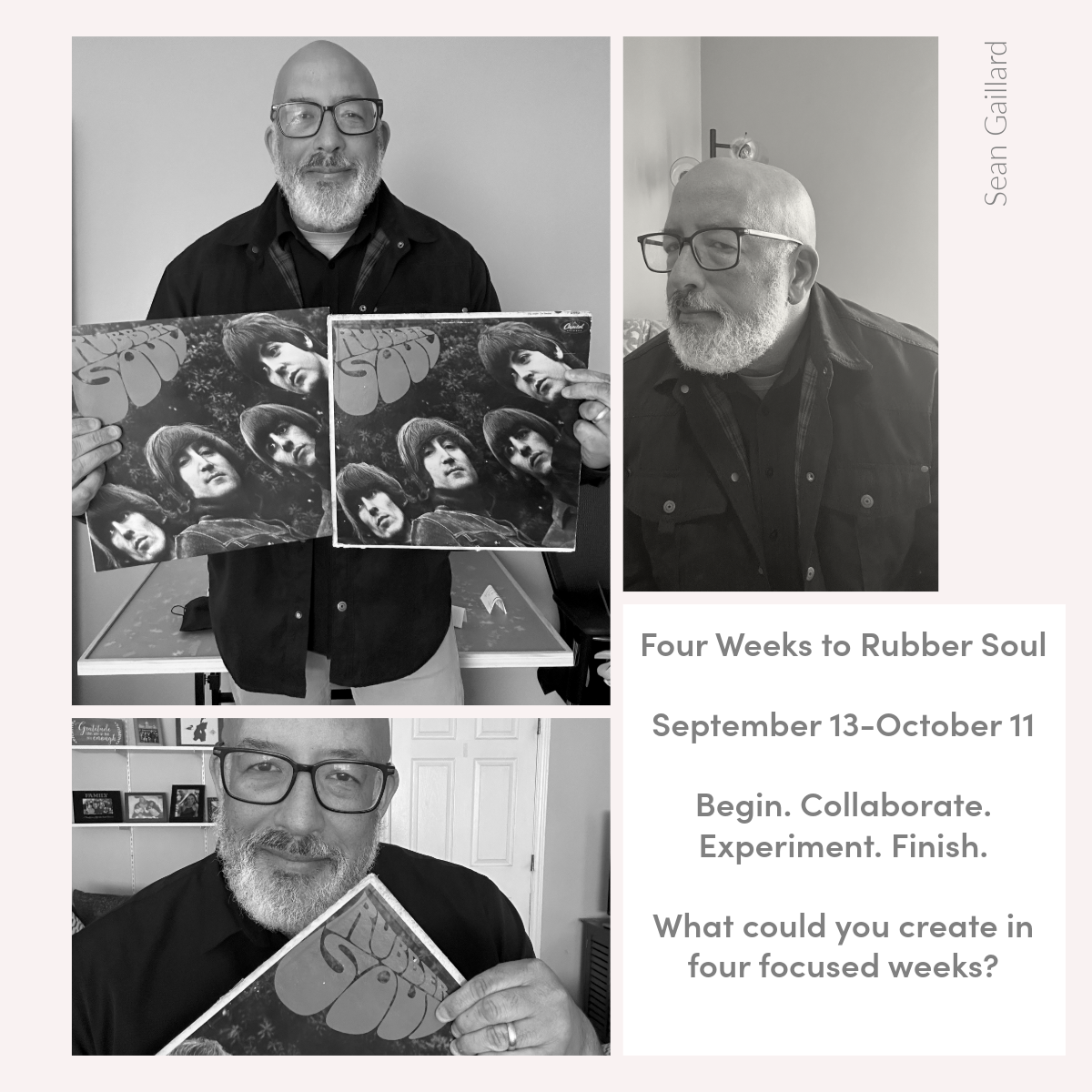
Bandmates: Day 8 of Four Weeks to Rubber Soul

Today is Day 8 of Four Weeks to Rubber Soul, and we begin a new theme in our four week journey. This week, we will explore the different ways creativity invites us to collaborate. Collaboration is woven throughout The Beatles story, and it is an essential ingredient of “Rubber Soul.” For all of the individual personalities and voices within the group, this is very much a band album.

“Rubber Soul” was not the product of isolated genius. John Lennon, Paul McCartney, George Harrison, and Ringo Starr each brought something different into the room. Producer George Martin and the studio team added their own ideas, judgment, expertise, and craft. Great collaboration expands the work without erasing the individual voices that make the work distinctive.

Our word for today is one of my favorite words: Bandmate.

If you know me, you know that I sometimes view the world as one big band. Each of us has a part to play. Each of us brings a gift that contributes to the sound. I often call people I cherish and trust as collaborators my “Bandmates.” It is my way of expressing gratitude, connection, trust, and kinship. When I call someone a Bandmate, I am saying, “I see you. I appreciate what you bring. I am grateful that we get to make something together.”

“Rubber Soul” offers a wonderful picture of this idea. Look at the back cover of the album and read the credits. Throughout the track listing, you see combinations of names and contributions. For example, you see credits like “Paul and John with George,” “George with John and Paul,” and “Ringo with Paul and John.” You even see specific musical contributions identified, such as George on sitar, Paul on fuzz bass, Ringo on Hammond organ, and George Martin on piano. The back cover almost becomes a set of liner notes for collaboration.

You can hear the same idea on “Think for Yourself.” It is George Harrison’s song, yet listen to everything his Bandmates bring into the recording. Paul contributes that memorable fuzz bass. John adds organ and harmony vocals. Ringo anchors the song with drums and percussion. The group layers its voices together around George. The song retains George’s voice while becoming richer because his Bandmates bring their voices into the room.

That is what great Bandmates do. They do not diminish your voice. They help you discover what your voice can become when it connects with theirs. The individual strengths of John, Paul, George, and Ringo became something even more powerful when those strengths worked together. Rubber Soul gives us fourteen reminders of what can happen when people bring their gifts into the room and make something together.

Who are your Bandmates?

Take a moment today to give someone your own liner notes shoutout. Send a text. Write an email or a note. Make a phone call. Find them in person and tell them what they bring to the band. Let somebody know that you see their contribution, that you appreciate their presence, and that the sound would not be quite the same without them.

Every great band needs Bandmates. Make sure yours know that they matter.

Check out today’s daily reel:
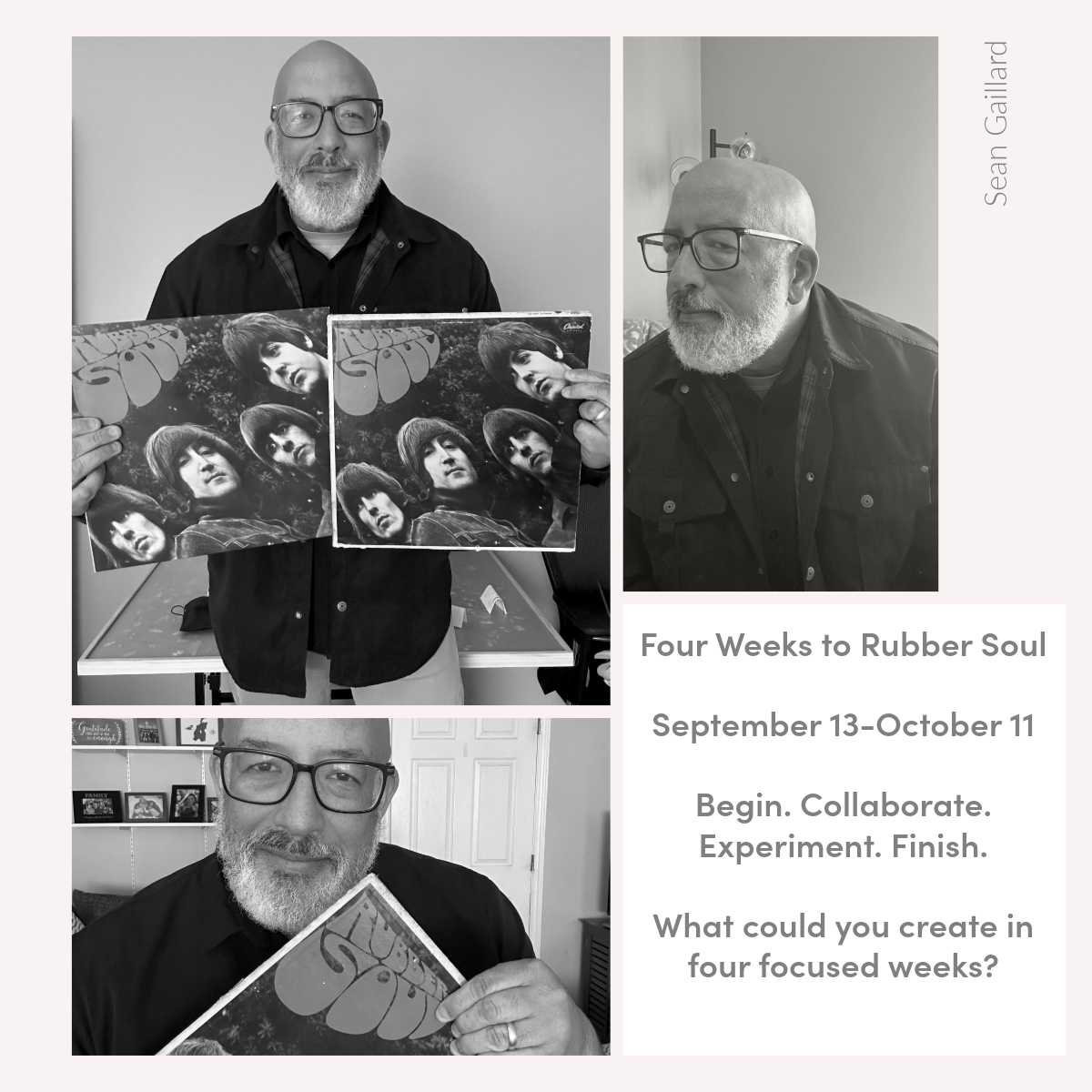
Reflect: Day 7 of Four Weeks to Rubber Soul

This is Day 7 of Four Weeks to Rubber Soul, and today’s word is Reflect. We are also closing out Week 1, which has centered on the theme of Begin. The Beatles’ creative growth, so evident on Rubber Soul, came from entering the room with songs, fragments, influences, ideas, and a willingness to work. The lesson is not to achieve perfection before starting. The lesson is to begin the work, knowing that it is completely acceptable if the beginning is rough and raw. What matters is that you enter the room and that the room is the right one, aligned with your creativity and ready to support the gifts you are bringing.

An important part of the creative process is reflection. Creative growth becomes visible when we stop long enough to notice what has changed since we began. Reflection asks us to pause, look back at what we created, and listen again. There is an art to that pause because we do not want to become so immersed in reflection that we lose momentum. Sometimes we need a trusted thought partner or bandmate who can help us listen, notice, and keep our creative work moving in the groove.

That brings me back to Rubber Soul. One reason I am looking forward to the multiple takes and alternate versions included with the forthcoming Rubber Soul Super Deluxe Edition is the opportunity to hear that creative evolution. The Beatles, along with producer George Martin, continually shaped these songs by changing harmonies, sounds, spaces, arrangements, and instrumentation. Reflection does not mean doubting what you created. Reflection means giving yourself enough space to hear what the work still needs.

Sometimes we need to return to what we made and ask three simple questions: What is working? What is missing? What could make this better? On Rubber Soul, a song could enter the studio one way and leave sounding very different on the finished master. That transformation happened because the band was willing to listen to the work as it developed and respond to what the song needed.

For example on “Norwegian Wood,” George Harrison felt that the song needed something different. His growing interest in Indian music led him toward the sitar, and he worked out a part that became one of the defining sounds of the song. That decision helped give the recording its distinctive character and introduced many listeners to a sound they may not have expected to hear on a Beatles record.

“In My Life” offers another beautiful example of reflection in action. The basic track had already been recorded, but the instrumental middle still needed something. George Martin experimented with ideas, including Hammond organ, before developing the Baroque inspired piano passage we now know so well. Since the part was difficult to play at the required speed, he recorded it more slowly and sped the tape up afterward. The result became an essential part of the song and a reminder that sometimes the creative breakthrough comes after we are willing to listen again.

As we close Week 1, take some time to reflect on something you have created. Do not judge it too quickly. Listen to it and ask yourself: What is working? What is missing? What could make this better? Consider bringing a trusted thought partner or bandmate into that reflection because sometimes another set of ears helps us hear possibilities we cannot hear alone.

Reflection is not about doubting your work. It is about asking what the work still needs and then having the courage to make the adjustment. I would love to hear how reflection fits into your creative process as we continue this journey through Four Weeks to Rubber Soul.

Check out today’s daily reel. Thanks to Starbucks for serving as my own Abbey Road Studios!

Listen: Day 6 of Four Weeks to Rubber Soul

Today’s word for Day 6 of Four Weeks to Rubber Soul is Listen.

One of the things I love about The Beatles is how much they listened. They absorbed what was happening around them. Folk music. Soul. Motown. Indian music. Bob Dylan. The Beach Boys. They were fans, students, competitors, and curious creators all at once.

They listened deeply, but they did not simply copy what they heard. They took those influences, filtered them through their own voices, and created something that still sounded unmistakably like The Beatles. You can hear that sense of curiosity and expansion throughout Rubber Soul.

That idea keeps coming back to me during this project.

If I ever have the chance to meet you in person, there is a good chance I will ask you one of my favorite questions:

What’s on your turntable?

Sometimes I mean that literally. I genuinely want to know what record you are spinning. The question also goes much deeper than music.

What are you reading? What are you listening to? What are you noticing? What ideas have your attention right now? What is feeding your work, your soul, and your passion?

For me, asking that question is an invitation to connect. I want to know what matters to you because I can learn from you. Your interests, ideas, and passions may help me see something differently. Listening becomes more than receiving information. It becomes an act of connection.

Creativity works that way, too.

We listen to the things that move us. We notice the work of other people. We absorb ideas, sounds, conversations, books, art, and experiences. Somewhere in all of that listening, something begins to stir within us. We take what inspired us and begin making something of our own.

That is part of what Four Weeks to Rubber Soul has become for me.

This is a daily creativity challenge. Every day, I am showing up with a word, recording a reel, and writing a blog post inspired by an album that continues to challenge and inspire me. Some days the ideas arrive easily. Other days I have to dig a little deeper. The point is to keep listening, noticing, creating, and showing up.

Rubber Soul has stayed on my turntable for years because it represents a courageous creative pivot. It reminds me what can happen when artists remain curious, listen widely, trust one another, and allow themselves to grow.

Plus, the music is pretty damn good.

My hope is that these daily riffs might do for someone else what Rubber Soul continues to do for me. Maybe a thought, a song, a question, or one small idea will encourage you to make something, try something, or return to something you have been putting aside.

So, here is today’s invitation:

What’s on your turntable?

What are you listening to, reading, noticing, or experiencing that is challenging you and inspiring your creativity?

Keep listening.

Keep creating.

And keep going.

Watch the Day 6 reel below.

Courage in the Grooves: Day 5 of Four Weeks to Rubber Soul

It can be daunting to face one’s creativity and then put on display for others. There are many forms and permutations of this feeling. Perhaps, it’s pressing “Publish” on a blog or reel. Maybe, it’s sitting at the keyboard and literally facing the music. We create doubts, orchestrate judgement from others, and quietly place a watermark of failure on our work. This impedes our expression and may even result in the zero sum of our creative output.

We need to dig deeply into our core for the courage to hold our heads high. We have to possess the belief in our creativity. We must be convicted that the world needs our ideas, dreams, and creative action. It takes courage to do all these things. I know it isn’t easy. By taking steps in these Four Weeks to Rubber Soul, my hope is to help inspire courage in your work. You may not have the camaraderie and support of a John, Paul, George, and Ringo surrounding you in your own creative pursuit. My hope is that creativity series will be like a bandmate for you as you dream, explore, and create.

Today’s word is Courage. I explore that very thing in today’s reel. Check out my riffs on “Rubber Soul” in today’s daily reel:

Practice Progression Not Perfection: Day 4 of Four Weeks to Rubber Soul

Day 4: Practice, Progression, Not Perfection

Welcome to Day 4 of Four Weeks to Rubber Soul. Today’s theme is practice.

Long before Rubber Soul, The Beatles had already spent years learning how to become a band. Hamburg was one of their great laboratories. During their early residencies there, they played punishing schedules in clubs like the Indra, Kaiserkeller, and Top Ten. At the Indra, they were playing four and a half hours on weekdays and six hours on weekends. When they returned to Hamburg in 1961, the Top Ten schedule stretched to seven hours a night and even longer on weekends. Night after night, they had to keep an audience engaged, stretch songs, improvise, recover from mistakes, and keep playing. 

That kind of work mattered. Hamburg did not magically turn them into The Beatles we know, but it gave them something difficult to manufacture: musical instinct with one another. They learned how to listen, anticipate, adjust, and respond. They developed stamina. They developed confidence. They developed a shared language.

By the fall of 1965, all of those hours were in the room with them when they began making Rubber Soul. The album sessions began in October with a looming Christmas release deadline, giving them roughly a month to create one of the defining albums of their career. That speed was not the absence of practice. It was one of the results of it.

Still, practice did not mean everything came easily.

Take “I’m Looking Through You.” The Beatles spent nine hours working on the song on October 24, 1965. They completed a version that they initially considered finished. Then they came back on November 6 and remade it. They still were not satisfied. They tried again on November 10, arriving at the arrangement that became the master, and completed the recording the following day. The earlier version was slower, arranged differently, and did not even contain the familiar “Why, tell me why” section.  I love that.

One of the great songs on a classic album was not simply delivered fully formed. They worked it. They listened. They changed it. They discarded something they had spent hours creating and began again. That is practice.

Practice is not simply repeating something until you stop making mistakes. Practice is remaining curious enough to ask, What else could this become? It is having enough commitment to return to the work when the first version does not quite say what you want it to say.

Maybe that is why this idea feels especially relevant to me during Four Weeks to Rubber Soul. I am practicing, too.

Every day for four weeks, I am showing up and trying something a little different. I am writing. I am recording reels. I am listening more closely to an album I have known for years. I am experimenting with ideas, formats, stories, and connections. Some days will flow better than others. Some reels will land. Some will need another take. Some ideas may evolve completely before this journey is finished.

I am not waiting until I have perfected the series before I share it. The series itself is the practice. I am learning by doing it.

The Beatles had Hamburg before Rubber Soul. They had thousands of performances, rehearsals, writing sessions, mistakes, arguments, breakthroughs, and countless hours of playing together. Then, when opportunity and pressure collided in late 1965, they had the craft and the connection to create something extraordinary.

Whatever you are working on, give yourself that same permission. Practice. Experiment. Take another run at it. Rewrite the paragraph. Record another take. Play the chord again. Change the arrangement. Keep chiseling away at the thing that matters to you. Do not make perfection the price of continuing. Stay with it.

Check out below for today’s reel:

Begin Your Creativity Journey with The Beatles: Day 1 of Four Weeks to Rubber Soul

A man with a beard and glasses holds up two copies of the album 'Rubber Soul' by The Beatles, standing in a room with a light background.

For Day 1 of my creativity series on The Beatles and their “Rubber Soul,” I share a quick video riff. In this video riff, I simply invite you to begin. All creativity has to start somewhere after the catalyst for inspiration. It may not be a monumental beginning, but it’s a start.

The first day of the “Rubber Soul” sessions began with two songs, “Run For Your Life” and “Norwegian Wood.” The former was later dismissed by its main author, John Lennon. “Norwegian Wood” is another story. This track sets the stage for the introspective angles evident in the final proudct of the completed “Rubber Soul.”

Today is serendipitous in that we get another sneak peek at the upcoming “Rubber Soul” Super Deluxe Edition with Take 2 of “Norwegian Wood.” It’s rough and raw and not quite the near the poetic elegance that final master reaches. In fact, the song is entitled “This Bird Has Flown.” This title is later hued from the Lennon-McCartney songwriting forest as “Norwegian Wood.”

Check it out here:

In case you missed it, here’s the Day 1 Reel that kicks off our “Four Weeks to Rubber Soul.” Please feel free to share in the comments what you creative pursuit are your beginning to today.

@smgaillard0

Day 1 of Four Weeks to Rubber Soul. Today’s word: BEGIN. The Beatles did not walk into the studio with Rubber Soul fully formed. They brought songs, fragments, influences, ideas, and a willingness to work. That is where creative work begins. Show up. Start. Trust the work. What are you making? FourWeeksToRubberSoul WhyTheBeatlesMatter TheBeatles RubberSoul Creativity

♬ original sound – @smgaillard – @smgaillard

Four Weeks to Rubber Soul

On September 14, I am starting a four week creative experiment and countdown inspired by one of my favorite albums and one of the most important records in popular music history. I am getting ready for the upcoming Super Deluxe Edition of Rubber Soul, arriving October 2, and I wanted to do more than simply count the days. I want to use that time to create.

The Beatles recorded Rubber Soul in roughly a month during the fall of 1965. That still amazes me. In that brief stretch of time, they created an album that included “Drive My Car,” “Norwegian Wood,” “Nowhere Man,” “Michelle,” “Girl,” “If I Needed Someone,” and “In My Life.” During that same period, they also recorded “Day Tripper” and “We Can Work It Out.” In a matter of weeks, they created a classic that would help change the direction of popular music.

Rubber Soul marked a turning point for The Beatles. The writing became deeper. The sound became broader. The studio became part of the creative process in new ways. The band was stretching beyond what had worked before and exploring what might come next.

The impact traveled far beyond The Beatles. Brian Wilson heard Rubber Soul and was inspired to create Pet Sounds. The album also influenced bands such as The Kinks and The Rolling Stones. Decades later, its legacy remains strong. Rubber Soul entered the Grammy Hall of Fame in 2000, and “Michelle” won the Grammy for Song of the Year. It continues to appear on lists of the most important albums ever recorded.

What stays with me most is the process. Four people walked into a studio with ideas, songs, curiosity, tension, trust, and a willingness to try something different. They worked with George Martin and the Abbey Road team. They collaborated, experimented, changed direction, and kept moving.

That process is the inspiration behind Four Weeks to Rubber Soul. For the next four weeks, I am going to focus on four creative moves: Begin, Collaborate, Experiment, and Finish. Begin is about giving an idea permission to exist before it is fully formed. Collaborate is about recognizing that our work can become stronger when we allow other voices, perspectives, and gifts into the process. Experiment is about following curiosity, trying something unfamiliar, and accepting that not everything has to work the first time. Finish is about carrying the work across the line and releasing it rather than keeping it trapped in our heads, notebooks, or hard drives.

I want to see what happens when I commit to those four moves for four focused weeks. Starting September 14, I will share something every day inspired by Rubber Soul and the creative process behind it as I count down to October 2. Some days it will be a reel. Some days it will be a blog post. There will also be special riffs on Why The Beatles Matter. The goal is not simply to talk about an album I love. The goal is to use the album as a catalyst for making something.

The question I will carry through these four weeks is simple: What can we create when we trust the process, work with intention, and keep moving forward?

The first reel drops September 14. Follow along, create something of your own, tag me, and use #FourWeeksToRubberSoul so we can encourage one another through the process.

Let’s see what four focused weeks can create.

From the Blog Archives: A Dream with The Beatles

Here’s an old post from the archive that I am re-blogging. In leadership, we often times downplay dreams. Sometimes dreams are viewed as impractical and wasteful when it comes to the daily grind. I still maintain a dream as an unabashed fan of The Beatles that Paul McCartney and Ringo Starr are going to visit my schoolhouse.

Now that may seem impossible and you may dismiss me as a pitiful dreamer. Why not? Why not have a dream? Why not share that dream with others? As leaders, we are called to be human-centered. Dreams are what make us human. We must support conditions where others feel safe to share their dreams as well.

Here’s my dream that I am re-sharing with you. I hope you enjoy it. I would love to hear your dreams, too. Please feel free to leave something in the comments or share this blog on your social media channels and tag me.

The Return of “Why The Beatles Matter” Podcast

Some music never leaves us.

Over the past few weeks, I have found myself returning again and again to The Beatles. Not simply as albums or songs, but as companions through different seasons of life.

Hearing “Two of Us” recently in “Project Hail Mary” brought me to tears. The song landed differently this time. Maybe that is what great music does. It grows alongside us.

With “Revolver” turning 60 this summer and the announcement of the upcoming 3 Savile Row fan experience in London, it feels like the right time to bring back “Why The Beatles” for a new season of conversations, reflections, stories, creativity, memory, and belonging.

This is not about nostalgia alone.
It is about why this music still matters.
Why it still connects.
Why it still inspires.
Why it still helps us feel human.

Season 2 is on the way. Please subscribe on Spotify or Apple Podcasts. Stay tuned!

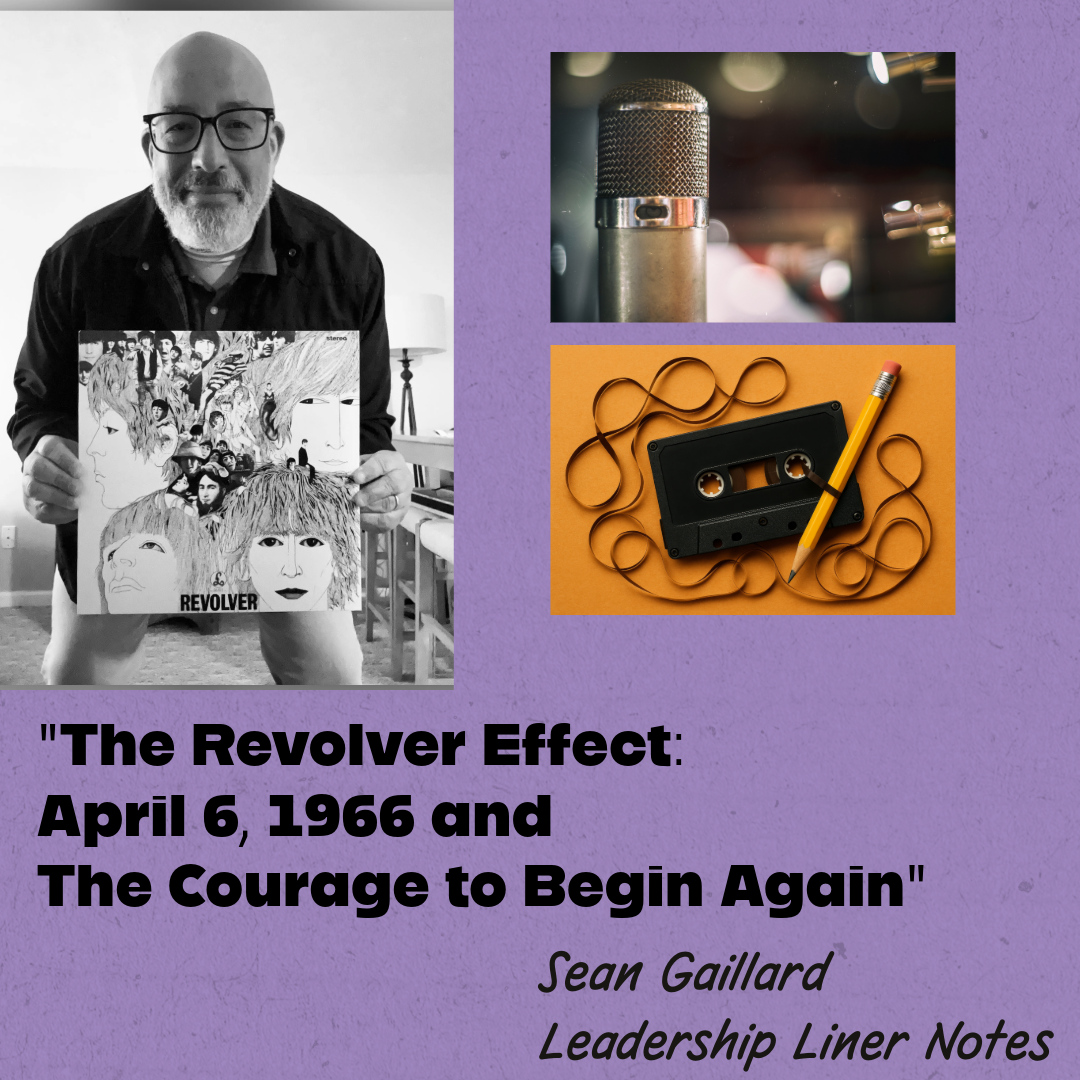
The Revolver Effect: April 6, 1966 and The Courage to Begin Again

On April 6, 1966, The Beatles walked into EMI Recording Studios in London and quietly began changing everything. There was no announcement. There were no crowds gathered outside signaling what was about to unfold. There was simply a band stepping into a new beginning.

That beginning started with a John Lennon demo known as “Mark 1,” which would later become “Tomorrow Never Knows,” the closing track of Revolver. It is a song that still feels ahead of its time, built on tape loops, backward guitar, distorted vocals, and the influence of Indian music. It was not just a song. It was a signal.

The band, alongside producer George Martin and a 19 year old engineer named Geoff Emerick, stepped into territory that had no clear blueprint. Touring had begun to wear on them. The noise, the expectations, and the repetition no longer matched who they were becoming. A storm was coming with their 1966 world tour, one that would eventually lead them to walk away from live performance altogether.

In that moment, they made a decision that continues to echo. They chose creation over replication. They chose the unknown over the expected. The songs on Revolver were not designed for the stage. They were designed for exploration.

Revolver exists in the shadow of albums like Sgt. Pepper’s Lonely Hearts Club Band and Abbey Road, yet it stands as the turning point. It is the moment where identity begins to shift. It is where the band sheds the weight of expectation and begins to move with intention toward something deeper, more expansive, and more honest.

This year marks the 60th anniversary of Revolver. That milestone carries more than nostalgia. It carries an invitation to revisit what it means to begin again.

As I have been writing my upcoming book, Leadership Riffs, I found myself drawn into a chapter centered on Revolver. The more I wrote, the more I realized this was not meant to stay confined to a manuscript. This moment felt too important. This album felt too alive. It needed to be shared here and now as part of a larger conversation about leadership, identity, and growth.

Just as I explored Sgt. Pepper in The Pepper Effect, I see Revolver as its own blueprint. It offers a way of thinking about leadership that is rooted in courage, craft, and reinvention. It shows what becomes possible when individuals bring their full creative gifts into a shared space and trust one another enough to take risks together.

I call this The Revolver Effect, and it is grounded in four core riffs:

Believe in the Courage to Experiment
Step into the unknown without a clear map. Growth does not wait for certainty.

Believe in the Craft
Commit to depth, intentionality, and mastery. Substance will always outlast noise.

Believe in Expanding Your Voice
Allow yourself to grow beyond your original identity. Invite new influences and perspectives into your work.

Believe in Reinvention Through Letting Go
Release who you were so you can become who you are meant to be.

These riffs are shaping a short series through my Vinyl Riffs podcast along with companion reflections here. This is both a celebration and an exploration of an album that continues to resonate six decades later.

The first episode of this series is now live:

🎧 Spotify: https://open.spotify.com/episode/1sPr0XIOsps9HTs5Sd5zSA?si=a1eQ_dh-S7GHF_TM0FCEOg
📺 YouTube: https://youtu.be/D8vjcWG70n8
🍎 Apple Podcasts: https://podcasts.apple.com/us/podcast/the-revolver-effect-the-day-everything-changed/id1875382603?i=1000759946748

This series is a reflection. It is a way of making sense of the moment we are all navigating. It is a reminder that transformation rarely arrives with fanfare. It often begins quietly, with a decision to try something new.

April 6, 1966 was one of those moments.

Perhaps this is yours.


An Invitation to Celebrate “Revolver”

I invite you to listen, reflect, and join this journey. I would love to hear how Revolver has impacted you. Share your thoughts through social media and tag me or reach out directly to me. There is something powerful that happens when we bring our stories together.

Also, I am looking for guests to share their “Revolver” stories of impact and inspiration for upcoming episodes of “Vinyl Riffs.” Please let me know if you are interested.

Here are my social media channels for you to drop me a line via DM:

LinkedIn

Facebook

Instagram