If School Leadership Had a Wrapped List

As the year winds down, our inboxes begin to tell a familiar story.

Year-end notices arrive in waves. Deadlines stack up. Checklists multiply. There is an understandable push toward closure, accountability, and tying up loose ends. Much of it is necessary. Much of it is also draining, especially in a profession where the emotional labor rarely slows down.

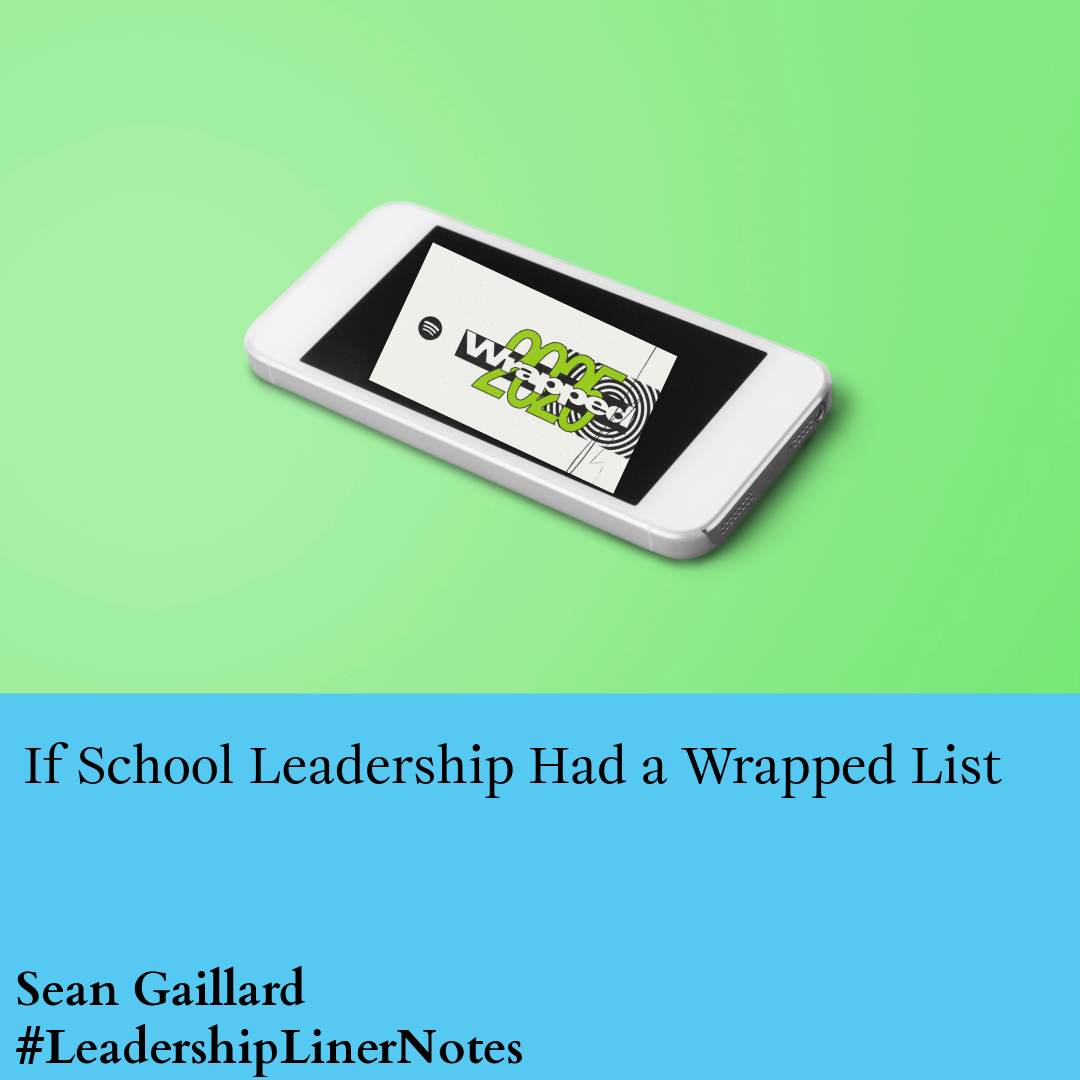
Then, there is Spotify Wrapped.

Every year, I look forward to it in a way that surprises me. Wrapped does not ask me to prove anything. It does not measure me against anyone else. Instead, it reflects back what I returned to over time. It names patterns. It celebrates consistency. It turns data into story.

No surprise that The Beatles were once again at the top of my list. It also did not surprise me to see that I landed in the top point five percent of listeners globally. That statistic is fun, but what matters more is what sits beneath it. These are the songs I go back to when I need grounding. The music that meets me where I am and helps me remember who I am.

That contrast stayed with me.

Wrapped invites reflection. School systems often rush toward evaluation. Both look back, but they do so with very different intentions.

The Leadership Reset That Sparked the Idea

This idea began to take shape during a Leadership Reset I have been practicing and sharing with others. You can see an earlier blog post on The Leadership Reset here. It is intentionally simple and designed to fit into real days, not ideal ones. It does not need special materials or extended time. Just a few minutes of presence.

The 3 Minute Leadership Reset

Step 1. Take a Breath for 30 seconds
Close your eyes if you can. Inhale slowly and say to yourself, I am still here.
Exhale and say, I am enough.
Repeat this three times. Let your shoulders drop and your breathing slow. This is the act of reclaiming your space in the moment.

Step 2. Anchor in Gratitude for 1 minute
Ask yourself quietly:
What one small moment today reminded me I am alive?
What one connection, a smile, a song, a student, gave me a spark?
What one thing am I proud of, even if no one noticed it
?
Write it down or say it aloud. These moments are leadership echoes that ripple outward even when they feel small.

Step 3. Affirm and Reframe for 1 minute
Say these words out loud, slowly and intentionally:
I am not invisible. I am building something that lasts beyond applause.
My work is meaningful, even when it is quiet.
The music I make through service, kindness, and creativity still plays, whether or not the crowd is listening.
Let these words settle. This is the act of tuning yourself back to the right frequency.

Step 4. Reconnect for 30 seconds
Before moving on with your day, take one small action to reconnect:
Send a brief message to a friend or colleague.
Offer a kind word to a student or staff member.
Play a song that brings you joy.
These micro moments rebuild our leadership core from the inside out.

As I reached this final step, I pressed play on “Now and Then” by The Beatles. It was my number one song again for the second year in a row on my Spotify Wrapped List.

There was something deeply fitting about that moment.

The song carries themes of time, memory, and continuity. It reminds us that voices can still be heard long after the room grows quiet. That truth feels especially relevant in schools, where so much meaningful work happens without applause or recognition.

Leadership is not always loud. Teaching is not always visible. Learning does not always announce itself on a dashboard.

But the work still plays.

What If Schools Had a Wrapped Moment?

Spotify Wrapped works because it tells a story of return. It shows us what we came back to again and again when no one was watching. It honors presence over perfection and patterns over isolated moments. It gives language to what sustained us.

What if we borrowed that spirit in our classrooms and schoolhouses?

Not as another initiative. Not as something to hand in or score. Not as a tool for comparison.

But as an invitation.

A moment to pause. A chance to reflect on the year through a human lens. A way to help students, teachers, and leaders feel seen in a season that often feels rushed.


Your Year Wrapped

A Reflection Template for Classrooms, Teams, and School Communities

This reflection can be used in many ways. It serves as a journaling activity. It can spark a classroom conversation. It can act as a PLC opener. It can also be a quiet end-of-year pause during a staff meeting. There are no right answers and no expectations for sharing. The goal is reflection, not performance.

Most Revisited Moment
What moment from this year did you find yourself returning to in your thoughts or conversations? What made it stay with you?

Most Meaningful Connection
Who made this year better simply by being part of it? This could be a student, a colleague, a mentor, or someone outside of school who helped you keep perspective.

The Song That Carried You
What song, quote, book, prayer, or moment gave you comfort? What gave you energy when you needed it most? Why did it matter?

A Quiet Win
What is something you are proud of that did not receive recognition or attention? What does that say about the kind of work you value?

Your Growth Genre
In what ways did you grow this year, even if it felt uncomfortable, unfinished, or messy? What did you learn about yourself?

Your Comeback Track
On hard days, what helped you reset and keep going? What practices, people, or routines supported you?

Your Hope for What Comes Next
What do you want to carry forward into the next season with intention and care?

This kind of reflection helps us name what often goes unnoticed. It gives dignity to effort, presence, and perseverance.

Why This Matters

In education, we spend a lot of time focusing on gaps and goals. We analyze what is missing, what needs to improve, and what did not move fast enough. That work has its place, but it cannot be the only story we tell.

Reflection like this builds belonging. It helps people feel valued for who they are, not just what they produce. It reminds students that their experiences matter. It helps teachers reconnect with purpose. It allows leaders to remember why they chose this work in the first place.

Most importantly, it creates space for humanity in systems that often move too quickly to notice it.

Press Play Before the Year Ends

Before we close the year with another notice or checklist, perhaps we take an intentional pause.

We take a breath.
We reflect on what carried us.
We press play on what still brings us joy and meaning.

The music we make through service, kindness, and creativity still plays whether or not the crowd is listening. That work echoes in ways we may never fully see.

And sometimes, that is exactly enough.

If you try a Year Wrapped reflection in your classroom or school, I would love to hear how it goes. Please feel free to leave a comment here or tag me on social media. This work is better when we share the music that keeps us grounded and moving ahead.

Keep listening.
Keep reflecting.
Keep believing.
Keeping the Faith When the Room Feels Quiet

I remember being one of the last kids picked for kickball. Standing there in the dust with my hands in my pockets, waiting for someone to call my name. Everyone else seemed to belong somewhere. Everyone else seemed to have a team. That feeling has followed me into adulthood more times than I care to admit.

It rises up again whenever I put something out into the world and the room stays quiet. Every blog post. Every episode. Every reflection. Each one is a small act of courage. Each one is a piece of my soul placed gently on the table. Yet the silence that follows can hit with the same sting I felt on that kickball field.

There are days when it feels like no one wants me in their band. No replies. No call backs. No echoes of connection. I have chosen two of the loneliest gigs in the world. Leadership asks you to walk into the unknown even when no one notices. Writing asks you to offer your heart with no promise that anyone will take it. There is no applause built into any of this. There is no guarantee that your work will lead to opportunity.

So I have to keep the faith that there are quiet listeners out there. I have to trust that someone is reading or watching or absorbing even if I never hear the echo. I have to accept that my work may never be seen by the people I wish would see it. I have to keep creating anyway because that is the only way I can stay true to myself.

When doubt begins to weigh me down, I think of George Harrison. In the latter days of The Beatles, he felt like an outsider in his own band. His songs were often pushed aside. Yet he kept writing. He kept believing in his sound. Even in those difficult seasons, he delivered “Something” and “Here Comes The Sun.” Those songs became the heart of what many considered to be their greatest album, “Abbey Road.”

Then came the moment when his backlog of unheard songs found their place. “All Things Must Pass “emerged as a three album masterpiece by George Harrison. A triumph born from years of quiet rejection. A reminder that some brilliance finds its home only after the world grows ready for it. That album just celebrated its fifty fifth anniversary. It is a cherished album for me. It reminds me that the work we create in the shadows can one day light the way for someone else.

Maybe the same can be true for me. I have been part of good bands in my life. Maybe one more band is still out there. Until then, I will keep the faith even when the room feels quiet. I will write anyway. I will lead anyway. I will create anyway.

Because someone somewhere may need the sound I am trying to make. Even if I never hear the echo, the act of making it still matters.

Finding My Band

When I was a kid, I was often one of the last picked for kickball. I remember the sting of waiting. I stood in awkward anticipation. I hoped someone would invite me on the team. I did my best to keep my head held high like my father had taught me. I watched captains point to someone else and tried not to show my disappointment. I was that kid hoping to belong. Hoping to be seen. Hoping to be chosen.

I think I have spent most of my life chasing that feeling of belonging. Wanting to be part of something bigger than myself. Wanting to feel the spark when you look around and know you are with your people who see you. Wanting a band.

A band for me is not just the literal type where individuals play music together. I use the band as an analogy for collaboration, belonging, and sustaining a shared vision. As a school leader, I would perpetuate this concept by referring to colleagues as “bandmates.” I thought that this mindset would help the culture and enhance belonging for all in the schoolhouse.

Being in a band is wonderful. There is purpose and possibility in the sound you create together. I felt that sense of belonging as a guitarist in a few literal bands. There is nothing like locking into a groove. Seeing another musician look over with that nod says we are in the pocket. I felt that same belonging when I taught English at Governor’s School. I was surrounded by a team of educators who celebrated collaboration and creativity. I felt it a few times in school leadership within administrative teams that shared a vision and worked in harmony.

Spinning on my turntable as of late is “The Beatles Anthology Collection.” It is a treasure trove of alternate takes, live recordings, and demos. It also includes unreleased tracks and a trio of their reunion songs. I love hearing the band workshopping songs and encouraging each other through various mistakes and flubs in the studio. It serves as a reminder of what a band should do when they face an echo of a failure. They should handle the resonance of a mistake wisely and stick together. You play through it, learn from it, and keep the groove moving on. Listening to this beautiful audio package of The Beatles in this alternate trajectory is wonderful. It makes me miss the joy of being in a band. I miss being with people who understand my sound.

Lately, I have been drifting. Feeling like a castaway. Wandering around a crossroads. Watching from a distance as others find their bands. I see camaraderie and connection and I often feel sadness that I am not part of it. Recently, I saw a group of leaders celebrating together in a LinkedIn post and I felt left out. I felt that old kickball feeling. The one that sits heavy.

For a long time I thought that if I waited long enough a band would find me. That a group would invite me in. That someone would want my presence, ideas, and voice. I waited. I believed. I hoped.

And then it hit me. I was waiting for a band that was never coming.

I have also forced the idea of band on others over the years. I regret that. Not everyone is ready to be in a band. I never took the time to realize that I am the barrier to the band. And the harder truth to accept is that maybe nobody wants to be in a band with me. Maybe I am not meant to join someone else’s group. Maybe I am meant to build something from the ground up. I am learning to sit with that. I am learning to accept it with honesty.

So here is where I am now.

I am at peace with where I am now.

I am at peace with the people I get to meet and support daily.

In the meantime, I am forming my own band.

Not by asking others or convincing colleagues or trying to prove myself that a band is the way to go. Not by waiting for an invitation that will never arrive. I am just going to keep creating. Keep writing. Keep podcasting. Keep blogging. Keep finishing the second book. Keep playing my sound without apology.

If I stay true to that maybe the right bandmates will hear the music. Maybe the ones who resonate with authenticity will wander into the room. Maybe belonging is not something you wait for. Maybe belonging is something you build.

I believe in the band. I always have.

And the next track begins now.

Failure Hurts, But the Beat Goes On

Failure hurts. There’s no sugar-coating that simple truth. When the Beatles were turned down by Decca Records, it could have been the end of their story. But it wasn’t. They found another path and changed the world. As I wrote in The Pepper Effect, that “no” was just the prelude to a bigger “yes.”

And they’re in good company. Walt Disney was once fired for “lacking imagination,” and Oprah Winfrey was told she was “unfit for television” before becoming a media icon. Each of them had moments that could have ended their journeys, but instead, they used those setbacks to fuel their next success.

In leadership, we all have those moments. And I’ll say personally, I’ve had my own failures. Sometimes the things I write or the ideas I share don’t resonate the way I hope. Sometimes a well-intentioned plan becomes a flop and I fall on the sword of doubt. Each of those moments is a chance to keep creating, keep pushing, and keep striving. It’s a reminder that our perseverance can inspire others to do the same.

In leadership, we face our own versions of these stories. Sometimes failure lands on our shoulders alone, and it feels isolating. The secret I have learned over the years is that failure is less sharp when you’re in a band, when you have those who know you and stand by you. It’s easier to turn a setback into a new song when you’re not playing solo. That’s why it is essential to surround yourself with those who support and empower you. That’s why it is essential to stay connected with those who knew you and stood by before you got the leadership gig, corner office, or prestigious title.

When failure comes, and it will, remember that you’re not the first and you won’t be the last. Take a breath, lean on your bandmates, and see failure as the beginning of a new opportunity. Failure is the spark for something greater. I know that failure can hurt and force you to stand still in the marrow of your doubts. Someone needs your spark and there is a band relies upon your sound. One day, your failure story will be the inspiration for someone else and may even be that spark that sets the world as a better place for others.

When failure comes, let it be your cue, not your curtain call. Let it remind you that you’re not alone, that your story isn’t over, and that the band is still playing. Every “no” carries the seed of a future “yes.” Every closed door echoes with the sound of what’s next. Lean into your vision, surround yourself with those who believe in your song, and keep showing up with your whole heart. Because someone out there needs the music only you can make.

Between What Was and What Is Next


This is a reflection for anyone who has ever stood in the in-between. The space where purpose meets uncertainty and the next chapter feels just out of reach. These are the moments that call for a leadership reset to pause, reflect, and begin again with renewed intention.


There is a strange stillness in the in-between. It is that quiet moment when one chapter fades but the next has not yet begun.

It is not regret. It is ache. The kind that comes from knowing you are at a crossroads. I have danced with failures and missed opportunities. I have wrestled with the silence that follows when you put your heart into something and it goes unseen. That silence has been my teacher.

I think often of those moments in music when an artist stood in their own in-between. When Miles Davis created Kind of Blue, he was leaving behind the familiar and stepping into something uncharted. He entered what is often called a liminal space, a threshold between what was and what could be. It was risky. It was uncertain. Yet from that space of transition came a timeless masterpiece that changed everything.

Or consider The Beatles during the Let It Be sessions. The band was fractured and weary. Yet in that fragile in-between space they still created moments of truth and beauty. They found the courage to keep recording even when it felt like the music had lost its way. Somehow, that honesty became the song that still echoes across time.

Liminal spaces are where the soul rewrites its melody. They are uncomfortable, but they are also sacred. They strip away titles, roles, and routines until only what is real remains.

What is real right now is that I still care. I still believe in people. I still believe in creativity, connection, and service. I still believe that words matter, even if no one reads them.

This is where the Leadership Reset comes alive. It is something I created and shared in a recent blog post. I was honored to share on a recent episode of the “Teachers on Fire Podcast” with Tim Cavey. It is a simple practice that can help any leader find rhythm again when the noise gets too loud or the silence feels too heavy.

Listen to the full conversation here: Take the 3 Minute Leadership Reset with Sean Gaillard


The 3 Minute Leadership Reset

1. Take a Breath (30 seconds)
Close your eyes.
Inhale slowly and say to yourself:

“I am still here.”

Exhale and say:

“I am enough.”

Do this three times. Feel your shoulders drop. Feel your pulse slow. You have just reclaimed your space in the moment.

2. Anchor in Gratitude (1 minute)
Ask yourself quietly:

What one small moment today reminded me I am alive?
What one connection, a smile, a song, a student, gave me a spark?
What one thing am I proud of, even if no one noticed it?

Write it down in a notebook or say it aloud. That is your leadership echo, a reminder that small actions still ripple outward.

3. Affirm and Reframe (1 minute)
Say these words out loud, slowly and intentionally:

“I am not invisible. I am building something that lasts beyond applause.”
“My work is meaningful, even when it is quiet.”
“The music I make through service, kindness, and creativity still plays, whether or not the crowd is listening.”

Let those words live in your breath. You have just tuned your soul back to the right frequency.

4. Reconnect (30 seconds)
Before moving on with your day, take one small action to reconnect:

Send a short message to a friend or colleague.
Share a kind word with a student or staff member.
Play a song that brings you joy.

These micro moments rebuild our leadership core from the inside out.


Maybe leadership is not about applause or spotlight moments. Maybe it is about keeping the song going when you cannot tell if anyone is listening.

So I will stay here for a while, between what was and what is next, trusting that this ache is not the end of the song but the bridge that leads to the next verse.

We are all in-between something. We are all tuning, listening, resetting. Wherever you are in your journey, may you find time to breathe, to notice, and to let your next melody emerge.

There Will Always Be Naysayers

Every leader faces doubt. Every visionary faces resistance. This reflection is about how we can rise above the noise, stay true to our purpose, and keep creating even when others question our path.

There will always be naysayers.

There will always be you, the one who dares to believe, to dream, and to create.

There will always be naysayers who question your heart, doubt your intentions, and smile to your face while tearing you down in private. There will always be your resilience, your steady conviction, and your choice to rise above the noise.

There will always be naysayers who talk about you. There will be you talking about solutions.

That contrast defines courageous leadership. The world has its critics. You have your calling.


The Constant and the Choice

Naysayers are not going anywhere. They are constant. In that regard, our values, beliefs, and dreams must remain constant, too.

Every leader faces the weight of skepticism and the sting of doubt. Even though naysayers can disturb our peace and invade our thoughts, they also present an opportunity for us to show courage and grit.

Rocky Balboa once said, “It ain’t about how hard you hit. It’s about how hard you can get hit and keep moving forward. How much you can take and keep moving forward. That’s how winning is done.”

Naysayers are not obstacles. They are resistance training. Each criticism, whisper, or eye roll becomes a repetition in the workout of our resolve.


Lessons from The Beatles

In my book The Pepper Effect, one of the four leadership riffs inspired by Sgt. Pepper’s Lonely Hearts Club Band is Ignore the Naysayers.

The other three riffs are Believe in Your Vision, Believe in Your Masterpiece, and Believe in Your Collaborators. Each one reminds us that masterpieces are born from vision, teamwork, and purpose.

When The Beatles were creating the Sgt. Pepper album, they were told they were finished and that their best work was behind them. They tuned out the static and created an album that forever changed music.

Sometimes, we can even invite the naysayers to the table. They rarely show up. They are often too busy critiquing from the sidelines while we are in the studio doing the work.


Holding On to Worth

We must believe in our worth and know that our impact matters.

It is time to stop allowing naysayers to live rent free in our minds. It is time to stop subscribing to their questioning of our value.

Naysayers will follow us with jibes, insults, and ridicule, but they will never step into the arena with us. They will never feel the rush of creation, the joy of risk, or the satisfaction of impact.


A Personal Note

I have been plagued by naysayers, too. Their words once haunted me. They disrupted my focus and dulled my joy. I regret giving them permission to occupy my thoughts and lower my head.

That regret became a teacher. It reminded me to stand taller, to protect my energy, and to refocus on what truly matters: purpose, integrity, and love for the work.


The Encore

There will always be naysayers. There will always be you.

You are leading with heart.
You are believing when others doubt.
You are building while others tear down.
You are staying in the arena while others remain in the cheap seats.

Keep leading. Keep creating. Keep believing.

The noise fades. The work remains. The song goes on.


How do you stay grounded when naysayers appear in your path? Share your reflection or story in the comments. Together, we can create a chorus of encouragement that reminds us to keep the music of leadership alive.

Be a Member of the Band: How Great Leaders Create Space for Others to Shine

The other day I was listening to The Beatles Channel on Sirius XM. I know that sounds like a casual moment, but truth be told, I spend plenty of time tuned into that station. As a lifelong Beatles fan, I’m fully immersed in their world of melodies, harmonies, and timeless lessons.

In between the songs and interviews, the channel often airs short reflections from musicians and fans. One that recently stood out to me came from John Oates, half of the legendary duo Hall & Oates. He shared a story about his friendship with George Harrison that has been playing in my mind ever since.

Oates talked about how he and George connected over a shared love of Formula One racing. That connection eventually led to visits at George’s home, Friar Park. During one visit, Oates mustered the courage to ask if George would play guitar on the Hall & Oates album Along the Red Ledge. George agreed, but he had one request: he only wanted to be a member of the band.

He didn’t want to take the lead. He didn’t want to be “George Harrison of The Beatles.” He just wanted to play alongside everyone else and contribute to the groove. His guitar work shines on the track “The Last Time,” yet what makes this story powerful is George’s humility. Here was someone who had stood on the world’s biggest stages, yet he found meaning in simply being part of the band.

That lesson resonates deeply with me. I’ve played in a few bands myself. I’m not a virtuoso guitarist, but I’m a solid rhythm player. I love creating that foundation that lets others soar. There’s something special about hearing another musician shine because you’re holding down the rhythm behind them. That’s leadership in action.

David Bowie did a similar move when formed the band, Tin Machine. Here was one of the most iconic solo acts in music simply wanting to be a part of a band. Bowie was known for making all kinds of unexpected turns and pivots in his career. Here, he took an eclectic turn and went back to the basics of being in a band. The band wasn’t called “David Bowie and Tin Machine.” It was simply Tin Machine.

Leadership is often seen as standing front and center, but the best leaders know when to step back. Sometimes the greatest impact we can have is to lay down a steady rhythm that allows others to take flight. Being a leader means being a collaborator, a listener, a supporter. It’s about tuning into the strengths of others and amplifying them for the good of the team.

George Harrison reminded us that leadership isn’t about spotlight moments or social media metrics. It’s about humility, collaboration, and humanity. It’s about seeing the gifts in others and creating the space for those gifts to be heard.

So, wherever you lead, whether it’s a classroom, a meeting, or a community, remember this simple truth: the best leaders know how to be a member of the band. Tune into the gifts of others. Uplift their strengths. Create harmony together. That’s how the best songs and the best teams are made.

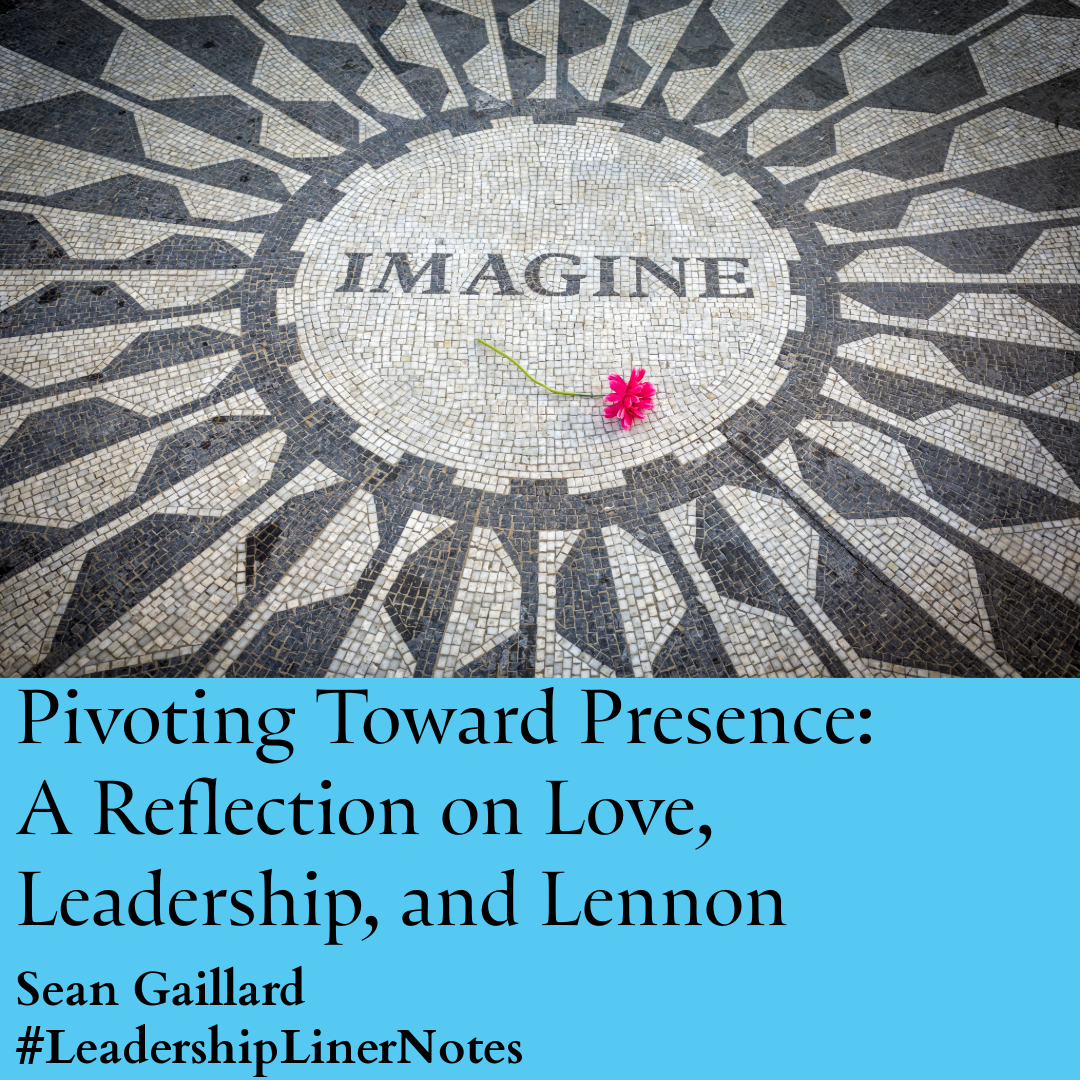
Pivoting Toward Presence: A Reflection on Love, Leadership, and Lennon

Today marks what would have been John Lennon’s 85th birthday. Had he not been so cruelly taken from the world, I imagine him surrounded by love, his wife, his sons, and perhaps a few close friends gathered around a cake. I can almost see John smiling, glasses glinting in the candlelight, grateful for another revolution around the sun. Grateful simply to be a husband and father.

Of course, this is a dream, a what if forever suspended in time. John Lennon is not with us. Yet every time we hear Imagine, or spin a Beatles record that once lifted the world, his spirit continues to sing. His ideas, his courage, and his music are eternal.

As I think about John’s life today, I am reminded of the profound pivot he made in his final years, a pivot that leaders, including myself, can learn from. After a painful separation from Yoko Ono, John chose to retreat from the spotlight. He became a stay at home father. He walked away from fame, record contracts, and the demands of celebrity life to raise his young son, Sean. He called this period his “househusband years.” Five years of seclusion. Five years of being present.

In that quiet season, John found peace. He cooked, baked bread, and rediscovered the small joys of daily life. He walked through Central Park and strolled with Yoko and Sean, savoring the moments that so many of us rush past. He wrote songs again, not for charts or critics, but from the heart. When he finally returned to the studio in 1980, he released Double Fantasy, a musical conversation between himself and Yoko celebrating love, family, and renewal. The album earned a Grammy for Album of the Year, a posthumous echo of his artistry at its most honest.

One song from that record, Beautiful Boy, contains a line that has haunted and guided me for years:
“Life is what happens to you while you’re busy making other plans.”

That lyric hits harder as I get older. I have lived its truth. As a husband, father, and leader, I have had moments when my presence was only partial, physically there but mentally buried in a phone, a to do list, or the next big initiative. When I faced my first serious health setback a year and a half ago, lying in a hospital room with machines beeping around me, I thought of all the moments I had missed. I remember wondering: Would I get to tell my children I loved them again? Would I see my wife’s beautiful smile? Would I have another chance to simply be, not as a principal, not as a leader, but as a husband, father, son, brother, and friend?

Thankfully, I was granted another chance. I am still learning and growing even as those health setbacks keep coming. That experience in the hospital room changed me. It reminded me that leadership is not just about impact, innovation, or outcomes. It is about love. It is about being present for the people who give your life meaning.

As leaders, we can lose ourselves in the rhythm of meetings, emails, and deadlines. The work matters, but so do the quiet moments that recharge our hearts. The people who know us beyond our title need us, not the version that is always on, but the one that listens, laughs, and lingers a little longer at the dinner table.

John Lennon’s decision to step away from the noise and focus on family was not an escape. It was an act of courage. It was his pivot into something beautiful.

So, what does that mean for us?


Leadership Action Steps: Simple Pivots into Something Beautiful

  1. Write for five minutes.
    End your day with a brief journal reflection, one sentence of gratitude or one small victory that made you smile.
  2. Call someone who matters.
    Reach out to a friend or loved one, not with an agenda, but simply to say, I’m thinking of you.
  3. Schedule sacred time.
    Block out 30 minutes this week for uninterrupted family time, a walk, or a shared meal. Treat it like your most important meeting and protect it.
  4. Be fully present.
    Put the phone away. Turn off notifications. Look into the eyes of the people you love and listen with your whole self.
  5. Revisit Your Pivot Song.
    Choose a song that helps you pause and reconnect with what truly matters. For me, it is Beautiful Boy by John Lennon, a reminder that love, presence, and purpose are the greatest compositions of all. John wrote that song for his youngest son and it serves as reminder that I must always pivot into fatherhood and being there for my three daughters.

John Lennon did not know that his five year retreat would be the last chapter of his life. Yet in those years, he created the most meaningful work of all: love, presence, and peace. His story challenges us to do the same. To pause. To connect. To pivot into something beautiful before life happens while we are busy making other plans.

What’s Right: A Pivot Into Bright Stops

A Guest Blog Post for Dave Burgess Consulting, Inc!


Recently, I had the honor of writing a guest post for my publisher, Dave Burgess Consulting, Inc.! Their support goes back to the very beginning, when the team believed in an idea I had for a book. That idea became The Pepper Effect—my mash-up love letter to The Beatles and education. I’ll always be grateful for their belief in this project.

This new guest post grew out of some reflections I’ve been having on The Pepper Effect. It was a refreshing chance to wander down a meaningful rabbit hole as I continue work on my next book, Leadership Riffs, also with Dave Burgess Consulting.

You can read the post here: What’s Right: A Pivot Into Bright Spots. I’d love to hear your thoughts! Leave a comment, share it, or tag me on your favorite social media platform so we can keep the conversation going.

A huge thank-you to Dave Burgess and Tara Martin of #dbcincbooks for their belief, encouragement, and ongoing support!

When Support Becomes a Habit

There is a weight that many are carrying right now. Some of it is visible and most of it is hidden. Leadership at its core can be an isolating gig. Doubts, setbacks, alienation from our purpose all of these are real. They come uninvited and often linger longer than we want.

What I have been learning, sometimes the hard way, is that support cannot be an afterthought. It has to be a habit. It is not just the occasional check-in, but the daily rhythm of leaning in to each other. Asking the extra question. Offering the listening ear. Sending the text that says, I am here.

The truth is that many of us do not want to share what we are going through. We mask our struggles with busyness or a brave face. Beneath the surface, loneliness and doubt gnaw away. That is when support becomes essential. Not as a sign of weakness, but as an act of survival.

I hear my Dad’s voice reminding me to hold my head high. Those words echo differently for me now. Holding your head high does not mean carrying everything alone. It means having the courage to reach out, to accept the hand that is extended, and to remember that someone else’s strength can steady us until we find our own again.

Support is not only about being present. It is about showing visible belief. When The Beatles were at their most fractured during the “Let It Be” sessions, Billy Preston walked into the studio. His presence was not just about playing keys. It was about belief. His energy and positivity shifted the atmosphere. He reminded them of what they could be when they trusted each other. That kind of support does not hide in the background. It is felt, seen, and heard.

History gives us the same lesson. When Nelson Mandela emerged from 27 years in prison, he carried a vision of reconciliation that could have faltered under the weight of bitterness. He surrounded himself with those who not only supported him, but visibly believed in the possibility of a different South Africa. Their belief gave him courage to keep moving forward.

And in my own journey, after a recent health scare, I realized that what helped most was not just colleagues covering tasks. It was their visible belief in me. Their check-ins, their words, their encouragement. It was more than help. It was the steady reminder that I was not alone, that they believed in me enough to carry the load until I could stand tall again.

As leaders, as colleagues, as human beings, we have the power to give that kind of support. To make belief tangible. To remind others of their worth when they cannot see it themselves.

Support has to be a habit. A daily practice of visible belief. Because in the end that is how we move forward. That is how we remember we are not alone. And that is how we hold our heads high together.