When the Impossible Finds Its Voice: How a Beatles Song Taught Me About Hope and Carrying On

There is a phrase I keep coming back to: the impossible becomes possible.

Recently, I had another health scare that resulted in a visit to the hospital. I am alright and recuperating, but in the days that followed, I found myself searching for something to hold onto. A remix of a Beatles reunion song sent me on a journey to re-embrace hope and belief.

When The Beatles broke up in 1970, the world declared it over. Headlines announced the end of the most influential band of all time. In the years that followed, reunion rumors surfaced constantly, often fueled by money, charity, or fan speculation. Yet, The Beatles remained steadfast: no reunion. Even after John Lennon’s senseless murder in 1980, people still asked if the three surviving members might somehow return, with John’s sons stepping in. It seemed impossible.

And yet in 1995, a demo tape of John Lennon’s rough home recording was dusted off. With the steady guidance of Jeff Lynne, Paul, George, and Ringo added their voices and instruments. Out of grief, absence, and fractured history came something astonishing: “Free As A Bird.”

For me, it was a moment of awe. I was a young teacher then, two years into my career. When I read a small article about the surviving Beatles reuniting for Anthology, I ran off copies for every teacher’s mailbox in my school. I wanted everyone to feel the electricity I felt: this is really happening. When the song finally aired on television, I remember tearing up. It was not just about music, it was about reconciliation, healing, and the audacity of creating something new out of what seemed broken forever. I wrote about this event and its personal meaning to me in my book, The Pepper Effect.

In my office today, I still keep a tattered photocopy of Linda McCartney’s photo of Paul, George, and Ringo together from that era. Above it, I have written: “The Impossible Becomes Possible.” Because that is what the reunion meant to me then, and what it still means now.

And now, nearly 30 years later, “Free As A Bird” returns in a brand new mix. Thanks to modern audio restoration, John Lennon’s voice emerges clearer, closer, more present. It feels as if all four Beatles are back in the studio together. Each time I play it, I feel renewal. I feel hope.


Hope as a Leadership Catalyst

Hope is a word often dismissed in leadership circles. Some see it as naïve or impractical, a soft idea in a world that demands hard results. But I believe hope is not a weakness. Hope is a catalyst. It is the ignition that sparks vision into action.

As Casey Gwinn and Chan Hellman remind us in Hope Rising, hope is the belief that “your future can be brighter and better than your past and that you actually have a role to play in making it better.” That belief matters, especially when the weight of challenges threatens to crush our momentum.

The space between vision and action is leadership. Hope and belief have to be in that vision as catalysts.

As leaders, we do not always need a grand plan or sweeping solution in every moment. Sometimes, we just need an entry point. A reminder that even the hardest, most impossible-seeming work can move forward. For me, that entry point is hearing John Lennon’s voice stitched back into the fabric of his bandmates’ music. It is a symbol of reconciliation, resilience, and possibility.


Belief Made Real

The truth is, leadership often feels like trying to reunite what has been broken. It is messy. It is emotional. It is full of skeptics. But the work is also full of potential. When we model belief for our students, for our teachers, for ourselves, we give others permission to believe too.

“Free As A Bird” reminds me daily that impossible things can be made possible. For The Beatles, it was a reunion across decades and even death. For us, it might be turning around a struggling school, reigniting a team’s confidence, or building something new when resources seem scarce.

Whatever the context, hope can be the spark. And belief, when it is shared, nurtured, and lived, can make it real.

So when the days are heavy and the obstacles feel immovable, I return to that song. I hear the reunion of four bandmates who found a way. And I am reminded: if The Beatles could find harmony after all they endured, then maybe we can find our way, too.

As leaders, we have to believe that the impossible becomes possible. That is the gig. We must be relentless in that belief, even when the naysayers gather and the narratives say it cannot be done. Hope gives us the entry point. Belief carries us the rest of the way.

Our calling as leaders is to believe when others doubt, and to carry hope when the weight feels too heavy. When the impossible finds its voice, leaders must believe enough for others to join in the song.


Check out “Free As A Bird” (2025 Mix) by The Beatles:

The Loneliness of Leadership: A Heartfelt Reflection for School Leaders


Typically, I don’t write blog posts back-to-back. I’ve kept to a steady rhythm of weekly writing since my heart episode last year. That ritual has become part of my healing—recommended by my therapist, yes, but also something I’ve come to cherish. Writing has broken through the fog of writer’s block that followed the release of The Pepper Effect. Through journaling and reflection, I’ve found my way back to words and meaning. I am even working on finishing up a proposal for a new book.

But this piece couldn’t wait.

I’ve been sitting with a question no one prepared me for in “Principal School”:
Why does leadership have to feel so lonely?

It’s a question that’s erupted into big feelings—enough to make me pause on other writing projects and sit with this one instead.

There’s a scene in Peter Jackson’s Get Back documentary that lingers with me. George has left the band. A meeting doesn’t go well. Paul and Ringo return to the studio, uncertain of what’s next. John is nowhere to be found. Paul, visibly shaken, says quietly, “And then there were two.” He stares off into the distance. His eyes well with tears. His voice trembles. You can feel the grief. The possibility that something beautiful and world-changing might be coming to an end.

Watching that moment recently, I didn’t just see it through the eyes of a Beatles fan—I saw it through the lens of a leader holding onto connection, trying not to lose grip.

I’ve been a principal for almost sixteen years. I’ve served in multiple schools, answered the call for turnaround, and poured myself into the gig. I’m grateful for a beautiful family—my wife and three amazing daughters. Their love is a constant light. And I do have a handful of trusted friends, most not nearby. But I’ve felt friendship fade over the years—some lost to distance, some to time, some to disillusionment.

This is the part they don’t tell you about leadership. That people may see your title before they see you. That the weight of tough decisions can sometimes isolate you. That you’ll have days where it feels like everyone is counting on you—and no one is standing with you.

I once thought the PLN (Professional Learning Network) would solve this. Twitter, Voxer groups, hashtags that I created like #CelebrateMonday and #TrendThePositive—those were my entry points to community. And for a while, they worked. I met incredible educators, interviewed inspirational guests for the Principal Liner Notes podcast, and even achieved my dream of becoming a published author.

But not all connections held. Some collaborations quietly ended. Some people I looked up to didn’t turn out to be who I thought they were. And yes, I’ve even had a book idea stolen.

Still, I’m thankful for the moments of light in those spaces—moments when a shoutout brightened someone’s Monday or a podcast guest became a kindred spirit. Yet, after the episode ended or the tweet was sent, the silence would sometimes creep in.

Loneliness doesn’t negate purpose. It doesn’t mean the work isn’t good. But it does mean we need to be mindful of our well-being and human need for belonging.

Recently, I’ve had the privilege of co-facilitating the ISTE-ASCD webinar series with Andrea Trudeau. We’ve explored what it means to create spaces of connection and belonging—especially for those in unique roles like principals and school librarians. These conversations have reminded me that belonging doesn’t just happen. It’s a practice. A choice. A rhythm to keep playing, even when the band seems scattered.

In her book The Let Them Theory, Mel Robbins has a powerful chapter on the quiet heartbreak of adult friendships. She describes how friendships shift from group experiences to individual efforts—and how easy it is to look around one day and realize your circle has vanished. Her advice? Reach out first. Be kind without expectation. Smile. Be curious. Give it time.

It’s advice I’ve tried to follow, even when it’s hard. Even when it’s lonely.

So what do we do with this?

We remember that our core matters. Our heart matters. And so does connection.

Here are a few ways I’m working to move through leadership loneliness—and maybe they’ll help you, too:

  • Savor family and those who know you beyond your title. The gig will wait—those moments with loved ones won’t. I am grateful daily for my wife and our daughters and my family.
  • Reach out. A coffee, a text, a hallway chat. Don’t wait for someone else to go first.
  • Find “only ones” like you. Look for the school librarian, the instructional coach, the counselor—others who might be the only one in their role. Forge that bond.
  • Be vulnerable. Share your story. Someone else might need to hear it. I have been writing deeply about the experiences surrounding my heart episode. I am grateful that others have found it helpful for their journey.
  • Build something outside the gig. A book club. A podcast. A project that brings joy without the pressure.

You are not alone—even when it feels that way. Someone out there gets it. Someone is looking for connection, too.

Keep showing up. Keep being kind. Keep playing your part in this great, imperfect, meaningful symphony of leadership.


Postscript:
During those Get Back sessions, Paul’s loneliness was palpable. But the story didn’t end there. The band found their way back. The Beatles regrouped. And they gave us the Rooftop Concert—a final live performance filled with joy, grit, and unity.

It was their last time playing live together. And it was iconic.

A reminder that even in moments of disconnection, something timeless can still emerge.

Echoes of Legacy: Reflecting on Impact, Vision, and What We Leave Behind

The other day, I was meeting someone for the first time, and—no surprise—The Beatles came up in conversation. I found myself doing what I often do: searching for shared connection, for kindred sparks, for the chords that bring people together.

As I sipped from my well-worn Let It Be coffee mug, I found myself reflecting—not just on my love for the band, but on why I love them so deeply. My thoughts landed in the final scene of The Beatles Anthology documentary, where each Beatle offers a summation of the band’s journey. Paul McCartney’s words have always stuck with me:

“I’m really glad that most of our songs were about love, peace, and understanding.”

That’s the legacy of The Beatles. A body of work grounded in themes that transcend time and trend. Love. Peace. Understanding. Their music is an echo that still resonates across generations, creating belonging, joy, and reflection in all who listen.

That’s the power of legacy.

As I wrap up my 33rd year in education, I find myself tuning in to that word—legacy—and asking what it means in the context of a school year. I think of my good friend, Meghan Lawson, and her powerful book, Legacy of Learning. She writes:

“What you do in your classroom and school matters. In a big way. We are always making an impact on students and colleagues, whether good or bad.”

Legacy is not about ego, applause, or glory. It’s not about showmanship or staged stunts dressed up as leadership. Legacy is about the quiet echoes we leave behind in the lives we’ve touched—the ones who are better because we showed up and stayed the course.

In my office hangs a photo of Walt Disney standing in the middle of a swamp in central Florida, surrounded by blueprints for what would one day become Walt Disney World. He never lived to see it finished. But his vision endured, carried forward by a team who believed in the mission.

I often show that photo to my leadership teams—not because I want us to build castles, but because I want us to believe in what’s possible. It’s a reminder that legacy is built not in isolation, but in collaboration. It takes vision, belief, and a team that leans into each other’s strengths.

This year, I invited our Instructional Leadership Team and School Improvement Team to create an Accomplishment Inventory—a running list of all we had done that positively impacted students. It was a celebration of small wins and shared progress. It was a testament to the legacy we’re building together, moment by moment, step by step.

As this school year nears its close, I offer these reflections and action steps for you to consider:

🎧 Reflect with Intention
Take 10 minutes. Journal. Ask yourself: What is the legacy I’ve left this year? Where did I show up? Who did I lift?

📷 Find Your “Swamp” Photo
Print or display a photo that symbolizes your long-term vision—the unfinished dream. Revisit it when you need clarity or courage.

📋 Create Your Accomplishment Inventory
Alone or with your team, write out the moments that made a difference. Celebrate them. Share them. Build on them.

Legacy isn’t what we say about ourselves. It’s what others say when we’re not in the room. It’s the tone we set, the hope we pass on, the lives we quietly change.

So tune in. Reflect. And keep building. Your echo matters.

Leadership Riffs: Jamming for Impact

In music, a riff is a heartfelt, memorable melody—like the opening chords Keith Richards plays on The Rolling Stones’ “Satisfaction.” But riffs aren’t limited to music alone; they’re found in those spontaneous, soulful exchanges we have as leaders after faculty meetings, in hallway conversations, or during inspiring conferences.

At the recent North Carolina Association for Middle Level Education (NCMLE) conference in Charlotte, NC, I experienced some deeply moving “Leadership Riffs.” Visionary leaders like Dr. Darrin Peppard opened my mind to fresh possibilities about cultivating vibrant leadership teams. Dr. Marie Moreno shared her heartfelt passion for an upcoming book, igniting an inspired dialogue that still resonates. These beautiful exchanges reminded me that leadership, like music, thrives on improvisation, authenticity, and the power of human connection.

Leadership Riffs aren’t about playing the same old notes—they’re about courageously pushing boundaries, creating harmonies, and passionately innovating together.

Here are a few heartfelt “Leadership Riffs” that underscore why our impact truly matters:

1. “A Throwaway Line in a Beatles Epic”

Paul McCartney nearly tossed out the lyric, “The movement you need is on your shoulder,” from the timeless Beatles’ classic “Hey Jude.” He saw it merely as a temporary placeholder, lacking clarity. But when John Lennon passionately insisted the line remain, Paul recognized something deeper—a powerful moment of trust and affirmation between friends. Now, every time Paul sings that lyric, he holds tightly to the memory of John’s insight, a bond made even more poignant by John’s absence. Lesson: The seemingly small details, moments, and gestures in our leadership carry profound significance and lasting impact.

2. “A Word of Thanks”

After a challenging and exhausting day filled with meetings, decisions, and the weight of responsibility, a teacher quietly appeared at my office door. Bracing myself for another issue to solve, I was instead met with a gentle smile and sincere words: “I just wanted to say thank you. You probably don’t hear it enough.” Her unexpected gratitude moved me deeply, serving as a gentle, transformative reminder of how kindness and acknowledgment can lift our spirits and renew our sense of purpose. Lesson: Every word of appreciation we speak has the potential to uplift and sustain those around us.

3. “The Words of a Child”

During a parent conference discussing support strategies, their first-grade child quietly explored the books on my office shelf, eventually selecting Green Eggs and Ham. As he confidently read aloud, his enthusiasm and ability amazed me. Inspired by his joy, I offered him a book from my collection, and with a smile, he whispered, “You’re my hero.” In truth, his words profoundly touched my heart and reminded me of the true heroes in our schools—our students, whose growth and potential inspire us daily. Lesson: Every interaction with a child echoes profoundly, reminding us why our roles in education matter.

4. “A Heart in the Wild”

My dear friend, Maria Galanis, recently shared a poignant image on X—a heart carefully crafted from seashells by an unknown stranger on a serene beach. Maria’s simple act of sharing this discovery instantly sparked joy and reflection in those who saw it. This beautiful moment powerfully illustrates how our intentional actions, even small gestures left anonymously, leave trails of positivity, hope, and inspiration that uplift others far beyond our immediate circle. Lesson: As leaders, we are called to intentionally leave pieces of our hearts behind, illuminating paths of connection and possibility.

How to Host Your Own Leadership Riffs Jam Session

Looking to cultivate deeper connections, creativity, and heartfelt impact in your school community? Consider hosting a “Leadership Riffs Jam Session”:

  1. Create a Welcoming Space: Offer an inviting, relaxed, 15-minute gathering after school—no pressure, just meaningful conversations.
  2. Invite Everyone to the Table: Emphasize inclusivity, encouraging participation from every role and level.
  3. Lead with Openness: Share your own authentic stories or pose a meaningful question to inspire genuine dialogue.
  4. Encourage Improvisation: Let ideas flow freely, embracing spontaneity to spark innovative and meaningful exchanges.
  5. Reflect and Empower: Conclude with clear insights and actionable steps, empowering everyone to bring their inspired “riffs” to life.

Heartfelt gratitude to Darrin Peppard, Marie Moreno, and Maria Galanis for their invaluable friendship, inspiration, and thought partnership.

Let’s keep riffing from the heart—because the songs we create together truly matter.

Keep Playing, Even If No One Is Listening

There’s something powerful about picking up the guitar, writing the words, and hitting record—even when it feels like no one is tuning in. The greatest artists, thinkers, and change-makers didn’t wait for an audience before they started creating. They played. They wrote. They spoke. They persevered against the silence.

Paul McCartney recorded McCartney alone, layering every instrument himself. Bruce Springsteen stripped it all down and put out Nebraska, unsure if anyone would connect with its raw vulnerability. Nick Drake’s Pink Moon was met with quiet indifference at first, only to become a masterpiece embraced long after he was gone. These albums weren’t made for applause; they were made because the artist had to create.

The same applies to you. Your words, your leadership, your creativity—it all matters, even if it feels like no one is paying attention. Keep writing the blog. Keep crafting the lesson. Keep showing up for your students and colleagues. Someone, somewhere, will be moved by your work when they need it most.

The silence isn’t a signal to stop. It’s an invitation to keep going. #LeadershipRiffs

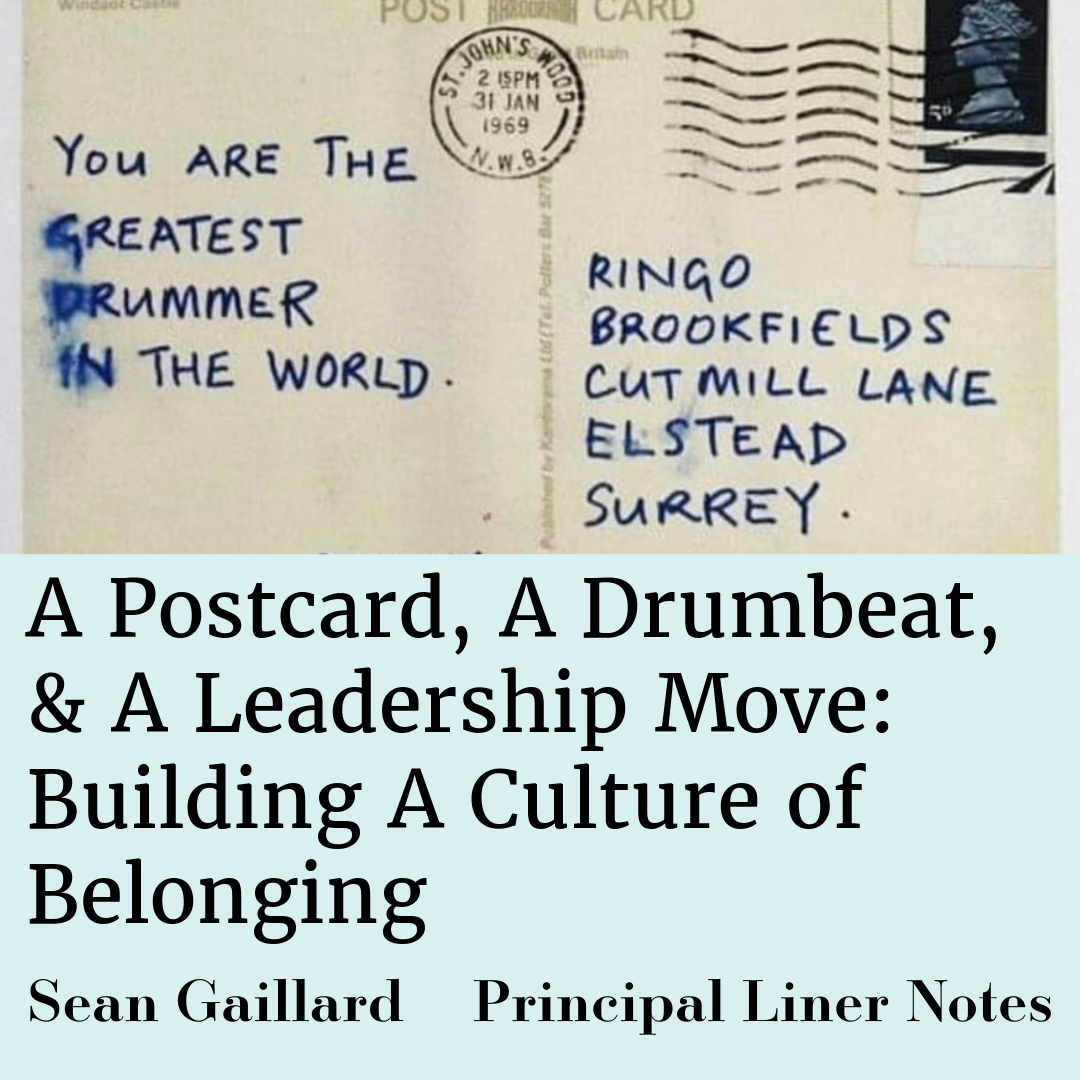
A Postcard, A Drumbeat, and A Leadership Move: Building a Culture of Belonging

Earlier this week, Beatles fans around the world commemorated the 56th anniversary of their final live performance—the legendary rooftop concert atop Apple Records. Captured in Get Back and memorialized in Let It Be, this moment was their live swan song, a testament to creative courage and collaboration.

Last week, I wrote about Rooftop Moments—the bold, defining moments that school leaders should cultivate with their teams. But there’s another, lesser-known moment in Beatles history that happened the day after that performance. A simple yet profound leadership move.

On January 31, 1969, Paul McCartney sent Ringo Starr a postcard that read:

“You are the greatest drummer in the world. Really.”

This wasn’t a public accolade or a grand gesture. It was a handwritten note—one musician reaching out to another, reinforcing connection and belonging. A small moment, but a significant one.

As school leaders, we talk about culture-building, trust, and recognition. Shoutouts in memos or emails are a start, but I’ve come to realize they often feel transactional, fleeting. Teachers deserve more than a quick mention in a newsletter that might be skimmed and forgotten. True belonging is built in the quiet, intentional moments—through handwritten notes and meaningful feedback.

The Power of a Handwritten Note

At Charles England Elementary, we start each faculty meeting with Praise and Thanks—a time to share shoutouts and gratitude. It sets a positive tone and creates psychological safety. But not everyone feels comfortable speaking in a large group, and exhaustion can sometimes make participation hard.

At a recent meeting, I placed blank Energy Bus-themed notes (inspired by Jon Gordon’s book) on tables and asked staff to write a message of gratitude to a colleague. No prompts, no pressure—just a moment to reflect and uplift. As I looked around, I saw teachers smiling, some wiping away tears, completely immersed in the moment. The next day, those notes found their way into mailboxes, and the ripple effect of encouragement began.

A handwritten note isn’t just ink on paper—it’s a tangible reminder that someone sees you. That your work matters. That you belong.

The Leadership Move: 30-Second Feedback

Another way we are reinforcing belonging is through 30-second feedback, a practice inspired by Mike Rutherford’s Seven Tools for Developing Teachers and Teaching (link). This simple but powerful strategy involves stopping into a classroom, identifying one specific positive thing, and sharing that feedback—either verbally or in a quick note.

Here’s what makes it work:

  • It’s not evaluative—just pure affirmation of great teaching.
  • It’s quick but intentional—a handwritten note, a short hallway chat, or a sticky note left on a desk.
  • It highlights strengths—no jargon, no checklist, just celebrating a moment of impact.
  • It builds connection—leaders engaging with teachers in a meaningful way, beyond scheduled observations.

I keep a pocketful of blank Post-its and make it a goal to visit at least three classrooms a day, leaving behind 30-second feedback. It’s transformed how teachers feel about their work. They light up, just like I imagine Ringo did when he read Paul’s postcard.

Four Ways to Build Belonging with Handwritten Notes & 30-Second Feedback

  1. Commit to Daily Touchpoints
    • Visit three teachers a day and leave either a quick verbal or written affirmation.
    • Track your visits to ensure everyone receives meaningful recognition.
  2. Use Specific Praise
    • Instead of “Great lesson!” try: “The way you engaged students in discussion today was fantastic. I could see their excitement!”
    • Authentic, detailed praise carries weight.
  3. Make Handwritten Notes a Habit
    • Keep blank notecards or sticky notes handy.
    • Surprise staff with a handwritten note in their mailbox or taped to their door.
  4. Encourage Peer-to-Peer Recognition
    • Incorporate note-writing into staff meetings or PLCs.
    • Provide postcards or themed templates to make it easy and fun.

A Legacy of Belonging

Think about the impact: just 90 seconds a day dedicated to 30-second feedback builds a culture where teachers feel seen, valued, and empowered. Multiply that over a school year, and you’ve created an environment where trust and belonging flourish.

As Meghan Lawson (link) reminds us in Legacy of Learning, these small wins shape the culture of a school. They’re the moments that keep teachers inspired and engaged.

56 years later, I’m still moved by a simple postcard between bandmates. It reminds me that leadership isn’t always about the big moves—it’s about the small, consistent moments of connection that build something lasting. Just like The Beatles, our legacy as educators is one of collaboration, impact, and belonging.

What’s your next leadership move? Maybe it’s as simple as writing a note.

Resetting Rejection: Leading with Resilience and Authenticity

Rejection is a reality. It happens, and it stings. Sometimes, the worst rejection isn’t from others who naysay, doubt, or echo endlessly the phrases, “We’ve never done it this way…” or “We always have…” Often, it’s the rejection we inflict upon ourselves that hurts the most.

The Beatles faced rejection head-on. In my 2018 book, The Pepper Effect, I recount their infamous rejection by Decca Records in 1962. The label dismissed them with the now-legendary phrase: “Guitar groups are on their way out.” Yet, the Beatles didn’t let that stop them. Instead, they adopted a “reset mindset” amidst the setback. They persevered, refined their craft, and sought opportunities elsewhere. Their resilience led to a groundbreaking partnership with producer George Martin and, eventually, music that would change the world.

Recently, I revisited the concept of resilience while reading Penny Zenker’s The Reset Mindset. Zenker outlines a three-step process for overcoming both personal and professional setbacks: Step Back, Get Perspective, and Realign. Her approach emphasizes mindful choices and intentional progress. The Beatles, whether consciously or not, exemplified this mindset. They regrouped, made strategic changes (including bringing Ringo Starr into the band), and doubled down on their songwriting. Their determination and shared vision propelled them to unimaginable heights.

I’ve endured my own share of rejection—writer’s block, rejected book proposals, pilfered ideas from unreliable collaborators, and negative problem admirers eclipsing possibilities. At times, I’ve been my harshest critic, rejecting myself before anyone else had the chance. Pressing “Publish” on a blog post can feel like stepping off a ledge, wondering if anyone will read it or if it will resonate. Recording a podcast episode Yet, a trusted thought partner recently reminded me to let my words go—to trust they’ll land where they’re meant to do so.

This advice brought to mind the Beatles’ 1968 self-titled album, commonly known as the “White Album.” This sprawling, 30-song masterpiece faced criticism for being too long or unfocused. Paul McCartney’s response? “It’s great, it sold, it’s the bloody Beatles’ White Album, shut up!” That unapologetic confidence is a lesson in staying true to one’s vision and maintaining a reset mindset.

I channeled that spirit recently when deciding whether to bring my guitar to a school assembly. As a new principal at my school, I felt hesitation. I have been a principal for 16 years and I have lugged my guitar to school for various events so this was not first gig with a guitar in the schoolhouse. Yet, I endured a series of stumbling doubts with bringing my guitar along to school. Would this feel out of place? Would it connect? But in the end, I applied the Reset Mindset. I took an intentional step back to reflect and wonder. I focused on my purpose: creating a joyful, meaningful moment for our students. I decided to move forward, tune into building a culture of belonging for students and faculty, and bring my beloved guitar to the scheduled grade level assemblies. Music is an entry point for others and serves a divine thread that connects us to our shared humanity.

The butterflies didn’t stop as I hurriedly carried my guitar into school, but when I sat down in front of our first graders and began to play, I knew I’d made the right choice. The laughter, joy, and connection we shared affirmed the decision. It was a reminder of the power of leading with authenticity and purpose. I love playing music and I wanted to be unabashedly comfortable with my best self.

Recently, on my podcast Why The Beatles Matter, I had a conversation with Dr. Donya Ball that gave me even more perspective on rejection. It was serendipitous that she brought up the idea of leaders leaning into and accepting rejection.  As I was just working on this blog post before our conversation, I readily welcomed her insight on rejection. She shared how we, as leaders, don’t talk about rejection enough and how it’s a necessary part of growth. I deeply appreciated her real talk on this reality. Rejection, she said, is an opportunity to renew, recalibrate, and re-focus. It’s another way to adapt the Reset Mindset—seeing rejection not as the end or the finality of an idea, but as a stepping stone to connect with others, build collaborative coalitions, or simply reset.

As leaders, our gig is to create meaningful moments that inspire, connect, and uplift. When we embrace resilience and focus on our purpose, we transcend rejection and lead from a place of authenticity.

Four Leadership Moves Inspired by The Beatles and the Reset Mindset:

  1. Evolve and Adapt: The Beatles didn’t let their rejection by Decca define them. They stepped back, reflected on what they needed, and made a bold move by bringing in Ringo Starr. This pivotal decision transformed their sound and solidified their lineup, exemplifying the importance of adapting to move forward.
  2. Collaborate with Vision: Recognizing the need for a fresh perspective, the Beatles partnered with George Martin, who brought a new dimension to their music. This collaboration highlighted the power of seeking thought partners who align with your vision and elevate your work.
  3. Refine Your Craft: After their setback at the failed Decca Records Audition, the Beatles didn’t stagnate. They doubled down on songwriting, tirelessly honing their skills and experimenting with new ideas. This relentless pursuit of excellence demonstrates how leaders can use rejection as fuel to refine their craft.
  4. Stay True to Your Purpose: Despite criticism and pushback, The Beatles never abandoned their creative vision. Whether it was the ambitious scope of the “White Album” or their genre-defying innovations, they stayed true to their purpose, leading with authenticity and confidence.

The importance of tuning into the Reset Mindset cannot be overstated. As leaders, modeling this mindset for others empowers our teams and fosters resilience. Let’s embrace the journey together and inspire others to do the same.


Resources to Dig Deeper for Reflection and Action

Tune in to the upcoming episode of my podcast, Why The Beatles Matter, where I continue this conversation with Dr. Donya Ball. Her insights on leadership, rejection, and authenticity are not to be missed. Plus, she’s a joy to engage in for conversation! You can also learn more about her work and check out her TEDx Talk at https://www.donyaball.com/.

Explore more connections to The Beatles and leadership in my book, The Pepper Effect: Tap into the Magic of Creativity, Collaboration, and Innovation.

Check out Penny Zenker’s The Reset Mindset: How To Get Unstuck, Focus on What Matters Most, and Reach Your Goals Faster.

Paul McCartney on “The White Album” as mentioned above: It’s a great quote and shows The Reset Mindset in action.

Magical Mystery Tweet: A Journey of Gratitude and Creativity

Boxing Day holds a special place in my heart. While it’s not widely celebrated in the United States, it marks a moment of reflection, creativity, and gratitude in my life. It’s a day that intertwines two of my great passions: my love of The Beatles and the power of small, intentional moves that ripple into something greater.

On December 26, 1967, The Beatles unveiled their BBC-TV film Magical Mystery Tour. At the time, critics dismissed the project as an odd misstep in the band’s otherwise stellar career. Yet, over the decades, it has transformed into a beloved piece of their psychedelic era—a testament to their willingness to embrace creativity and collaboration, undeterred by the opinions of naysayers.

This day also marks what I call my “Magical Mystery Tweet,” a small action that changed the course of my life. About eight years ago, while observing my personal Boxing Day tradition of watching Magical Mystery Tour, I posted a simple tweet:

“Happy Boxing Day. Happy Magical Mystery Tour Day.”

I included a picture of my well-loved DVD copy of the film, celebrating my fandom and connection to the enduring magic of The Beatles. It was a small, seemingly inconsequential act of sharing.

But something extraordinary happened. Nicole Michael of 910 Public Relations noticed that tweet and responded to it. That response ignited a journey that ultimately led to the publication of my first book, #ThePepperEffect, through the incredible vision of Dave Burgess. What began as a casual celebration of The Beatles evolved into an opportunity to share my ideas with educators worldwide.

Since its release in 2018, #ThePepperEffect has inspired educators to “think outside the box” and create collaborative, Beatles-inspired magic in their schools. I’ve had the honor of sharing its message as a keynote speaker at conferences and have even seen it adapted into a stage production by a school drama club in Canada. One small tweet sparked a movement that continues to connect, inspire, and transform.

This experience taught me a valuable lesson: you never know what impact your creative expression will have when you share it with the world. The Beatles, despite criticism, embraced their creative impulses, and their willingness to take risks gave us masterpieces that resonate across generations. We can do the same when we dare to share our gifts, no matter how small they may seem.

Four Actions to Embrace Creativity and Share Your Voice

  1. Celebrate Your Passions
    Honor the things that bring you joy and inspire you. Whether it’s music, art, or storytelling, your enthusiasm can spark connections and creativity in others.
  2. Take Small Steps
    Share a tweet, write a blog post, or create something that reflects your authentic self. It doesn’t have to be perfect—it just has to be real.
  3. Seek Collaboration
    The Beatles created their masterpieces through collaboration. Surround yourself with others who uplift and challenge you. Great things happen when we build together.
  4. Ignore the Critics
    Like Magical Mystery Tour, your work might not resonate with everyone at first. That’s okay. Stay true to your vision and trust in the process.

As educators and leaders, we have the power to inspire those around us through our creativity and vulnerability. We all have a masterpiece within us waiting to be shared. My journey, sparked by a single tweet, is proof that even the smallest action can create waves of change.

This Boxing Day, as I watch Magical Mystery Tour again, I’ll reflect on the gratitude I have for that tweet, for the connections it brought, and for the inspiration it continues to provide.

Dare to share your voice. You never know whose life you might change—including your own.

Why The Beatles Matter

Earlier this week, the world marked a somber anniversary—44 years since the tragic loss of John Lennon. For me, this day always stirs vivid memories. It was around this time that I first discovered The Beatles, embarking on a journey into a world of creativity, harmony, and collaboration that continues to shape my life and career. The Beatles have left an indelible mark on me, not only as a fan of their groundbreaking music but as someone who sees their legacy as a model for leadership, culture, and collaboration.

The Beatles’ story offers profound lessons for educators and leaders. Their journey is a testament to excellence, creativity, and innovation—qualities we all strive to cultivate in our schools and organizations. By nature, I am a storyteller, and I’ve always believed in the power of stories to build connections, foster belonging, and create psychological safety. In my years as a teacher and principal, I often found myself drawing comparisons to The Beatles, using their journey as a metaphor for teamwork and innovation. While I don’t expect everyone to love The Beatles as much as I do, I believe in sharing our passions as leaders. It’s a vehicle for hope, and education is a field that thrives on hope in abundance.

The Beatles didn’t invent creativity or collaboration, but they redefined it. They reinvented music, setting a standard for excellence that still resonates today. Imagine if we embraced their mindset in education—pushing boundaries, seeking new ideas, and innovating for the betterment of our students and communities. Steve Jobs, the visionary behind Apple, once credited The Beatles as his model for innovation and teamwork. He admired how the band’s chemistry and ability to balance each other’s strengths led to extraordinary accomplishments. Whether or not you’re a Beatles fan, every leader can appreciate the value of fostering a culture of excellence and innovation.

Next semester, I have the privilege of teaching a course on The Beatles at High Point University. It’s an opportunity to delve deeper into the band’s cultural impact and explore how their music and legacy continue to influence the world. Preparing for this course has inspired me to think about how The Beatles’ story resonates with others. Their music, recorded over a mere seven years, remains a staple on playlists and soundtracks across generations. The enduring relevance of their work speaks to their unparalleled ability to connect with people on a human level.

This reflection has also inspired the launch of my new podcast, Why The Beatles Matter, debuting December 12. Through this podcast, I aim to explore the band’s profound impact and why their music and legacy still matter today. I’m eager to hear and share stories from others who have been touched by The Beatles—whether as fans, creatives, or leaders. This podcast is a space to celebrate their influence and to discuss how their spirit of innovation and collaboration can inspire us in our own lives and work. I invite you to join the conversation by using the hashtag #WhyTheBeatlesMatter and share on the social media channel of your choice. Let’s connect, share, and celebrate the stories that bind us together.

As some of you may know, I am the author of The Pepper Effect, a book that explores how The Beatles’ timeless lessons can inspire creativity and collaboration in schools. If you’re interested, you can order a copy on Amazon. I hope the book serves as another bridge for connection and inspiration.

The Beatles matter because they remind us that we matter. They show us that we all have gifts to share, ideas to spark, and the potential to create something extraordinary. As we reflect on their legacy, let’s take a page from their story and embrace our own potential to innovate, collaborate, and make a lasting impact. I hope you’ll tune in to the podcast, join the conversation, and, together, let’s discover why The Beatles truly matter.

Beat Support Revisited: Leadership in Rhythm

Leadership can feel like navigating the swirling chaos of a live performance—where the screams of the crowd threaten to drown out your rhythm. As school leaders, it’s easy to get lost in the noise, but it’s in these moments that we must tune into those around us. The people we lead and serve are our rhythm section, and finding the right “beat support” can make all the difference.

I’ve been reflecting on this idea recently, inspired by a moment I once shared on my podcast, #PrincipalLinerNotes. Years ago, during one of my “Impromptu Carpool Episodes,” I recorded an off-the-cuff reflection about a clip of The Beatles performing “I Feel Fine” live. Amidst the chaos of Beatlemania—where stage monitors were nonexistent and screaming fans drowned out everything—Paul McCartney stepped in with a move of pure leadership. During Ringo Starr’s incredible drum break, Paul gave a quick cue, counting Ringo back in and ensuring he nailed his return to the beat.

That moment wasn’t just about music; it was a masterclass in leadership. It demonstrated the importance of being attuned to your team, providing support when they need it, and ensuring that everyone finds their rhythm.

The Rhythm of Belonging

I explored this connection between The Beatles, leadership, and education in my book, The Pepper Effect. In it, I share lessons from the Fab Four that remind us of the power of collaboration, creativity, and connection. (You can check out the book here! The Pepper Effect on Amazon).

One of the most important lessons from both The Beatles and leadership is the role of belonging. As leaders, we need to provide the cues and support that allow our team to thrive. Whether it’s a trusted teacher who serves as your barometer or the intentional moments where you help others find their groove, belonging starts with building connections.

Four Ways Leaders Can Build Beat Support

Here are four actionable ways leaders can create their own “beat support” and foster belonging:

1. Find Your Barometer

Identify someone you trust—someone who will be honest with you—and use them as a gauge to understand how your decisions and words land with your team.

2. Be a Barometer for Others

Provide clear and supportive cues for your team. Let them know where they stand and help them feel confident in their role.

3. Celebrate Strengths

Like Paul recognizing Ringo’s brilliance, tune into the unique gifts of your team members and amplify their contributions.

4. Create Collaborative Spaces

Build opportunities for your team to share ideas, support each other, and work toward common goals. Belonging grows in the spaces where collaboration thrives.

What’s Next: Why The Beatles Matter

This reflection on leadership, belonging, and The Beatles has inspired me to launch a new podcast called “Why The Beatles Matter,”starting December 12. This podcast will explore the lasting impact of The Beatles and their legacy through conversations with people whose lives have been shaped by their music and message.

I’m looking for future guests to share their stories of how The Beatles inspired them. If you’d like to join me on this journey, email me at sgaillard84@gmail.com. Spaces are filling up fast.