We all want to be a part of something that is meaningful and that gives a sense of belonging. That truth has never felt more real to me than it does right now. It is not just a passing thought. It is something I carry with me in the quiet moments and in the spaces where I am trying to make sense of where I am and where I am going.
Sometimes the hardest truth to carry is that your own backyard may not hear your song the way it was meant to be heard. For me, that is not just a metaphor. I can point to moments that still sit with me. I remember sharing the idea for #CelebrateMonday in a meeting and being laughed at. That idea later grew beyond those walls as schools across the country and beyond began using it to build culture and recognize the good in their communities. I have shared #InstantPD, presented on it, and believed in its potential to create quick, meaningful learning for teachers, yet it never fully took root in the schools and district where I served. I have stood as a finalist for North Carolina Principal of the Year and still felt like I was on the outside of that circle, never quite included in the way I had hoped. I think about principal meetings where I would sit alone, not quite feeling like I fit in, with no one saving me a seat. I think about presenting at local and state conferences and seeing small turnouts for sessions I poured myself into. I think about traveling to state and national conferences on my own without a team beside me, navigating those spaces as an individual rather than as part of a group. These are not grievances. These are truths. They have shaped how I understand what it means to feel like an outsider in my own professional community.
That realization has forced me to look inward in ways that are both honest and uncomfortable. I have had to sit with the reality that the spaces I thought would affirm me have often been quiet. That silence can feel heavy. It can make you question your voice and your place.
I have felt adrift in that silence.
At the same time, I know that this season has been both joyful and agonizing. There have been moments of clarity where I feel aligned with the work I am doing. There have also been moments where I question everything and wonder if any of it is landing with anyone beyond me. That tension is real. It is part of what it means to be human in this work.
What I am learning is that peace cannot be dependent on whether others hear the music.
It has to come from within.
I have to be willing to be transparent with myself. I have to face the truths of my past, the realities of my present, and the uncertainty of my future without turning away. That kind of honesty is not easy. It requires me to separate the events of failure from my identity. It requires me to acknowledge the hurt without allowing it to define me. It requires me to keep going even when the path forward is not clear.
The absence of recognition does not mean the music is wrong.
It means I am still in the process of finding my people.
There are people out there who will recognize this sound. They will lean in. They will connect with what I am creating in a way that feels real and mutual. They will not just hear the dream. They will help me play it louder. That belief matters, even on the days when it feels fragile.
At the same time, I am coming to terms with another truth.
No band is going to come calling for me.
That realization is not defeat. It is clarity.
It is my cue to build something of my own.
Instead of waiting to be called in or tapped on the shoulder, I am choosing to create my own spaces and invite others in. I am doing that through the work I am building with my podcast projects and through the Disruption Table webinar, where leaders from different spaces can come together in honest conversation. I am doing that in collaboration with Dr. Donya Ball as we create a space for “Real Riffs,” a podcast that is grounded in truth, reflection, and the voices of those who want to be part of something real. That work is coming to life in April, and it represents more than a project. It represents a shift in how I see my role in this work.
If I want a space where belonging is real, where voices are valued, and where the work carries meaning, then I have to create it. I have to be willing to take the same risks I have been waiting for others to take with me. I have to trust that what I am building has value, even before anyone else affirms it.
This is what leading while human looks like for me right now.
It is holding joy and struggle in the same space.
It is continuing to create even when the response is quiet.
It is choosing peace within myself while still seeking connection with others.
It is believing that there is a place for this work and being willing to build that place if it does not yet exist.
I am still learning.
I am still searching.
I am still here.
There is a sound within me that is not finished.
I am going to keep playing until it finds its way.
During this week of Thanksgiving, I am reflecting actively on the things I am grateful for this year. I am zoning in on those people who have filled my bucket with inspiration in meaningful ways. The last two years have been filled with intentional paths. I am intentionally focusing on inspiration for my self care. This approach benefits my well being. My PLN has been an oasis for inspiration and connection and belonging. I have been fortunate to develop authentic friendships beyond hashtags and GIFs with a select few.
There are two individuals who I want to honor in this space. I have been blessed with their friendship. Both have been mentioned here before and both have been guests on my podcast. This time, I want to share how both serve as beacons for human centeredness.
Meghan Lawson and Maria Galanis are humble voices in my PLN. They create space for belonging in the way they craft their content. Meghan writes a weekly blog that stirs the soul. Her Instagram is a pocket of joy. She shares inspiring words and pictures of her cats. She also shares the delight of friendships and learning communities. Maria posts beautiful reminders about cherishing family. She shares her love of Coldplay. She also celebrates those magical moments when she finds images of hearts in the wild.
Most importantly, both remind us what it means to be human centered. Their content is never about promoting themselves. They uplift our humanity in the joy they capture and share. Maria literally shares the images of hearts she discovers in her travels. Meghan shares the joy she feels when she amplifies the voices of others.
Human centeredness is not a buzz word. It is a mindset that our world needs more than ever. Especially in education. Too often we are buried in acronyms and staged icebreakers and meetings and data points. Human centeredness is the pause we take. It allows us to connect with others through a kind word. We also ask an authentic question and call out the good in the moment. We do not do it enough in our profession in my opinion. Human centeredness is the spark that ignites belonging. We sustain it when we lean into each other and take the time to help one another along the way.
The other day before Thanksgiving Break, I was passing out Little Debbie snack cakes. It was not a stunt for social media. It was an entry point to connect with the people I serve. I wanted to express gratitude. I wanted to listen and share a moment of joy face to face. I wanted to stand together as humans and bandmates.
This is the path I want to walk with intention. I want to offer a pathway for others to embrace human centeredness. I want to express gratitude for Meghan and Maria. They inspire me to live with greater presence and heart. I am grateful for our friendship.
Here is the simple truth that rises in my heart. People matter most. Moments matter most. Belonging matters most.
May we listen more than we speak. May we see one another fully and without agenda. May we choose connection over convenience. May we choose love over hurry. May we lift each other through small gestures that echo far beyond the moment.
When we lead from a place of human centeredness, we create rooms where others feel seen and valued. People feel safe to become who they are meant to be. We create communities where joy grows. We create teams that play like bands in perfect rhythm.
That is the work that lasts. That is the work that changes schools and lives.
Here is my invitation. Let us keep our hearts open. Let us reach across the divide with generosity and presence. Let us build something beautiful through the way we treat each other.
Human centeredness is not a strategy. It is a way of being.
When I was a kid, I was often one of the last picked for kickball. I remember the sting of waiting. I stood in awkward anticipation. I hoped someone would invite me on the team. I did my best to keep my head held high like my father had taught me. I watched captains point to someone else and tried not to show my disappointment. I was that kid hoping to belong. Hoping to be seen. Hoping to be chosen.
I think I have spent most of my life chasing that feeling of belonging. Wanting to be part of something bigger than myself. Wanting to feel the spark when you look around and know you are with your people who see you. Wanting a band.
A band for me is not just the literal type where individuals play music together. I use the band as an analogy for collaboration, belonging, and sustaining a shared vision. As a school leader, I would perpetuate this concept by referring to colleagues as “bandmates.” I thought that this mindset would help the culture and enhance belonging for all in the schoolhouse.
Being in a band is wonderful. There is purpose and possibility in the sound you create together. I felt that sense of belonging as a guitarist in a few literal bands. There is nothing like locking into a groove. Seeing another musician look over with that nod says we are in the pocket. I felt that same belonging when I taught English at Governor’s School. I was surrounded by a team of educators who celebrated collaboration and creativity. I felt it a few times in school leadership within administrative teams that shared a vision and worked in harmony.
Spinning on my turntable as of late is “The Beatles Anthology Collection.” It is a treasure trove of alternate takes, live recordings, and demos. It also includes unreleased tracks and a trio of their reunion songs. I love hearing the band workshopping songs and encouraging each other through various mistakes and flubs in the studio. It serves as a reminder of what a band should do when they face an echo of a failure. They should handle the resonance of a mistake wisely and stick together. You play through it, learn from it, and keep the groove moving on. Listening to this beautiful audio package of The Beatles in this alternate trajectory is wonderful. It makes me miss the joy of being in a band. I miss being with people who understand my sound.
Lately, I have been drifting. Feeling like a castaway. Wandering around a crossroads. Watching from a distance as others find their bands. I see camaraderie and connection and I often feel sadness that I am not part of it. Recently, I saw a group of leaders celebrating together in a LinkedIn post and I felt left out. I felt that old kickball feeling. The one that sits heavy.
For a long time I thought that if I waited long enough a band would find me. That a group would invite me in. That someone would want my presence, ideas, and voice. I waited. I believed. I hoped.
And then it hit me. I was waiting for a band that was never coming.
I have also forced the idea of band on others over the years. I regret that. Not everyone is ready to be in a band. I never took the time to realize that I am the barrier to the band. And the harder truth to accept is that maybe nobody wants to be in a band with me. Maybe I am not meant to join someone else’s group. Maybe I am meant to build something from the ground up. I am learning to sit with that. I am learning to accept it with honesty.
So here is where I am now.
I am at peace with where I am now.
I am at peace with the people I get to meet and support daily.
In the meantime, I am forming my own band.
Not by asking others or convincing colleagues or trying to prove myself that a band is the way to go. Not by waiting for an invitation that will never arrive. I am just going to keep creating. Keep writing. Keep podcasting. Keep blogging. Keep finishing the second book. Keep playing my sound without apology.
If I stay true to that maybe the right bandmates will hear the music. Maybe the ones who resonate with authenticity will wander into the room. Maybe belonging is not something you wait for. Maybe belonging is something you build.
Back to the Mic: The Leadership Liner Notes Podcast
I am back to podcasting, and it feels good.
After some time away from the mic, I am excited to share a brand new project that is close to my heart, The Leadership Liner Notes Podcast. This new series builds on everything I have learned from Principal Liner Notes and takes it to a new space for reflection, connection, and growth.
This season begins with a fresh rhythm and a simple idea: #CelebrateTheMoment. It is a reminder that joy, gratitude, and presence are not limited to one day of the week. They live in the moments we create, when a student smiles, a colleague feels seen, or we take a breath to appreciate where we are right now.
Each episode will explore stories, lessons, and insights that inspire us to lead with heart. Some moments will be reflective, others practical, but all will be grounded in the belief that leadership is most powerful when it is authentic and human.
In the first episode, I share what inspired this return to podcasting, how I have been rethinking presence and purpose, and why now felt like the right time to reconnect with this creative space.
Thank you for continuing to be part of this journey. Your encouragement and support keep the music playing. Here is to new conversations, fresh insights, and moments that matter.
A Note on Leadership Riffs, My Upcoming Book
This podcast is also an echo of my upcoming book, Leadership Riffs. Both are rooted in the same belief that leadership, like music, is about harmony, collaboration, and finding your unique sound. We all have riffs to share: those small but powerful ideas and actions that lift others, shape culture, and bring rhythm to our work.
The Leadership Liner Notes Podcast is another verse in that song. It is a space for leaders, dreamers, and difference makers to reflect, recharge, and rediscover the joy in what they do.
Thank you for tuning in and being part of the band.
In the swirl of learning and connection at the ISTE Live and ASCD Annual Conference, a friend’s kind act of saving a seat became something greater. It was a quiet reminder that leadership is not found in titles or stages, but in creating space where others feel they belong.
The other day, I was reminiscing about my experience this past summer at the ISTELive and ASCD Annual Conference in San Antonio. I had traveled there for two special reasons: co-presenting with my friend and thought partner, Dr. Andrea Trudeau, on Principal and School Librarian Collaboration, and being honored as one of the recipients of the ISTE + ASCD 20 to Watch recognition.
This conference was meaningful on many levels. With ISTE and ASCD coming together for the first time, it felt like the formation of a supergroup similar to The Traveling Wilburys of education. The learning sessions, the keynotes, and the energy of being surrounded by thousands of passionate educators were inspiring. Still, I arrived feeling a bit like a solo act.
Even though I was meeting up with friends from my Professional Learning Network (PLN), I could not help but feel that familiar pang of introverted hesitation. Traveling alone sometimes brings that quiet ache of wondering, Will I find my place here?
A Seat Saved
Then came a simple yet powerful act of kindness.
On the first day, my friend Meghan Lawson reached out and invited me to sit with her group. Meghan was a seat saver in every sense of the phrase. She sent messages throughout the conference:
“We have a seat for you.” “We are over here. Come join us.”
When I arrived, there she was with a smile and a wave, making sure there was space for me. She introduced me to her colleagues as if I had always been part of their circle. In those moments, I did not feel like an outsider anymore.
That act of saving a seat, so small on the surface, became a profound gesture of belonging. It was not just about a physical chair in a crowded session room. It was about creating space for someone else to feel seen, valued, and connected.
A Third Place in Action
This sense of belonging reminded me of an article by Superintendent Teresa Hill in the September 2025 issue of Educational Leadership titled“Help Students Find Their Third Place.” She builds on sociologist Ray Oldenburg’s concept of the third place, a setting beyond home (the first place) and work or school (the second place), where people gather, connect, and belong.
Hill’s words resonated deeply because, as leaders, we need to cultivate third places not just for students but for the adults we serve. Our schools, offices, and even conferences can become those spaces of belonging when we intentionally carve out room for others emotionally, physically, and spiritually.
That is exactly what Meghan did for me. Her saved seat was a third place. It represented welcome, community, and care. Andrea Trudeau did the same by inviting me to join sessions, co-presenting with encouragement and joy, and extending genuine friendship.
Even our friend Danny Steele showed up at our poster session just to support us. He did not need to be there, but he was, a quiet reminder that belonging is built one intentional gesture at a time.
Creating Space for Others
Something as simple as saving a seat carries great power. As leaders, we are often the ones carrying the weight of decisions, expectations, and responsibilities. It can be easy to isolate, even unintentionally. But we are called to do the opposite.
We are called to be seat savers, those who create and hold space for others to belong, contribute, and thrive.
Belonging is not a slogan or a tagline in a memo. It is the living, breathing act of inclusion. It is checking in with intentionality on another human. It is inviting others into a shared space of belonging. It is sharing what we have learned. It is offering encouragement without condition.
That is what Meghan and Andrea modeled in San Antonio. They made belonging an action, not an idea.
Paying It Forward
Before the conference ended, Meghan and I reached out to our friendLauren Kaufman, who was not in attendance. We missed our friend. We looped her into our group chat and shared the sessions that had inspired us. In a way, we were saving her a seat, too, a digital one in our learning community.
I carried that spirit home. I wanted to continue saving seats for others through my social media posts, sharing reflections and takeaways from the conference. Those posts were not just updates. They were invitations, small ways of saying, Come sit with us.
The Leadership Invitation
I am grateful for friends like Meghan, Andrea, and Danny who made space for me in San Antonio. Their kindness reminded me that belonging begins with awareness and intention.
As leaders, we can all be seat savers. We can all be the ones who make sure everyone has a place in the band.
Because when we save a seat, we do not just fill space. We create community. We create belonging. We create harmony.
During my days in “administrator school,” I was fortunate to have our superintendent, where I was employed as a teacher, instruct one of our courses. The course was Strategic Planning, and I gained much wisdom from his years as a seasoned district leader. The class happened to land on the final day of the semester for our cohort. Looking back, it was a meaningful milestone as it marked the last class on the last day of my entire Master’s in School Administration program.
A moment from that day has stayed with me throughout my career. At the time, I did not realize how deeply it would echo through my leadership journey.
A Moment That Still Resonates
We were wrapping up the final review before exams when our superintendent began to share parting wisdom. I do not know what moved him to do so, but his reflections were powerful. He began to riff on lessons from his own career, weaving together aphorisms, stories, and insights.
Then came the moment I will never forget. He said, “Remember those conversations you had about your principal or even about me after a faculty meeting? Remember those meetings after the meetings where you shared your thoughts about leadership decisions? Maybe you complained and maybe you didn’t. Well, someday soon, you will be the topic of those conversations in the parking lot. How will you respond to that?”
He paused and looked at each of us. The room fell silent. We all sat in the weight of his words.
At the time, those words felt heavy and unsettling. Over the years, I have come to understand their profound truth about leadership and influence.
The Power of the Leadership Echo
All leaders have what I call a leadership echo. This is the way our tone, actions, empathy, and integrity ripple beyond our presence. It is the resonance of the legacy we create for others. Each of us has a leadership echo, and we are the composers of the melody it leaves behind.
Music and the Subtle Notes That Stay
As a lifelong music fan, I am always drawn to the small details in a song that stay with you. One of my favorite moments in music is the bridge of “Here Comes the Sun” by The Beatles. The sequence of handclaps adds a percussive joy that lingers long after the song ends.
Leadership works the same way. The small, intentional acts: kind word, a listening ear, a thoughtful pause before reacting—create lasting harmony. They resonate across classrooms and communities.
I still remember the high five I received from my principal after he observed my American Literature class. I was teaching “Richard Cory” and playing Simon and Garfunkel’s musical version. That simple gesture not only encouraged me, but I could see my students respond to it, too. It was a cool moment, one that continues to echo for me.
Echoes in Action
Leadership echoes take many forms. A leader checking in on a struggling teacher. A principal celebrating small wins during a tough week. A colleague modeling grace under pressure. A teacher calling home to share a moment of student success.
These gestures may seem small, but they often become the stories others tell later. When we amplify these positive echoes, they build the shared culture that defines our schools.
Hearing the Unflattering Echo
Sometimes, the echoes we hear are not flattering. Thinking back to what my superintendent said that day, leaders will always be the subject of conversation. Those conversations are sometimes positive and sometimes not.
As leaders, we must approach those moments with reflection, not fear. Even when the echo is critical, it can still reveal purpose and integrity. I recently reviewed survey data about my leadership. Some of it stung, but I chose to use it as a mirror for growth rather than a judgment.
Listening to your leadership echo takes humility and curiosity. It is an opportunity to grow, not to defend.
Three Ways to Strengthen Your Leadership Echo
Here are three reflective strategies for tuning your leadership echo into a source of growth and impact:
Tune Your Tone: Pause before responding. Speak as if your words might echo in someone’s memory tomorrow.
Play Small Notes Loud: Celebrate micro moments with either a handwritten note, a hallway check-in, or a quick “thank you.” Small gestures can carry great resonance.
Listen for Resonance: Ask for feedback, reflect often, and be open to what comes back, even when it is uncomfortable.
The Last Chord
Just like the handclaps in “Here Comes the Sun,” your leadership will ring on long after you have turned the page to a new chapter. Think of the final chord in “A Day in the Life” by The Beatles. It sustains, fades, and lingers with an unforgettable sound that carries on long after the needle travels off the record.
Leadership is the same way. The decisions we make, the tone we set, and the kindness we extend all continue to reverberate through others long after we leave the room. Every word, action, and choice becomes part of our echo.
Each of us has the power to shape what that echo sounds like. We can choose to create an echo that uplifts, inspires, and builds others. The more we lead with intention, empathy, and grace, the more beautiful that resonance becomes.
My father often reminded me to lead with humility and to hold my head high. His words, much like that chord in “A Day in the Life,” continue to echo in my life and in my leadership.
May your echo be one of kindness, courage, and grace. May it be the kind that reminds others of the good they carry within. And may it continue to resonate long after the music fades.
One More Thing
This reflection is part of my ongoing Leadership Liner Notes blog, where I explore the harmony between music and leadership. The idea of the leadership echo reminds me that every interaction carries a note of influence, just like every chord in a great song contributes to the melody.
As I continue to write and learn, I’m inspired by the small moments that form the soundtrack of leadership. Every conversation, every decision, and every high five in the hallway becomes part of the echo we leave behind.
If this reflection resonates with you, share your own leadership echo story on social media using #LeadershipRiffs and #LeadershipLinerNotes, and tag me in your post. Let’s keep the conversation. and the echoes going.
The other day I was listening to The Beatles Channel on Sirius XM. I know that sounds like a casual moment, but truth be told, I spend plenty of time tuned into that station. As a lifelong Beatles fan, I’m fully immersed in their world of melodies, harmonies, and timeless lessons.
In between the songs and interviews, the channel often airs short reflections from musicians and fans. One that recently stood out to me came from John Oates, half of the legendary duo Hall & Oates. He shared a story about his friendship with George Harrison that has been playing in my mind ever since.
Oates talked about how he and George connected over a shared love of Formula One racing. That connection eventually led to visits at George’s home, Friar Park. During one visit, Oates mustered the courage to ask if George would play guitar on the Hall & Oates album Along the Red Ledge. George agreed, but he had one request: he only wanted to be a member of the band.
He didn’t want to take the lead. He didn’t want to be “George Harrison of The Beatles.” He just wanted to play alongside everyone else and contribute to the groove. His guitar work shines on the track “The Last Time,” yet what makes this story powerful is George’s humility. Here was someone who had stood on the world’s biggest stages, yet he found meaning in simply being part of the band.
That lesson resonates deeply with me. I’ve played in a few bands myself. I’m not a virtuoso guitarist, but I’m a solid rhythm player. I love creating that foundation that lets others soar. There’s something special about hearing another musician shine because you’re holding down the rhythm behind them. That’s leadership in action.
David Bowie did a similar move when formed the band, Tin Machine. Here was one of the most iconic solo acts in music simply wanting to be a part of a band. Bowie was known for making all kinds of unexpected turns and pivots in his career. Here, he took an eclectic turn and went back to the basics of being in a band. The band wasn’t called “David Bowie and Tin Machine.” It was simply Tin Machine.
Leadership is often seen as standing front and center, but the best leaders know when to step back. Sometimes the greatest impact we can have is to lay down a steady rhythm that allows others to take flight. Being a leader means being a collaborator, a listener, a supporter. It’s about tuning into the strengths of others and amplifying them for the good of the team.
George Harrison reminded us that leadership isn’t about spotlight moments or social media metrics. It’s about humility, collaboration, and humanity. It’s about seeing the gifts in others and creating the space for those gifts to be heard.
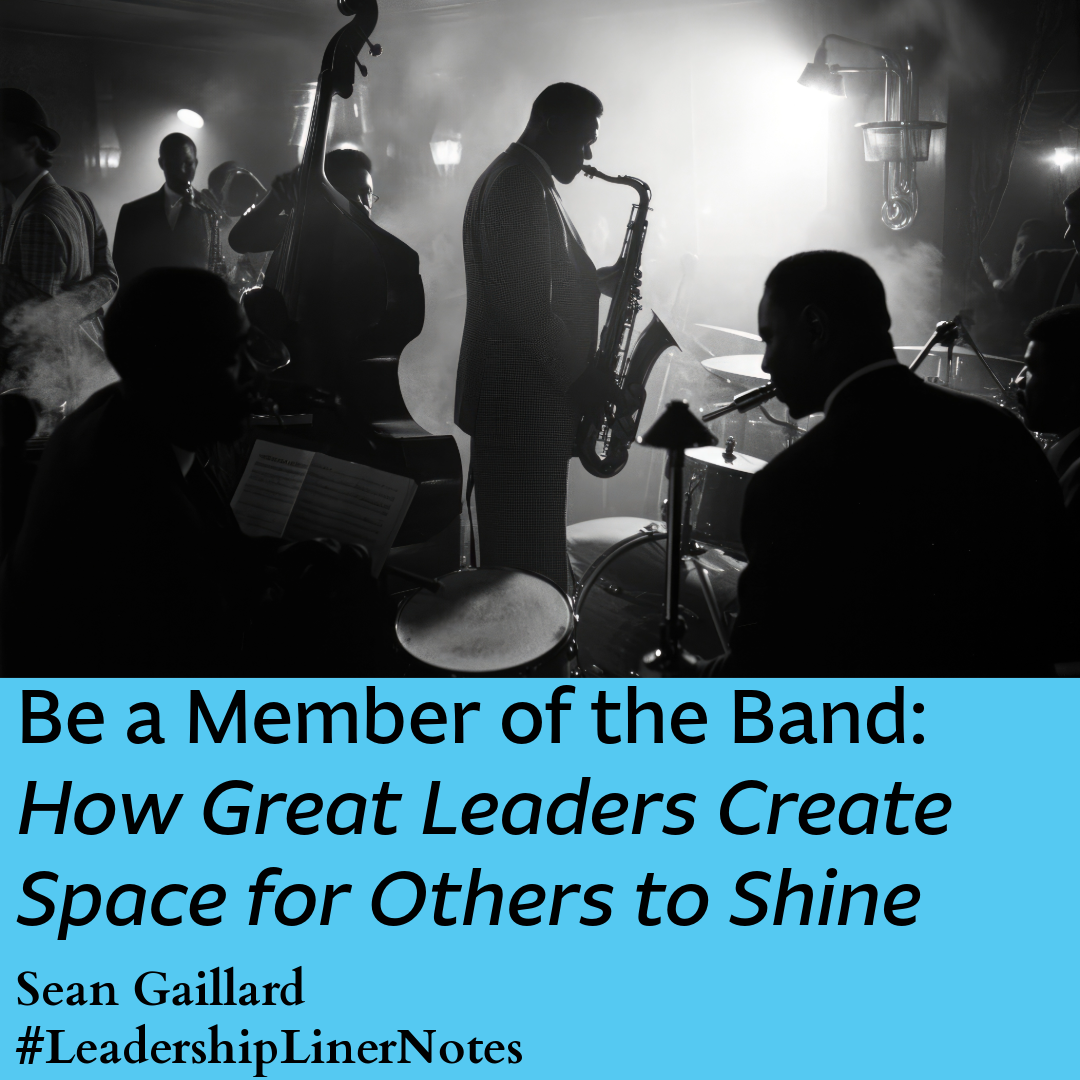
So, wherever you lead, whether it’s a classroom, a meeting, or a community, remember this simple truth: the best leaders know how to be a member of the band. Tune into the gifts of others. Uplift their strengths. Create harmony together. That’s how the best songs and the best teams are made.
What if we lived like the masterpiece was already within us?
Not something to chase. Not something to prove. But something to uncover: one brushstroke, one note, one word, one choice at a time.
Every student. Every educator. Every human.
Brushstrokes of Belief
I think about the times I’ve compromised this mindset. When I was told I dreamed too big. When I was advised to play it safe. I think of the moments when I silenced the masterpiece inside me and gave in to the ease of the status quo. I remember the opportunities I allowed to slip by: ideas that could’ve blossomed into impact because I chose comfort over courage.
As leaders, we must stay grounded in our core. We must also recognize and nurture the masterpiece within the people we serve. Every child, every teacher, every staff member-each one carries the potential for something extraordinary. And it’s our role to invite them into that mindset by stewarding a culture of trust and belonging.
The Invitational Question
As the school year begins, it’s easy to get swept up in to-do lists, calendars, classroom setups, and kickoff meetings. We aim for a smooth start. We hope for a clean slate and an open horizon.
But what if we paused and started the year with one powerful, invitational question?-
How might we co-create a masterpiece in our schoolhouse: one that uplifts our students and each other?
Let that question be your catalyst. Maybe it’s what your team needs to hear from you. Maybe it’s what you need to hear from yourself. Let it refuel your purpose. Let it restore your voice. Let it help you walk in your truth.
Rewriting the Lesson Plan Narrative
In The Pepper Effect, I write about believing in your school’s masterpiece. Just like The Beatles banded together to create Sgt. Pepper’s Lonely Hearts Club Band, a masterpiece isn’t made in isolation—it’s built in collaboration and powered by belief.
At one school where I served as principal, we embraced this mindset in an unexpected place: lesson plans.
Too often, lesson plans become compliance checklists, stifling creativity and reducing the work of educators to mere documentation. Some principals use them as instruments of what Stephen M.R. Covey calls “Command and Control” leadership.
We flipped the script.
Instead of just turning in lesson plans, teachers would highlight a Masterpiece Moment: a singular experience they crafted with passion and intention. It might be a writing prompt, a science experiment, a read-aloud, or a student-led discussion. It didn’t have to be perfect: it had to be purposeful.
In faculty meetings, these moments were shared and celebrated. One teacher compared her lesson to Georgia O’Keeffe’s Sky Above Clouds. Another likened hers to a jazz solo-improvised yet deeply moving.
That small practice opened space for connection, creativity, and belonging. And it reminded us that teaching, like art, is about resonance not replication.
Beethoven’s Ninth and the Schoolhouse
When Beethoven composed his Ninth Symphony, he was completely deaf. Yet, out of silence, he created one of the most profound masterpieces in human history, a work that transcends time, language, and boundaries. The Ode to Joy finale still brings audiences to their feet in awe. It always brings me to tears.
What does that have to do with school leadership?
Everything.
Sometimes leadership feels like working through silence. This can occur when feedback is absent, progress feels slow, or inspiration wanes. And yet, like Beethoven, we still compose. We still create. We still believe. Because the masterpiece is not in the noise, it’s in the conviction, the resilience, and the courage to keep going.
Your school can be your Ode to Joy—crafted not out of perfection, but out of perseverance and purpose.
Four Moves to Practice Masterpiece Leadership All Year Long
1. Curate “Masterpiece Moments” Monthly Set aside 5 minutes during staff meetings to highlight one standout teaching moment from a colleague. Let them share what made it special. Invite joy, not judgment.
2. Embed the Question Into Coaching & Walkthroughs Use the question “What part of your instruction this week feels like a masterpiece?” as a reflection prompt in coaching conversations or feedback forms.
3. Display Masterpiece Boards In a shared space, physically or virtually, let staff (and students!) contribute their own “masterpiece” moments throughout the year. This builds a gallery of impact, belonging, and belief.
4. Model It as a Leader Share your own masterpiece moments as a principal—an email to families, a conversation with a student, a restored partnership. Let your staff see your brushstrokes, too.
The Masterpiece Within
A true masterpiece is timeless and universal. It’s not about accolades or applause; rather, it’s about meaning. It connects us to our humanity. It sparks new ideas. And in leadership, that’s our calling: to ignite that mindset in others.
Especially on the days filled with deadlines, meetings, emails, and decisions—remember:
You are the catalyst. You carry the brush, the baton, the pen.
We all carry a masterpiece within us. What if that belief became the prevailing mindset—in our schools, in our leadership, in our lives?
Let’s lead from that place. Let’s teach from that place. Let’s be that place.
A Collaborative Blog Post by Meghan Lawson & Sean Gaillard
Sean:
This post is a follow-up to our recent collaboration on Season 4 of The Bear. Meghan Lawson and I had such a great time thought-partnering and exploring leadership through the lens of this compelling show that we knew we had to keep the conversation going. When a story grabs your heart and your mind in equal measure, you follow it. For us, The Bear does just that.
We both love this show. We find ourselves returning to its characters, their struggles, their growth, and the environments they navigate because there are so many leadership lessons embedded in their journeys. These are not neat, polished takeaways. These are messy, raw, and very real moments that mirror the work we do in schools and systems every day.
One of the most moving scenes from Season Two is found in Episode Seven, “Forks.” It’s a moment where Richie, played with heart and grit by recent Emmy nominee Ebon Moss-Bachrach, has just completed a transformative stage at a fine dining restaurant. He wanders into the kitchen, reflecting, observing, absorbing. There, he finds Chef Terry, portrayed with quiet power by Olivia Colman, delicately peeling mushrooms.
They exchange a short but unforgettable conversation.
Richie asks, “Why do you do this?” Terry replies, “Respect.”
That single word hangs in the air—soft yet commanding. It lands like a truth bomb.
Richie follows up, “Time well spent. That’s what it’s all about?” Terry responds, “Yeah, I think so.”
As she steps away, she shares a simple, affirming note: Carmy, Richie’s current boss, told her that Richie was good with people.
That moment is not loud. It is not filled with urgency or ego. It is filled with presence, affirmation, and intentionality. Those are the moments worth striving for as a leader.
I love those quiet moments when I’m walking the hallways and visiting classrooms in the school I serve. These are the quiet moments that reflect the glow of a child who feels that sense of belonging. It is the knowing glance from a teacher when I see them in action with a teachable moment. Those are the moments which sustain and carry me on the days when I may be bereft of energy or I have forgotten my leadership purpose.
You go in quest of those moments that echo your purpose as a leader and resonate in impact that ignites the good for others. That makes the whole gig worthwhile.
Over the years, school leadership has sometimes been mistaken for performance art—standing on tables, performing viral-worthy stunts, orchestrating social media optics. While there’s a place for fun, it should never be contrived. Leadership is not about applause. It’s about authenticity.
The “Forks” episode plays like a compelling work of art. It simmers and marinates with beautifully-wrought simplicity. And in that quiet simplicity, we’re reminded: respect isn’t loud. It’s intentional.
And there it is—one leadership lesson.
Meghan:
Sean has so beautifully captured this story, and I’m so glad he mentions it because it is indeed one of my favorite moments from the show.
My husband works in college basketball, and a while back, I wrote a blog post titled, Painting Ladders. It was about how I learned from him that every little detail matters, and none of us are above contributing to those little details.
There was a season when his team won their conference. We all know the tradition: players climb the ladder to cut down the net. That moment is symbolic, beautiful, and hard-earned.
But before the moment, there was the ladder.
The team’s ladder was yellow—not one of the school’s colors. My husband didn’t complain or delegate. He went out, bought navy paint, and stayed up until midnight painting it. No announcement. No credit. He just did it.
Because it mattered. Because of respect.
I try to carry that lesson with me into schools. No job is below me. No detail is too small. It’s about honoring the work and the people who do it. It’s about the culture we’re building—one choice at a time.
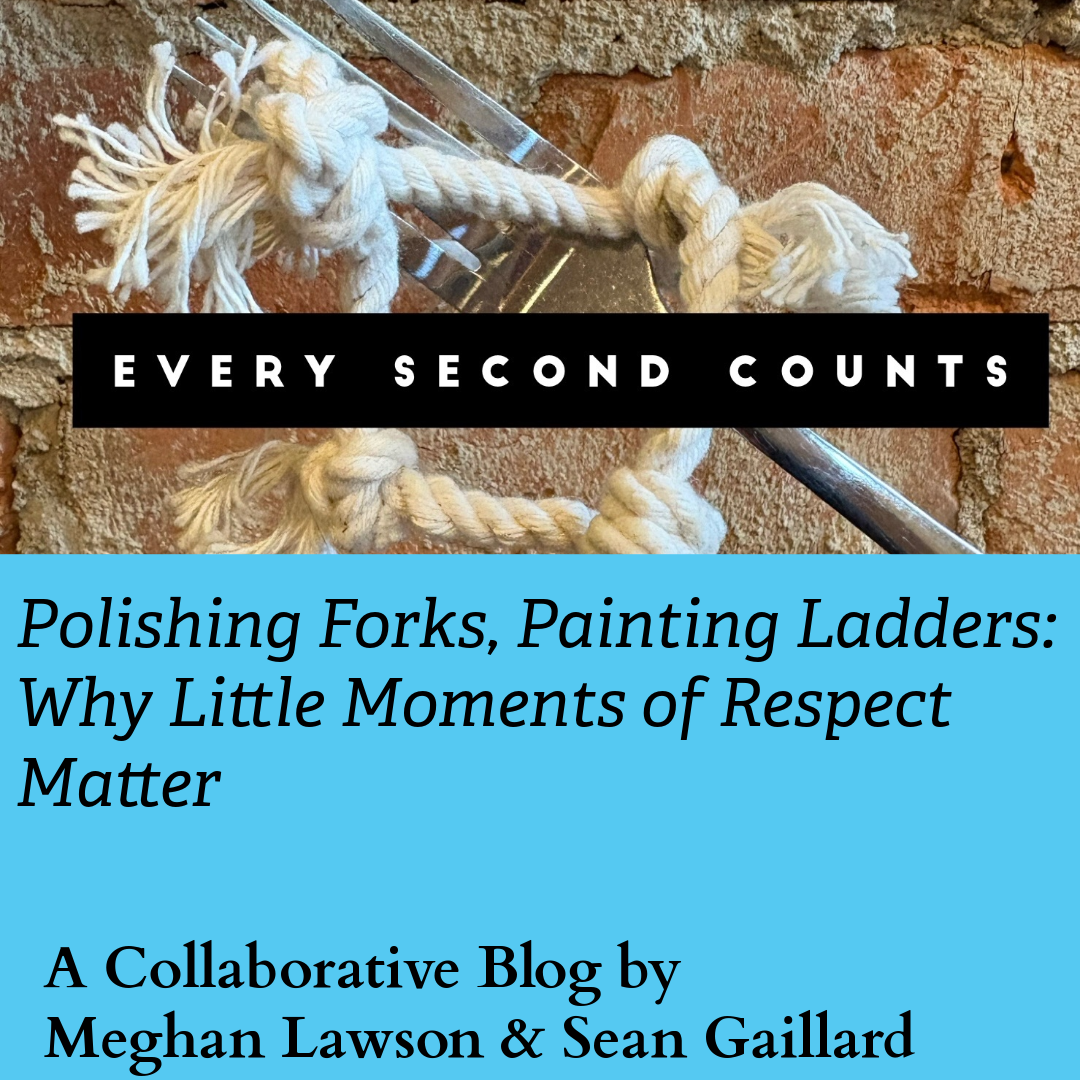
“Every second counts” is a phrase repeated throughout The Bear. It’s even emblazoned on the kitchen wall. But this scene reminds us: it doesn’t mean hustle until you break. It means something deeper. Every second is an opportunity to honor your work, your people, and the space you share.
Leadership isn’t just pushing for results. It’s about presence. Listening. Quietly showing someone they matter.
Terry is peeling mushrooms. Richie is paying attention. A few words are exchanged. A leader is affirmed. A purpose is clarified.
That is leadership.
I believe these kinds of moments shape culture. Hallway conversations. Check-ins after a tough day. The unseen prep done with care. The fork that gets polished when no one is watching.
I remember when I first became a building principal. I had dreams of grand gestures for staff, but I was serving over 700 students PK–5 with no assistant principal or counselor. The grand ideas gave way to meaningful ones: showing up in classrooms, learning kids’ names (first, last, and middle), greeting students at the door, cleaning fingernails, brushing hair, riding the bus.
That’s where the culture was built.
There are no small moments in a school.
So, here’s to peeling mushrooms. Here’s to painting ladders. Here’s to time well spent, quiet presence, and respect that shows up without a microphone.
Every second really does count.
Let’s keep leading like it matters. Because it does.
Four Actionable Leadership Moves:
Lead with Presence, Not Performance Show up consistently, not for the spotlight, but for the people. Leadership is built in everyday interactions, not staged moments.
Honor the Small Details From a clean classroom to a student’s confidence boost, the smallest touches reflect the greatest respect. Don’t underestimate their impact.
Practice Intentional Affirmation Just like Terry affirmed Richie, leaders should look for genuine moments to recognize others. Quiet encouragement often speaks the loudest.
Be Willing to Paint the Ladder Do the behind-the-scenes work. Fix the overlooked things. Whether anyone notices or not, that’s how you show respect for the team and the mission.
Let’s keep polishing forks and painting ladders. Leadership lives in the quiet corners.
A collaborative reflection by Meghan Lawson & Sean Gaillard on leadership, belonging, and bright spots inspired by Season 4 of The Bear
Special Note: Big thanks to my good friend, Meghan Lawson, for collaboration and thought partnership on this joint blog post! Meghan is a dream to collaborate with and I am honored that we joined writing forces on this shared piece. Thank you, Chef!
Lessons from Season 4 of The Bear
So, if you haven’t watched, SPOILER ALERT.
I told my good friend, Sean Gaillard, this week that his friendship not only makes me a better leader, it helps me to listen more deeply and appreciate more fully. This includes music which won’t surprise those of you who know Sean. Over the past couple of years, Sean and I have bonded over our love of the show, The Bear, a show filled with beautiful messy people who love imperfectly but love deeply. We cannot help but see many connections to education and hope you enjoy our six lessons from season 4 below.
Meghan 1: Less is More
Prior to this season, Carmy wanted to put out a new menu every day. He claimed to have many reasons for this. Fresh ingredients, novelty, the possibility of a Michilin star, but this proved to be both taxing on his team and expensive and unsustainable long-term. If The Bear wanted to stay in business, they would have to simplify. They would have to do less well. So, they started to minimize ingredients, focused on making simplified but exquisite meals consistently, and they worked to optimize the customer experience. As a result, things start to turn around for their restaurant.
I couldn’t help but see the inevitable parallel between this restaurant story and our work in schools. Too often, well-intentioned educational leaders learn of the latest and greatest in education and push those initiatives out to the staff in the hopes that this will be the year that they reach their school goals and see swift improvements in their data. We all know how the story ends. Some teachers burnout and others become disengaged figuring that “this too shall pass” so why bother with some of these “flavor of the month” strategies.
There is such a thing as too much of a good thing. When I need reminding of this, life humbles me with little missteps. I’ve put too much salt on my food to the point it’s become inedible. I’ve used too much blush or too much hair product and spent the day looking like a Broadway stage wannabe. And I’ve tried to do too much at one time with my team and had it backfire. So, I’m not writing this as some leadership expert. I’m writing this as someone who seems to learn lessons over and over again and only one way: the hard way.
We’ve been working on growing the capacity of our building leadership teams in my school district. I presented a plan for the work to principals for feedback in the spring. Then, when the hustle of the school year subsided, and we shifted gears to summer planning and learning, after digging into some learning together, it was clear. Parts of my plan were too much, and we needed to pivot. So, we did.
And this is why you need to listen to and trust your team.
Meghan 2: You Need a Team More than You Think
I read something powerful. I believe I found it in The Culture Code by Daniel Coyle. Essentially, in a study of teams, the team of high achievers who didn’t work closely together did not perform as well as the average performers on a high-functioning team. In The Bear, members of the team fully embrace their special role on the team. Ebraheim focuses on The Beef sandwich shop where it all started for this family owned restaurant. Turns out, this simple sandwich window is single-handedly keeping The Bear afloat. Syd focuses on her scallops. Tina (man, I just love her) focuses on making her pasta dish in under 3 minutes. Marcus focuses on being the best pastry chef he can be and even earns recognition in Food & Wine magazine. Richie, perhaps my favorite character, focuses on service. Nat on finances. They all do their part and do it well, and when another person is in some kind of trouble, they offer to help. They are in constant communication throughout the night. They have to be. They have to know when someone is walking behind them or when someone has a hot plate in their hands and or how much time remains before service. As they say, “Every Second Counts.” For the most part, they all have enough basic knowledge required to execute on various basic functions of the restaurants as needed. But they don’t have to do it all.
And yet, here we are. Often expecting ourselves to be the master of all things in our classrooms and schools. We want to be able to do it all and do it all at a high level. But what if we shifted our energy to identify how to leverage the strengths of our team? It’s not that we aren’t going to meet and won’t be collaborating. The Bear has a team meeting every day as do most restaurants. Some even break bread together before they begin service. But are we being strategic about the way we utilize the gifts of our teammates in a way that is equitable and advances our mission? I’m not a whiz at spreadsheets, but I know how to facilitate a meeting that moves us from point A to point B and ensures equity of voice. Can I learn how to be better at spreadsheet work? Sure, I can. We are all learners. Learning is our business. Is becoming a spreadsheet master, something I hate by the way, the best use of my time and energy when I have teammates who thrive in spreadsheets? Probably not. Planning an impactful meeting, using those sheets, gives me energy and is also needed.
Meghan 3: You Are Not Your Job
Throughout this season of The Bear, it’s clear that Carmy is having an existential crisis. He’s spent his adult life hyper-focused on his work. So much so, that this work became all he knew of the world and himself. For those of us, myself included, with childhood and adult trauma, this is a coping mechanism that I know all too well. It’s easier to compartmentalize the hard stuff and throw ourselves fully into our work than it is to confront painful realities. Natalie forces Carmy to hold her baby for a moment. He’s meeting her baby for the first time, and you can tell he is uncomfortable holding the baby at first but with time, he eases into it and himself in the moment with her. There’s a split second where Richie catches a glimpse of them, uncle and niece together, and smiles to himself realizing how special this moment truly is for Carmy. Carmy has countless moments of awakening outside of the kitchen this season and explains in the final season that he doesn’t know who he is outside of the kitchen.
I love our profession. I believe deeply in the work we do. And I worry about us. For too many of us, myself included, we’ve centered our lives and identities on success in education. I worry about this so much that I wrote about it in Legacy of Learning, “You are giving others the strength to move forward, the strength to believe in themselves, the strength to try to make this world a better place. Knowing this makes being an educator so meaningful. But we don’t have to suffer while we make this kind of impact. In fact, the more we can live well and be well, the more our impact will grow.”
If our well-being and self-esteem is solely predicated on how well we are believe we are performing in our work, that is a very fragile ecosystem. We don’t have to earn love or earn self-worth. We already have it. Everything we have is everything we need. So, let’s start paying attention to how we talk to ourselves. Let’s talk to ourselves like we talk to people we love. The most important work is the work we do on ourselves. Everything else is secondary.
Sean: Collaborating with Meghan Lawson is always a bright spot. Her lens on leadership sharpens mine. What’s even better is that her friendship always makes be better. Her reflections on The Bear Season 4 kick open the door for all of us to pause, reflect, and notice the extraordinary in the everyday. I’m grateful to add to this conversation not just as a fan of the show, but as a school leader who believes deeply in the power of culture, connection, and care just as Meghan exemplifies.
This summer, Meghan and I had the chance to hear Dan Heath speak live at the ISTE + ASCD Annual Conference in San Antonio. His keynote, inspired by his book Reset: How To Change What’s Not Working, challenged us to “study the bright spots.” His words weren’t just memorable; they were actionable. That idea has stayed with me, echoing in my heart and practice.
Bright spots can be found in great TV, too. And The Bear is brimming with them—tiny, powerful moments that show what leadership, belonging, and humanity look like under pressure. Here are a few that have stuck with me and how they’ve nudged me to lead better:
Sean: 1. The Art of Delight
In one of the standout scenes, Richie makes sure a guest gets an authentic Chicago Beef sandwich. That alone would’ve been enough. But then? The restaurant team makes it snow. A surprise. A moment of joy. An act of intentional delight.
Great leaders do the same. They listen for delight opportunities. They tune into what others need even if they don’t say it out loud. Delight isn’t about flashy gestures; it’s about showing people they matter.
For me, this takes the form of Positive Principal Phone Calls Home. I call families not because something went wrong—but because something went right. A student showed kindness. A kid made growth. A teacher created magic. It’s the equivalent of snow falling indoors. And it always lands.
Sean: 2. You Are Never Alone
Carmy, fractured and guarded, prepares lunch for his estranged mother. Syd chooses to show up for Richie even though the wedding they’re attending is for his ex-wife. These moments speak volumes. In the kitchen or in the chaos, someone chooses to be there.
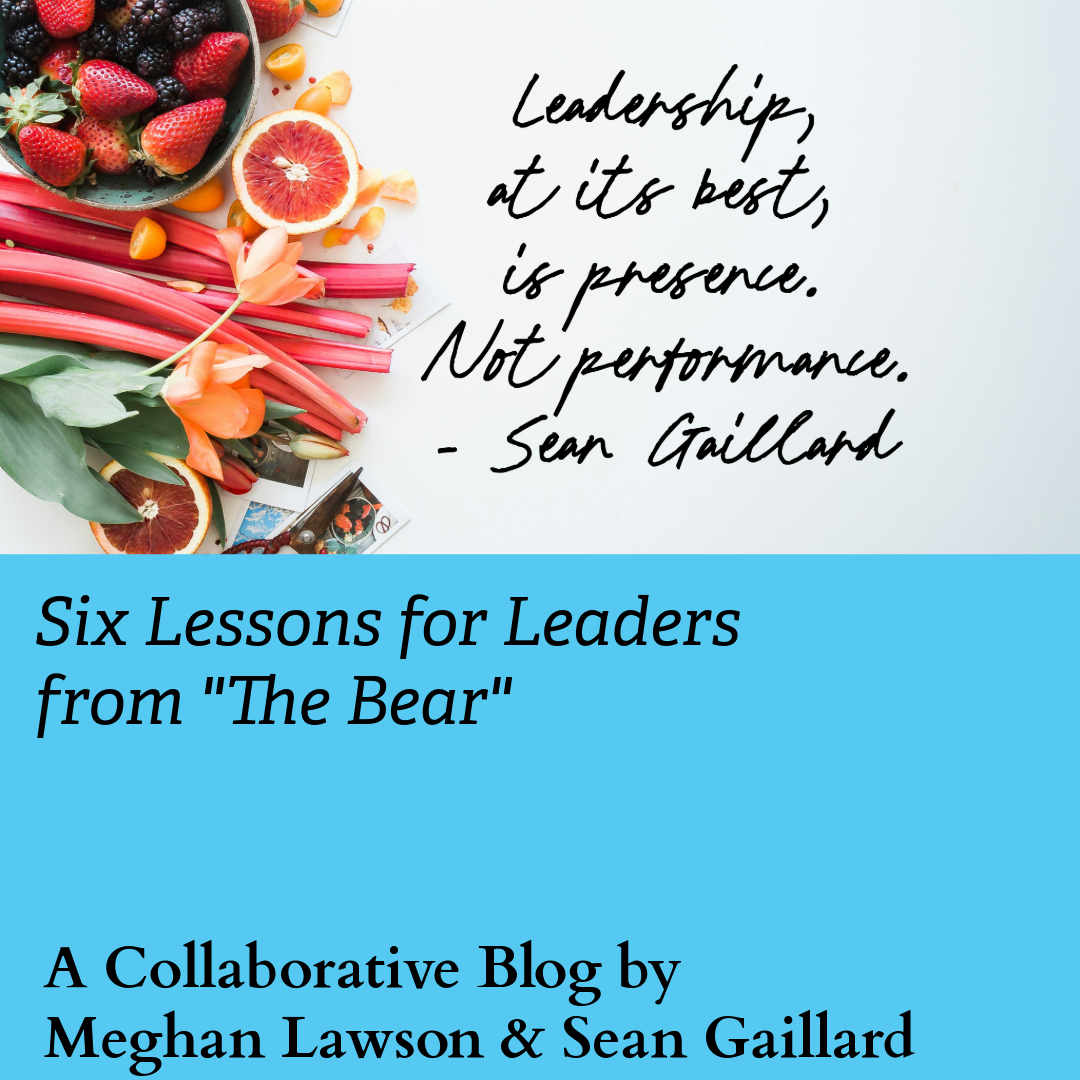
Leadership, at its best, is presence. Not performance.
On a recent flight home, I noticed a fellow passenger battling flight anxiety. No fanfare. Just a quiet offer to talk, sit, and be. We shared the journey—sky and fear alike. That moment reminded me of school. We often say the principal’s office can be a lonely place. But it doesn’t have to be. Leaders must extend that reminder: you are not alone to students, staff, and families. And sometimes, to ourselves.
Sean: 3. Belonging Matters
There’s a powerful scene where Richie’s daughter is too afraid to dance at a wedding. What do the adults do? They crawl under the table and share their own fears. It’s tender, honest, and unforgettable.
Leadership is often loud. But sometimes, it’s quiet courage: the willingness to go under the table with someone else’s fear and stay there with them until they’re ready to rise.
This summer, I wrote handwritten letters to my staff. Simple notes of gratitude and anticipation. No big speech. Just connection. It’s how belonging begins by saying: I see you. I’m glad you’re here. I can’t wait for what’s ahead.
The Bear isn’t just entertainment. It’s a mirror. A reminder. A bright spot. And as we get ready for a new school year, there’s no better time to slow down, reflect, and carry these lessons into our leadership.
-Here’s to delight. -Here’s to presence. – Here’s to belonging. – Here’s to the bright spots.



 Leadership Liner Notes: Sean Gaillard