A Guest Blog Post for Dave Burgess Consulting, Inc!
Recently, I had the honor of writing a guest post for my publisher, Dave Burgess Consulting, Inc.! Their support goes back to the very beginning, when the team believed in an idea I had for a book. That idea became The Pepper Effect—my mash-up love letter to The Beatles and education. I’ll always be grateful for their belief in this project.
This new guest post grew out of some reflections I’ve been having on The Pepper Effect. It was a refreshing chance to wander down a meaningful rabbit hole as I continue work on my next book, Leadership Riffs, also with Dave Burgess Consulting.
You can read the post here: What’s Right: A Pivot Into Bright Spots. I’d love to hear your thoughts! Leave a comment, share it, or tag me on your favorite social media platform so we can keep the conversation going.
A huge thank-you to Dave Burgess and Tara Martin of #dbcincbooks for their belief, encouragement, and ongoing support!
There is a phrase I keep coming back to: the impossible becomes possible.
Recently, I had another health scare that resulted in a visit to the hospital. I am alright and recuperating, but in the days that followed, I found myself searching for something to hold onto. A remix of a Beatles reunion song sent me on a journey to re-embrace hope and belief.
When The Beatles broke up in 1970, the world declared it over. Headlines announced the end of the most influential band of all time. In the years that followed, reunion rumors surfaced constantly, often fueled by money, charity, or fan speculation. Yet, The Beatles remained steadfast: no reunion. Even after John Lennon’s senseless murder in 1980, people still asked if the three surviving members might somehow return, with John’s sons stepping in. It seemed impossible.
And yet in 1995, a demo tape of John Lennon’s rough home recording was dusted off. With the steady guidance of Jeff Lynne, Paul, George, and Ringo added their voices and instruments. Out of grief, absence, and fractured history came something astonishing: “Free As A Bird.”
For me, it was a moment of awe. I was a young teacher then, two years into my career. When I read a small article about the surviving Beatles reuniting for Anthology, I ran off copies for every teacher’s mailbox in my school. I wanted everyone to feel the electricity I felt: this is really happening. When the song finally aired on television, I remember tearing up. It was not just about music, it was about reconciliation, healing, and the audacity of creating something new out of what seemed broken forever. I wrote about this event and its personal meaning to me in my book,The Pepper Effect.
In my office today, I still keep a tattered photocopy of Linda McCartney’s photo of Paul, George, and Ringo together from that era. Above it, I have written: “The Impossible Becomes Possible.” Because that is what the reunion meant to me then, and what it still means now.
And now, nearly 30 years later, “Free As A Bird” returns in a brand new mix. Thanks to modern audio restoration, John Lennon’s voice emerges clearer, closer, more present. It feels as if all four Beatles are back in the studio together. Each time I play it, I feel renewal. I feel hope.
Hope as a Leadership Catalyst
Hope is a word often dismissed in leadership circles. Some see it as naïve or impractical, a soft idea in a world that demands hard results. But I believe hope is not a weakness. Hope is a catalyst. It is the ignition that sparks vision into action.
As Casey Gwinn and Chan Hellman remind us in Hope Rising, hope is the belief that “your future can be brighter and better than your past and that you actually have a role to play in making it better.” That belief matters, especially when the weight of challenges threatens to crush our momentum.
The space between vision and action is leadership. Hope and belief have to be in that vision as catalysts.
As leaders, we do not always need a grand plan or sweeping solution in every moment. Sometimes, we just need an entry point. A reminder that even the hardest, most impossible-seeming work can move forward. For me, that entry point is hearing John Lennon’s voice stitched back into the fabric of his bandmates’ music. It is a symbol of reconciliation, resilience, and possibility.
Belief Made Real
The truth is, leadership often feels like trying to reunite what has been broken. It is messy. It is emotional. It is full of skeptics. But the work is also full of potential. When we model belief for our students, for our teachers, for ourselves, we give others permission to believe too.
“Free As A Bird” reminds me daily that impossible things can be made possible. For The Beatles, it was a reunion across decades and even death. For us, it might be turning around a struggling school, reigniting a team’s confidence, or building something new when resources seem scarce.
Whatever the context, hope can be the spark. And belief, when it is shared, nurtured, and lived, can make it real.
So when the days are heavy and the obstacles feel immovable, I return to that song. I hear the reunion of four bandmates who found a way. And I am reminded: if The Beatles could find harmony after all they endured, then maybe we can find our way, too.
As leaders, we have to believe that the impossible becomes possible. That is the gig. We must be relentless in that belief, even when the naysayers gather and the narratives say it cannot be done. Hope gives us the entry point. Belief carries us the rest of the way.
Our calling as leaders is to believe when others doubt, and to carry hope when the weight feels too heavy. When the impossible finds its voice, leaders must believe enough for others to join in the song.
Check out “Free As A Bird” (2025 Mix) by The Beatles:
What if we lived like the masterpiece was already within us?
Not something to chase. Not something to prove. But something to uncover: one brushstroke, one note, one word, one choice at a time.
Every student. Every educator. Every human.
Brushstrokes of Belief
I think about the times I’ve compromised this mindset. When I was told I dreamed too big. When I was advised to play it safe. I think of the moments when I silenced the masterpiece inside me and gave in to the ease of the status quo. I remember the opportunities I allowed to slip by: ideas that could’ve blossomed into impact because I chose comfort over courage.
As leaders, we must stay grounded in our core. We must also recognize and nurture the masterpiece within the people we serve. Every child, every teacher, every staff member-each one carries the potential for something extraordinary. And it’s our role to invite them into that mindset by stewarding a culture of trust and belonging.
The Invitational Question
As the school year begins, it’s easy to get swept up in to-do lists, calendars, classroom setups, and kickoff meetings. We aim for a smooth start. We hope for a clean slate and an open horizon.
But what if we paused and started the year with one powerful, invitational question?-
How might we co-create a masterpiece in our schoolhouse: one that uplifts our students and each other?
Let that question be your catalyst. Maybe it’s what your team needs to hear from you. Maybe it’s what you need to hear from yourself. Let it refuel your purpose. Let it restore your voice. Let it help you walk in your truth.
Rewriting the Lesson Plan Narrative
In The Pepper Effect, I write about believing in your school’s masterpiece. Just like The Beatles banded together to create Sgt. Pepper’s Lonely Hearts Club Band, a masterpiece isn’t made in isolation—it’s built in collaboration and powered by belief.
At one school where I served as principal, we embraced this mindset in an unexpected place: lesson plans.
Too often, lesson plans become compliance checklists, stifling creativity and reducing the work of educators to mere documentation. Some principals use them as instruments of what Stephen M.R. Covey calls “Command and Control” leadership.
We flipped the script.
Instead of just turning in lesson plans, teachers would highlight a Masterpiece Moment: a singular experience they crafted with passion and intention. It might be a writing prompt, a science experiment, a read-aloud, or a student-led discussion. It didn’t have to be perfect: it had to be purposeful.
In faculty meetings, these moments were shared and celebrated. One teacher compared her lesson to Georgia O’Keeffe’s Sky Above Clouds. Another likened hers to a jazz solo-improvised yet deeply moving.
That small practice opened space for connection, creativity, and belonging. And it reminded us that teaching, like art, is about resonance not replication.
Beethoven’s Ninth and the Schoolhouse
When Beethoven composed his Ninth Symphony, he was completely deaf. Yet, out of silence, he created one of the most profound masterpieces in human history, a work that transcends time, language, and boundaries. The Ode to Joy finale still brings audiences to their feet in awe. It always brings me to tears.
What does that have to do with school leadership?
Everything.
Sometimes leadership feels like working through silence. This can occur when feedback is absent, progress feels slow, or inspiration wanes. And yet, like Beethoven, we still compose. We still create. We still believe. Because the masterpiece is not in the noise, it’s in the conviction, the resilience, and the courage to keep going.
Your school can be your Ode to Joy—crafted not out of perfection, but out of perseverance and purpose.
Four Moves to Practice Masterpiece Leadership All Year Long
1. Curate “Masterpiece Moments” Monthly Set aside 5 minutes during staff meetings to highlight one standout teaching moment from a colleague. Let them share what made it special. Invite joy, not judgment.
2. Embed the Question Into Coaching & Walkthroughs Use the question “What part of your instruction this week feels like a masterpiece?” as a reflection prompt in coaching conversations or feedback forms.
3. Display Masterpiece Boards In a shared space, physically or virtually, let staff (and students!) contribute their own “masterpiece” moments throughout the year. This builds a gallery of impact, belonging, and belief.
4. Model It as a Leader Share your own masterpiece moments as a principal—an email to families, a conversation with a student, a restored partnership. Let your staff see your brushstrokes, too.
The Masterpiece Within
A true masterpiece is timeless and universal. It’s not about accolades or applause; rather, it’s about meaning. It connects us to our humanity. It sparks new ideas. And in leadership, that’s our calling: to ignite that mindset in others.
Especially on the days filled with deadlines, meetings, emails, and decisions—remember:
You are the catalyst. You carry the brush, the baton, the pen.
We all carry a masterpiece within us. What if that belief became the prevailing mindset—in our schools, in our leadership, in our lives?
Let’s lead from that place. Let’s teach from that place. Let’s be that place.
Spinning a New Track: Announcing My Next Book Leadership Riffs
As I write this blog on an early Saturday morning, the soulful sounds of jazz guitarist Wes Montgomery are playing in the background. I can’t think of a better soundtrack to accompany this announcement: my next book is on the way, Leadership Riffs: Harmonizing Inspiration, Innovation, and Impact.
In music, a riff is a catchy, repeated musical phrase or pattern—something that grabs your attention, moves the song forward, and stays with you long after the final note. That’s the heart of this book: exploring the powerful, repeatable moves that leaders can make to inspire others, spark innovation, and create lasting impact.
I am deeply honored to partner once again with the amazing team at Dave Burgess Consulting, Inc. Their belief in my first book, The Pepper Effect, a mash-up love letter to The Beatles and school leadership, meant the world to me. Their continued support of Leadership Riffs is just as heartfelt and I am filled with gratitude.
Imagine leadership as a beautifully orchestrated album:
Each decision is a purposeful chord
Each collaboration is a blend of voices in harmony
Each courageous innovation becomes a memorable melody
Leadership Riffs will serve as a guidebook for educational leaders. It will blend timeless lessons from legendary musicians with practical, actionable strategies for leading schools and teams. This is about crafting leadership that grooves with authenticity and resonates with those we serve.
Publishing The Pepper Effect was a dream come true. Now I’m thrilled that it will have a “bandmate” in Leadership Riffs. If you’d like to revisit The Pepper Effect or read it for the first time as I continue work on the new book, you can find it here on Amazon.
I invite you to join me on this journey. Follow along here on the blog for behind-the-scenes updates and maybe a few surprises along the way.
Stay tuned and be sure to follow the conversation on #LeadershipRiffs via X, BlueSky, Instagram, Facebook, and LinkedIn.
In the meantime, let’s keep the vinyl spinning and move forward with the kind of inspiration that stays at the top of our leadership playlist. The kind that makes the world a better place for others.
Signing the book contract for #LeadershipRiffs! Photo Courtesy of Courtney Gaillard
Hope is something we all need. Whether we’re leading a school, guiding a team, or simply navigating the ups and downs of daily life, hope serves as our compass. It’s the whisper that reminds us we’re on the right path, that our vision matters, and that our efforts have the potential to create something meaningful.
But let’s be real—there are days when the compass feels broken. Days when we question our choices, when doubt creeps in, and Imposter Syndrome casts a shadow over our accomplishments. I’ve been there. We all have. And in those moments, I’ve learned that it’s the small, unexpected flashes of hope that keep us going: the spontaneous smile from a student as I walk down the hallway, the moment a teacher’s lesson hits its stride, or even a kind text from a loved one reminding me I’m not alone in this work.
Sometimes, hope arrives in the form of a song. As many of you know, I’m an unabashed Beatles fan. From The Pepper Effect to #ThePepperEffect, to countless references in talks, blog posts, and podcasts, The Beatles are my creative wellspring. My book, The Pepper Effect, explores the lessons of collaboration, creativity, and leadership that can be drawn from The Beatles’ groundbreaking Sgt. Pepper’s Lonely Hearts Club Band. If you’d like to learn more about it, you can check it out here.
Last year, I had the privilege of writing a piece for Culture Sonar about Now and Then, the “last” Beatles song. The story behind this song resonates deeply with me as a testament to the power of hope. You can read that full piece here.
The story of Now and Then is itself a lesson in hope and perseverance. John Lennon recorded a rough demo at his piano in 1977. When the surviving Beatles—Paul McCartney, George Harrison, and Ringo Starr—tried to finish it in the mid-90s, the project hit a wall. The synergy wasn’t there, and the technical limitations made it impossible to isolate John’s vocal clearly. The song was shelved, unfinished, but Paul never let it go. He believed there was something special in John’s demo—a spark waiting to ignite.
Decades later, in 2022, Paul and Ringo revisited Now and Then. With the help of advances in AI and the brilliant production skills of Giles Martin (son of George Martin, The Beatles’ original producer), they were able to clean up John’s vocal and add new musical elements. In 2023, the song was released, and for me, it felt like the world was witnessing a small miracle—a moment when something lost was found again. It was a triumph of hope, a testament to the belief that the impossible can become possible.
Earlier this week, I heard the news: Now and Then has been nominated for a Grammy Award for Record of the Year. It’s a powerful reminder that music—like hope—has the power to change the world. This song, born from a rough demo and sustained by Paul McCartney’s unwavering belief, is a symbol of what can happen when we refuse to give up on something that matters. It’s a lesson for all of us as leaders: sometimes, our vision won’t be embraced right away. There will be times when our ideas are met with polite nods or silence. But that doesn’t mean the idea isn’t worth pursuing. It just means we need to persevere and trust in the process.
Hope isn’t just a feeling; it’s a leadership move. It’s the quiet persistence to revisit ideas, to keep communicating, to invite others to collaborate and play together in the sandbox of possibility. I think about my latest initiative at school—the Principal Read Aloud. As a new leader, I wanted to find a way to connect with our students and teachers, to build trust and community. I proposed giving teachers a 30-minute break while I read aloud to their classes. It’s a simple idea, but it’s grounded in hope and the desire to show our school community that I’m here for them.
So far, only two teachers have signed up, and that’s okay. I’m hanging in there, just like Paul McCartney did with Now and Then. I believe in this small act of connection, and I’m willing to wait for it to grow, one read-aloud session at a time. Because that’s what hope looks like—it’s the willingness to keep showing up, to keep believing in the possibility of something beautiful taking shape.
As leaders, we have to hold onto hope like a North Star. It’s our guiding light, helping us navigate through challenges and inspiring others to do the same. Whether it’s in our school hallways, our team meetings, or even in the quiet moments of reflection, we have to keep hope in the foreground. It’s not always easy, but it’s always worth it.
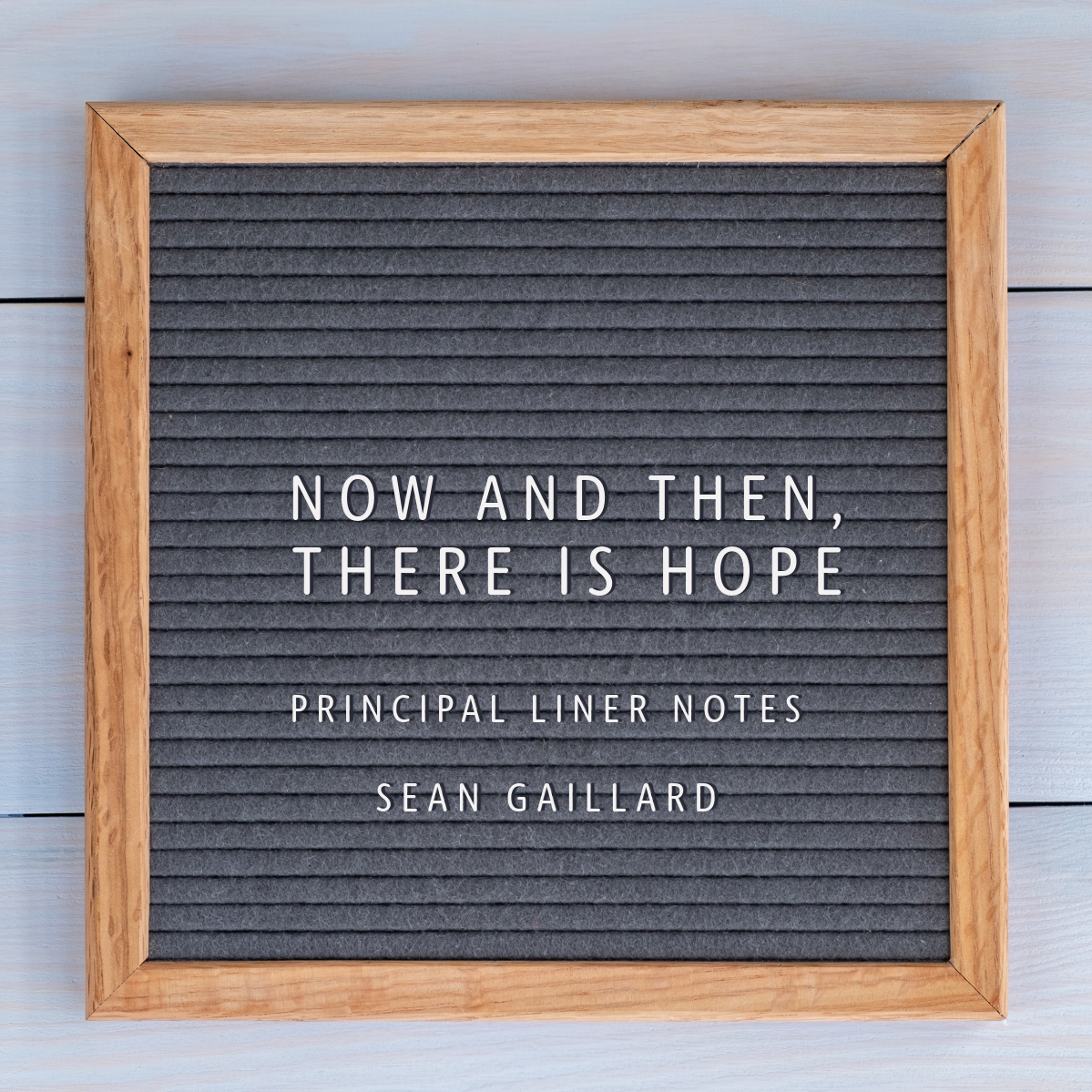
And as The Beatles remind us in their final song, hope is the thread that ties the past, present, and future together. Now and then, there is hope. It’s what brings us back, time and time again, to believe in the magic of possibility and the power of collaboration.
Let’s keep hope alive in our leadership moves. Let’s embrace the small moments that spark joy and connection. Let’s take the time to revisit old ideas, to share our vision with others, and to trust that, in the end, something beautiful will emerge.
Tune in to Hope:
Embrace Small Acts of Connection: Like my Principal Read Aloud, find simple ways to show your heart and commitment to your school community.
Persevere with Your Ideas: Even if your vision isn’t immediately accepted, keep refining and revisiting it. Trust that it has the potential to resonate with others over time.
Invite Others to Collaborate: Hope grows when we invite others to join us on the journey. Create space for shared ownership and creative contributions.
The journey of Now and Then is a reminder that we’re all part of something bigger. When we lead with hope, we open the door for new possibilities to enter, and that’s when the real magic happens.
As someone who proudly wears the badge of a “Beatles Encyclopedia,” my journey in music appreciation is a perpetual adventure. The joy I derive from delving into the world of music, particularly the legendary band that holds a special place in my heart, knows no bounds. If you were to step into my home office, you’d find it adorned with shelves filled to the brim with books dedicated to none other than “The Beatles.” I’ve devoured so many books over the years on this iconic band that I could probably recite passages from memory. (I’d likely be of little help in the book refuge depicted in Fahrenheit 451!)
Currently, my literary journey has led me to “The Lyrics” by Paul McCartney. Released just last year in hardcover, I couldn’t resist adding the paperback edition to my collection. This remarkable book sees McCartney opening up about the stories and personal anecdotes behind the songs that defined his tenure with The Beatles and his solo career. In the book’s introduction, McCartney shares an anecdote from the early days of The Beatles that, surprisingly, I had never encountered before.
Let me share a quick recap. Picture the scene: The Beatles, in the nascent stages of their career, find themselves on a wintry night journeying between gigs. Suddenly, their van skids on ice, careening off the road and down an embankment. Miraculously, no one is hurt, but they’re left stranded. Amidst the chaos, McCartney recalls a pivotal statement uttered by someone in the band: “Something will happen.” This simple phrase quickly became a rallying cry for The Beatles whenever faced with adversity or uncertainty. I try to envision when this statement would echo at various stages during The Beatles trajectory as a band. It is a tantalizing game to play in imagining when this line would be appropriate.
The profound simplicity of this statement struck a chord with me as I immersed myself in McCartney’s book. It served as a poignant reminder that even the idols we admire are, at their core, human. “Something will happen” encapsulates a resolute hope, reminding us that amidst seemingly insurmountable odds, the realm of possibility remains wide open.
Reflecting on this mantra, I couldn’t help but draw parallels to my own journey as a principal and school leader. In the face of daunting challenges, “Something will happen” embodies a steadfast belief in the power of resilience and perseverance. It speaks to the essence of our roles as leaders, tasked with navigating complex landscapes against all odds. We have to tune into possibilities on a daily basis. Additionally, we have to encourage others to tune into possibilities as we educate and empower the kids we serve.
Recently, our team encountered a situation demanding swift action and collaboration. In its aftermath, I found myself echoing a similar mantra to reassure my colleagues: “We responded. We were there for others.” I have echoed this statement many times as a leader to serve as a salve for others who support during a crisis. This instance brought to mind The Beatles and their mantra, reinforcing the notion that amidst uncertainty, hope prevails.
My mantra, “We responded,” shares the same essence and intention as The Beatles’ rallying cry. As leaders, it’s our responsibility to provide comfort and empowerment through compassionate words and actions. Whether serving as a soothing balm in times of crisis or bringing clarity to chaos, our words hold the power to inspire and uplift. Being intentional with our words is a necessary move as a leader. We are the navigators of our narrative and we must choose our words with care, compassion, and intention.
Stepping back and reflecting on our experiences is not just advisable; it’s imperative for effective leadership. Taking stock of our decisions and actions allows us to glean valuable insights and pave the way for growth. In the end, it’s the simple yet profound words—whether “Something will happen” or “We responded”—that ignite the spark of hope and resilience in those we lead.
Next Moves for Dynamic Leadership Action: Reflection on Communication
-Reflect: Find intentional time to reflect on the words you use as a leader to comfort or inspire during a crisis.
-Write: Jot down those words and statements you use. Reflect upon the meaning and intention in each of those words. Do they empower? Do they avoid judgement or placing blame?
-Share: Find a trusted thought partner and share words to gain feedback and growth.
-Connect: With people you serve and collaborate, take time as a group to discuss words used during a crisis. Establish kinship and understanding along with ensuring that meanings are understood.
Whether serving as a soothing balm in times of crisis or bringing clarity to chaos, our words hold the power to inspire and uplift. Being intentional with our words is a necessary move as a leader. We are the navigators of our narrative and we must choose our words with care, compassion, and intention.
Here’s Episode 20 of “The Principal Liner Notes Podcast.”
It is entitled “In the Fan Club.” I explore how the recent release of the “Yesterday” movie connects to my pride in being a Beatles Fan. I also explore connections from the film to our noble profession as educators.
Here’s the latest episode of “The Principal Liner Notes Podcast.” It’s entitled “Embrace the Crossroads.” I explore how a pivotal moment in the “Mad Men” television series coupled with a song by Buddy Holly connects to the infinite possibilities at the end of a school year.
A renaissance for kindness has surfaced within the last few years as a vital component of a schoolhouse’s culture. Educators in classrooms all around the world are finding ways to slow things down a bit and take notice of acts of kindness and goodwill — prioritizing relationships and making memories together along the way.
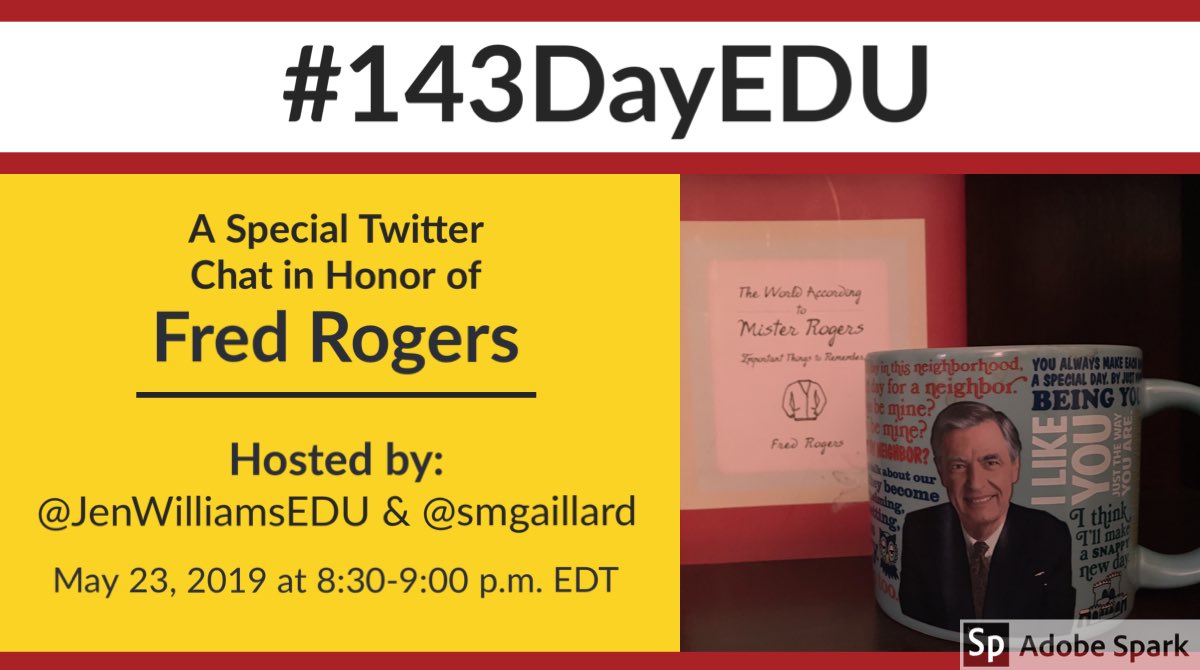
Fred Rogers, children’s broadcasting icon, promoted kindness for 31 seasons in a simple and sincere way on the television masterpiece, “Mister Rogers Neighborhood.” In honor of Mr. Rogers, the state of Pennsylvania has designated May 23 (the 143rd day of the calendar year) as #143DayinPA. This stands as a tribute to homestate hero, Fred Rogers, and his favorite number. “143” is numeric code for “I Love You.” We thought it would be fitting to extend the 143 culture of kindness to education with the #143DayEdu hashtag.
#143DayEdu
Using the #143DayEdu hashtag, we are encouraging all educators to share examples of kindness happening on May 23. To join in on the fun, simply use #143DayEdu to promote acts of kindness and compassion happening in the schoolhouse. You are also invited to join us this Thursday, May 23 at 8:30 – 9:00 p.m. EDT for a special Twitter Chat where we intend to promote positivity and celebrate the enduring legacy of Fred Rogers.
Here are the questions and times for Thursday night’s Twitter chat. To join, simply head over to Twitter by clicking HERE at 8:30pm ET and watch for the Qs from @smgaillard and @JenWilliamsEdu.
Q1: Thinking back to Mr. Roger’s Neighborhood, what are some of your fondest memories of the show? (8:35 pm ET)
Q2: What lessons can we learn from Mr. Rogers that we can apply to the classroom? (8:40 pm ET)
Q3: How did you promote kindness in your school recently? (8:47pm ET)
Q4: What are some ways we can finish the school year promoting kindness with our school communities? (8:53 pm ET)
Pass It On
As we prepare for #143DayEdu and the #143DayEdu Twitter chat, we invite you to consider this quote on kindness from Mr. Rogers along with these related resources. Please feel free to share the invitation for a Day of Kindness — pass it on! We look forward to this special week and the opportunity to celebrate you — just for being you!
Imagine what our real neighborhoods would be like if each of us offered, as a matter of course, just one kind word to another person.



 Leadership Liner Notes: Sean Gaillard