Movement I: The Darkness of Being Unseen
In yesterday’s blog post, Am I Missed? Did I Make a Difference?, I reflected on whether my contributions as a leader mattered to others. That question led me down some deep paths of introspection and retrospection as I considered the schools, people, and communities that have been part of my journey. Today, I find myself asking a different and much more personal question. Do I matter as a human being beyond what I have contributed?
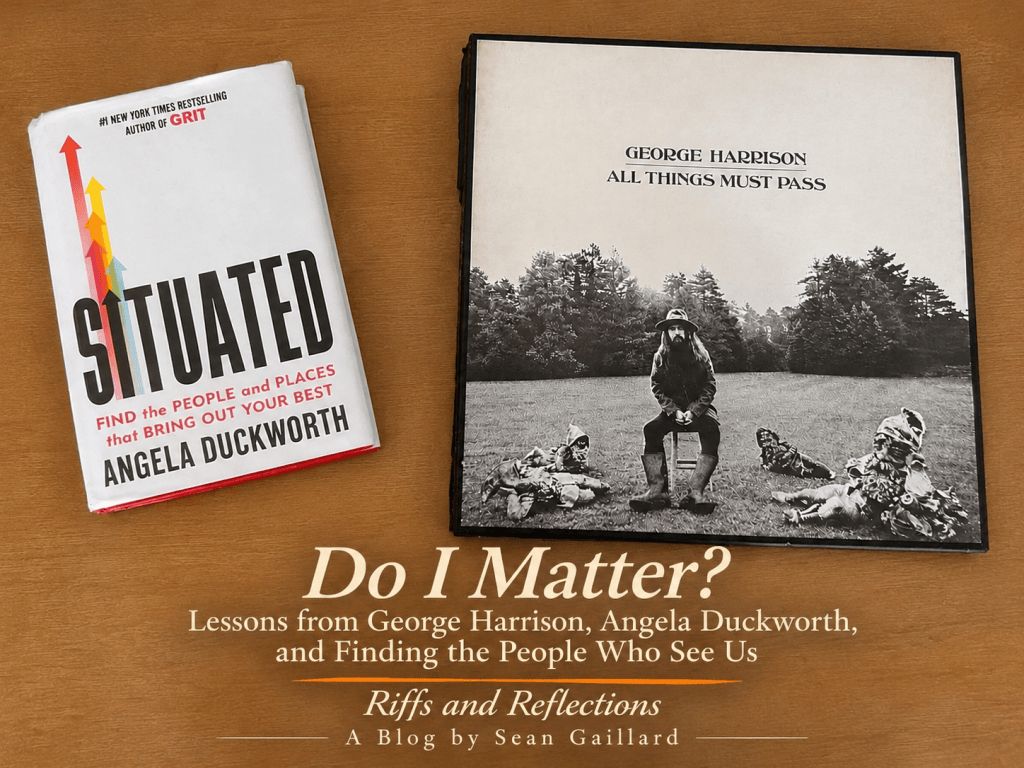
Music has always been a therapeutic thought partner for me during these journeys of reflection. Lately, I have been spending considerable time listening deeply to George Harrison’s “Beware of Darkness,” a remarkable song from his epic 1970 triple album, All Things Must Pass. Produced with Phil Spector and featuring an extraordinary collection of musicians and friends, including Ringo Starr, Eric Clapton, Klaus Voormann, and Billy Preston, the album marked George’s emergence as a solo artist following the breakup of The Beatles. Alongside familiar songs like “My Sweet Lord” and “What Is Life,” the album offers a deeply personal exploration of spirituality, independence, and finding one’s way into a new chapter.
“Beware of Darkness” has long been my favorite song on the album. It has become something of a personal anthem and a source of comfort when I need encouragement or perspective. There is a gentle urgency in George’s warning to recognize the influences that threaten our inner peace, obscure our sense of self, and pull us away from what matters. Listening to the song lately has led me to reflect on some difficult experiences from my years as a school principal.
I have been fortunate to serve as a principal at the elementary, middle, and high school levels. Each assignment brought its own joys, challenges, relationships, and lessons. The principalship is an extraordinarily demanding role that places a person under a constant spotlight and an almost unrelenting microscope. Every decision is examined, every action interpreted, and every expectation filtered through the perspectives of others. Principals are expected to encourage, solve problems, make difficult decisions, absorb criticism, and sometimes deliver news that no one wants to hear.
There is a contradiction within this work that I have come to understand more deeply. A principal can be the most visible person in a school and still feel completely unseen as a human being. Everyone recognizes the position and the responsibilities associated with it, but not everyone takes the time to recognize the person carrying those responsibilities.
That contradiction became painfully evident during my last two principalships. In both assignments, I struggled with expectations that I should lead like my predecessors rather than bring my own values, experiences, and approach to the role. I had followed other principals throughout my career and understood that transitions require patience, relationship building, and trust. Those earlier experiences had their challenges, but I eventually found opportunities to establish meaningful connections and lead authentically. These two assignments felt different.
At one school, for example, I was expected to push a snack cart through the building and provide treats for teachers and staff because that had been a tradition established by my predecessor. I purchased the snacks with my own money and made the rounds because I genuinely wanted people to feel appreciated. Yet what might have been a meaningful gesture of care gradually felt more like an obligation. The snack cart became an expectation rather than an expression of appreciation.
I tried other ways to support and encourage the staff that reflected my own approach to leadership, but those efforts often seemed to fall short of what people wanted. I received occasional expressions of gratitude, yet I struggled to build the reciprocal trust and commitment necessary to move our work forward for students. I increasingly felt that I was being measured against the memory of someone else rather than being given the opportunity to lead as myself.
There were smaller moments that reinforced this feeling. Principal appreciation occasions passed without acknowledgment, while I continued to invest considerable energy in teacher appreciation, celebrations, and school spirit activities. I never entered the principalship expecting applause or recognition for doing my job. What troubled me was the growing sense that care and consideration were expected to flow in only one direction.
Over time, I began to feel invisible in places where I was constantly visible. I was showing up, giving, and trying to build connections, yet I did not feel genuinely known or accepted. I was beginning to lose sight of something far more important than whether I was meeting everyone’s expectations.
I was losing sight of myself.
Movement II: The Giving Tree and the Cost of Losing Ourselves
Rather than recognizing the misalignment and responding with greater clarity, I convinced myself that I needed to give even more. I worked harder, extended myself further, overlooked things I should have addressed, and tried to become the kind of principal I believed others wanted. Somewhere along the way, I began compromising the very values and leadership practices that had guided me throughout my career.
I think about Shel Silverstein’s The Giving Tree when I reflect on this period. The tree gives and gives until almost nothing remains except a stump. The story has often been interpreted as a celebration of generosity and unconditional love, but I have come to see another meaning through the lens of leadership. What happens when giving becomes the only way we believe we can demonstrate our worth?
I call this Giving Tree Leadership. It happens when leaders become so consumed with serving, pleasing, and meeting the needs of others that they neglect their own humanity. We celebrate leaders who are always available, always willing to sacrifice, and always ready to give a little more. We rarely stop to consider what happens when there is nothing left to give.
That was the path I found myself traveling during those two principalships. I kept giving because I believed that one more gesture, one more sacrifice, or one more effort might finally help me earn the trust and acceptance I was seeking. Instead, I became increasingly disconnected from the leader I had worked so hard to become.
Both experiences eventually contributed to serious physical and emotional strain that resulted in hospital visits. It is difficult to write those words because I have had to acknowledge my own part in allowing these circumstances to continue. I ignored warning signs, compromised boundaries, and convinced myself that I simply needed to work harder. I was so determined to make things better for everyone else that I failed to recognize how much I was hurting myself.
The second hospitalization brought an especially painful realization. During that experience, no one from my school or district called my wife or me to check on my well being. There was no card, no text, and no phone call. I had spent so much time trying to be present for others, yet during one of my most vulnerable moments, I felt profoundly alone.
That silence stayed with me. It caused me to question not only whether my leadership mattered, but whether I mattered as a person beyond the responsibilities I carried. I had become so accustomed to being the giver that I had almost forgotten what it felt like to need care myself.
I share these experiences because they have changed how I think about the principalship and leadership in general. Schools often expect principals to be endlessly available, emotionally resilient, and personally responsible for challenges that extend far beyond their control. The role carries responsibilities and emotional demands that are not always accompanied by the boundaries, resources, or support structures available in other professions.
Somewhere along the way, we have confused servant leadership with endless self sacrifice. We praise leaders for giving everything without always asking what that expectation costs them or whether the people doing the giving are receiving the care they need.
When did giving everything become the measure of being a good leader?
This is where Harrison’s “Beware of Darkness” resonates even more deeply with me. I hear the song as a reminder to recognize the influences that can diminish our spirit and cloud our understanding of what truly matters. Darkness can emerge through disappointment, isolation, ego, and the gradual surrender of our sense of self. Sometimes it becomes so familiar that we fail to recognize how deeply it has affected us.
Looking back, I can see that I had allowed the expectations of others to shape my understanding of my own worth. I was giving so much of myself in pursuit of acceptance that I was losing the very things that made my leadership authentic. My health, peace, and sense of purpose were paying a tremendous price.
The lesson has been difficult, but it has become increasingly clear. We cannot continue giving from a place of depletion and expect to remain whole. A leader should never have to become a stump to demonstrate a commitment to serving others.
Movement III: Choosing the Light and Picking Our Peers
These reflections have also shaped how I think about the people and environments that surround me. Lately, I have been reading Angela Duckworth’s Situated: Find the People and Places That Bring Out Your Best. I have long respected Duckworth’s work, and the title immediately resonated with me. After spending time in environments where I struggled to bring my best self to the work, I was drawn to the possibility of understanding how our surroundings influence who we become.
One chapter, however, gave me pause. It was entitled “Pick Your Peers,” and I found myself reluctant to begin reading it. I have experienced disappointments in personal and professional relationships that have left me questioning connections I once believed were strong and lasting. Revisiting those feelings was not something I particularly wanted to do.
Eventually, I returned to the chapter and began reading it slowly and deliberately. I wanted to sit with the ideas rather than rush through them. What I found was a timely reminder that our growth and well being are influenced not simply by our own determination, but also by the people and environments that shape our daily lives.
Duckworth’s work challenges the notion that grit and individual effort alone are enough. The people with whom we surround ourselves can influence our aspirations, habits, confidence, and capacity to flourish. Choosing our peers is not simply a matter of finding people who make us feel comfortable. It is about developing relationships with people who inspire us, challenge us, encourage our growth, and help bring out our best.
That message arrived at a meaningful time in my life. I have been thinking carefully about the people I invite into my circle and the relationships in which I invest my time, energy, ideas, and vulnerability. For someone who has always valued collaboration, connection, and the idea of finding bandmates along the journey, this has required some honest reflection.
I used to believe that almost everyone could become a bandmate. I wanted to build connections, share ideas, celebrate others, and create opportunities for people to grow together. Those values remain important to me, but I am learning that not every relationship is reciprocal and not every person belongs in the same circle of trust.
I am becoming more intentional about my band lineup.
Earlier this week, I wrote about the joy of recording an in person episode of Real Riffs with my friend and thought partner, Dr. Donya Ball. There was something especially meaningful about sharing the same room, having an honest conversation, and exploring important ideas without the pressure of performing a particular role. I felt seen, heard, and valued as a human being.
I experience that same sense of connection during meaningful conversations with my mentor, Todd Whitaker. These are relationships that offer encouragement, honest perspectives, thoughtful challenges, and opportunities for growth. I do not have to become someone else to earn a place in those conversations. I can simply show up as myself, share what is on my mind, and know that the connection is grounded in mutual respect.
These experiences remind me that being seen is not the same as being praised. I am not looking for people who constantly agree with me or offer empty affirmations. I value people who will challenge my thinking, encourage my growth, celebrate meaningful moments, and offer support when life becomes difficult. I want relationships where care flows in both directions and where people recognize one another beyond their titles, accomplishments, or usefulness.
I also recognize the importance of returning to the people who knew me long before I became a principal. My family and the friends who have remained present through the different chapters of my life remind me that I am more than a professional role or a collection of accomplishments. Their love and friendship are not dependent upon whether I solve a problem, lead a school, or meet someone else’s expectations.
That is the kind of belonging I want to nurture more intentionally.
As I continue listening to “Beware of Darkness,” I hear Harrison’s warning with a renewed sense of understanding. Recognizing darkness is important, but so is making a conscious decision about where we direct our attention and energy. We have to become more discerning about the environments we enter, the expectations we accept, and the people with whom we share our lives.
Duckworth’s invitation to pick our peers offers a practical companion to Harrison’s musical warning. We cannot always control the circumstances surrounding us, and we cannot make every relationship become what we hoped it would be. We can, however, make more intentional choices about the people who encourage our growth, recognize our humanity, and help us remain connected to our values.
Yesterday, I wondered whether my work had made a difference and whether I was missed in the places I once served. Today, I am realizing that those questions cannot become the sole measure of my worth. I cannot allow my sense of mattering to depend entirely upon how others remember me, acknowledge my contributions, or respond to my efforts.
I still believe deeply in serving others, building relationships, and making a difference. Those commitments remain part of who I am, but I am learning that meaningful service should never require the surrender of my own humanity. I want to continue giving, creating, encouraging, and contributing while also making room for the relationships that sustain me.
Perhaps that is the lesson I needed from George Harrison and Angela Duckworth at this particular moment. Beware of the darkness that causes us to lose sight of ourselves, and be intentional about choosing the people who help us find the light.
I matter beyond what I give, and so do you.

