This morning, while working on my next book Leadership Riffs, I let Keith Jarrett’s The Köln Concert play in the background. I have written about this album before, but something unexpected happened when I decided to drop the needle on the vinyl instead of streaming.
The turntable, set incorrectly at 45 rpm instead of 33⅓, landed me in the middle of Part I around the 20:06 mark. What I heard stopped me cold.
After minutes of Jarrett leaning into discord and dissonance, suddenly there was light. Luminous chords, flowing lines, and then his voice crying out in release. It was as if he had reached a destination he had been searching for all along. The sound was not just music. It was hope.
That serendipitous moment struck my soul. It became an epiphany, a reminder that even in chaos and constraint we can pivot into something beautiful. It was the salve I needed after a recent health scare and series of setbacks.
The Story Behind the Concert
On January 24, 1975, Keith Jarrett nearly did not play that night in Köln.
The wrong piano had been delivered, a rehearsal instrument with thin upper registers, clunky pedals, and a weak bass. Jarrett was exhausted, suffering from back pain and lack of sleep. He wanted to cancel. Only the persuasion of a 17 year-old promoter, Vera Brandes, brought him onto the stage.
What emerged was a 66 minute improvisation that has since become the best selling solo piano album in history. By leaning into the piano’s limitations, using the middle register, repeating rolling ostinatos, and drawing beauty out of imperfection, Jarrett transformed adversity into transcendence.
That is the essence of leadership, too.
Leadership Lessons from 20:06
That breathtaking passage embodies resolution after chaos. It is not effortless sweetness. It is earned beauty, a pivot through difficulty into light.
Leadership asks the same of us.
Resilience under Constraints Jarrett could have walked away. Instead, he transformed weakness into strength. Leaders are often asked to do the same, to make music with the instrument we are given even when it is not the one we wanted.
Breakthrough After Discord Just as Jarrett’s improvisation cycles through tension before reaching radiance, we lead through doubt, criticism, and setbacks. Persistence turns noise into resonance.
Authenticity and Presence His whoops and grunts are raw and unfiltered. They testify to the power of being fully present. Leadership demands that same authenticity, showing up as our full selves even when it is messy.
Hope as Resolution At 20:06 the sound is not just technical brilliance, it is hope. And hope matters. Hope is the ignition for inspiring action. It may not be the entire strategy, but it sparks the courage to act.
Pivoting Forward
As leaders we face naysayers, doubters, and moments of discord. We face seasons where the piano is broken and the odds are stacked. But like Jarrett, we can pivot into something beautiful.
That pivot might look like a coaching conversation with a teacher after a walkthrough that helps shift practice and confidence. It might be listening deeply to a student who is carrying the weight of grief and helping them take a small next step. It might be celebrating the quiet win of a class finally nailing a concept that once felt unreachable. It might even be choosing to recognize the dedication of a colleague who shows up each day despite personal struggles.
Just as Jarrett cried out in exhilaration when he reached that breakthrough, we, too, can carry communities forward by pivoting into light, naming the hope, and helping others step into it with us.
Because on the far side of difficulty there is beauty. And on the far side of discord there is hope.
That is what leaders do. We pivot into something beautiful.
Check out Part 1 of Keith Jarrett’s masterpiece below and go to the 20:06 mark or hear it from the beginning of the track.
There is a phrase I keep coming back to: the impossible becomes possible.
Recently, I had another health scare that resulted in a visit to the hospital. I am alright and recuperating, but in the days that followed, I found myself searching for something to hold onto. A remix of a Beatles reunion song sent me on a journey to re-embrace hope and belief.
When The Beatles broke up in 1970, the world declared it over. Headlines announced the end of the most influential band of all time. In the years that followed, reunion rumors surfaced constantly, often fueled by money, charity, or fan speculation. Yet, The Beatles remained steadfast: no reunion. Even after John Lennon’s senseless murder in 1980, people still asked if the three surviving members might somehow return, with John’s sons stepping in. It seemed impossible.
And yet in 1995, a demo tape of John Lennon’s rough home recording was dusted off. With the steady guidance of Jeff Lynne, Paul, George, and Ringo added their voices and instruments. Out of grief, absence, and fractured history came something astonishing: “Free As A Bird.”
For me, it was a moment of awe. I was a young teacher then, two years into my career. When I read a small article about the surviving Beatles reuniting for Anthology, I ran off copies for every teacher’s mailbox in my school. I wanted everyone to feel the electricity I felt: this is really happening. When the song finally aired on television, I remember tearing up. It was not just about music, it was about reconciliation, healing, and the audacity of creating something new out of what seemed broken forever. I wrote about this event and its personal meaning to me in my book,The Pepper Effect.
In my office today, I still keep a tattered photocopy of Linda McCartney’s photo of Paul, George, and Ringo together from that era. Above it, I have written: “The Impossible Becomes Possible.” Because that is what the reunion meant to me then, and what it still means now.
And now, nearly 30 years later, “Free As A Bird” returns in a brand new mix. Thanks to modern audio restoration, John Lennon’s voice emerges clearer, closer, more present. It feels as if all four Beatles are back in the studio together. Each time I play it, I feel renewal. I feel hope.
Hope as a Leadership Catalyst
Hope is a word often dismissed in leadership circles. Some see it as naïve or impractical, a soft idea in a world that demands hard results. But I believe hope is not a weakness. Hope is a catalyst. It is the ignition that sparks vision into action.
As Casey Gwinn and Chan Hellman remind us in Hope Rising, hope is the belief that “your future can be brighter and better than your past and that you actually have a role to play in making it better.” That belief matters, especially when the weight of challenges threatens to crush our momentum.
The space between vision and action is leadership. Hope and belief have to be in that vision as catalysts.
As leaders, we do not always need a grand plan or sweeping solution in every moment. Sometimes, we just need an entry point. A reminder that even the hardest, most impossible-seeming work can move forward. For me, that entry point is hearing John Lennon’s voice stitched back into the fabric of his bandmates’ music. It is a symbol of reconciliation, resilience, and possibility.
Belief Made Real
The truth is, leadership often feels like trying to reunite what has been broken. It is messy. It is emotional. It is full of skeptics. But the work is also full of potential. When we model belief for our students, for our teachers, for ourselves, we give others permission to believe too.
“Free As A Bird” reminds me daily that impossible things can be made possible. For The Beatles, it was a reunion across decades and even death. For us, it might be turning around a struggling school, reigniting a team’s confidence, or building something new when resources seem scarce.
Whatever the context, hope can be the spark. And belief, when it is shared, nurtured, and lived, can make it real.
So when the days are heavy and the obstacles feel immovable, I return to that song. I hear the reunion of four bandmates who found a way. And I am reminded: if The Beatles could find harmony after all they endured, then maybe we can find our way, too.
As leaders, we have to believe that the impossible becomes possible. That is the gig. We must be relentless in that belief, even when the naysayers gather and the narratives say it cannot be done. Hope gives us the entry point. Belief carries us the rest of the way.
Our calling as leaders is to believe when others doubt, and to carry hope when the weight feels too heavy. When the impossible finds its voice, leaders must believe enough for others to join in the song.
Check out “Free As A Bird” (2025 Mix) by The Beatles:
They don’t tell you in principal school just how lonely this gig can be.
Sure, there’s training on instructional leadership, school law, strategic planning, and evaluation protocols. All important stuff. But no one pulls you aside and says, Hey, just so you know, this work will sometimes feel like you’re on an island. Even when you’re surrounded by people, it may feel like no one sees the real you.
This is something I’ve carried with me in all my years as a principal.
Maybe it’s the pace. Maybe it’s the weight of making sure every child is seen, every adult is supported, and every decision aligns with the mission. Or maybe it’s just that in the whirlwind of trying to show up for everyone else, I started to drift from those who know me best.
I’ve lost friends. Not from fights. Not from falling outs. Just from the slow fade that happens when the job becomes the only song you play. And I’m learning through therapy, reflection, and some long walks with myself that it doesn’t have to be that way.
This summer reminded me.
At the ISTE-ASCD Conference in San Antonio, I was surrounded by kindred spirits. Educators, innovators, and thought partners I’ve known for years through screens and conversations. We laughed. We shared. We learned together. But most importantly, I wasn’t “Principal Gaillard.” I was just Sean. The same Sean who loves vinyl records and The Beatles. The same Sean who shows up with a notepad full of scribbles and a heart full of ideas. That feeling of being seen and embraced without the title attached nourished something in me.
That same feeling showed up again in a different space at my cousin’s wedding in Michigan. No one was asking for school updates or strategic plans. I was simply a cousin. A brother. A nephew. A dad. A husband. I was known not because of what I do, but because of who I am. Nothing will beat the joyful moment of hitting the dance floor at the wedding repection with my wife and daughters.
Those moments sustained me. And they reminded me that who I am matters just as much as what I do. Maybe more.
So this post isn’t just a message for my fellow school leaders as we enter another school year. It’s a note to myself.
Don’t lose your people.
The ones who love you for your corny jokes. The ones who know your favorite song. The ones who don’t care about your school data but care deeply about your heart.
Leadership doesn’t have to be lonely. But we have to choose connection on purpose. That’s the work I’m trying to do. And if it helps, here are four small, doable moves I’m committing to this year. Maybe they’ll work for you too.
4 Moves to Stay Connected (That Even a Busy School Leader Can Do):
1. Send one text a week to a friend. Not a long update. Just a quick check-in. Thinking of you. Hope you’re good. It takes less than a minute but can mean everything.
2. Put a standing “non-school” date on your calendar. Maybe it’s coffee with a college friend once a month. Maybe it’s a walk with your partner every Thursday evening. Block the time like it’s a meeting. Because it is a meeting with the best parts of yourself.
3. Say “yes” to one invite. Even when you’re tired. Even when the to-do list is yelling. If a friend invites you to dinner, a concert, a call—say yes. One yes can reconnect you to who you are outside of the principal’s office.
4. Name your people. Make a list of 3 to 5 folks who know you beyond the job. Tape it to your desk. These are your people. When the days get heavy, look at those names. Then call one. Or just remember their laughter. That’s your reset button.
As this new school year begins, don’t forget the people who walk with you outside of the school walls. They’re the ones who keep your heart steady. They’re the ones who remind you that being just you is more than enough.
What if we lived like the masterpiece was already within us?
Not something to chase. Not something to prove. But something to uncover: one brushstroke, one note, one word, one choice at a time.
Every student. Every educator. Every human.
Brushstrokes of Belief
I think about the times I’ve compromised this mindset. When I was told I dreamed too big. When I was advised to play it safe. I think of the moments when I silenced the masterpiece inside me and gave in to the ease of the status quo. I remember the opportunities I allowed to slip by: ideas that could’ve blossomed into impact because I chose comfort over courage.
As leaders, we must stay grounded in our core. We must also recognize and nurture the masterpiece within the people we serve. Every child, every teacher, every staff member-each one carries the potential for something extraordinary. And it’s our role to invite them into that mindset by stewarding a culture of trust and belonging.
The Invitational Question
As the school year begins, it’s easy to get swept up in to-do lists, calendars, classroom setups, and kickoff meetings. We aim for a smooth start. We hope for a clean slate and an open horizon.
But what if we paused and started the year with one powerful, invitational question?-
How might we co-create a masterpiece in our schoolhouse: one that uplifts our students and each other?
Let that question be your catalyst. Maybe it’s what your team needs to hear from you. Maybe it’s what you need to hear from yourself. Let it refuel your purpose. Let it restore your voice. Let it help you walk in your truth.
Rewriting the Lesson Plan Narrative
In The Pepper Effect, I write about believing in your school’s masterpiece. Just like The Beatles banded together to create Sgt. Pepper’s Lonely Hearts Club Band, a masterpiece isn’t made in isolation—it’s built in collaboration and powered by belief.
At one school where I served as principal, we embraced this mindset in an unexpected place: lesson plans.
Too often, lesson plans become compliance checklists, stifling creativity and reducing the work of educators to mere documentation. Some principals use them as instruments of what Stephen M.R. Covey calls “Command and Control” leadership.
We flipped the script.
Instead of just turning in lesson plans, teachers would highlight a Masterpiece Moment: a singular experience they crafted with passion and intention. It might be a writing prompt, a science experiment, a read-aloud, or a student-led discussion. It didn’t have to be perfect: it had to be purposeful.
In faculty meetings, these moments were shared and celebrated. One teacher compared her lesson to Georgia O’Keeffe’s Sky Above Clouds. Another likened hers to a jazz solo-improvised yet deeply moving.
That small practice opened space for connection, creativity, and belonging. And it reminded us that teaching, like art, is about resonance not replication.
Beethoven’s Ninth and the Schoolhouse
When Beethoven composed his Ninth Symphony, he was completely deaf. Yet, out of silence, he created one of the most profound masterpieces in human history, a work that transcends time, language, and boundaries. The Ode to Joy finale still brings audiences to their feet in awe. It always brings me to tears.
What does that have to do with school leadership?
Everything.
Sometimes leadership feels like working through silence. This can occur when feedback is absent, progress feels slow, or inspiration wanes. And yet, like Beethoven, we still compose. We still create. We still believe. Because the masterpiece is not in the noise, it’s in the conviction, the resilience, and the courage to keep going.
Your school can be your Ode to Joy—crafted not out of perfection, but out of perseverance and purpose.
Four Moves to Practice Masterpiece Leadership All Year Long
1. Curate “Masterpiece Moments” Monthly Set aside 5 minutes during staff meetings to highlight one standout teaching moment from a colleague. Let them share what made it special. Invite joy, not judgment.
2. Embed the Question Into Coaching & Walkthroughs Use the question “What part of your instruction this week feels like a masterpiece?” as a reflection prompt in coaching conversations or feedback forms.
3. Display Masterpiece Boards In a shared space, physically or virtually, let staff (and students!) contribute their own “masterpiece” moments throughout the year. This builds a gallery of impact, belonging, and belief.
4. Model It as a Leader Share your own masterpiece moments as a principal—an email to families, a conversation with a student, a restored partnership. Let your staff see your brushstrokes, too.
The Masterpiece Within
A true masterpiece is timeless and universal. It’s not about accolades or applause; rather, it’s about meaning. It connects us to our humanity. It sparks new ideas. And in leadership, that’s our calling: to ignite that mindset in others.
Especially on the days filled with deadlines, meetings, emails, and decisions—remember:
You are the catalyst. You carry the brush, the baton, the pen.
We all carry a masterpiece within us. What if that belief became the prevailing mindset—in our schools, in our leadership, in our lives?
Let’s lead from that place. Let’s teach from that place. Let’s be that place.
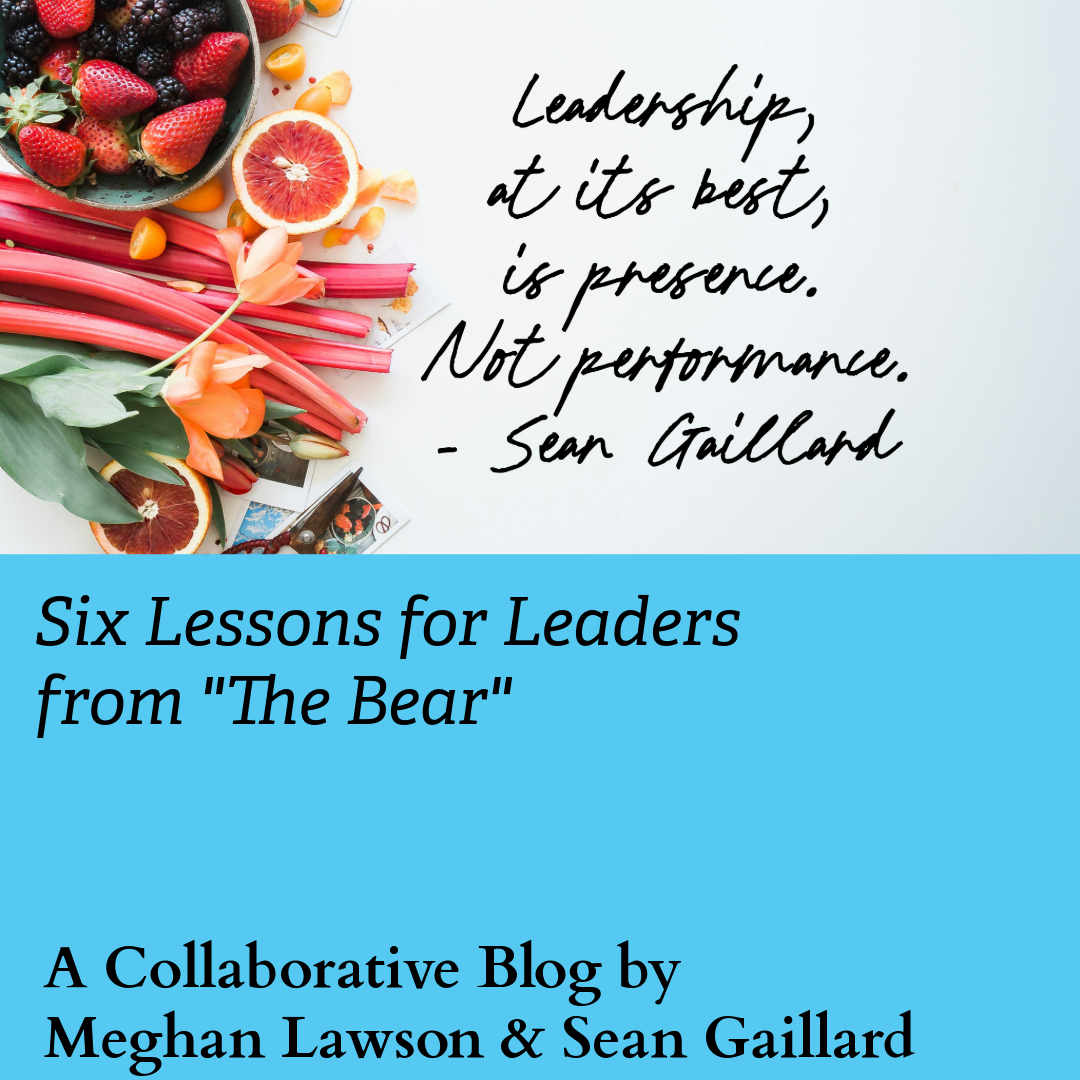
A collaborative reflection by Meghan Lawson & Sean Gaillard on leadership, belonging, and bright spots inspired by Season 4 of The Bear
Special Note: Big thanks to my good friend, Meghan Lawson, for collaboration and thought partnership on this joint blog post! Meghan is a dream to collaborate with and I am honored that we joined writing forces on this shared piece. Thank you, Chef!
Lessons from Season 4 of The Bear
So, if you haven’t watched, SPOILER ALERT.
I told my good friend, Sean Gaillard, this week that his friendship not only makes me a better leader, it helps me to listen more deeply and appreciate more fully. This includes music which won’t surprise those of you who know Sean. Over the past couple of years, Sean and I have bonded over our love of the show, The Bear, a show filled with beautiful messy people who love imperfectly but love deeply. We cannot help but see many connections to education and hope you enjoy our six lessons from season 4 below.
Meghan 1: Less is More
Prior to this season, Carmy wanted to put out a new menu every day. He claimed to have many reasons for this. Fresh ingredients, novelty, the possibility of a Michilin star, but this proved to be both taxing on his team and expensive and unsustainable long-term. If The Bear wanted to stay in business, they would have to simplify. They would have to do less well. So, they started to minimize ingredients, focused on making simplified but exquisite meals consistently, and they worked to optimize the customer experience. As a result, things start to turn around for their restaurant.
I couldn’t help but see the inevitable parallel between this restaurant story and our work in schools. Too often, well-intentioned educational leaders learn of the latest and greatest in education and push those initiatives out to the staff in the hopes that this will be the year that they reach their school goals and see swift improvements in their data. We all know how the story ends. Some teachers burnout and others become disengaged figuring that “this too shall pass” so why bother with some of these “flavor of the month” strategies.
There is such a thing as too much of a good thing. When I need reminding of this, life humbles me with little missteps. I’ve put too much salt on my food to the point it’s become inedible. I’ve used too much blush or too much hair product and spent the day looking like a Broadway stage wannabe. And I’ve tried to do too much at one time with my team and had it backfire. So, I’m not writing this as some leadership expert. I’m writing this as someone who seems to learn lessons over and over again and only one way: the hard way.
We’ve been working on growing the capacity of our building leadership teams in my school district. I presented a plan for the work to principals for feedback in the spring. Then, when the hustle of the school year subsided, and we shifted gears to summer planning and learning, after digging into some learning together, it was clear. Parts of my plan were too much, and we needed to pivot. So, we did.
And this is why you need to listen to and trust your team.
Meghan 2: You Need a Team More than You Think
I read something powerful. I believe I found it in The Culture Code by Daniel Coyle. Essentially, in a study of teams, the team of high achievers who didn’t work closely together did not perform as well as the average performers on a high-functioning team. In The Bear, members of the team fully embrace their special role on the team. Ebraheim focuses on The Beef sandwich shop where it all started for this family owned restaurant. Turns out, this simple sandwich window is single-handedly keeping The Bear afloat. Syd focuses on her scallops. Tina (man, I just love her) focuses on making her pasta dish in under 3 minutes. Marcus focuses on being the best pastry chef he can be and even earns recognition in Food & Wine magazine. Richie, perhaps my favorite character, focuses on service. Nat on finances. They all do their part and do it well, and when another person is in some kind of trouble, they offer to help. They are in constant communication throughout the night. They have to be. They have to know when someone is walking behind them or when someone has a hot plate in their hands and or how much time remains before service. As they say, “Every Second Counts.” For the most part, they all have enough basic knowledge required to execute on various basic functions of the restaurants as needed. But they don’t have to do it all.
And yet, here we are. Often expecting ourselves to be the master of all things in our classrooms and schools. We want to be able to do it all and do it all at a high level. But what if we shifted our energy to identify how to leverage the strengths of our team? It’s not that we aren’t going to meet and won’t be collaborating. The Bear has a team meeting every day as do most restaurants. Some even break bread together before they begin service. But are we being strategic about the way we utilize the gifts of our teammates in a way that is equitable and advances our mission? I’m not a whiz at spreadsheets, but I know how to facilitate a meeting that moves us from point A to point B and ensures equity of voice. Can I learn how to be better at spreadsheet work? Sure, I can. We are all learners. Learning is our business. Is becoming a spreadsheet master, something I hate by the way, the best use of my time and energy when I have teammates who thrive in spreadsheets? Probably not. Planning an impactful meeting, using those sheets, gives me energy and is also needed.
Meghan 3: You Are Not Your Job
Throughout this season of The Bear, it’s clear that Carmy is having an existential crisis. He’s spent his adult life hyper-focused on his work. So much so, that this work became all he knew of the world and himself. For those of us, myself included, with childhood and adult trauma, this is a coping mechanism that I know all too well. It’s easier to compartmentalize the hard stuff and throw ourselves fully into our work than it is to confront painful realities. Natalie forces Carmy to hold her baby for a moment. He’s meeting her baby for the first time, and you can tell he is uncomfortable holding the baby at first but with time, he eases into it and himself in the moment with her. There’s a split second where Richie catches a glimpse of them, uncle and niece together, and smiles to himself realizing how special this moment truly is for Carmy. Carmy has countless moments of awakening outside of the kitchen this season and explains in the final season that he doesn’t know who he is outside of the kitchen.
I love our profession. I believe deeply in the work we do. And I worry about us. For too many of us, myself included, we’ve centered our lives and identities on success in education. I worry about this so much that I wrote about it in Legacy of Learning, “You are giving others the strength to move forward, the strength to believe in themselves, the strength to try to make this world a better place. Knowing this makes being an educator so meaningful. But we don’t have to suffer while we make this kind of impact. In fact, the more we can live well and be well, the more our impact will grow.”
If our well-being and self-esteem is solely predicated on how well we are believe we are performing in our work, that is a very fragile ecosystem. We don’t have to earn love or earn self-worth. We already have it. Everything we have is everything we need. So, let’s start paying attention to how we talk to ourselves. Let’s talk to ourselves like we talk to people we love. The most important work is the work we do on ourselves. Everything else is secondary.
Sean: Collaborating with Meghan Lawson is always a bright spot. Her lens on leadership sharpens mine. What’s even better is that her friendship always makes be better. Her reflections on The Bear Season 4 kick open the door for all of us to pause, reflect, and notice the extraordinary in the everyday. I’m grateful to add to this conversation not just as a fan of the show, but as a school leader who believes deeply in the power of culture, connection, and care just as Meghan exemplifies.
This summer, Meghan and I had the chance to hear Dan Heath speak live at the ISTE + ASCD Annual Conference in San Antonio. His keynote, inspired by his book Reset: How To Change What’s Not Working, challenged us to “study the bright spots.” His words weren’t just memorable; they were actionable. That idea has stayed with me, echoing in my heart and practice.
Bright spots can be found in great TV, too. And The Bear is brimming with them—tiny, powerful moments that show what leadership, belonging, and humanity look like under pressure. Here are a few that have stuck with me and how they’ve nudged me to lead better:
Sean: 1. The Art of Delight
In one of the standout scenes, Richie makes sure a guest gets an authentic Chicago Beef sandwich. That alone would’ve been enough. But then? The restaurant team makes it snow. A surprise. A moment of joy. An act of intentional delight.
Great leaders do the same. They listen for delight opportunities. They tune into what others need even if they don’t say it out loud. Delight isn’t about flashy gestures; it’s about showing people they matter.
For me, this takes the form of Positive Principal Phone Calls Home. I call families not because something went wrong—but because something went right. A student showed kindness. A kid made growth. A teacher created magic. It’s the equivalent of snow falling indoors. And it always lands.
Sean: 2. You Are Never Alone
Carmy, fractured and guarded, prepares lunch for his estranged mother. Syd chooses to show up for Richie even though the wedding they’re attending is for his ex-wife. These moments speak volumes. In the kitchen or in the chaos, someone chooses to be there.
Leadership, at its best, is presence. Not performance.
On a recent flight home, I noticed a fellow passenger battling flight anxiety. No fanfare. Just a quiet offer to talk, sit, and be. We shared the journey—sky and fear alike. That moment reminded me of school. We often say the principal’s office can be a lonely place. But it doesn’t have to be. Leaders must extend that reminder: you are not alone to students, staff, and families. And sometimes, to ourselves.
Sean: 3. Belonging Matters
There’s a powerful scene where Richie’s daughter is too afraid to dance at a wedding. What do the adults do? They crawl under the table and share their own fears. It’s tender, honest, and unforgettable.
Leadership is often loud. But sometimes, it’s quiet courage: the willingness to go under the table with someone else’s fear and stay there with them until they’re ready to rise.
This summer, I wrote handwritten letters to my staff. Simple notes of gratitude and anticipation. No big speech. Just connection. It’s how belonging begins by saying: I see you. I’m glad you’re here. I can’t wait for what’s ahead.
The Bear isn’t just entertainment. It’s a mirror. A reminder. A bright spot. And as we get ready for a new school year, there’s no better time to slow down, reflect, and carry these lessons into our leadership.
-Here’s to delight. -Here’s to presence. – Here’s to belonging. – Here’s to the bright spots.
Spinning a New Track: Announcing My Next Book Leadership Riffs
As I write this blog on an early Saturday morning, the soulful sounds of jazz guitarist Wes Montgomery are playing in the background. I can’t think of a better soundtrack to accompany this announcement: my next book is on the way, Leadership Riffs: Harmonizing Inspiration, Innovation, and Impact.
In music, a riff is a catchy, repeated musical phrase or pattern—something that grabs your attention, moves the song forward, and stays with you long after the final note. That’s the heart of this book: exploring the powerful, repeatable moves that leaders can make to inspire others, spark innovation, and create lasting impact.
I am deeply honored to partner once again with the amazing team at Dave Burgess Consulting, Inc. Their belief in my first book, The Pepper Effect, a mash-up love letter to The Beatles and school leadership, meant the world to me. Their continued support of Leadership Riffs is just as heartfelt and I am filled with gratitude.
Imagine leadership as a beautifully orchestrated album:
Each decision is a purposeful chord
Each collaboration is a blend of voices in harmony
Each courageous innovation becomes a memorable melody
Leadership Riffs will serve as a guidebook for educational leaders. It will blend timeless lessons from legendary musicians with practical, actionable strategies for leading schools and teams. This is about crafting leadership that grooves with authenticity and resonates with those we serve.
Publishing The Pepper Effect was a dream come true. Now I’m thrilled that it will have a “bandmate” in Leadership Riffs. If you’d like to revisit The Pepper Effect or read it for the first time as I continue work on the new book, you can find it here on Amazon.
I invite you to join me on this journey. Follow along here on the blog for behind-the-scenes updates and maybe a few surprises along the way.
Stay tuned and be sure to follow the conversation on #LeadershipRiffs via X, BlueSky, Instagram, Facebook, and LinkedIn.
In the meantime, let’s keep the vinyl spinning and move forward with the kind of inspiration that stays at the top of our leadership playlist. The kind that makes the world a better place for others.
Signing the book contract for #LeadershipRiffs! Photo Courtesy of Courtney Gaillard
The Summer Series of The Principal Liner Notes Podcast continues with an inspiring and heartfelt conversation featuring Dr. Sonia Matthew, the 2025 Maryland Assistant Principal of the Year.
Dr. Matthew brings deep insight, clarity, and joy to this conversation. We explore the essential role of the assistant principal and the importance of school leaders being intentional about mentoring and empowering their APs. Our discussion was more than a reflection, it was a call to action. As principals, we are called to create space for leadership to grow and thrive at every level.
One of my favorite moments in this episode is the mention by Sonia of Lauren Kaufman and her amazing book, The Leader Inside. As many of you know, Lauren is a frequent guest on my podcast. Her book is a great resource for mentorship and inspiration that is worthwhile for several revisitations. The impact of the book on Sonia is definitely compelling and you will get an opportunity to experience that impact in this episode.
What you’ll also hear in this episode is just the beginning. Dr. Matthew and I are already planting seeds for a new collaboration that will shine a spotlight on the assistant principalship and provide meaningful support and coaching resources for those who serve in that vital role.
Listen and join us in this reflection on purpose, leadership, and the power of lifting each other up. I would love to hear your comments on this episode. Please feel free to share here or on one of the podcast platforms shared here.
There are checklists to check off. Boxes to move. Emails to answer. Meetings to attend. Conversations to wrap. It can feel like you’re racing a clock with no hands—just noise, motion, and that persistent push toward “done.” As school leaders, we often wear this urgency like a badge of honor. But somewhere in the frenzy, we lose sight of something vital:
The pause.
The other day, our custodian was out, and I had to stay late to close the building. Alone. I walked the halls, locking doors and preparing to set the alarm. The building was still. No laughter echoing down the halls. No rush of students heading to the buses. Just me and the walls that had witnessed a school year’s worth of highs, lows, pivots, and quiet victories.
That simple rhythm—step, door, lock, breathe—became something sacred. I wasn’t just closing a building. I was closing a chapter. In that silence, the year spoke back to me. I remembered the breakthroughs. The bruises. The bounce-backs. The beauty of what we had built together.
And I realized something all over again: reflection is not a luxury. It’s a necessity.
Since my heart episode last year—a moment that forced me to recharge not just physically, but mentally and spiritually—I’ve come to believe even more deeply in the power of pause. I spent too many years avoiding it. Confusing the speed of leadership with the strength of leadership. I mistook checklists for vision. And it nearly broke me.
Innovation doesn’t come from being in constant motion. It comes from being still enough to listen to what the year has been teaching us all along.
So I offer this, not just as a fellow school leader, but as someone who had to learn the hard way: Make reflection part of your leadership practice. Not later. Now.
Here are three ways I’m leaning into reflection, even in the middle of the end-of-year mania:
🎧 1. Schedule 15 Minutes of Stillness
Block out 15 minutes this week—no email, no meetings, no phone. Find a quiet corner of your school. Sit. Breathe. Let the silence remind you of your why.
📝 2. Journal with Three Prompts
What am I most proud of this year? What did I learn from my staff? What will I do differently next year? Keep it short. Keep it honest. But write it down. Let your words catch up with your heart.
🚶♂️ 3. Take a Solo Walk Through the Building
No agenda. No checklist. Just walk. Let the sights, sounds, and stillness speak to you. Every poster, every student project, every empty seat is a story. These are the artifacts of your leadership.
If you’re reading this and feeling overwhelmed or alone, know this: you’re not. I’m walking this with you. And if you need a thought partner or a word of encouragement, I’m here.
Leadership is lonely—but it doesn’t have to be isolating. Especially when we choose to pause, reflect, and lead with presence.
This post is dedicated to my true Fab Four: Deb, Maddie, Emily, & Rachel.
This past weekend, our family was called to divide and conquer. A moment we had both dreamed of and quietly feared had finally arrived: our twin daughters were graduating from college—at two different universities, with ceremonies only an hour apart.
That scheduling twist, which had loomed as a distant possibility, finally became reality. But in true fashion, our daughters made the call for us. They knew the challenge of being in two places at once, and they handled it with grace, maturity, and love. One twin would be celebrated in Boone, the other in Charlotte. My wife, Deborah, attended Emily’s ceremony, while I went to Rachel’s.
It wasn’t easy. We wanted so badly to be in the same place, to celebrate both daughters together as a complete family. But our hearts remained united, even across the miles.
As I sat in the Convocation Center at Appalachian State University, surrounded by the joyful noise of other families, I found myself scanning the sea of black caps and gowns. I was determined to catch a glimpse of Rachel. Our oldest daughter, Maddie, who had just completed her second year of law school, finally spotted her and pointed excitedly.
And then—there she was.
Waving. Smiling. Radiant in her graduation regalia.
For a moment, time folded in on itself. Her wave transported me to another milestone—the day of Rachel’s First Communion. That same smile, that same sparkle in her eye. She had looked across the church, found me in the crowd, and sent me a quiet wave. I had waved back, with the same lump in my throat that returned to me all these years later.
But something else happened, too. In Rachel’s smile, I also saw Emily’s. Her twin’s light and laughter seemed to echo in that moment. It was as if both were standing there in front of me, even though Emily was an hour away in Charlotte. I felt a powerful closeness to both daughters, woven together in that one unforgettable glance.
That’s the thing about being a parent. These moments hit you like a thunderclap. They echo from the past and resonate into the future. And suddenly, you realize the most important title you’ll ever hold isn’t “Principal” or “Author” or anything in your email signature. It’s simply “Dad.”
I am so proud of all three of my daughters—Maddie, Emily, and Rachel. They are bright, strong, kind, and wise. They are charting their own paths as young adults, and watching them step into their lives fills me with awe. I’m even more grateful for my wife, Deborah, whose quiet strength and boundless love have held the center of our family together through every season of growth.
Now, with the nest officially empty, I find myself reflecting—not with sadness, but with gratitude. The house may be quieter, but my heart is louder than ever with pride and love.
What Matters Most
It’s easy to get lost in the deadlines, testing windows, evaluations, checklists, and calendar invites. But in the rush of it all, don’t lose sight of what matters most—your people. Your family. Your loved ones.
I’ve made mistakes. I’ve put the job first far too many times. I’ve been the principal who stared at the calendar and missed moments that I can’t get back. And I’m still learning.
John Lennon said it best in “Beautiful Boy (Darling Boy),” a song he wrote for his five-year-old son, Sean. It appears on Double Fantasy, the final album Lennon released in his lifetime, just weeks before he was so senselessly killed by gunfire at the age of 40.
In that song, Lennon offers this lyric that has never left me:
“Life is what happens to you while you’re busy making other plans.”
It’s more than a line—it’s a truth that rings louder the older we get, especially when the nest starts to empty and the calendar continues to fill.
So, as the year closes and you check off your last task, I offer a few humble reminders:
Action Steps for Leaders to Thrive in Life and Work
1. Calendar Your Family First Put family time on the calendar with the same importance as meetings or walkthroughs. Block it out. Protect it.
2. Celebrate Milestones—Big and Small A graduation, a recital, a family dinner. These are not interruptions. They are the point.
3. Let Your Team In Model balance for your team. Share your family moments. Celebrate theirs. Normalize stepping away to be present.
4. Unplug With Purpose Turn off the notifications. Leave the laptop in the bag. Watch the game, take the walk, enjoy the silence.
5. Reflect Often Journal. Take a quiet moment in the car. Play a favorite song or album. Remind yourself why you do what you do—and for whom.
The nest may be empty, but the heart stays full. And at the end of the day, love is the legacy that lasts far beyond our leadership roles.
So here’s to what matters. Here’s to waving daughters, twin smiles, and a family that found a way to be in two places at once—with love as the through line.





 Leadership Liner Notes: Sean Gaillard