The Power of Belonging and Curiosity in Schools


Inspired by “Why Curiosity Not Coding Is the Top Trait CEOs Need for the Future of Work”
https://www.inc.com/joe-galvin/why-curiosity-not-coding-is-the-top-trait-ceos-need-for-the-future-of-work/91278344

I recently read an article in Inc. that stopped me in my tracks. It argued that curiosity, not coding, is the most essential trait leaders will need for the future of work. That idea resonated deeply because it echoes what many of us in education feel but often struggle to defend. Human centeredness matters. Curiosity matters. Schools often over rely on test scores. They depend too much on canned surveys and unfunded mandates. As a result, we miss the very conditions that allow real learning to take root.

Curiosity is not an add on. Curiosity is not a kit. Curiosity is not a scripted program rolled out with fidelity checklists. Curiosity is a mindset embedded in culture. It shapes how people ask questions, how they listen, and how they engage with uncertainty. When curiosity is confined to a STEM lab or a special event, the message becomes clear. Wonder is optional. Compliance is the goal.

That is not the world our students are walking into now.

A culture of curiosity cannot exist without belonging. Students do not take intellectual risks in spaces where they do not feel seen, valued, and safe. Teachers do not model curiosity in environments where trust is fragile. Leaders cannot inspire curiosity without the conviction that belonging matters first.

Belonging is the catalyst.

When students feel they belong, they ask better questions. When teachers feel they belong, they experiment. When leaders build belonging intentionally, curiosity follows naturally. Culture is not built through slogans on the wall. Culture is built through interactions, shared experiences, and the daily signals that tell people they matter.

This belief was reinforced for me at the ISTE+ASCD Conference in San Antonio this past summer. One of the keynotes was delivered by Scott Shigeoka, author of Seek: How Curiosity Can Transform Your Life and Change the World. His message was powerful and deeply affirming. He shared research that shows deep curiosity strengthens relationships, expands empathy, and fuels innovation. Curiosity, he reminded us, is an invitation. An invitation to seek. An invitation to share what we are learning. An invitation to be open to one another.

That keynote moved me so much that I left the session and immediately bought his book for myself and for a friend. It raised questions that continue to linger. What if we inspired curiosity without inhibition? What if we were curious about each other’s gifts? What if curiosity became a shared practice rather than a private trait?

These ideas are not theoretical for me.

Years ago, when I served as principal of a STEAM Magnet Middle School, we intentionally stepped outside the schoolhouse to experience innovation in action. We formed a community partnership with the Innovation Quarter in Winston Salem, a living ecosystem of research, entrepreneurship, and collaboration. The most important decision was sending teachers first.

Teachers visited the space. Teachers listened to innovators describe their work. Teachers asked questions about how ideas move from concept to impact. No binders were handed out. No scripts were followed. Conversations emerged organically. Beliefs began to shift. Instruction changed because mindsets changed.

This work is possible in any schoolhouse.

Here are practical first steps leaders can take to build a culture of curiosity grounded in belonging.

Start with a PLC on Curiosity
Begin by naming curiosity as a shared value. Use a PLC to explore what curiosity looks like in classrooms, adult learning, and leadership practice. Invite teachers to reflect on when they feel most curious and when students seem most engaged. Anchor the conversation in real experiences rather than initiatives. Curiosity grows when people feel heard.

Lead With Questions
Model curiosity as a leader. Replace quick answers with thoughtful questions during meetings, walkthroughs, and coaching conversations. Ask students what they are wondering. Ask teachers what they are noticing. Ask teams what might happen if they tried something new. Questions communicate trust and signal that thinking matters.

Build Authentic Problem Based Experiences
Design learning experiences connected to real problems students care about. Invite students to tackle challenges in their school or community. Allow them to research, collaborate, and present solutions. Authentic problems invite ownership and deepen belonging because students see their voices matter.

Schedule Time for Curiosity
Schools protect time for silent reading because literacy matters. Curiosity deserves the same respect. Build dedicated time into the master schedule for inquiry, exploration, and passion projects. This time might look like Genius Hour, inquiry labs, or interdisciplinary exploration blocks. Time signals value.

Partner With Innovative Organizations
Seek partnerships with businesses or organizations where innovation is embedded in the culture. Invite professionals to share how curiosity drives their work. Organize site visits for staff. Allow students to see curiosity modeled beyond the classroom walls. Exposure expands possibility.

I am over test scores and canned surveys being the primary guides for the work that needs to be done in service of students. Data has a place, but humanity must lead. Human centered schools create the conditions for belonging. Belonging ignites curiosity. Curiosity fuels learning that lasts.

If schools are to prepare students for an unknown future, leaders must have the courage to protect curiosity and the conviction to build belonging. This work is bold. This work is attainable. This work is necessary.

Curiosity is not a distraction from achievement. Curiosity is the pathway.

That is the work worth doing.
Embracing the AI Sputnik Moment: Why Schools Must Prepare Now

AI is not a passing trend. It is our wake-up call. In this defining moment for education, how we respond matters more than ever. The G.A.I.N Effect offers a roadmap for rising to the challenge.


I keep thinking about that moment when I read the headline: over 14,000 layoffs at Amazon. The reason? Artificial Intelligence. And these were not warehouse or frontline jobs. These were white collar roles. The kind of jobs many of us grew up believing were secure.

That was the gut punch. That was the message.

This is not just a corporate restructuring. It is a cultural turning point. It is our Sputnik moment.

Back in 1957, when Sputnik launched into orbit, it forced an entire education system to recalibrate. Science and innovation had to move from theory to reality. The classroom had to change fast.

Now AI is sending us that same signal. And we are the ones who must decide: do we lead into this new world, or do we cling to old maps that no longer guide?

Too often, we treat innovation like a slogan. A selfie at an edtech conference. A new tool we buy, but never deeply integrate.

Innovation cannot just be about branding or the latest tech buzz.

This seismic change requires attention, reflection, and action.

It also requires a mindset we take into dynamic motion. This is where I lean into the G.A.I.N. Effect: a leadership compass that moves beyond buzzwords and into bold, daily practice:

  • Growth: Embrace the mindset of a learner. Stay curious. Read. Reflect. Evolve.
  • Agility: Pivot with purpose. Stay flexible. Be ready to shift as needed. The world is not waiting.
  • Insight: Tune into your values. Lead with clarity. Stay grounded in what matters most.
  • Network: Find your people. Surround yourself with fellow learners and bold thinkers. Collaboration is essential.

We do not need to panic. But we do need to move.

We do not need to fear change. We need to embrace it together.

We do not need to avoid the current reality of AI. We need to lean into each other and collaborate in tune with other’s strengths and vulnerabilities.

We must help, support, encourage, collaborate, and learn together.

This is not about knowing all the answers. This is about having the courage to ask the right questions and take the next bold step forward.

Here are five visceral action steps that leaders, educators, and stakeholders can take right now:

  1. Create space for curiosity
    Host a conversation. Invite wonder. Ask what people are thinking and feeling about AI. Include students. Include families. Let the questions guide the learning.
  2. Model the learning
    Pick one AI tool. Use it. Reflect. Share what you noticed. If you are not exploring, you are signaling that learning stops at the top.
  3. Design student-centered experiences
    Connect AI to real-world problem solving. Let students create, reflect, and engage with purpose. Prepare them for a future that demands more than memorization.
  4. Connect with others doing the work
    Find your bandmates. Reach out. Share what is working. Ask for help. No one leads in isolation.
  5. Anchor in purpose
    AI is not the destination. It is part of the journey. Our mission remains to see every student, support every educator, and strengthen every community. Let that be our guide.

This is not the time for passivity. This is not the time to say, “We will figure it out later.”

We have a moral imperative to prepare all of our students for a world where they can contribute as innovators.

We are not waiting for the future to arrive. It is already here.

This is the moment.

Let’s lead like it.

A Mindset for Masterpiece Leadership

What if we lived like the masterpiece was already within us?

Not something to chase.
Not something to prove.
But something to uncover: one brushstroke, one note, one word, one choice at a time.

Every student.
Every educator.
Every human.


Brushstrokes of Belief

I think about the times I’ve compromised this mindset. When I was told I dreamed too big. When I was advised to play it safe. I think of the moments when I silenced the masterpiece inside me and gave in to the ease of the status quo. I remember the opportunities I allowed to slip by: ideas that could’ve blossomed into impact because I chose comfort over courage.

As leaders, we must stay grounded in our core. We must also recognize and nurture the masterpiece within the people we serve. Every child, every teacher, every staff member-each one carries the potential for something extraordinary. And it’s our role to invite them into that mindset by stewarding a culture of trust and belonging.


The Invitational Question

As the school year begins, it’s easy to get swept up in to-do lists, calendars, classroom setups, and kickoff meetings. We aim for a smooth start. We hope for a clean slate and an open horizon.

But what if we paused and started the year with one powerful, invitational question?-

How might we co-create a masterpiece in our schoolhouse: one that uplifts our students and each other?

Let that question be your catalyst.
Maybe it’s what your team needs to hear from you.
Maybe it’s what you need to hear from yourself.
Let it refuel your purpose. Let it restore your voice. Let it help you walk in your truth.


Rewriting the Lesson Plan Narrative

In The Pepper Effect, I write about believing in your school’s masterpiece. Just like The Beatles banded together to create Sgt. Pepper’s Lonely Hearts Club Band, a masterpiece isn’t made in isolation—it’s built in collaboration and powered by belief.

At one school where I served as principal, we embraced this mindset in an unexpected place: lesson plans.

Too often, lesson plans become compliance checklists, stifling creativity and reducing the work of educators to mere documentation. Some principals use them as instruments of what Stephen M.R. Covey calls “Command and Control” leadership.

We flipped the script.

Instead of just turning in lesson plans, teachers would highlight a Masterpiece Moment: a singular experience they crafted with passion and intention. It might be a writing prompt, a science experiment, a read-aloud, or a student-led discussion. It didn’t have to be perfect: it had to be purposeful.

In faculty meetings, these moments were shared and celebrated. One teacher compared her lesson to Georgia O’Keeffe’s Sky Above Clouds. Another likened hers to a jazz solo-improvised yet deeply moving.

That small practice opened space for connection, creativity, and belonging. And it reminded us that teaching, like art, is about resonance not replication.


Beethoven’s Ninth and the Schoolhouse

When Beethoven composed his Ninth Symphony, he was completely deaf. Yet, out of silence, he created one of the most profound masterpieces in human history, a work that transcends time, language, and boundaries. The Ode to Joy finale still brings audiences to their feet in awe. It always brings me to tears.

What does that have to do with school leadership?

Everything.

Sometimes leadership feels like working through silence. This can occur when feedback is absent, progress feels slow, or inspiration wanes. And yet, like Beethoven, we still compose. We still create. We still believe. Because the masterpiece is not in the noise, it’s in the conviction, the resilience, and the courage to keep going.

Your school can be your Ode to Joy—crafted not out of perfection, but out of perseverance and purpose.


Four Moves to Practice Masterpiece Leadership All Year Long

1. Curate “Masterpiece Moments” Monthly
Set aside 5 minutes during staff meetings to highlight one standout teaching moment from a colleague. Let them share what made it special. Invite joy, not judgment.

2. Embed the Question Into Coaching & Walkthroughs
Use the question “What part of your instruction this week feels like a masterpiece?” as a reflection prompt in coaching conversations or feedback forms.

3. Display Masterpiece Boards
In a shared space, physically or virtually, let staff (and students!) contribute their own “masterpiece” moments throughout the year. This builds a gallery of impact, belonging, and belief.

4. Model It as a Leader
Share your own masterpiece moments as a principal—an email to families, a conversation with a student, a restored partnership. Let your staff see your brushstrokes, too.


The Masterpiece Within

A true masterpiece is timeless and universal. It’s not about accolades or applause; rather, it’s about meaning. It connects us to our humanity. It sparks new ideas. And in leadership, that’s our calling: to ignite that mindset in others.

Especially on the days filled with deadlines, meetings, emails, and decisions—remember:

You are the catalyst.
You carry the brush, the baton, the pen.

We all carry a masterpiece within us.
What if that belief became the prevailing mindset—in our schools, in our leadership, in our lives?

Let’s lead from that place.
Let’s teach from that place.
Let’s be that place.

Light Our Fire: Leadership, Problem-Solving, and the Sound of Collaboration

Recently, I came across a clip on YouTube of the late Ray Manzarek of The Doors telling the origin story of their 1967 hit Light My Fire. It’s one of those creative origin stories that just sticks. Ray talked about how each band member added a unique musical flavor that transformed the song into something iconic.

Guitarist Robby Krieger brought his flamenco background and wrote the core of the tune. John Densmore layered in a Latin beat on drums. Jim Morrison added a poetic and haunting verse about a funeral pyre. Ray himself took a page from Bach to create that unforgettable keyboard intro. All these ingredients came together like a great jam session, different parts working in harmony to create something innovative, inspired, and bold.

The Doors didn’t play it safe. They took a leap. They trusted each other. And they built something greater than the sum of their parts. That story got me thinking about what it means to lead and solve problems in a school.

When it came time to revise our master schedule at the school I serve as principal, the challenge was real. We needed to maximize instructional time and expand opportunities for intervention. But we didn’t tackle it in isolation. We did it together.

Over two weeks, I brought the challenge to our Instructional Leadership Team, the School Improvement Team, and several staff and teacher partners. These weren’t just quick drop-ins or top-down mandates. These were real conversations, one-on-one meetings, small group huddles, and full team sessions. I started each one with a simple design thinking prompt: How Might We…?

I’ll never forget one particular session with the School Improvement Team. We were all gathered around the same table. Teachers led the discussion. We weighed pros and cons. Ideas flew. Everyone added a perspective, and each voice mattered. There was no single author of the final schedule. Just like The Doors building Light My Fire, each person added a line, a beat, a riff.

Once we landed on a draft, I shared we’d treat it as a trial run. That removed pressure and opened space for feedback. We gave it a shot, came back, reflected, and adjusted. And here’s the best part—it worked. Not because it was perfect, but because it was owned. Teachers had skin in the game. Everyone contributed. Everyone collaborated. Everyone made it better.

This process reminded me that these collaborative moments between teachers and school leaders must echo what we want our students to experience. According to the World Economic Forum, one of the top job skills for 2025 is complex problem solving. Our students won’t master that skill from worksheets alone. They’ll learn it because we model it. Because we live it. Because we solve problems together.


3 Action Steps To Take Build A Collaborative Problem Solving Culture

Leadership is about making space for others to create. It’s about asking How Might We instead of You Must. It’s about letting teachers jam. Here are three ways schools can start building that kind of collaborative problem-solving culture:

1. Create Solution Building Time
Set aside time during the month for small, creative think tanks. Bring together teachers, staff, and leaders in a low-pressure space to brainstorm, ideate, and prototype solutions. Use design thinking prompts. Use sticky notes. Use music. Just make it fun and focused.

2. Launch #InstantPD Moments
Give teachers the mic. Once a week, host a 15-minute pop-up PD session where a teacher shares a strategy that works. These micro-sessions build confidence, spread great practice, and create the conditions for more teacher-led innovation.

3. Use the Power of the Trial Run
When testing something new, give permission to try without pressure. Frame it as a pilot. Invite feedback. Circle back. This builds trust and opens the door for authentic input that shapes real change.


Whether it’s jamming with colleagues on a new idea or leading a full schedule redesign, when we bring people together, we get better. We build trust. We spark creativity. We light fires.

Let’s keep jamming. Let’s keep solving. Let’s keep leading like it matters.

This is your latest #LeadershipRiffs moment from the desk of a school principal who still believes in the power of collaboration, creativity, and the beautiful noise we make when we lead together.

Keep leading with rhythm. Keep building with heart.
Watch the Ray Manzarek Clip

Shadows of Future Potential: In Appreciation for Teachers

In an old comic book from my childhood, there’s a powerful image that has always stayed with me. It was an issue of Detective Comics that told the origin story of Batman. A young Bruce Wayne walks into Wayne Manor, ready to begin his hero’s journey. As he enters, his shadow stretches behind him—not as a boy, but as the full-formed silhouette of Batman. It was a simple panel, but it carried a profound truth: even in our earliest steps, the shadows of our future potential are already taking shape.

This image made me think about our calling as educators. Every day, we walk alongside students and teachers who are living their own origin stories. Some are just starting out, unsure of who they are or where they belong. Yet within them, we can glimpse the shadows of what they may become—leaders, artists, scientists, changemakers, or quiet heroes who make the world better in unseen ways.

This week is Teacher Appreciation Week, a moment to celebrate the educators who see those shadows before anyone else does. Teachers have a remarkable gift—a kind of superpower. They tune into the potential of their students and help them believe in it, even when the students can’t yet see it for themselves. Our teachers transform the impossible into the possible. They are not just instructors; they are cultivators of hope.

As school leaders, we are called to be architects of that hope. Our job is to build cultures where teachers are empowered to do their best work—where they can create the conditions for students to discover who they are meant to be.

I’ll never forget my fifth-grade teacher, Mrs. McMonagle. I was a new student, the only Black child in the class, adjusting to a new school in a new state. I felt lost—alienated, unsure, and afraid. But Mrs. McMonagle saw something in me that I couldn’t see in myself. She created a space where I felt seen and welcomed. She introduced me to the joy of writing, literature, and even encouraged my growing love for The Beatles. She pushed me, challenged me, and inspired me. I am forever grateful for the way she believed in me and gave me a sense of belonging.

Everyone carries the shadow of future potential. Teachers have a special sense for detecting those shadows and helping students realize the greatness within them. This week, and every week, let’s honor and celebrate that gift.

Here’s to the ones who chose to build trajectories of hope in our classrooms. Here’s to the ones who see the future before it arrives.

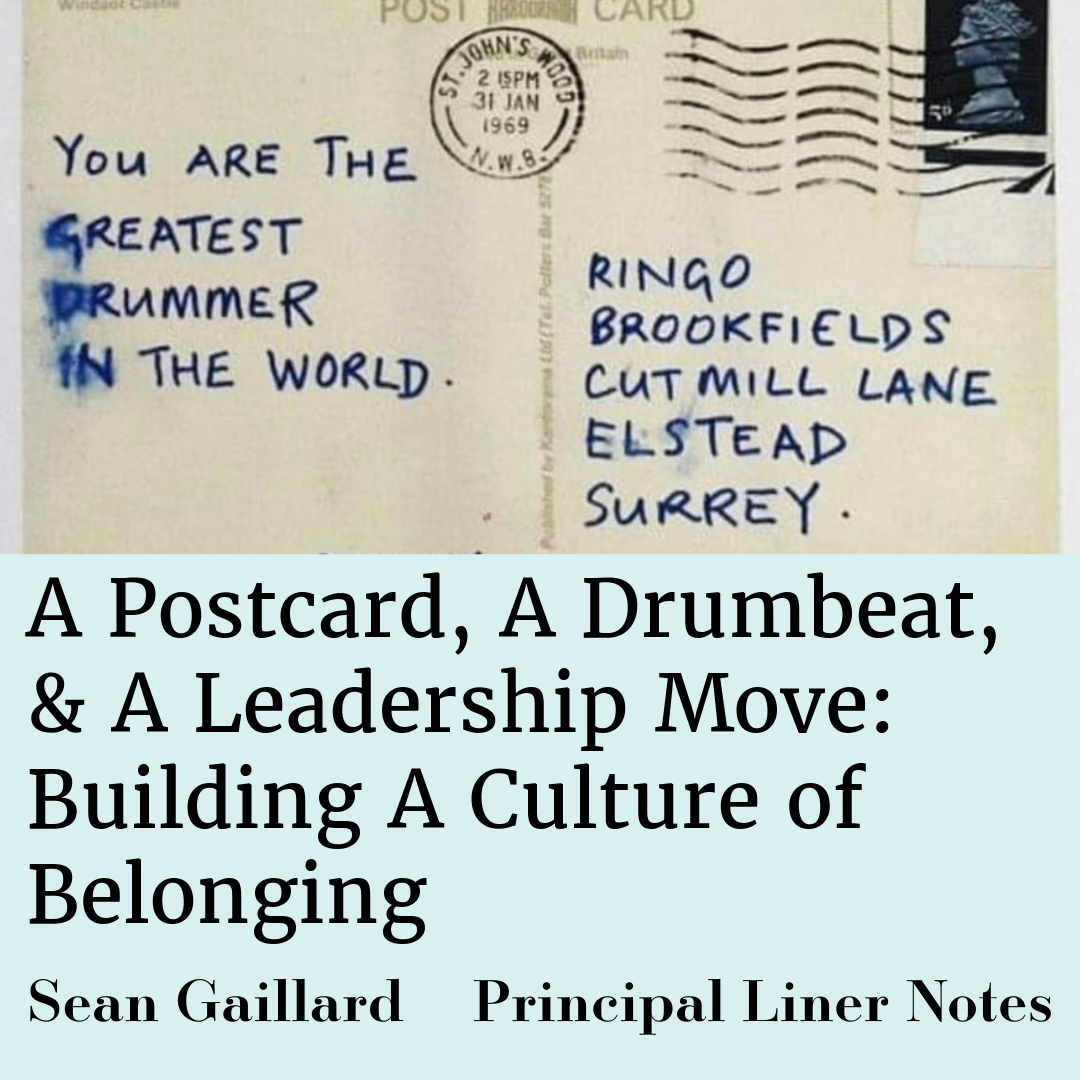
A Postcard, A Drumbeat, and A Leadership Move: Building a Culture of Belonging

Earlier this week, Beatles fans around the world commemorated the 56th anniversary of their final live performance—the legendary rooftop concert atop Apple Records. Captured in Get Back and memorialized in Let It Be, this moment was their live swan song, a testament to creative courage and collaboration.

Last week, I wrote about Rooftop Moments—the bold, defining moments that school leaders should cultivate with their teams. But there’s another, lesser-known moment in Beatles history that happened the day after that performance. A simple yet profound leadership move.

On January 31, 1969, Paul McCartney sent Ringo Starr a postcard that read:

“You are the greatest drummer in the world. Really.”

This wasn’t a public accolade or a grand gesture. It was a handwritten note—one musician reaching out to another, reinforcing connection and belonging. A small moment, but a significant one.

As school leaders, we talk about culture-building, trust, and recognition. Shoutouts in memos or emails are a start, but I’ve come to realize they often feel transactional, fleeting. Teachers deserve more than a quick mention in a newsletter that might be skimmed and forgotten. True belonging is built in the quiet, intentional moments—through handwritten notes and meaningful feedback.

The Power of a Handwritten Note

At Charles England Elementary, we start each faculty meeting with Praise and Thanks—a time to share shoutouts and gratitude. It sets a positive tone and creates psychological safety. But not everyone feels comfortable speaking in a large group, and exhaustion can sometimes make participation hard.

At a recent meeting, I placed blank Energy Bus-themed notes (inspired by Jon Gordon’s book) on tables and asked staff to write a message of gratitude to a colleague. No prompts, no pressure—just a moment to reflect and uplift. As I looked around, I saw teachers smiling, some wiping away tears, completely immersed in the moment. The next day, those notes found their way into mailboxes, and the ripple effect of encouragement began.

A handwritten note isn’t just ink on paper—it’s a tangible reminder that someone sees you. That your work matters. That you belong.

The Leadership Move: 30-Second Feedback

Another way we are reinforcing belonging is through 30-second feedback, a practice inspired by Mike Rutherford’s Seven Tools for Developing Teachers and Teaching (link). This simple but powerful strategy involves stopping into a classroom, identifying one specific positive thing, and sharing that feedback—either verbally or in a quick note.

Here’s what makes it work:

  • It’s not evaluative—just pure affirmation of great teaching.
  • It’s quick but intentional—a handwritten note, a short hallway chat, or a sticky note left on a desk.
  • It highlights strengths—no jargon, no checklist, just celebrating a moment of impact.
  • It builds connection—leaders engaging with teachers in a meaningful way, beyond scheduled observations.

I keep a pocketful of blank Post-its and make it a goal to visit at least three classrooms a day, leaving behind 30-second feedback. It’s transformed how teachers feel about their work. They light up, just like I imagine Ringo did when he read Paul’s postcard.

Four Ways to Build Belonging with Handwritten Notes & 30-Second Feedback

  1. Commit to Daily Touchpoints
    • Visit three teachers a day and leave either a quick verbal or written affirmation.
    • Track your visits to ensure everyone receives meaningful recognition.
  2. Use Specific Praise
    • Instead of “Great lesson!” try: “The way you engaged students in discussion today was fantastic. I could see their excitement!”
    • Authentic, detailed praise carries weight.
  3. Make Handwritten Notes a Habit
    • Keep blank notecards or sticky notes handy.
    • Surprise staff with a handwritten note in their mailbox or taped to their door.
  4. Encourage Peer-to-Peer Recognition
    • Incorporate note-writing into staff meetings or PLCs.
    • Provide postcards or themed templates to make it easy and fun.

A Legacy of Belonging

Think about the impact: just 90 seconds a day dedicated to 30-second feedback builds a culture where teachers feel seen, valued, and empowered. Multiply that over a school year, and you’ve created an environment where trust and belonging flourish.

As Meghan Lawson (link) reminds us in Legacy of Learning, these small wins shape the culture of a school. They’re the moments that keep teachers inspired and engaged.

56 years later, I’m still moved by a simple postcard between bandmates. It reminds me that leadership isn’t always about the big moves—it’s about the small, consistent moments of connection that build something lasting. Just like The Beatles, our legacy as educators is one of collaboration, impact, and belonging.

What’s your next leadership move? Maybe it’s as simple as writing a note.

Momentary Awareness: Leadership Riffs for Belonging

The other day, I had a text conversation with a friend who was transitioning to a new job opportunity. While my friend was leaving on good terms, it saddened me to hear that the departure went unacknowledged—no farewell, no simple goodbye. This person, whom I hold in high regard, experienced a silent exit. It struck me deeply and reminded me of the power of moments in our professional lives.

As a principal, I believe in the significance of building intentional bookends in service to others. These bookends, moments that begin and conclude a journey, are crucial in creating a tapestry of experiences that resonate. I developed this habit from my days in a band, where I would help arrange setlists to craft an experience for the audience. We’d start strong, set the tone, and build to a powerful conclusion that lingered long after the final note. I carried the same approach into my lesson planning as an English teacher.

As leaders, we are called to foster a culture of belonging for the people we serve. One key to building that sense of belonging is being mindful of the moments. How we welcome our people is just as important as how we conclude things. In the midst of the day’s chaos—meetings, deadlines, hurried communications—it’s easy to lose sight of this. But nothing is more important than investing time in making sure moments are meaningful for those we serve.

Whether we’re creating an upbeat orientation for new team members or wishing someone well as they move on to a new opportunity, it’s essential to be intentional. These interactions should be personal and meaningful, honoring the role that person played in our organization. We want them to leave with a positive narrative about their experience. More importantly, as leaders, we want to be decent, kind, and supportive.

Several years ago, I was captivated by The Power of Moments by Chip Heath and Dan Heath. The book emphasizes the impact of meaningful experiences in organizations, making it a must-read for any leader. One quote that resonates with me is, “Our lives are measured in moments, and defining moments are the ones that endure in our memories.” As school leaders, we must invest in creating moments that will echo in the lives of those we serve, ensuring that our teachers and students walk away from our schools feeling connected and a true sense of belonging. How we welcome is just as important as how we bid farewell.

Here are four ways school leaders can build meaningful moments that serve as bookends for the teachers and students they serve:

  1. Morning Meetings: Start the day with intention by hosting Morning Meetings. This time can be used to set a positive tone, share goals, and build a sense of community. It’s a moment where everyone can feel seen and heard, setting the stage for a productive and connected day.
  2. #CelebrateMonday: Kick off the week with #CelebrateMonday. This initiative is about starting each week on a positive and inviting note for all stakeholders. Recognize achievements, share uplifting stories, and set the tone for the days ahead. It’s a simple yet powerful way to create an environment where everyone feels valued and motivated.
  3. Closing Meetings for Students: As the school day ends, hold a Closing Meeting for Students. This is an opportunity to reflect on the day’s successes, address any challenges, and leave students with an empowering message. It ensures that they leave on an uplifting note, carrying that positive energy into their homes and communities.
  4. Personalized Farewells: When someone leaves your school, whether a student, teacher, or staff member, make it a point to acknowledge their departure in a meaningful way. A personalized farewell, whether it’s a small gathering, a handwritten note, or a simple but sincere goodbye, honors their contributions and ensures they leave with a sense of closure and appreciation.

Moments are intentional moves that must align with the vision and mission but must also resonate with the hearts of the people we get to serve and support. As leaders, let’s commit to creating those defining moments that will endure in the memories of those we lead