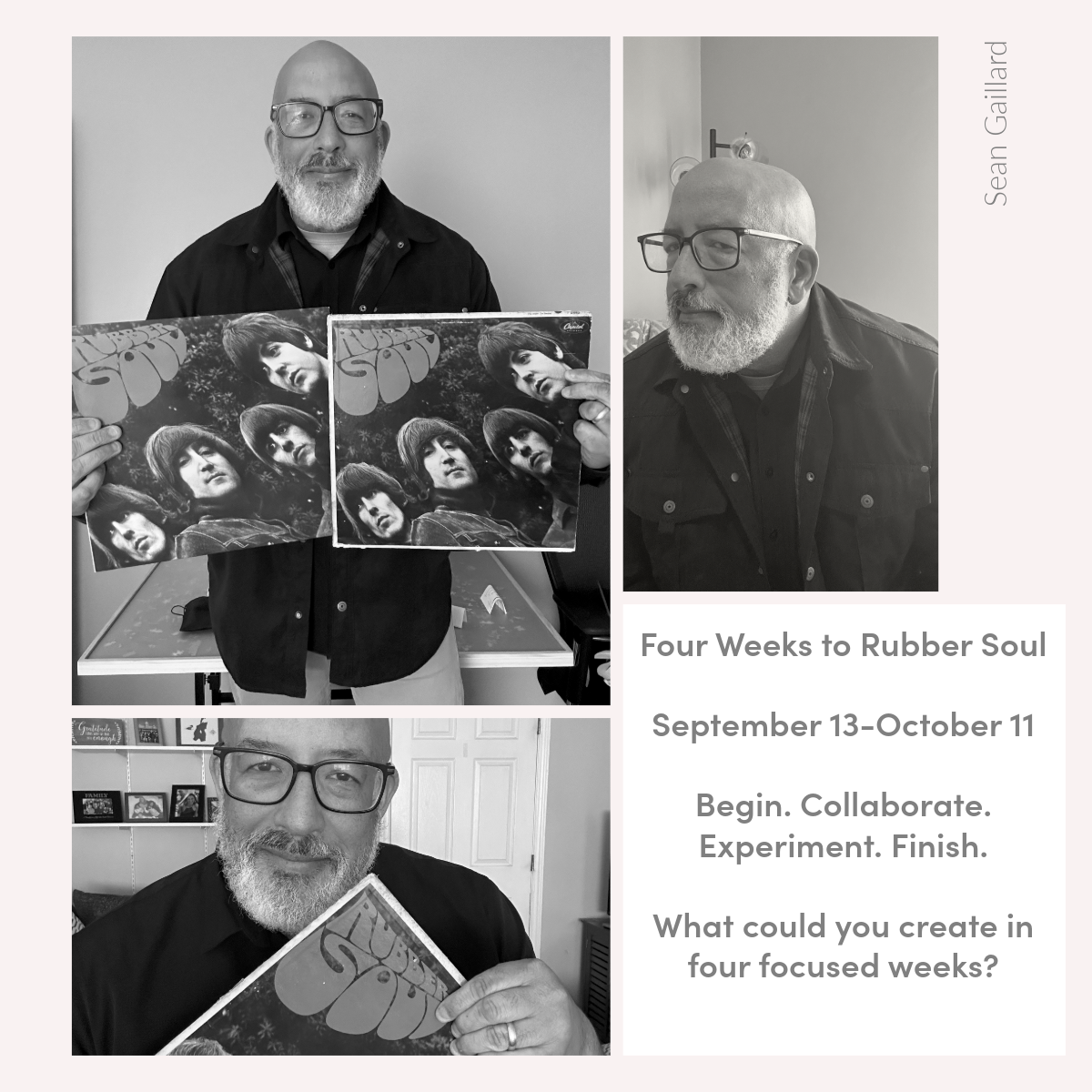
Day 15 Curiosity: Four Weeks to Rubber Soul

This is Day 15 of Four Weeks to Rubber Soul, which means we have reached the halfway point of our month together. We have spent the past two weeks exploring the creative journey The Beatles took during the fall of 1965 as they recorded Rubber Soul along with “Day Tripper” and “We Can Work It Out.” Those two songs were released separately from the album as their first double A side single.

I am grateful for everyone who has followed these daily blog posts and reels, shared them, reposted them, or offered a nudge of encouragement along the way. If you have missed a day or fallen behind, there is no checklist, deadline, or test waiting at the end. Creativity does not always move according to a schedule. Sometimes we need room to explore, wander, return, and move at the pace that helps the work grow.

Today also begins a new week and a new theme: Experiment. Our word for Day 15 is Curiosity, because experimentation usually begins with one of the simplest and most powerful creative questions we can ask:

What if?

That question seems especially fitting for Rubber Soul. The Beatles were increasingly interested in finding different sounds, trying unfamiliar instruments, and pushing beyond the musical boundaries that had defined their earlier recordings. George Martin later recalled that they were constantly experimenting with unusual sounds and bringing new ideas into the studio.

Imagine some of the questions surrounding those sessions. What if George Harrison tried a sitar on “Norwegian Wood?” What if a piano part could be manipulated to create a completely different texture? What if another harmony changed the emotional feel of a passage? What if an unexpected percussion sound gave a song exactly what it needed?

Those questions may be imagined, but the experimentation behind them was very real. George Harrison brought the sitar into “Norwegian Wood,” one of the album’s most distinctive sounds and an early sign of his growing fascination with Indian music. The larger spirit of Rubber Soul was one of exploration, with the band deliberately searching for sounds and approaches they had not used before.

“What if?” is an essential question for any creative pursuit because it creates room for possibility. It moves us beyond the safety of what we already know and invites us to explore what might happen next. Curiosity opens the door to conversation, experimentation, collaboration, and discovery.

The best part is that asking the question does not require knowing the answer. Creativity rarely gives us that luxury. Sometimes we simply have to follow the idea, try the sound, write the paragraph, make the call, invite the collaboration, or test the possibility.

What question are you willing to follow as you work to ship something that matters? What question could invite a new idea, a different perspective, or an unexpected collaboration into your work?

Curiosity gives us permission to wonder before we know. Experimentation gives us permission to find out.

Curiosity is “What if?” in action.

Check out today’s reel for more:

The Power of Belonging and Curiosity in Schools


Inspired by “Why Curiosity Not Coding Is the Top Trait CEOs Need for the Future of Work”
https://www.inc.com/joe-galvin/why-curiosity-not-coding-is-the-top-trait-ceos-need-for-the-future-of-work/91278344

I recently read an article in Inc. that stopped me in my tracks. It argued that curiosity, not coding, is the most essential trait leaders will need for the future of work. That idea resonated deeply because it echoes what many of us in education feel but often struggle to defend. Human centeredness matters. Curiosity matters. Schools often over rely on test scores. They depend too much on canned surveys and unfunded mandates. As a result, we miss the very conditions that allow real learning to take root.

Curiosity is not an add on. Curiosity is not a kit. Curiosity is not a scripted program rolled out with fidelity checklists. Curiosity is a mindset embedded in culture. It shapes how people ask questions, how they listen, and how they engage with uncertainty. When curiosity is confined to a STEM lab or a special event, the message becomes clear. Wonder is optional. Compliance is the goal.

That is not the world our students are walking into now.

A culture of curiosity cannot exist without belonging. Students do not take intellectual risks in spaces where they do not feel seen, valued, and safe. Teachers do not model curiosity in environments where trust is fragile. Leaders cannot inspire curiosity without the conviction that belonging matters first.

Belonging is the catalyst.

When students feel they belong, they ask better questions. When teachers feel they belong, they experiment. When leaders build belonging intentionally, curiosity follows naturally. Culture is not built through slogans on the wall. Culture is built through interactions, shared experiences, and the daily signals that tell people they matter.

This belief was reinforced for me at the ISTE+ASCD Conference in San Antonio this past summer. One of the keynotes was delivered by Scott Shigeoka, author of Seek: How Curiosity Can Transform Your Life and Change the World. His message was powerful and deeply affirming. He shared research that shows deep curiosity strengthens relationships, expands empathy, and fuels innovation. Curiosity, he reminded us, is an invitation. An invitation to seek. An invitation to share what we are learning. An invitation to be open to one another.

That keynote moved me so much that I left the session and immediately bought his book for myself and for a friend. It raised questions that continue to linger. What if we inspired curiosity without inhibition? What if we were curious about each other’s gifts? What if curiosity became a shared practice rather than a private trait?

These ideas are not theoretical for me.

Years ago, when I served as principal of a STEAM Magnet Middle School, we intentionally stepped outside the schoolhouse to experience innovation in action. We formed a community partnership with the Innovation Quarter in Winston Salem, a living ecosystem of research, entrepreneurship, and collaboration. The most important decision was sending teachers first.

Teachers visited the space. Teachers listened to innovators describe their work. Teachers asked questions about how ideas move from concept to impact. No binders were handed out. No scripts were followed. Conversations emerged organically. Beliefs began to shift. Instruction changed because mindsets changed.

This work is possible in any schoolhouse.

Here are practical first steps leaders can take to build a culture of curiosity grounded in belonging.

Start with a PLC on Curiosity
Begin by naming curiosity as a shared value. Use a PLC to explore what curiosity looks like in classrooms, adult learning, and leadership practice. Invite teachers to reflect on when they feel most curious and when students seem most engaged. Anchor the conversation in real experiences rather than initiatives. Curiosity grows when people feel heard.

Lead With Questions
Model curiosity as a leader. Replace quick answers with thoughtful questions during meetings, walkthroughs, and coaching conversations. Ask students what they are wondering. Ask teachers what they are noticing. Ask teams what might happen if they tried something new. Questions communicate trust and signal that thinking matters.

Build Authentic Problem Based Experiences
Design learning experiences connected to real problems students care about. Invite students to tackle challenges in their school or community. Allow them to research, collaborate, and present solutions. Authentic problems invite ownership and deepen belonging because students see their voices matter.

Schedule Time for Curiosity
Schools protect time for silent reading because literacy matters. Curiosity deserves the same respect. Build dedicated time into the master schedule for inquiry, exploration, and passion projects. This time might look like Genius Hour, inquiry labs, or interdisciplinary exploration blocks. Time signals value.

Partner With Innovative Organizations
Seek partnerships with businesses or organizations where innovation is embedded in the culture. Invite professionals to share how curiosity drives their work. Organize site visits for staff. Allow students to see curiosity modeled beyond the classroom walls. Exposure expands possibility.

I am over test scores and canned surveys being the primary guides for the work that needs to be done in service of students. Data has a place, but humanity must lead. Human centered schools create the conditions for belonging. Belonging ignites curiosity. Curiosity fuels learning that lasts.

If schools are to prepare students for an unknown future, leaders must have the courage to protect curiosity and the conviction to build belonging. This work is bold. This work is attainable. This work is necessary.

Curiosity is not a distraction from achievement. Curiosity is the pathway.

That is the work worth doing.