Finding My Band

When I was a kid, I was often one of the last picked for kickball. I remember the sting of waiting. I stood in awkward anticipation. I hoped someone would invite me on the team. I did my best to keep my head held high like my father had taught me. I watched captains point to someone else and tried not to show my disappointment. I was that kid hoping to belong. Hoping to be seen. Hoping to be chosen.

I think I have spent most of my life chasing that feeling of belonging. Wanting to be part of something bigger than myself. Wanting to feel the spark when you look around and know you are with your people who see you. Wanting a band.

A band for me is not just the literal type where individuals play music together. I use the band as an analogy for collaboration, belonging, and sustaining a shared vision. As a school leader, I would perpetuate this concept by referring to colleagues as “bandmates.” I thought that this mindset would help the culture and enhance belonging for all in the schoolhouse.

Being in a band is wonderful. There is purpose and possibility in the sound you create together. I felt that sense of belonging as a guitarist in a few literal bands. There is nothing like locking into a groove. Seeing another musician look over with that nod says we are in the pocket. I felt that same belonging when I taught English at Governor’s School. I was surrounded by a team of educators who celebrated collaboration and creativity. I felt it a few times in school leadership within administrative teams that shared a vision and worked in harmony.

Spinning on my turntable as of late is “The Beatles Anthology Collection.” It is a treasure trove of alternate takes, live recordings, and demos. It also includes unreleased tracks and a trio of their reunion songs. I love hearing the band workshopping songs and encouraging each other through various mistakes and flubs in the studio. It serves as a reminder of what a band should do when they face an echo of a failure. They should handle the resonance of a mistake wisely and stick together. You play through it, learn from it, and keep the groove moving on. Listening to this beautiful audio package of The Beatles in this alternate trajectory is wonderful. It makes me miss the joy of being in a band. I miss being with people who understand my sound.

Lately, I have been drifting. Feeling like a castaway. Wandering around a crossroads. Watching from a distance as others find their bands. I see camaraderie and connection and I often feel sadness that I am not part of it. Recently, I saw a group of leaders celebrating together in a LinkedIn post and I felt left out. I felt that old kickball feeling. The one that sits heavy.

For a long time I thought that if I waited long enough a band would find me. That a group would invite me in. That someone would want my presence, ideas, and voice. I waited. I believed. I hoped.

And then it hit me. I was waiting for a band that was never coming.

I have also forced the idea of band on others over the years. I regret that. Not everyone is ready to be in a band. I never took the time to realize that I am the barrier to the band. And the harder truth to accept is that maybe nobody wants to be in a band with me. Maybe I am not meant to join someone else’s group. Maybe I am meant to build something from the ground up. I am learning to sit with that. I am learning to accept it with honesty.

So here is where I am now.

I am at peace with where I am now.

I am at peace with the people I get to meet and support daily.

In the meantime, I am forming my own band.

Not by asking others or convincing colleagues or trying to prove myself that a band is the way to go. Not by waiting for an invitation that will never arrive. I am just going to keep creating. Keep writing. Keep podcasting. Keep blogging. Keep finishing the second book. Keep playing my sound without apology.

If I stay true to that maybe the right bandmates will hear the music. Maybe the ones who resonate with authenticity will wander into the room. Maybe belonging is not something you wait for. Maybe belonging is something you build.

I believe in the band. I always have.

And the next track begins now.
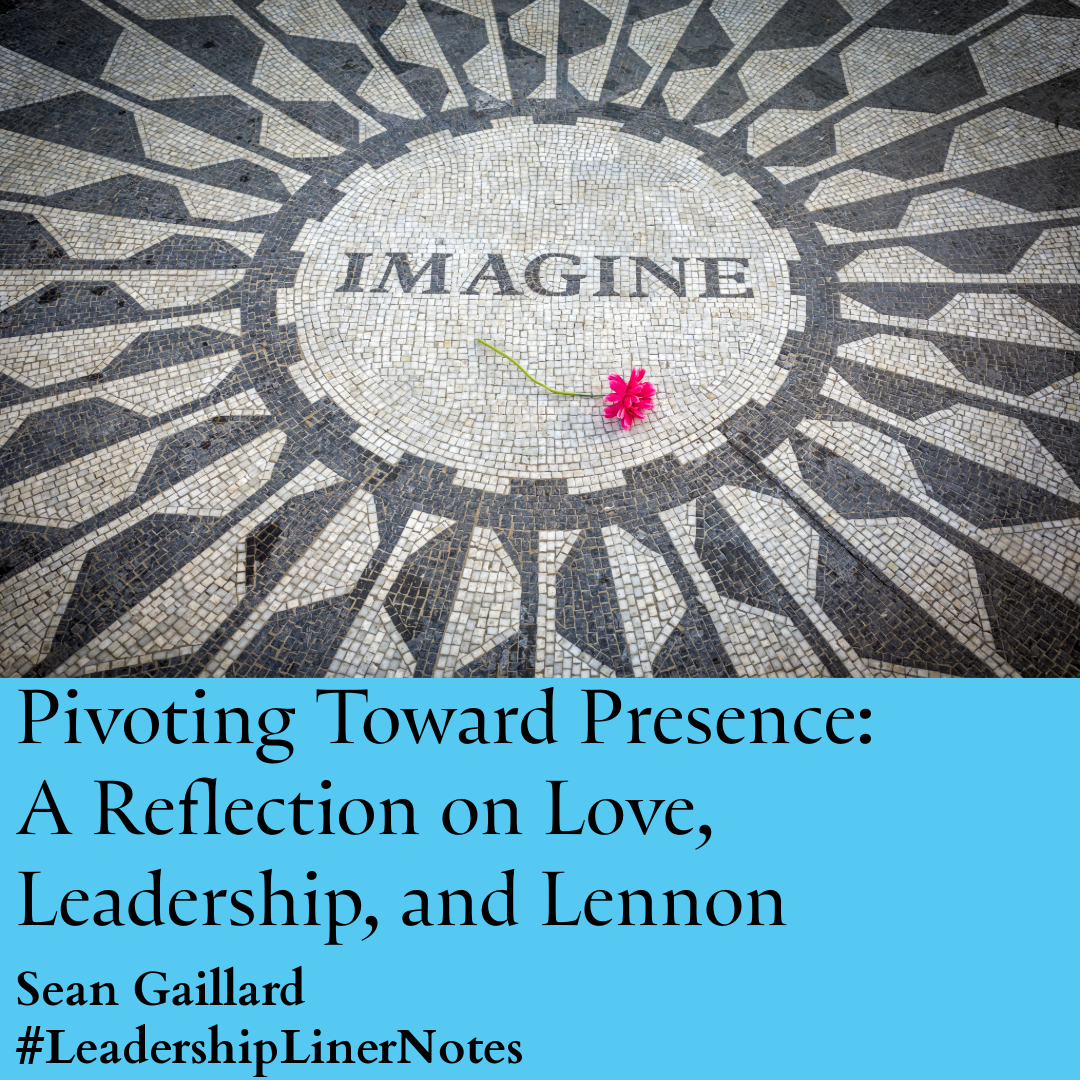
Pivoting Toward Presence: A Reflection on Love, Leadership, and Lennon

Today marks what would have been John Lennon’s 85th birthday. Had he not been so cruelly taken from the world, I imagine him surrounded by love, his wife, his sons, and perhaps a few close friends gathered around a cake. I can almost see John smiling, glasses glinting in the candlelight, grateful for another revolution around the sun. Grateful simply to be a husband and father.

Of course, this is a dream, a what if forever suspended in time. John Lennon is not with us. Yet every time we hear Imagine, or spin a Beatles record that once lifted the world, his spirit continues to sing. His ideas, his courage, and his music are eternal.

As I think about John’s life today, I am reminded of the profound pivot he made in his final years, a pivot that leaders, including myself, can learn from. After a painful separation from Yoko Ono, John chose to retreat from the spotlight. He became a stay at home father. He walked away from fame, record contracts, and the demands of celebrity life to raise his young son, Sean. He called this period his “househusband years.” Five years of seclusion. Five years of being present.

In that quiet season, John found peace. He cooked, baked bread, and rediscovered the small joys of daily life. He walked through Central Park and strolled with Yoko and Sean, savoring the moments that so many of us rush past. He wrote songs again, not for charts or critics, but from the heart. When he finally returned to the studio in 1980, he released Double Fantasy, a musical conversation between himself and Yoko celebrating love, family, and renewal. The album earned a Grammy for Album of the Year, a posthumous echo of his artistry at its most honest.

One song from that record, Beautiful Boy, contains a line that has haunted and guided me for years:
“Life is what happens to you while you’re busy making other plans.”

That lyric hits harder as I get older. I have lived its truth. As a husband, father, and leader, I have had moments when my presence was only partial, physically there but mentally buried in a phone, a to do list, or the next big initiative. When I faced my first serious health setback a year and a half ago, lying in a hospital room with machines beeping around me, I thought of all the moments I had missed. I remember wondering: Would I get to tell my children I loved them again? Would I see my wife’s beautiful smile? Would I have another chance to simply be, not as a principal, not as a leader, but as a husband, father, son, brother, and friend?

Thankfully, I was granted another chance. I am still learning and growing even as those health setbacks keep coming. That experience in the hospital room changed me. It reminded me that leadership is not just about impact, innovation, or outcomes. It is about love. It is about being present for the people who give your life meaning.

As leaders, we can lose ourselves in the rhythm of meetings, emails, and deadlines. The work matters, but so do the quiet moments that recharge our hearts. The people who know us beyond our title need us, not the version that is always on, but the one that listens, laughs, and lingers a little longer at the dinner table.

John Lennon’s decision to step away from the noise and focus on family was not an escape. It was an act of courage. It was his pivot into something beautiful.

So, what does that mean for us?


Leadership Action Steps: Simple Pivots into Something Beautiful

  1. Write for five minutes.
    End your day with a brief journal reflection, one sentence of gratitude or one small victory that made you smile.
  2. Call someone who matters.
    Reach out to a friend or loved one, not with an agenda, but simply to say, I’m thinking of you.
  3. Schedule sacred time.
    Block out 30 minutes this week for uninterrupted family time, a walk, or a shared meal. Treat it like your most important meeting and protect it.
  4. Be fully present.
    Put the phone away. Turn off notifications. Look into the eyes of the people you love and listen with your whole self.
  5. Revisit Your Pivot Song.
    Choose a song that helps you pause and reconnect with what truly matters. For me, it is Beautiful Boy by John Lennon, a reminder that love, presence, and purpose are the greatest compositions of all. John wrote that song for his youngest son and it serves as reminder that I must always pivot into fatherhood and being there for my three daughters.

John Lennon did not know that his five year retreat would be the last chapter of his life. Yet in those years, he created the most meaningful work of all: love, presence, and peace. His story challenges us to do the same. To pause. To connect. To pivot into something beautiful before life happens while we are busy making other plans.

You Are Never Alone: A Note on Mental Health & Well-Being

Let’s cut to the chase.

I go regularly to a therapist.

I live with panic, anxiety, and depression.

I take medication for that, as well as for high blood pressure. I lean on prayer for guidance, strength, and courage. Music, exercise, and writing serve as my entry points for continued healing.

This is a reality that I face and accept. I am okay. I am a proud father, a grateful husband, and a human being doing his best each day.

We have to normalize the conversation around mental health. It is not a stigma, and it should not be a secret.

Years ago, I listened to an interview where Dwayne Johnson openly shared his battle with depression. Bruce Springsteen, in his memoir Born to Run, wrote candidly about his own struggles. Both sought professional help. Both broke through the stereotype of invulnerability. And when I heard their stories, something deep within me stirred. It was a reminder that I was not alone.

It takes courage to be that open. Johnson and Springsteen are seen as strong, larger than life figures. Leaders, creators, and entertainers who have given millions joy. And yet, they are human. Their willingness to be vulnerable gave me the courage to carry my own weight and step forward in hope.

I want to be clear. I am not an expert on mental health. I can only share the truth I know and the experiences I have lived. What I do know is what it feels like to be alone in the struggle, to wonder if anyone else understands, and to silently hope for connection. I write this with my arm extended, reaching toward you, to say that you do not have to endure this alone.

The myth of leadership tells us to wear capes, to never stumble, to prove our strength through invulnerability. Social media only amplifies this illusion. But the truth is simpler and more profound. We are human. And being human means there are seasons when the darkness feels too heavy to carry on our own.

Viktor Frankl once wrote, “When we are no longer able to change a situation, we are challenged to change ourselves.” That quote has carried me in the hardest moments. It reminds me that even in the weight of depression, there is always a small step forward, always a chance to choose connection, always a chance to choose hope.

Depression is real. But so is support. So is the slow, steady step toward light when we reach out, seek help, and allow others to walk beside us.

This summer, on a turbulent flight, I sat next to a man in the grip of a panic attack. I recognized the signs instantly because I have been there. I leaned in and gently reminded him of strategies I knew he likely carried with him. He looked at me in surprise and whispered, “You know about the strategies, too?” I nodded. “Yes. You are going to be okay.” In that moment, both of us were reminded of a powerful truth. We are not alone when we reach out.

I am learning peace. I still face setbacks, but I continue to carry forward with my faith, the love of my wife and our daughters, the guidance of my therapist, and the support of my family along with a few trusted friends who check in on me. Each moment, however small, is a victory. Each step into the light is a lesson in resilience. And each time I share my story, I am reminded that others are waiting for the validation that they, too, are not alone.

Maya Angelou said it beautifully: “We may encounter many defeats but we must not be defeated.” Her words remind me that setbacks are part of the journey, but they do not define us. They are reminders to rise, to endure, to keep moving toward the light.

So, if you are silently struggling, know this: I see you. You are loved. You are valued. You belong.

As my father taught me to hold my head high, you are encouraged to do the same. If you do not feel compelled, then you are welcome to lean on me and we can walk forward together.

As I write, Beethoven’s 7th Symphony plays in the background. He composed it even as he faced the devastating reality of losing his hearing. He leaned into his craft and created something timeless. That reminder gives me courage: even in the face of struggle, we can pivot into something beautiful.

Let us do that together. Let us lean on one another. Let us check in with each other. Let us create, compose, and carry forward.

You are never alone.

Hold On to Your People: A Note for School Leaders (and Myself)

They don’t tell you in principal school just how lonely this gig can be.

Sure, there’s training on instructional leadership, school law, strategic planning, and evaluation protocols. All important stuff. But no one pulls you aside and says, Hey, just so you know, this work will sometimes feel like you’re on an island. Even when you’re surrounded by people, it may feel like no one sees the real you.

This is something I’ve carried with me in all my years as a principal.

Maybe it’s the pace. Maybe it’s the weight of making sure every child is seen, every adult is supported, and every decision aligns with the mission. Or maybe it’s just that in the whirlwind of trying to show up for everyone else, I started to drift from those who know me best.

I’ve lost friends. Not from fights. Not from falling outs. Just from the slow fade that happens when the job becomes the only song you play. And I’m learning through therapy, reflection, and some long walks with myself that it doesn’t have to be that way.

This summer reminded me.

At the ISTE-ASCD Conference in San Antonio, I was surrounded by kindred spirits. Educators, innovators, and thought partners I’ve known for years through screens and conversations. We laughed. We shared. We learned together. But most importantly, I wasn’t “Principal Gaillard.” I was just Sean. The same Sean who loves vinyl records and The Beatles. The same Sean who shows up with a notepad full of scribbles and a heart full of ideas. That feeling of being seen and embraced without the title attached nourished something in me.

That same feeling showed up again in a different space at my cousin’s wedding in Michigan. No one was asking for school updates or strategic plans. I was simply a cousin. A brother. A nephew. A dad. A husband. I was known not because of what I do, but because of who I am. Nothing will beat the joyful moment of hitting the dance floor at the wedding repection with my wife and daughters.

Those moments sustained me. And they reminded me that who I am matters just as much as what I do. Maybe more.

So this post isn’t just a message for my fellow school leaders as we enter another school year. It’s a note to myself.

Don’t lose your people.

The ones who love you for your corny jokes. The ones who know your favorite song. The ones who don’t care about your school data but care deeply about your heart.

Leadership doesn’t have to be lonely. But we have to choose connection on purpose. That’s the work I’m trying to do. And if it helps, here are four small, doable moves I’m committing to this year. Maybe they’ll work for you too.


4 Moves to Stay Connected (That Even a Busy School Leader Can Do):

1. Send one text a week to a friend.
Not a long update. Just a quick check-in. Thinking of you. Hope you’re good. It takes less than a minute but can mean everything.

2. Put a standing “non-school” date on your calendar.
Maybe it’s coffee with a college friend once a month. Maybe it’s a walk with your partner every Thursday evening. Block the time like it’s a meeting. Because it is a meeting with the best parts of yourself.

3. Say “yes” to one invite.
Even when you’re tired. Even when the to-do list is yelling. If a friend invites you to dinner, a concert, a call—say yes. One yes can reconnect you to who you are outside of the principal’s office.

4. Name your people.
Make a list of 3 to 5 folks who know you beyond the job. Tape it to your desk. These are your people. When the days get heavy, look at those names. Then call one. Or just remember their laughter. That’s your reset button.


As this new school year begins, don’t forget the people who walk with you outside of the school walls. They’re the ones who keep your heart steady. They’re the ones who remind you that being just you is more than enough.

I’m holding onto my people this year.

Hold onto yours.

In the Key of Brian

How Brian Wilson’s Music Taught Me About Leadership, Vulnerability, and the Courage to Keep Going

Devastated.

Brian Wilson is gone.

The news hit me hard today. Brian wasn’t just a musical genius. He was a spiritual guide, a quiet architect of harmony, and the voice behind songs that shaped my life. His music—those symphonies of soul, longing, and joy—have been my compass through the loud and quiet moments of living.

Just last week, I was basking in the joy of a surprise Father’s Day gift from my wife and daugthers: tickets to see The Beach Boys live. Brian had long since retired from performing, but his presence was felt. It always is. It lingers in the harmonies. It rises in the arrangements. It pulses in every chorus sung by a crowd of strangers suddenly made family by melody.

I was fortunate to see Brian perform live several times in the late 1990s and early 2000s during his remarkable comeback. It was more than a concert. It was a rebirth.


Brian’s music has accompanied the milestones of my life.

I remember pressing my ear to a clock radio 45 years ago, trying to catch every layered nuance of Good Vibrations. I didn’t understand the complexity of what I was hearing yet—but I felt it. I was entranced.

I remember watching a Beach Boys concert on HBO in the 1980s with my dad. He loved R&B and soul, and yet there we were—grooving, smiling, singing along to Fun, Fun, Fun like it was gospel.

I remember hearing the opening chords of California Girls in the delivery room as my twin daughters were being born. That mini-symphony played while new life entered the world, and in that moment, I felt the rush of peace. God was with us. Everything was going to be okay.

I remember not getting Pet Sounds, in its first when I first heard it in 1990. But I grew into it—and came to see it for what it is: the greatest album of all time. A masterpiece of heart, soul, and innovation.

I remember hearing Cabin Essence from a bootleg copy of SMiLE on vinyl in a record store. I looked around in stunned silence. A clerk caught my gaze and nodded as if to silently say, “We get it, don’t we?” No words. Just knowing.

I remember driving my oldest daughter home from daycare, both of us singing Heroes and Villains at the top of our lungs. Laughter and joy spilling through the car like sunshine.


But Brian Wilson didn’t just give us songs. He gave us strength.

Through Pet Sounds, he showed me that vulnerability isn’t weakness—it’s strength in its purest form.
Through SMiLE, he taught me that unfinished dreams can be resurrected with grace, imagination, and perseverance.
Through his life, he reminded us that the creative process is messy, sacred, and worth the fight.

Brian Wilson’s willingness to face his mental health struggles publicly—amidst a whirlwind of fame and pressure—changed how I view courage. He didn’t hide his pain. He didn’t pretend it wasn’t there. He just kept going. Kept writing. Kept harmonizing. That quiet, determined bravery became a guiding light for me.

Last year, when I experienced a heart episode that resulted in me being rushed to the hospital, I found myself in one of the most vulnerable seasons of my life. Alongside the physical recovery came emotional weight—mental health struggles I didn’t always know how to name. In that difficult stretch, I thought of Brian. I revisited his story. I played Pet Sounds and SMiLE. His music gave me permission to slow down, to feel, to heal. His example reminded me that we don’t have to be perfect to keep going—we just have to keep showing up, one note at a time.


Brian Wilson’s quote, “Music is God’s voice,” echoes eternally in my mind.

As a school leader, that idea centers me. It reminds me that learning is sacred. That harmony matters. That love, when set to rhythm, can move hearts and minds in ways nothing else can.

For those who’ve followed this blog or listened to the Principal Liner Notes podcast, you’ve heard me talk about Creative Courage. That’s Brian Wilson to the core. The courage to innovate. To feel deeply. To fail. To rise. To try again.

Today, I mourn. But I also give thanks.

I give thanks for the peace his songs brought me in a delivery room.
I give thanks for the laughter his melodies brought into my car.
I give thanks for the strength his life gave me when I needed it most.

Brian Wilson changed my life.

His harmonies still ring. His spirit still sings. And for those of us willing to listen, his legacy keeps leading us forward—in the key of empathy, in the tempo of grace.

Thank you, Brian.
You gave us harmony.
You gave us honesty.
You gave us your heart.

We’ll carry the melody from here.

Keeping Your Beat: The Power of Impact Visits for School Leaders

A reflection inspired by John Bonham, legacy, and the rhythm of leadership
#PrincipalLinerNotes

Special Thanks to Jimmy Casas and Lainie Rowell for their respective missions inspiring my gig! I am grateful that our PLN connections have evolved into sincere, lifelong friendships.

A very special thanks to my amazing wife, Deb, for being that constant source of love, inspiration, and strength every day! Thanks for inspiring Impact Visits!


A Soundcheck at Knebworth

It was just a soundcheck.
August 1979. Knebworth. A wide open field waiting to be filled with music. Led Zeppelin was preparing for a monumental return to the British stage. But as the band warmed up, it wasn’t John Bonham—the thunderous backbone of the band—behind the drum kit. It was his 13-year-old son, Jason.

In a rare and touching moment, Bonham stepped away from the drums and wandered into the field. He didn’t just want to hear the band; he wanted to listen from a distance. He stood alone, away from the stage, and let the sound wash over him. The rhythm of his legacy. His son’s rhythm.

There were no headlines. No fanfare. But there was something sacred in that quiet act: a father making space for the next generation, a rock legend becoming an audience member. Trust. Love. Legacy. It was all there in that field of amplifiers and dreams.

As a teenager, I remember reading about that moment in one of the many music biographies I devoured. It stuck with me. Especially knowing that John Bonham would pass away just over a year later. His son, Jason, would grow up to carry the torch—eventually joining surviving members of Led Zeppelin for reunion shows, most notably in the legendary 2007 performance captured on Celebration Day.

That soundcheck was more than rehearsal. It was legacy in action. It was impact. It was a leader stepping back—so something deeper could move forward.


Stepping Back for Impact

The response to my recent blog post, The Loneliness of Leadership, has been both humbling and healing. I wrote it to name and navigate the isolation I’ve felt in leadership—and to extend a hand to others who may be feeling the same. The heartfelt messages and outreach reminded me that we’re not as alone as we think. There is resonance when we share our truth.

This morning, I had the sincere honor of being a guest on Jimmy Casas’ podcast, The Interview Chair.
You can listen to that episode soon, but here’s what struck me during our conversation: Jimmy asked how I maintain mental health in leadership—especially after sharing my heart episode experience from last year. My answer came quickly: Impact Visits.


What Are Impact Visits?

Impact Visits are intentional moments carved out of the chaos. They’re brief detours in your day where you go and witness your leadership in motion—where the fingerprints of your work are making a difference.

Over the years of my principalship, my wife Deb would often tell me, especially on the hard days, “Go visit a classroom where you know it’s working.” She’d say it gently but with urgency—usually on the days when I was feeling discouraged, disconnected, or alienated. I didn’t always listen. I’d get swept up in the whirlwind of tasks and to-dos. But since my heart episode and my renewed focus on mental health, I’ve made it a point to follow her advice.

So, thank you, Deb. I know to listen to you now.

These are not evaluative visits. They’re not walk-throughs with clipboards and checklists. They’re personal moments—to be reminded, to be renewed. A time to refuel your spirit and reconnect to why you said yes to this work in the first place.

If you can, use these visits as a chance to connect. To offer a word of thanks. A fist bump. A simple “You’re doing great.” As my friend Lainie Rowell reminds us in her #EvolvingWithGratitude mission—gratitude is a powerful act of leadership. A little goes a long way.


Four Ways to Make Impact Visits Happen

  1. Schedule Intentionally
    Block time on your calendar each week. Just 10–15 minutes to step into a classroom, a hallway, or the front line of your impact.
  2. Make It Routine
    Ritual turns into rhythm. If you make Impact Visits a part of your leadership practice, they’ll become the pause that powers your next move.
  3. Share the Visit
    Reflect on your visits with a thought partner or friend. If you don’t have someone, you’re welcome to reach out to me. I’d be honored to be that listening ear: sgaillard84@gmail.com
  4. Encourage Others
    Inspire your team, your assistant principals, or even colleagues in your PLN to create their own version of Impact Visits. Help build a culture of reflection and renewal.

Your Beat Still Matters

Leadership is not a sprint of perfection. It’s a series of riffs—some raw, some refined. We owe it to ourselves and those we serve to keep our rhythm aligned with our core values.

So, take that walk. Stand in that hallway. Listen to the beat that’s still echoing from something you once helped shape.

Because even in the quiet moments—maybe especially in the quiet moments—we find proof that we’re still making a difference.

Keep your beat.

The Loneliness of Leadership: A Heartfelt Reflection for School Leaders


Typically, I don’t write blog posts back-to-back. I’ve kept to a steady rhythm of weekly writing since my heart episode last year. That ritual has become part of my healing—recommended by my therapist, yes, but also something I’ve come to cherish. Writing has broken through the fog of writer’s block that followed the release of The Pepper Effect. Through journaling and reflection, I’ve found my way back to words and meaning. I am even working on finishing up a proposal for a new book.

But this piece couldn’t wait.

I’ve been sitting with a question no one prepared me for in “Principal School”:
Why does leadership have to feel so lonely?

It’s a question that’s erupted into big feelings—enough to make me pause on other writing projects and sit with this one instead.

There’s a scene in Peter Jackson’s Get Back documentary that lingers with me. George has left the band. A meeting doesn’t go well. Paul and Ringo return to the studio, uncertain of what’s next. John is nowhere to be found. Paul, visibly shaken, says quietly, “And then there were two.” He stares off into the distance. His eyes well with tears. His voice trembles. You can feel the grief. The possibility that something beautiful and world-changing might be coming to an end.

Watching that moment recently, I didn’t just see it through the eyes of a Beatles fan—I saw it through the lens of a leader holding onto connection, trying not to lose grip.

I’ve been a principal for almost sixteen years. I’ve served in multiple schools, answered the call for turnaround, and poured myself into the gig. I’m grateful for a beautiful family—my wife and three amazing daughters. Their love is a constant light. And I do have a handful of trusted friends, most not nearby. But I’ve felt friendship fade over the years—some lost to distance, some to time, some to disillusionment.

This is the part they don’t tell you about leadership. That people may see your title before they see you. That the weight of tough decisions can sometimes isolate you. That you’ll have days where it feels like everyone is counting on you—and no one is standing with you.

I once thought the PLN (Professional Learning Network) would solve this. Twitter, Voxer groups, hashtags that I created like #CelebrateMonday and #TrendThePositive—those were my entry points to community. And for a while, they worked. I met incredible educators, interviewed inspirational guests for the Principal Liner Notes podcast, and even achieved my dream of becoming a published author.

But not all connections held. Some collaborations quietly ended. Some people I looked up to didn’t turn out to be who I thought they were. And yes, I’ve even had a book idea stolen.

Still, I’m thankful for the moments of light in those spaces—moments when a shoutout brightened someone’s Monday or a podcast guest became a kindred spirit. Yet, after the episode ended or the tweet was sent, the silence would sometimes creep in.

Loneliness doesn’t negate purpose. It doesn’t mean the work isn’t good. But it does mean we need to be mindful of our well-being and human need for belonging.

Recently, I’ve had the privilege of co-facilitating the ISTE-ASCD webinar series with Andrea Trudeau. We’ve explored what it means to create spaces of connection and belonging—especially for those in unique roles like principals and school librarians. These conversations have reminded me that belonging doesn’t just happen. It’s a practice. A choice. A rhythm to keep playing, even when the band seems scattered.

In her book The Let Them Theory, Mel Robbins has a powerful chapter on the quiet heartbreak of adult friendships. She describes how friendships shift from group experiences to individual efforts—and how easy it is to look around one day and realize your circle has vanished. Her advice? Reach out first. Be kind without expectation. Smile. Be curious. Give it time.

It’s advice I’ve tried to follow, even when it’s hard. Even when it’s lonely.

So what do we do with this?

We remember that our core matters. Our heart matters. And so does connection.

Here are a few ways I’m working to move through leadership loneliness—and maybe they’ll help you, too:

  • Savor family and those who know you beyond your title. The gig will wait—those moments with loved ones won’t. I am grateful daily for my wife and our daughters and my family.
  • Reach out. A coffee, a text, a hallway chat. Don’t wait for someone else to go first.
  • Find “only ones” like you. Look for the school librarian, the instructional coach, the counselor—others who might be the only one in their role. Forge that bond.
  • Be vulnerable. Share your story. Someone else might need to hear it. I have been writing deeply about the experiences surrounding my heart episode. I am grateful that others have found it helpful for their journey.
  • Build something outside the gig. A book club. A podcast. A project that brings joy without the pressure.

You are not alone—even when it feels that way. Someone out there gets it. Someone is looking for connection, too.

Keep showing up. Keep being kind. Keep playing your part in this great, imperfect, meaningful symphony of leadership.


Postscript:
During those Get Back sessions, Paul’s loneliness was palpable. But the story didn’t end there. The band found their way back. The Beatles regrouped. And they gave us the Rooftop Concert—a final live performance filled with joy, grit, and unity.

It was their last time playing live together. And it was iconic.

A reminder that even in moments of disconnection, something timeless can still emerge.

A Principal’s Rebirth: Finding Life, Love, and Leadership Again

“Call 911.”

These were the last words I heard from our SRO before everything went dark and I fell to the ground.

This was not just a sudden medical emergency—it was the culmination of years spent silently carrying anxiety, stress, and deepening depression. It was the moment my body forced me onto a new path, the first steps toward rebirth.

Last year, I experienced a traumatic health crisis, what doctors described as a cardiac episode triggered by years of relentless anxiety, chronic chest pains, and suffocating Imposter Syndrome. It happened at school, amid the daily chaos and pressures we face as leaders. My body simply gave out.

When I regained consciousness, I was surrounded by paramedics and the incredible members of my office staff, working rapidly to keep me alive. Tears filled my eyes as fear overtook me—I genuinely believed I might never see my wife and our three beautiful daughters again. Breathing was impossible, and the chest pains intensified.

As they rolled me into the ambulance, a flood of thoughts rushed in. I saw my family—moments missed, memories sacrificed. My heart ached thinking of the countless times I’d prioritized my work over my loved ones, placing duty to my school ahead of duty to my family and, ultimately, myself. I called out to God, and then darkness returned.

When I awoke in the hospital, tethered to various medical devices, my heart eased the moment I met my wife’s calming eyes. My oldest daughter was already there, confidently navigating conversations with doctors, demonstrating remarkable strength and poise. Pride overwhelmed me—but so did shame. As her father, I should have been protecting her, not the other way around.

It’s been a full year since that fateful day—a journey of healing, renewal, and rediscovery. My physical health and blood pressure are now managed carefully. Regular therapy sessions every other week have transformed my outlook, grounded in the love and unwavering support of my family and a few deeply cherished friends who check in weekly. Every day, I practice intentional self-care, finally understanding that my identity as a principal should never overshadow my humanity.

As the creator of #CelebrateMonday, I recognize now that I wasn’t celebrating myself. I leaned too heavily on fleeting PLN connections, seeking external validation while overlooking the unconditional, immediate love from my family. While my PLN gifted me a handful of true friendships, I realize my greatest strength comes from being fully present with those who truly cherish me. In pursuit of acceptance, I had unknowingly compromised my core values as a leader.

This past year has gifted me profound clarity and growth. I’ve learned to distinguish between genuine leadership and the seductive illusion often sold through polished selfies, viral gimmicks, and ego-driven platforms. I now seek authenticity, humility, and depth, distancing myself from empty slogans and superficial validations. I am grateful being at a new assignment returning to a school district I truly love and feel sincere support, empowerment, and belonging.

This month marks a year since my rebirth—a new birthday I honor with deep gratitude. My perspective is forever changed. I embrace each moment ahead with my family and true friends, choosing authenticity over illusion, presence over performance, and self-care over self-neglect.

Here’s to life renewed, leadership redefined, and love fully embraced.

The Rooftop Moment: Embracing Creative Courage Amidst Doubt

I’ve written and rewritten this blog post countless times in my mind. It has been weighing on my heart, especially after navigating a week filled with a few setbacks. Nothing catastrophic, but still moments of dejection that linger. One of those moments was particularly difficult: an idea I had for a collaborative book was taken in a new direction—without me.

As someone who values collaboration and the joy it brings, I’ve learned that I need to be more mindful of whom I choose to collaborate with. Seeing my work and ideas rebranded as someone else’s originality hurt deeply. It stung because the creative journey is already fraught with battles against Imposter Syndrome and anxiety. These emotions creep in especially when I venture into new creative territory: Will it be good enough? Will people understand what I’m trying to do? When someone else quickly disinvites you from a project and takes it solo, it’s a painful reminder of the delicate steps needed to protect your own creative vision.

Late last year, I thought I had cracked the code on a follow-up to my first book, The Pepper Effect. I had an outline, a vision, and an unshakable drive. But that momentum fizzled as life threw its challenges my way. Stress, high blood pressure, and self-doubt culminated in a health scare that landed me in the hospital. It was a wake-up call. With the support of my incredible wife, my family, my therapist, and my faith, I began to rebuild—both physically and emotionally. Part of that rebuilding process involved reconnecting with my writing. Blogging weekly became my creative anchor, a way to keep my writing muscles intact and grooving. Each blog post has been a step forward, a way to regain confidence and prepare myself for the marathon of writing another book.

The recent letdown with the collaborative book idea is a chapter I’m reframing not as failure, but as a lesson learned. It’s a reminder to trust my vision, something I wrote about extensively in The Pepper Effect. Sure, it stings to see accolades being given for an idea that I helped shape, but as Mel Robbins writes in The Let Them Theory, I can’t let other people’s actions control my journey. Let them take their version of the idea, I tell myself. Let me move forward with my vision. And as my therapist often reminds me, “…and that’s okay.”

When I need inspiration, I return to The Beatles. They are my creative North Star. My first book explored how their story is a template for creativity, collaboration, and innovation. My follow-up book, which I’m calling The Let It Be Effect, will continue in that vein, diving into the Get Back/Let It Be era. If you’ve followed me on social media, read my blogs, or listened to my podcasts, you’ve seen glimpses of this concept. The Let It Be Effect will build on the four tenets of The Pepper Effect (Believe in your vision, Believe in your masterpiece, Believe in your collaborators, Ignore the Naysayers), but it will also introduce something new: the idea of the Rooftop Moment.

The Rooftop Moment is inspired by the Beatles’ legendary final live performance in January 1969. During the recording of what would become the Let It Be album, the band faced immense challenges. They hadn’t performed live in three years, there were creative differences, and at one point, George Harrison even quit the band. Despite all this, they decided to perform—not in a grand concert hall, but on the rooftop of their Apple Corps headquarters in London. It was a cold January day, and the decision to perform wasn’t finalized until the last minute. According to director Michael Lindsay-Hogg, John Lennon’s decisive words were, “F— it—let’s go do it.”

And they did. The Beatles, joined by keyboardist Billy Preston, walked up to the rooftop and made history. That performance became their iconic Rooftop Concert, a moment of creative triumph amidst doubt and adversity. It was the final time they performed live together, and it remains a testament to the power of taking bold action despite uncertainty.

The Rooftop Moment is about just that: taking a dynamic leap of creative courage when the odds feel overwhelming. It’s about playing your gig, painting your masterpiece, or writing your book, even when doubt tries to hold you back. The Beatles ignored convention and their own self-doubts to create something unforgettable. I know I need to do the same with my follow-up book.

Let the critics and naysayers have their opinions. Let them. As for me, I’ll aim for my Rooftop Moment—that decisive act of putting my creativity into the world, no matter what. I’ll let the inspiration flow and trust that what I create will resonate with those who need it most. And that’s okay.

I hope this inspires you to find your own Rooftop Moment. Whether it’s a project you’ve been hesitant to start, a challenge you’re ready to face, or a dream you’ve been quietly nurturing, remember: the world is waiting for your masterpiece. Let it be.


Four Moves to Create Your Rooftop Moment:

  1. Lead with Vulnerability: Share your passion or a creative idea with your team or community, even if it feels risky. Vulnerability fosters connection and courage. For me, this was bringing my guitar to school and sharing a song I wrote based on our school’s core values during grade-level assemblies. It was risky, but it created a memorable and inspiring moment for my students and staff.
  2. Model Risk-Taking: Show your team that it’s okay to step outside their comfort zones by doing it yourself. Whether it’s trying a new teaching strategy or presenting an innovative idea, your example can inspire others to embrace risks.
  3. Create Space for Creativity: Provide opportunities for your staff and students to experiment and express their ideas. This could be through collaborative brainstorming sessions, innovation labs, or simply encouraging them to bring their unique talents to the table.
  4. Celebrate the Journey: Acknowledge the effort and courage it takes to create something new, even if the outcome isn’t perfect. Recognizing progress builds momentum and reinforces the value of the creative process.

Sometimes you have to aim for what I call that Rooftop Moment—that moment where you take a move for dynamic creative action amidst overwhelming odds and you simply play your gig, paint your masterpiece, write your book. The Beatles ignored convention and their own self-doubts and applied the Let Them theory in their own way. I know I have to do the same in writing my book follow-up because I know I have another book in me and that’s ok.