Some connections are for a season. They help us grow, reflect, and find our footing. Then, sometimes, the paths quietly diverge.
I am learning that clarity around values can be both grounding and lonely. It does not mean anger. It does not mean judgment. It simply means paying attention to what no longer fits.
I am choosing to keep moving toward what aligns with who I am becoming. I am choosing alignment over approval. I am choosing peace over proximity. With gratitude for what was. With honesty about what is.
This is a weekly space where I connect music, grooves, and stories. Albums that sit with us. Songs that carry us. Records that feel like companions in certain seasons of life.
I am not waiting anymore. I am building the space I wish existed.
Season One begins this week.
If you love music that means something, then you belong here.
There is a place I often call Principal School. It is the imaginary training ground where we believe all the lessons of leadership will be handed to us before we ever step into the role. Over time, I have learned that some of the most important lessons are never taught there at all. They are learned the hard way, often quietly, and sometimes at great cost.
One of the biggest myths perpetuated in school leadership is that there is a single way to lead well. I bought into that myth for far too long. I watched other principals on social media and began to believe that if my style did not look like theirs, then I must not be good enough. I measured myself against highlight reels instead of my own values. That comparison and pressure sent me to the emergency room twice. It took a toll on my body, my mind, and my spirit.
Another lesson they do not teach you in Principal School is that leadership can slowly pull you away from the very relationships that sustain you. I regret not investing the time I once did in friendships. I regret choosing email replies and late night work over phone calls and shared meals. I felt the weight of that loss deeply over the last few years when the invitations stopped coming. I am grateful for the meaningful friendships I still have, even though many of them live far away. Today, I cherish every text message, every phone call, and every Zoom conversation because I know how easily those connections can fade when duty becomes all consuming.
I also regret the moments I missed with my wife and daughters. There were times when I chose the principalship over being fully present with them. That truth is hard to name, but it matters. You blink, and your children are grown and moving out of the house. You do not get that time back. Now, I cherish my family even more, and I hold our time together with greater care and intention than ever before.
For my physical and mental health, I made the decision to step away from the principalship. I returned to my assistant principal roots and found something I had lost along the way. I found myself again. I am happier, healthier, and more grounded. I have grown in my therapy work and remain deeply committed to it. That commitment has helped me reconnect with my core, my purpose, and my humanity. The version of leadership I was living was not aligned with who I am or how I want to live. In trying to be everything for everyone at school, I lost sight of who I needed to be for myself and for the people who love me.
Recently, in a conversation with Dr. Andrea Trudeau, a phrase stayed with me. We need to rescript the narrative. Human Centered Leadership is not widely accepted in some spaces, and I am fully aware of that. Still, I am determined to disrupt the conversation in a good way. Leadership does not have to cost you your health. It does not have to require the sacrifice of your family or your friendships. Human Centered Leadership is not only about how you serve others. It is also about how you care for yourself and how you show up for those who cherish you as a spouse, a parent, and a friend.
I learned these lessons the hard way. I do not want others to have to do the same. My purpose now is simple and deeply personal. If these words help one leader put their phone down and spend time with their child, then I have done my job. If they help one leader step away from email long enough to call a friend, then I have done my job. If they help one person avoid being rushed to the hospital from the schoolhouse like I was, then I have done my job.
This post will not go viral. It will not collect metrics or applause. That is not the point. Leadership does not have to be lonely. Leadership does not have to break you. You can lead with love. You can protect your humanity. You can serve others well without losing yourself along the way.
This reflection is not the end of the conversation for me. It is the beginning of a deeper commitment to naming what matters and creating space for a more human way to lead. One of the ways I am continuing this work is through a new podcast series I am co- hosting with Dr. Sonia Matthew called Leading While Human.
Our first episode drops on February 1 and features a powerful conversation with Dr. Rachel Edoho-Eket. Throughout February, we will release a new episode every Sunday with guests including Lauren Kaufman, Dr. Donya Ball, and Principal Kafele. Each voice brings wisdom, honesty, and lived experience to the question of what it truly means to lead while human.
Leading While Human will be a quarterly podcast. Each series will feature four guests and four conversations designed to slow us down, ground us, and remind us that leadership does not have to cost us our health, our relationships, or our humanity.
I am grateful for the opportunity to learn alongside these voices and to invite others into this space. Stay tuned for what comes next as we continue to rescript the narrative on leadership together, one human centered conversation at a time.
Lately, I have been thinking deeply about leadership and where the conversation has drifted. Somewhere along the way, leadership became confused with performance. It became about big voices, bigger platforms, viral moments, staged selfies, best selling books, and canned keynotes. It became about stunts and acrobatics designed for attention rather than impact.
That version of leadership is not sustainable, and it is not humane.
Leadership is not a social media highlight reel. Leadership is not defined by beleaguered metrics, fluctuating test scores, or anonymous survey data stripped of context and humanity. Leadership is not about being the loudest voice in the room or the most visible person on the stage. Chasing those myths of leadership can cost you your nervous system, distance you from the people you love, and leave you with an empty shell of what leadership was meant to be.
I know this because I lived it. That path sent me to the hospital twice.
There was a time when toxicity, doubt, and Impostor Syndrome defined far too much of my leadership experience. I bought into a broken paradigm that told me I had to prove myself constantly and that rest was a weakness. I believed that my value as a leader was tied to outcomes I could never fully control. That way of leading led to exhaustion, anxiety, and a version of leadership that felt hollow and unsustainable.
Thankfully, I have moved away from those times and places.
Through prayer, therapy, fitness, and intentional work on my own humanity, I am learning to lead differently. I am learning to slow down and to listen more deeply. I am learning to honor liminal spaces instead of rushing through them. I am learning to be present in the moment rather than constantly chasing what comes next. Most importantly, I am learning to value my own humanity so that I can better recognize and support the humanity in others.
This is the leadership conversation that I believe must be disrupted and reimagined.
Leadership, at its core, is relational. Leadership is guided by empathy, kindness, and a deep sense of belonging. Leadership is not about perfection or performance. Leadership is about presence. Leadership is not about having all the answers. Leadership is about creating spaces where people feel safe enough to ask honest questions and be fully seen.
From these reflections and lived experiences, something meaningful has emerged.
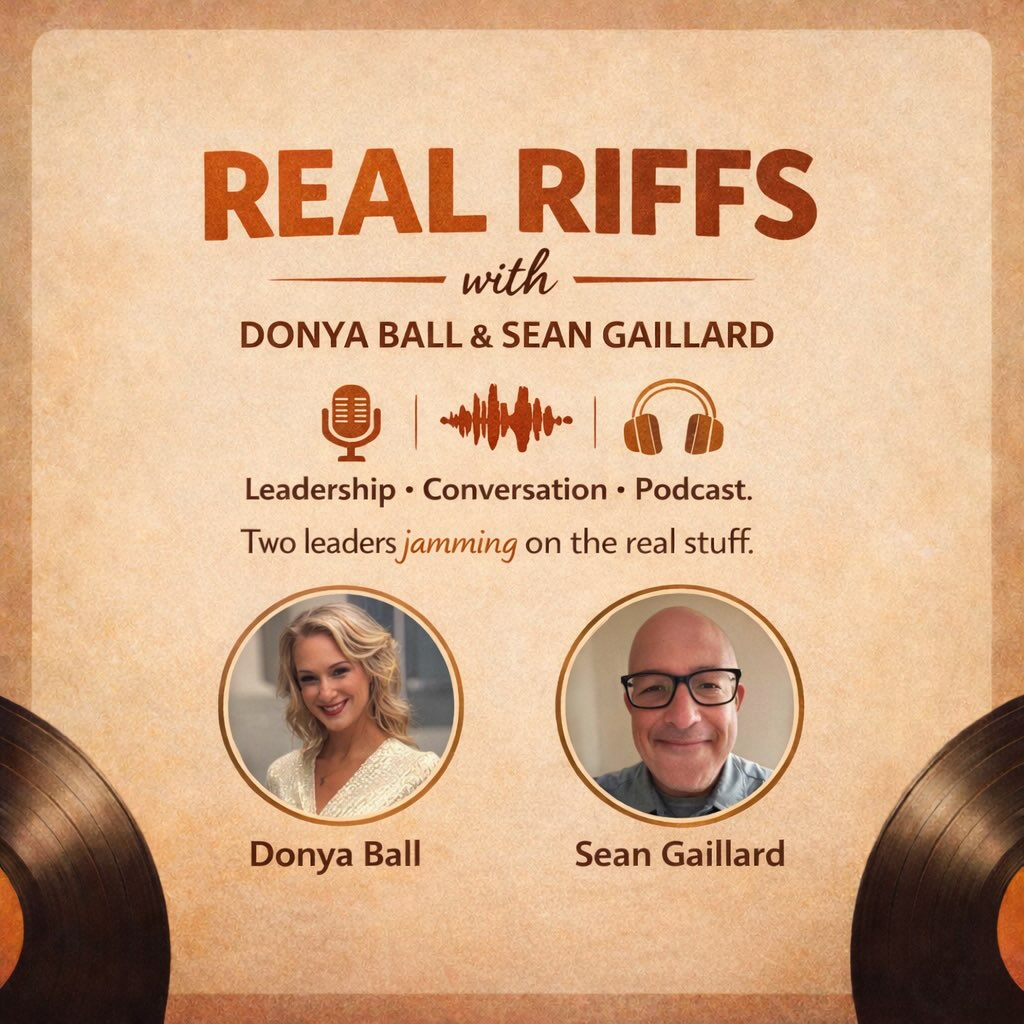
I am deeply grateful to be co-hosting a new podcast series with the amazing Dr. Sonia Matthew called Leading While Human. This special series debuts on February 1 and comes straight from the heart. Together, we are creating space for honest conversations about what it truly means to lead while human.
Our inaugural series features four voices I deeply admire: Dr. Rachel Edoho-Eket, Lauren Kaufman, Dr. Donya Ball, and Principal Kafele. We will release a new episode every Sunday throughout February, and we will return four months later with four additional guests to continue the conversation.
This work matters deeply to me because it is personal. It is born from struggle, healing, and a firm belief that leadership must return to its human roots if we are going to build schools, organizations, and communities where people can truly thrive.
If you would like to hear my reflections on Leading While Human, you can listen to or watch the latest episode of Leadership Liner Notes on the platform of your choice.
My hope is that this reflection invites you to pause, reflect, and reclaim a version of leadership that honors who you are as a human being first. We do not need more performances. We need more presence. We do not need louder voices. We need deeper listening. We do not need leadership myths. We need leadership rooted in meaning, care, and humanity.
Some mornings arrive heavier than others. You wake up carrying more than you expected, unsure where the weight came from, only knowing that it is there. In those moments, the quiet around your work, your words, and your efforts can feel louder than any criticism. This reflection comes from one of those mornings.
This blog post is a form of self-talk for me. It is equally written for anyone else who is struggling quietly right now.
Leadership can be deeply meaningful, but it can also be profoundly lonely. We are encouraged to share our thinking, our learning, and our growth. We are reminded that vulnerability builds trust and that authenticity matters. Still, there are times when we share something heartfelt. We direct it toward others or put it into the world with care, and nothing comes back. That absence can hurt in ways that are hard to explain.
I have learned that sometimes our ideas are not heard in our own backyard. That realization can sting, especially when the words came from a sincere and hopeful place. It is also why it is essential to find spaces and platforms where your voice can breathe. For me, that space is writing. It is blogging. It is podcasting. These are the places where I process, reflect, and continue learning out loud.
It is easy to fall into the trap of measuring impact by numbers. Views. Downloads. Likes. Shares. Over time, those metrics can quietly convince us that our work only matters if it reaches a certain volume. I am still unlearning that thinking. Today, I remind myself of something simple and grounding. If one person finds what they need in something I share, then the work has meaning. If one person feels seen or steadied for a moment, then the effort was worth it.
This reflection is a reminder to keep showing up anyway. It is an invitation to keep sharing your thoughts even when the response is uneven or delayed. It is a quiet act of trust in the belief that someone is listening, even when you cannot see them. The work of leadership is not about being the loudest voice in the room. It is about being a steady one.
I am writing this to remind myself that my voice still matters on the days when it feels unseen. I am also writing it for anyone else who needs permission to keep going without guarantees. The quiet does not mean you failed. Sometimes it simply means your words are traveling, settling, and finding their way to the right person at the right moment.
Hope does not always arrive with applause. Sometimes it shows up as resolve. Sometimes it shows up as consistency. Sometimes it shows up as choosing to center people over metrics and meaning over momentum.
For today, choosing to stay human in the work is enough.
There are albums that arrive in your life right on time. There are also albums that feel as if they have been waiting for you all along.
Neil Diamond’s Gold is that kind of record for me.
It was recorded live at the Troubadour on Santa Monica Boulevard in July of 1970. Just about ten miles away, in Inglewood, I was two months old and brand new to the world. I did not know it then, but something meaningful was happening nearby. A voice was finding its footing. A performer was stepping into himself. A bridge was being built toward what would come next.
I did not discover Gold until my junior year of college. I found it in a used record store in Washington, D.C., sometime around 1990 or 1991. I remember taking it back to my dorm room. I lowered the needle and felt something familiar. It was something I could not yet name. Even then, it sounded like an album caught between chapters. Confident, yet searching. Grounded, yet reaching.
That feeling has only deepened with time.
Gold captures Neil Diamond in a liminal season. He was between record labels. He had experienced success in the 1960s, yet the full arc of his 1970s creative breakthrough had not fully arrived. This was not a greatest hits collection, even though the title suggests one. It was something far more human. It was a document of becoming.
The band matters here. Carol Hunter’s guitar work has a raw edge. It gives the music a sense of forward motion. Her style was shaped by time alongside artists like Bob Dylan. Eddie Rubin’s drumming, informed by deep jazz roots and work with artists like Billie Holiday, brings both restraint and release. Randy Sterling’s bass provides an anchor that allows everything else to breathe. This was a group capable of listening, responding, and taking risks in real time. That truth is audible.
Then there is “Lordy.”
That song feels like a door being pushed open. Gospel-inflected. Theatrical. Unfiltered. It hints at the ambition that would soon fully emerge on Tap Root Manuscript. On this album, “Cracklin’ Rosie” would become Neil Diamond’s first number-one hit. “The African Trilogy” placed on Side 2 of that album would expand his songwriting into something expansive and cinematic. “Lordy” is not the destination. “Lordy” is the signal.
This is why Gold resonates so deeply with me right now.
I find myself in my own in-between season. Years of experience remain present. Familiar structures are loosening their grip. Listening has become more important than certainty. This album reminds me that the middle matters. The bridge is not wasted time. Confidence is often built quietly in rooms that do not yet resemble arenas.
My connection to Gold also brings to mind the film Song Sung Blue. I love that movie deeply. The film is based on the real life story of Mike and Claire Sardina, who form a Neil Diamond tribute band known as Lightning & Thunder. Watching the two main characters played by Hugh Jackman and Kate Hudson is profoundly life-affirming. They challenge the impossible until it becomes possible. The film honors persistence, hope, and belief without irony. It treats becoming with dignity. The music performances are truly “so good, so good!”
That same spirit lives inside Gold.
This record honors the becoming.
This post accompanies the latest episode of #LeadershipLinerNotes. In it, I share more about this album and the Troubadour. I explain why this particular season of my life feels so closely tied to it. You can listen to the podcast version here: Spotify/Megaphone:
I would love to know what your Gold has been. Was there an album, moment, or season that met you in the middle? Did it quietly remind you that something meaningful was still unfolding? Please share in the comments. I would love to hear from you.
Sometimes the gold is not found at the beginning. Sometimes the gold is not waiting at the end. Sometimes the gold lives right in the in-between.
Some blog posts arrive quietly. Others land with weight and warmth.
When Lauren Kaufman’s latest post, People Come First, landed in my inbox, I paused before opening it. Not out of hesitation, but out of trust. I knew, just as I always do, that I would walk away feeling enriched. I would feel inspired. I would be nudged to be better in my own practice after reading her words.
That has been the gift of being a long time reader of Lauren’s work. It has also been the gift of friendship and thought partnership with Lauren.
Lauren Kaufman is a district leader, a disciplined weekly blogger, and the author of the inspiring book The Leader Inside. She is also someone who writes from lived experience, not from a pedestal. Her posts are never about performance. They are about presence.
Her blog consistently shows up with clarity and heart. When her writing lands in my inbox, I know I will be enriched, inspired, and motivated. Lauren has a way of making her words resonate so deeply that you want to do better and be better.
In People Come First, she reflects on a poignant exchange with another human being. The moment is simple on the surface, yet profound in its implications. The post does not rush toward resolution. It does not offer a checklist or a framework. It invites the reader to slow down and sit with what it truly means to show up for someone else.
That restraint is precisely what makes it powerful.
Here’s the Core of What It Shows
At its heart, this post is about listening. Not listening as a leadership move or a strategic tool, but listening as an act of humanity.
As I continue to delve deeper into human-centered leadership, Lauren’s words echoed something I have been reflecting on myself. Sincere and deep listening is not an accessory to leadership. It is an entry point.
To listen well is to communicate worth. To listen deeply is to make space. To listen without fixing is to honor someone’s story.
Lauren reminds us that people do not need us to be impressive. They need us to be present.
What This Stirred in Me
Reading this post led me to reflect on how often leadership culture rewards speed over stillness. We are praised for having answers, for moving quickly, and for resolving things efficiently.
The leaders who have shaped me most were the ones who slowed the moment down. They listened without interruption. They stayed curious. They did not rush me toward clarity before I was ready. Lauren is one of those leaders for me and so many others.
Lauren’s post reinforced a truth I am still learning. Human centered leadership begins long before we speak. It begins in how we listen.
A Thought Partnership That Matters
Lauren is also my most frequent guest on my podcast, Leadership Liner Notes, and the unofficial executive producer of the show. Our conversations consistently ground me and stretch my thinking.
One of our most recent episodes was a co-hosted conversation celebrating and amplifying the work of Elizabeth Dampf, author of Am I Cut Out for This?. The episode explored self doubt, courage, and staying rooted in purpose.
This “Inc. Magazine” piece goes beyond business strategy and gets at something deeper: the human need for connection. The idea of the third place reminds us that people are not looking for more transactions. They are looking for places and cultures where they feel seen, welcomed, and able to belong.
That idea matters far beyond coffee shops. I do appreciate the intentionality Starbucks is doing to create a meaningful and human-centered experience for their customers.
Here’s the Core of What It Shows
When organizations intentionally design spaces that invite people to slow down, connect, and stay awhile, trust and loyalty follow. The article reinforces that strong leadership is not about efficiency alone. It is about creating environments where relationships can take root and people feel grounded.
That is the heart of human centered leadership.
Why This Connects to My Work
This concept echoes the work I collaborated on with Dr. Andrea Trudeau during our ISTE+ASCD Webinar Series and poster session at the ISTE+ASCD Conference in San Antonio. It also aligns closely with the conversations Dr. Sonia Matthew and I are exploring in an upcoming podcast series focused on human centered leadership.
Whether in schools, organizations, or communities, leaders shape the culture by shaping the spaces people experience every day.
Bottom Line
Leadership is not just what we measure or manage. It is what we build for people to gather, connect, and belong. This article is a timely reminder that presence still matters and so does place.
I just read this great leadership article in Inc. Magazine. I’m really impressed because it looks at leadership in ways that feel fresh. These perspectives are relevant outside of the typical education leadership lens.
As someone who is an unabashed geek and reader, I am committed as a leader to enlarging my learning. I want to use this blog platform to share my learning. It will also hold me accountable to consistent growth as a leader. You are invited to join on this journey with me. I hope you’ll get a lot out of it, too: 👉 https://bit.ly/3L05k7h
Why it’s worth your time:
The piece highlights that the best leaders don’t just manage. They behave differently. Their actions build trust, enhance performance, and create real connections with their teams. These aren’t complicated tricks or buzzwords they’re simple behaviors that most leaders actually skip.
Here’s the core of what it shows:
• Great leaders model servant leadership. They put people first focus on clarity and support and prioritize team success over ego. • These actions build trust and performance not just productivity. • The article comes from Marcel Schwantes a seasoned leadership coach and Inc. contributing editor so the ideas are practical and grounded in real world experience.
I always appreciate the learning from Inc. Magazine especially when it intersects with leadership in ways that resonate outside traditional education circles.