Leadership Echoes: Small Moments, Big Legacy

A Lesson from Administrator School

During my days in “administrator school,” I was fortunate to have our superintendent, where I was employed as a teacher, instruct one of our courses. The course was Strategic Planning, and I gained much wisdom from his years as a seasoned district leader. The class happened to land on the final day of the semester for our cohort. Looking back, it was a meaningful milestone as it marked the last class on the last day of my entire Master’s in School Administration program.

A moment from that day has stayed with me throughout my career. At the time, I did not realize how deeply it would echo through my leadership journey.

A Moment That Still Resonates

We were wrapping up the final review before exams when our superintendent began to share parting wisdom. I do not know what moved him to do so, but his reflections were powerful. He began to riff on lessons from his own career, weaving together aphorisms, stories, and insights.

Then came the moment I will never forget. He said, “Remember those conversations you had about your principal or even about me after a faculty meeting? Remember those meetings after the meetings where you shared your thoughts about leadership decisions? Maybe you complained and maybe you didn’t. Well, someday soon, you will be the topic of those conversations in the parking lot. How will you respond to that?”

He paused and looked at each of us. The room fell silent. We all sat in the weight of his words.

At the time, those words felt heavy and unsettling. Over the years, I have come to understand their profound truth about leadership and influence.

The Power of the Leadership Echo

All leaders have what I call a leadership echo. This is the way our tone, actions, empathy, and integrity ripple beyond our presence. It is the resonance of the legacy we create for others. Each of us has a leadership echo, and we are the composers of the melody it leaves behind.

Music and the Subtle Notes That Stay

As a lifelong music fan, I am always drawn to the small details in a song that stay with you. One of my favorite moments in music is the bridge of “Here Comes the Sun” by The Beatles. The sequence of handclaps adds a percussive joy that lingers long after the song ends.

Leadership works the same way. The small, intentional acts: kind word, a listening ear, a thoughtful pause before reacting—create lasting harmony. They resonate across classrooms and communities.

I still remember the high five I received from my principal after he observed my American Literature class. I was teaching “Richard Cory” and playing Simon and Garfunkel’s musical version. That simple gesture not only encouraged me, but I could see my students respond to it, too. It was a cool moment, one that continues to echo for me.

Echoes in Action

Leadership echoes take many forms. A leader checking in on a struggling teacher. A principal celebrating small wins during a tough week. A colleague modeling grace under pressure. A teacher calling home to share a moment of student success.

These gestures may seem small, but they often become the stories others tell later. When we amplify these positive echoes, they build the shared culture that defines our schools.

Hearing the Unflattering Echo

Sometimes, the echoes we hear are not flattering. Thinking back to what my superintendent said that day, leaders will always be the subject of conversation. Those conversations are sometimes positive and sometimes not.

As leaders, we must approach those moments with reflection, not fear. Even when the echo is critical, it can still reveal purpose and integrity. I recently reviewed survey data about my leadership. Some of it stung, but I chose to use it as a mirror for growth rather than a judgment.

Listening to your leadership echo takes humility and curiosity. It is an opportunity to grow, not to defend.

Three Ways to Strengthen Your Leadership Echo

Here are three reflective strategies for tuning your leadership echo into a source of growth and impact:

  1. Tune Your Tone:
    Pause before responding. Speak as if your words might echo in someone’s memory tomorrow.
  2. Play Small Notes Loud:
    Celebrate micro moments with either a handwritten note, a hallway check-in, or a quick “thank you.” Small gestures can carry great resonance.
  3. Listen for Resonance:
    Ask for feedback, reflect often, and be open to what comes back, even when it is uncomfortable.

The Last Chord

Just like the handclaps in “Here Comes the Sun,” your leadership will ring on long after you have turned the page to a new chapter. Think of the final chord in “A Day in the Life” by The Beatles. It sustains, fades, and lingers with an unforgettable sound that carries on long after the needle travels off the record.

Leadership is the same way. The decisions we make, the tone we set, and the kindness we extend all continue to reverberate through others long after we leave the room. Every word, action, and choice becomes part of our echo.

Each of us has the power to shape what that echo sounds like. We can choose to create an echo that uplifts, inspires, and builds others. The more we lead with intention, empathy, and grace, the more beautiful that resonance becomes.

My father often reminded me to lead with humility and to hold my head high. His words, much like that chord in “A Day in the Life,” continue to echo in my life and in my leadership.

May your echo be one of kindness, courage, and grace. May it be the kind that reminds others of the good they carry within. And may it continue to resonate long after the music fades.


One More Thing

This reflection is part of my ongoing Leadership Liner Notes blog, where I explore the harmony between music and leadership. The idea of the leadership echo reminds me that every interaction carries a note of influence, just like every chord in a great song contributes to the melody.

As I continue to write and learn, I’m inspired by the small moments that form the soundtrack of leadership. Every conversation, every decision, and every high five in the hallway becomes part of the echo we leave behind.

If this reflection resonates with you, share your own leadership echo story on social media using #LeadershipRiffs and #LeadershipLinerNotes, and tag me in your post. Let’s keep the conversation. and the echoes going.

Hold On to Your People: A Note for School Leaders (and Myself)

They don’t tell you in principal school just how lonely this gig can be.

Sure, there’s training on instructional leadership, school law, strategic planning, and evaluation protocols. All important stuff. But no one pulls you aside and says, Hey, just so you know, this work will sometimes feel like you’re on an island. Even when you’re surrounded by people, it may feel like no one sees the real you.

This is something I’ve carried with me in all my years as a principal.

Maybe it’s the pace. Maybe it’s the weight of making sure every child is seen, every adult is supported, and every decision aligns with the mission. Or maybe it’s just that in the whirlwind of trying to show up for everyone else, I started to drift from those who know me best.

I’ve lost friends. Not from fights. Not from falling outs. Just from the slow fade that happens when the job becomes the only song you play. And I’m learning through therapy, reflection, and some long walks with myself that it doesn’t have to be that way.

This summer reminded me.

At the ISTE-ASCD Conference in San Antonio, I was surrounded by kindred spirits. Educators, innovators, and thought partners I’ve known for years through screens and conversations. We laughed. We shared. We learned together. But most importantly, I wasn’t “Principal Gaillard.” I was just Sean. The same Sean who loves vinyl records and The Beatles. The same Sean who shows up with a notepad full of scribbles and a heart full of ideas. That feeling of being seen and embraced without the title attached nourished something in me.

That same feeling showed up again in a different space at my cousin’s wedding in Michigan. No one was asking for school updates or strategic plans. I was simply a cousin. A brother. A nephew. A dad. A husband. I was known not because of what I do, but because of who I am. Nothing will beat the joyful moment of hitting the dance floor at the wedding repection with my wife and daughters.

Those moments sustained me. And they reminded me that who I am matters just as much as what I do. Maybe more.

So this post isn’t just a message for my fellow school leaders as we enter another school year. It’s a note to myself.

Don’t lose your people.

The ones who love you for your corny jokes. The ones who know your favorite song. The ones who don’t care about your school data but care deeply about your heart.

Leadership doesn’t have to be lonely. But we have to choose connection on purpose. That’s the work I’m trying to do. And if it helps, here are four small, doable moves I’m committing to this year. Maybe they’ll work for you too.


4 Moves to Stay Connected (That Even a Busy School Leader Can Do):

1. Send one text a week to a friend.
Not a long update. Just a quick check-in. Thinking of you. Hope you’re good. It takes less than a minute but can mean everything.

2. Put a standing “non-school” date on your calendar.
Maybe it’s coffee with a college friend once a month. Maybe it’s a walk with your partner every Thursday evening. Block the time like it’s a meeting. Because it is a meeting with the best parts of yourself.

3. Say “yes” to one invite.
Even when you’re tired. Even when the to-do list is yelling. If a friend invites you to dinner, a concert, a call—say yes. One yes can reconnect you to who you are outside of the principal’s office.

4. Name your people.
Make a list of 3 to 5 folks who know you beyond the job. Tape it to your desk. These are your people. When the days get heavy, look at those names. Then call one. Or just remember their laughter. That’s your reset button.


As this new school year begins, don’t forget the people who walk with you outside of the school walls. They’re the ones who keep your heart steady. They’re the ones who remind you that being just you is more than enough.

I’m holding onto my people this year.

Hold onto yours.

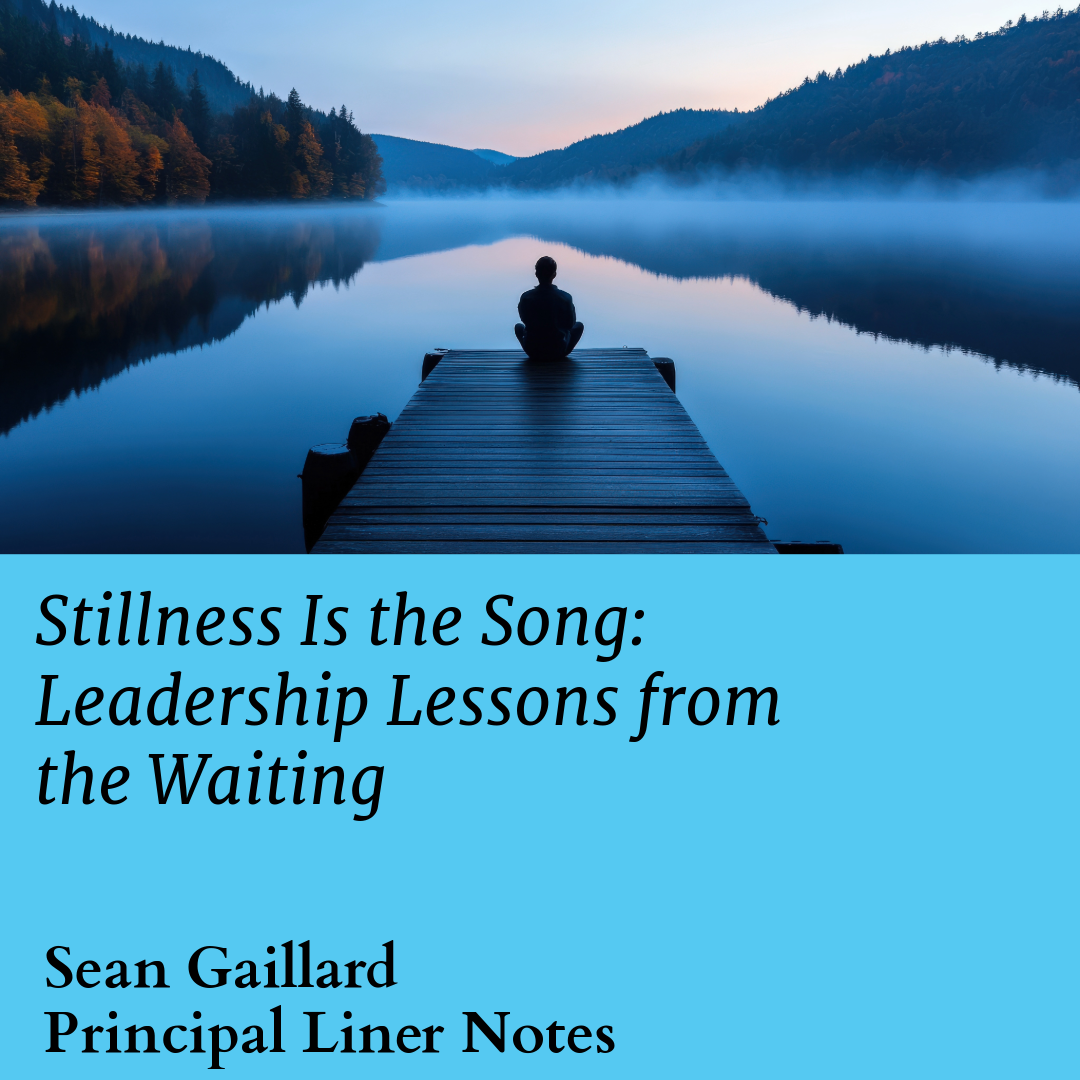
Stillness Is the Song: Leadership Lessons from the Waiting

“The waiting is the hardest part.”-Tom Petty (1981)


As I continue my sojourn in Maine, I gaze upon the lake on another cool summer morning. A warm cup of coffee is my company along with the occasional sparkles smiling at me on the water and a lone loon swimming alongside this morning reverie in the distance.

There’s a certain kind of silence that settles in when your waiting. It’s not always peaceful. It’s filled with hope, doubt, questions, and whispers of “what if.” That’s where I have been reflecting upon lately. There is an art to waiting that leaders must take hold of and learn to appreciate. Many look to us as a lamppost on a dark, foggy night. It is important that we make that the light we carry within, our leadership core, is intact, balanced, and focused.


The Struggle of Waiting

It is important to acknowledge the truth. Waiting is frustrating. It is excruciating into its life span and sometimes I allow negative moments to roam rent free in my head. I try to cope with waiting by cueing up familiar songs to carry me through the anxiety of waiting: “The Waiting” by Tom Petty, “Tired of Waiting for You” by The Kinks, or “I Am Waiting” by The Rolling Stones (a great deep cut by them from my favorite album of theirs, “Aftermath.”) Speaking of the Stones, I even imagine myself in their classic “Waiting on a Friend” video hanging out on the stoop with Mick Jagger looking for Keith Richards. Yet, the bottom line remains for me that waiting is just plain hard.

As leaders, we are wired to take action, make moves, plan next steps. We calculate, strategize, and analyze. There is urgency in the air that needs our focus and we called to act. The clock is ticking, people need decisions, and our vision and mission to serve our school community must be maintain momentum.

Sometimes the most important growth most important growth happens when nothing appears to be happening. For leaders, waiting can feel like failure. It can compel us to embrace the abysmal and tune into second-guesses and should haves. But in this stillness, I’m learning that not moving doesn’t mean not growing.

Waiting is an opportunity.


A Leadership Riff in the Shadows: George’s Quiet Resilience

George Harrison waited. He always did. Whether it was waiting for his guitar solo cue during the early days of The Beatles or waiting for spiritual enlightenment during his pursuit of Transcendental Meditation, George simply waited. He endured a long journey to have his voice and songs recognized within The Beatles. He waited in the shadow of the successful and thriving shadow of the Lennon-McCartney songwriting partnership for years. He watched song after song of his get passed over. But instead of giving up and surrendering to doubt, he kept writing. Occasionally, a song would be accepted and many of his songs in The Beatles still resonate today like “Something,” “While My Guitar Gently Weeps,” and “Here Comes The Sun.”

When the time finally came, George Harrison released the epic-three album, “All Things Must Pass.” This was an album of such depth, resonance, and majesty that it proved to the waiting wasn’t a waste; rather, it was a gathering. That gathering included an all-star line up musicians ranging from former bandmate, Ringo Starr, to Eric Clapton, Klaus Voorman, and all members of Badfinger. Phil Spector co-produced and served the album up with the Wall of Sound. It was filled with songs that The Beatles had rejected and hits that still spin today like “My Sweet Lord” and “What Is Life.”

George Harrison proved that waiting does not have to yield in an abrupt ending. Waiting can compel something beautiful to happen.


Leadership Wait Time

Waiting is a leadership discipline. It can take years to cultivate and nuance for one’s own leadership practice. Waiting teaches us patience, humility, faith, and emotional agility. In the classroom, teachers use “wait time” as a move to create space for students to pause, think, and reflect. It is an intentional pause that is meant to create belonging for students who may feel bashful at responding or to set the stage for a teachable moment to resonate within the classroom.

Leaders have wait time, too. The waiting room is where character gets built. It’s where we learn to lead without control, to listen instead of speak, to reflect instead of react.

As leaders, we have to cultivate space for waiting to ignite reflection. We have to give permission for ourselves to roam into that space to discover new things within ourselves and the people we serve.

This is not always easy and it can be ponderous. I reflect upon the moments of when I am challenged to wait as a leader and as an individual. Within the frustration of the moments of endless waiting, I have sometimes missed those opportunities for reflection and positivity. It’s easy to default to damning doubts and shifting the blame to some universe conspiring against me. Waiting does not have to be negative. We have to shift the paradigm on waiting to something akin to opportunity.

Brene Brown expressed this best for leaders, “Patience is not about waiting. It’s about how we behave while we’re waiting.” This is where we must be very cognizant of how we respond and move during our leadership wait time. We model the expectations and set the tone in our moves. Many look us to be that solid beacon of calm during any level of wait time and it’s important that we lead with grace, poise, and purpose during a leadership wait time.

Waiting can be a pressure cooker for leaders, but it’s important to maintain our core during those ponderous wait times.

There may have been pressure to fill a vacancy quickly whether it was for a teacher, assistant principal, or support staff member. But instead of rushing, you held out for the right fit. You waited, trusted your instincts, and stayed aligned with your school’s mission and values. And when that person arrived, it was clear they were the one. They didn’t just fill a role; they elevated the culture, built trust, and made a lasting impact on students and staff.

That moment, that hire validated the wait. The right choice often takes time.


A Quiet Riff to Carry Forward

Waiting is not weakness. It’s part of the journey. The silence we endure on a decision to be made or an action to occur is not empty. The silence may be an opportunity for you to compose a new song you don’t yet hear. I think of a time during my first principalship when our school was waiting for the outcome of our magnet grant application. The waiting was far-reaching and I remember checking my inbox every day several minutes at a time. This lasted for months and it was not pleasant. The waiting period did bring the faculty closer together as we shared this collective anticipation.

Looking back, it was the waiting that not only bonded us but it helped us persevere when we found out that we didn’t get the grant. The community that was forged during this period lead our school to being the first in the district to successfully implement a non-funded magnet. We had a positive impact on kids and achievement due to the community that was forged during the waiting game.

The truth is, we don’t always get to fast-forward through uncertainty. But we do get to keep showing up with grace, grit, and belief. You can use waiting as an opportunity to model resilience, reflection, and connection with others. And that’s the kind of leadership I want to grow in, one quiet step at a time.


    Three Action Steps to Make Waiting More Meaningful for Your Leadership

    1. Seek Out Thought Partners

    Waiting doesn’t have to be lonely. Use the pause to deepen your leadership bench. Reach out to a mentor, a colleague, or someone who inspires you. Take a spin within your Professional Learning Network (PLN) to seek those people out who can inspire and support you. Share your thoughts and listen to theirs. Thought partnership sharpens perspective, calms uncertainty, and reminds you that you’re not navigating the unknown alone. Collaboration during the waiting season often leads to renewed clarity and creative momentum.


    2. Study Leadership Riffs from History

    Waiting has shaped some of the most significant leaders and movements in history. Lincoln waited through agonizing losses before the tide turned. Mandela waited in a prison cell for 27 years before transforming a nation. Singer-songwriter Carole King waited years to emerge as a solo artist and record her multi-platinum selling masterpiece, Tapestry. Even The Beatles waited through setbacks and missteps before crafting Sgt. Pepper. Explore these stories not just for inspiration, but as evidence that purpose-driven delay can lead to extraordinary outcomes.


    3. Use the Quiet to Bring Your People Closer

    While the external outcome is pending, focus inward. Use this time to connect more deeply with your team. Hold space for listening. Celebrate small wins. Reaffirm your shared mission. Leadership isn’t just about making decisions, it’s about fostering belonging. Waiting offers a powerful window to strengthen community, build trust, and ensure your team feels seen and valued.

    The Power of the Pause:

    3 Reflection Tips for School Leaders

    It’s loud at the end of the school year.

    There are checklists to check off. Boxes to move. Emails to answer. Meetings to attend. Conversations to wrap. It can feel like you’re racing a clock with no hands—just noise, motion, and that persistent push toward “done.” As school leaders, we often wear this urgency like a badge of honor. But somewhere in the frenzy, we lose sight of something vital:

    The pause.

    The other day, our custodian was out, and I had to stay late to close the building. Alone. I walked the halls, locking doors and preparing to set the alarm. The building was still. No laughter echoing down the halls. No rush of students heading to the buses. Just me and the walls that had witnessed a school year’s worth of highs, lows, pivots, and quiet victories.

    That simple rhythm—step, door, lock, breathe—became something sacred. I wasn’t just closing a building. I was closing a chapter. In that silence, the year spoke back to me. I remembered the breakthroughs. The bruises. The bounce-backs. The beauty of what we had built together.

    And I realized something all over again: reflection is not a luxury. It’s a necessity.

    Since my heart episode last year—a moment that forced me to recharge not just physically, but mentally and spiritually—I’ve come to believe even more deeply in the power of pause. I spent too many years avoiding it. Confusing the speed of leadership with the strength of leadership. I mistook checklists for vision. And it nearly broke me.

    Innovation doesn’t come from being in constant motion. It comes from being still enough to listen to what the year has been teaching us all along.

    So I offer this, not just as a fellow school leader, but as someone who had to learn the hard way: Make reflection part of your leadership practice. Not later. Now.

    Here are three ways I’m leaning into reflection, even in the middle of the end-of-year mania:

    🎧 1. Schedule 15 Minutes of Stillness

    Block out 15 minutes this week—no email, no meetings, no phone. Find a quiet corner of your school. Sit. Breathe. Let the silence remind you of your why.

    📝 2. Journal with Three Prompts

    What am I most proud of this year? What did I learn from my staff? What will I do differently next year? Keep it short. Keep it honest. But write it down. Let your words catch up with your heart.

    🚶‍♂️ 3. Take a Solo Walk Through the Building

    No agenda. No checklist. Just walk. Let the sights, sounds, and stillness speak to you. Every poster, every student project, every empty seat is a story. These are the artifacts of your leadership.

    If you’re reading this and feeling overwhelmed or alone, know this: you’re not. I’m walking this with you. And if you need a thought partner or a word of encouragement, I’m here.

    Leadership is lonely—but it doesn’t have to be isolating. Especially when we choose to pause, reflect, and lead with presence.

    The noise will pass. The moment won’t.

    Make space for it.

    The Applause We Don’t Hear

    The Applause We Don’t Hear

    #PrincipalLinerNotes

    There are moments in leadership—more than we care to admit—when it feels like leadership isn’t there for you.

    You stand in a room and no one greets you. No one looks up. No one notices.

    You offer ideas, vision, care—and it’s met with silence, or worse, indifference.

    You give your best self and sometimes receive no acknowledgment in return.

    The gig is tough. The gig is lonely. The gig will ask you to keep showing up, especially when the room grows quiet. And sometimes, it stays quiet.

    And yet—we still walk in.

    Why?

    Because we’re human.

    Because we crave meaning.

    Because we want to belong just like anyone else.

    I carry what my father taught me in these moments: Hold your head high. Even when no one seems to see you. Especially then.

    And so, I look for the small things.

    The fleeting glances. The quiet nods. The invisible applause.

    Those moments when you know—deep in your gut—that you’re still in the groove.

    I remember those moments when I played in bands. We’d be deep into a tune, and someone across the band space would catch my eye and offer a knowing smile. Just a look. A small moment that said, We’ve got this.

    There’s a video I love of the Dave Brubeck Quartet performing Take Five. During Joe Morello’s legendary drum solo, Brubeck stops playing. He turns from the piano—not to take center stage, but to watch. To admire. To honor. No words. Just presence.

    The Beatles did it, too. During that final rooftop concert, even amid the tension, they stole glances. Smiles. They saw each other. And they saw Billy Preston, too—playing keys right alongside them, lifting the sound, lifting the moment.

    Even as the world watched from the streets below, the real audience wasn’t the crowd down there—it was amidst the band.

    That’s what keeps me going in leadership—the small, true things.

    A student’s unexpected smile.

    A teacher’s thank-you whispered in the hallway.

    A quiet moment where someone sees you—and maybe, just maybe, you see them too.

    We may not always receive the applause. But we can give it.

    We can be the nod.

    We can be the smile.

    We can be the Dave Brubeck who turns his head in full admiration.

    We can be the Beatle who shares a grin in the middle of the chaos.

    Those small moves? They matter.

    They are leadership.

    And when the room is quiet—lead anyway.

    You never know who might be listening for your cue.

    A Leadership Riff for You

    Here’s a thought to share from my reflection and writing this morning.

    I hope you know that your sound matters and any band is lucky to have you. I sure do believe in you. Thanks for being in the band!

    Keeping Your Beat: The Power of Impact Visits for School Leaders

    A reflection inspired by John Bonham, legacy, and the rhythm of leadership
    #PrincipalLinerNotes

    Special Thanks to Jimmy Casas and Lainie Rowell for their respective missions inspiring my gig! I am grateful that our PLN connections have evolved into sincere, lifelong friendships.

    A very special thanks to my amazing wife, Deb, for being that constant source of love, inspiration, and strength every day! Thanks for inspiring Impact Visits!


    A Soundcheck at Knebworth

    It was just a soundcheck.
    August 1979. Knebworth. A wide open field waiting to be filled with music. Led Zeppelin was preparing for a monumental return to the British stage. But as the band warmed up, it wasn’t John Bonham—the thunderous backbone of the band—behind the drum kit. It was his 13-year-old son, Jason.

    In a rare and touching moment, Bonham stepped away from the drums and wandered into the field. He didn’t just want to hear the band; he wanted to listen from a distance. He stood alone, away from the stage, and let the sound wash over him. The rhythm of his legacy. His son’s rhythm.

    There were no headlines. No fanfare. But there was something sacred in that quiet act: a father making space for the next generation, a rock legend becoming an audience member. Trust. Love. Legacy. It was all there in that field of amplifiers and dreams.

    As a teenager, I remember reading about that moment in one of the many music biographies I devoured. It stuck with me. Especially knowing that John Bonham would pass away just over a year later. His son, Jason, would grow up to carry the torch—eventually joining surviving members of Led Zeppelin for reunion shows, most notably in the legendary 2007 performance captured on Celebration Day.

    That soundcheck was more than rehearsal. It was legacy in action. It was impact. It was a leader stepping back—so something deeper could move forward.


    Stepping Back for Impact

    The response to my recent blog post, The Loneliness of Leadership, has been both humbling and healing. I wrote it to name and navigate the isolation I’ve felt in leadership—and to extend a hand to others who may be feeling the same. The heartfelt messages and outreach reminded me that we’re not as alone as we think. There is resonance when we share our truth.

    This morning, I had the sincere honor of being a guest on Jimmy Casas’ podcast, The Interview Chair.
    You can listen to that episode soon, but here’s what struck me during our conversation: Jimmy asked how I maintain mental health in leadership—especially after sharing my heart episode experience from last year. My answer came quickly: Impact Visits.


    What Are Impact Visits?

    Impact Visits are intentional moments carved out of the chaos. They’re brief detours in your day where you go and witness your leadership in motion—where the fingerprints of your work are making a difference.

    Over the years of my principalship, my wife Deb would often tell me, especially on the hard days, “Go visit a classroom where you know it’s working.” She’d say it gently but with urgency—usually on the days when I was feeling discouraged, disconnected, or alienated. I didn’t always listen. I’d get swept up in the whirlwind of tasks and to-dos. But since my heart episode and my renewed focus on mental health, I’ve made it a point to follow her advice.

    So, thank you, Deb. I know to listen to you now.

    These are not evaluative visits. They’re not walk-throughs with clipboards and checklists. They’re personal moments—to be reminded, to be renewed. A time to refuel your spirit and reconnect to why you said yes to this work in the first place.

    If you can, use these visits as a chance to connect. To offer a word of thanks. A fist bump. A simple “You’re doing great.” As my friend Lainie Rowell reminds us in her #EvolvingWithGratitude mission—gratitude is a powerful act of leadership. A little goes a long way.


    Four Ways to Make Impact Visits Happen

    1. Schedule Intentionally
      Block time on your calendar each week. Just 10–15 minutes to step into a classroom, a hallway, or the front line of your impact.
    2. Make It Routine
      Ritual turns into rhythm. If you make Impact Visits a part of your leadership practice, they’ll become the pause that powers your next move.
    3. Share the Visit
      Reflect on your visits with a thought partner or friend. If you don’t have someone, you’re welcome to reach out to me. I’d be honored to be that listening ear: sgaillard84@gmail.com
    4. Encourage Others
      Inspire your team, your assistant principals, or even colleagues in your PLN to create their own version of Impact Visits. Help build a culture of reflection and renewal.

    Your Beat Still Matters

    Leadership is not a sprint of perfection. It’s a series of riffs—some raw, some refined. We owe it to ourselves and those we serve to keep our rhythm aligned with our core values.

    So, take that walk. Stand in that hallway. Listen to the beat that’s still echoing from something you once helped shape.

    Because even in the quiet moments—maybe especially in the quiet moments—we find proof that we’re still making a difference.

    Keep your beat.

    The Heart of Leadership: Humility and Belonging

    Earlier this week, our country lost a remarkable leader in former President Jimmy Carter. The tributes that followed didn’t focus on grand speeches or flashy displays of power. Instead, they celebrated Carter’s unwavering faith, his steadfast dedication to community, and his lifelong commitment to making the world a better place for others. His leadership wasn’t about being the center of attention or staging photo-ops; it was about rolling up his sleeves and humbly serving those around him.

    As educators, we must ask ourselves: What kind of leaders are we striving to be? Are we chasing the spotlight or building the light in others? For too long, I’ve seen school leaders drawn to performative leadership—the standing on tables, the viral stunts, the costumes designed for “likes” rather than lasting impact. While these acts may entertain for a moment, they often fail to empower others or build the foundation of belonging that our students, teachers, and families need.

    Leadership isn’t about gimmicks or self-promotion. True leadership lies in tuning into the gifts of others and encouraging them to follow their unique paths. It’s about listening more than speaking, serving more than being served, and building a culture where everyone feels valued, seen, and capable of greatness.

    Jimmy Carter once said, “We must adjust to changing times and still hold to unchanging principles.” His words remind us that the principles of humility, service, and community are timeless in leadership. Humble leadership is a quiet force that lifts others without fanfare. It builds cultures of belonging, not through stunts, but through consistency, care, and compassion.

    For many years, my father instilled in me the idea that greatness comes not from being on a stage but from being in service to others. He taught me to dare to be great by encouraging others to step off the sidelines and into their potential. As leaders, it’s our calling to help others “kick off the bench” and take those daring steps toward their own greatness.

    Four Leadership Moves to Build a Culture of Belonging with Humility

    1. Listen With Purpose

    Create opportunities to listen to the voices of students, teachers, and families. Regularly ask, “What do you need?” or “How can I support you?” and act on what you hear. Listening isn’t just hearing—it’s responding with action and intention.

    2. Celebrate Others’ Gifts

    Leadership isn’t about being the hero of every story. Shine the spotlight on your team. Recognize the unique talents and achievements of those you serve. Build platforms where others can share their brilliance.

    3. Serve Quietly and Consistently

    Leadership is often found in the small, unseen moments. Show up early to greet students. Pitch in during tough times without announcing it. Let your actions speak louder than your words.

    4. Model Humility in Every Interaction

    Humility isn’t weakness; it’s strength in understanding that leadership is about others, not ourselves. Admit mistakes, ask for feedback, and be willing to learn alongside your team.

    Let us step away from the noise of performative leadership and into the quiet power of service. Leadership isn’t standing on a table or staging antics that distract from our core mission. It’s about humbly helping others discover their greatness.

    As I reflect on Jimmy Carter’s legacy and the lessons my father taught me, I’m reminded of the simple truth: Leadership is not about being in the spotlight—it’s about igniting the light in others. Dare to be great by building a culture where everyone belongs and is empowered to lead.

    Let’s get to work, sleeves rolled up, hearts full of humility, and hands ready to serve.

    Beat Support Revisited: Leadership in Rhythm

    Leadership can feel like navigating the swirling chaos of a live performance—where the screams of the crowd threaten to drown out your rhythm. As school leaders, it’s easy to get lost in the noise, but it’s in these moments that we must tune into those around us. The people we lead and serve are our rhythm section, and finding the right “beat support” can make all the difference.

    I’ve been reflecting on this idea recently, inspired by a moment I once shared on my podcast, #PrincipalLinerNotes. Years ago, during one of my “Impromptu Carpool Episodes,” I recorded an off-the-cuff reflection about a clip of The Beatles performing “I Feel Fine” live. Amidst the chaos of Beatlemania—where stage monitors were nonexistent and screaming fans drowned out everything—Paul McCartney stepped in with a move of pure leadership. During Ringo Starr’s incredible drum break, Paul gave a quick cue, counting Ringo back in and ensuring he nailed his return to the beat.

    That moment wasn’t just about music; it was a masterclass in leadership. It demonstrated the importance of being attuned to your team, providing support when they need it, and ensuring that everyone finds their rhythm.

    The Rhythm of Belonging

    I explored this connection between The Beatles, leadership, and education in my book, The Pepper Effect. In it, I share lessons from the Fab Four that remind us of the power of collaboration, creativity, and connection. (You can check out the book here! The Pepper Effect on Amazon).

    One of the most important lessons from both The Beatles and leadership is the role of belonging. As leaders, we need to provide the cues and support that allow our team to thrive. Whether it’s a trusted teacher who serves as your barometer or the intentional moments where you help others find their groove, belonging starts with building connections.

    Four Ways Leaders Can Build Beat Support

    Here are four actionable ways leaders can create their own “beat support” and foster belonging:

    1. Find Your Barometer

    Identify someone you trust—someone who will be honest with you—and use them as a gauge to understand how your decisions and words land with your team.

    2. Be a Barometer for Others

    Provide clear and supportive cues for your team. Let them know where they stand and help them feel confident in their role.

    3. Celebrate Strengths

    Like Paul recognizing Ringo’s brilliance, tune into the unique gifts of your team members and amplify their contributions.

    4. Create Collaborative Spaces

    Build opportunities for your team to share ideas, support each other, and work toward common goals. Belonging grows in the spaces where collaboration thrives.

    What’s Next: Why The Beatles Matter

    This reflection on leadership, belonging, and The Beatles has inspired me to launch a new podcast called “Why The Beatles Matter,”starting December 12. This podcast will explore the lasting impact of The Beatles and their legacy through conversations with people whose lives have been shaped by their music and message.

    I’m looking for future guests to share their stories of how The Beatles inspired them. If you’d like to join me on this journey, email me at sgaillard84@gmail.com. Spaces are filling up fast.

    Mending Hearts: The Essential Role of Coaching in Leadership

    Heartbreak in Leadership

    My leadership heart was broken.

    An idea I had nurtured and built was dismissed. The specifics of the idea are not important for this blog. What matters is that I had a vision for the schoolhouse that wasn’t embraced by the faculty I served. This is a familiar scenario when you sit in the principal’s chair—you have an idea that energizes you and perhaps others. You see some momentum, but for various reasons, the idea fizzles out. It’s part of the leadership journey. Some ideas gain traction, while others don’t. I accept the responsibility for the failure of an idea to take hold. Maybe I didn’t communicate the ‘why’ compellingly, or perhaps my own arrogance hindered capacity-building with others. Regardless, we invest passion into our ideas. When we push beyond the mundane tasks and have-tos as school leaders and our passion isn’t accepted, it’s a challenge not to take it personally.

    I bounced back from this setback. It wasn’t the first time my leadership heart had cracked, and it wouldn’t be the last. There would be future successes and failures. What made this particular loss resonate was the profound sense of loneliness. The principal gig is isolating as it is, but feeling the rejection of a cherished idea made it especially painful. At that time, my usual network of thought partners wasn’t available. I had to endure this one alone and dig deeply into my core to carry on.

    Eventually, I was able to connect with a trusted thought partner. That person was able to listen to me, ask critical questions, and empower me to get back at it. I was fortunate that I had someone to help me navigate through the leadership blues and help me recalibrate my course.

    Not every school leader has this resource. A 2022 study from NASSP cites that 77% of principals in the US desire to connect with other leaders facing similar challenges. School leaders faces many challenges alone bereft of authentic and consistent support.

    The Loneliness of Leadership

    They don’t teach you enough in “principal school” about how lonely leadership can be. That’s why nurturing your core as a leader and keeping your loved ones close is essential. It’s also crucial for school leaders to be open to coaching. Despite the title and position, no amount of status should make us look down on the need for a network of thought partners and coaching. School systems must develop intentional coaching networks for leaders due to the loneliness, anxiety, and fatigue that often accompany leadership roles. I’ve been fortunate to have valued thought partners and coaches in various leadership assignments. It’s vital that we, as leaders, find those trusted voices to harmonize with and share our thoughts, fears, and ideas. Every leader needs a coach, and there are many pathways to find one if your school district doesn’t provide one. Tapping into a Professional Learning Network is one way to find helpful school leaders willing to share their expertise.

    The Power of Coaching

    Coaching is essential for sustaining momentum and balance in a leadership role. We must be open to and accept the strengths of others to fill our buckets. Coaching helps us navigate the complex landscape of leadership, providing us with the tools to overcome challenges and celebrate successes. An effective coach offers a fresh perspective, helping us see our blind spots and areas for growth.

    Three Ways for School Leaders to Seek Out Coaching Support

    1. Join a Mastermind Group
    • Mastermind groups bring together like-minded leaders who support and challenge each other to grow. These groups provide a safe space to share ideas, seek advice, and gain new insights.
    • Resource: Here’s one to explore with the Teach Better Team at this site: https://teachbetter.com/mastermind/

    2. Participate in a Book Study

    • Engaging in a book study with fellow leaders allows for deep dives into relevant topics and provides a structured way to learn and discuss new concepts. It also fosters a sense of community and shared purpose.
    • Resource: ASCD Book Study Groups provide opportunities to explore educational leadership books with peers.

    3. Utilize Virtual Coaching

    • Virtual coaching offers flexibility and access to a wide range of experts. Whether through video calls, webinars, or online courses, virtual coaching can provide valuable support and guidance tailored to your specific needs.
    • Resource: BTS Spark offers a wealth of resources and opportunities for individualized coaching.

    Specific Resources for Coaching Support

    1. The National Association of Elementary School Principals (NAESP)
    • NAESP offers mentoring programs, professional development resources, and a supportive community for elementary school leaders seeking guidance and support.

    2. The Association for Supervision and Curriculum Development (ASCD)

    • ASCD provides numerous professional development opportunities, including book studies, webinars, and conferences that can help school leaders grow and connect with others.

    3. The International Society for Technology in Education (ISTE)

    • ISTE offers resources and professional learning opportunities focused on integrating technology in education, supporting school leaders in leveraging digital tools for effective leadership.

    4. The National Association of Secondary School Principals (NASSP)

    • NASSP provides leadership resources, professional development, and a network of support specifically for secondary school leaders.

    5. BTS Spark

    • BTS Spark offers coaching and leadership development programs tailored for educators, focusing on personal and professional growth.

    Leadership is a journey filled with sublime peaks and ponderous valleys. Embracing coaching can make the journey less lonely and more enriching. By seeking out coaching support, we sharpen our saw, maintain our leadership core, and continue to grow and inspire those we lead. In this ever-shifting landscape of Education especially felt with the onset of AI, it is vital for school leaders to have needed support.

    I invite you to share your resources and ideas in the comments for this blog post. Let’s learn and grow together.