Stillness Is the Song: Leadership Lessons from the Waiting

“The waiting is the hardest part.”-Tom Petty (1981)


As I continue my sojourn in Maine, I gaze upon the lake on another cool summer morning. A warm cup of coffee is my company along with the occasional sparkles smiling at me on the water and a lone loon swimming alongside this morning reverie in the distance.

There’s a certain kind of silence that settles in when your waiting. It’s not always peaceful. It’s filled with hope, doubt, questions, and whispers of “what if.” That’s where I have been reflecting upon lately. There is an art to waiting that leaders must take hold of and learn to appreciate. Many look to us as a lamppost on a dark, foggy night. It is important that we make that the light we carry within, our leadership core, is intact, balanced, and focused.


The Struggle of Waiting

It is important to acknowledge the truth. Waiting is frustrating. It is excruciating into its life span and sometimes I allow negative moments to roam rent free in my head. I try to cope with waiting by cueing up familiar songs to carry me through the anxiety of waiting: “The Waiting” by Tom Petty, “Tired of Waiting for You” by The Kinks, or “I Am Waiting” by The Rolling Stones (a great deep cut by them from my favorite album of theirs, “Aftermath.”) Speaking of the Stones, I even imagine myself in their classic “Waiting on a Friend” video hanging out on the stoop with Mick Jagger looking for Keith Richards. Yet, the bottom line remains for me that waiting is just plain hard.

As leaders, we are wired to take action, make moves, plan next steps. We calculate, strategize, and analyze. There is urgency in the air that needs our focus and we called to act. The clock is ticking, people need decisions, and our vision and mission to serve our school community must be maintain momentum.

Sometimes the most important growth most important growth happens when nothing appears to be happening. For leaders, waiting can feel like failure. It can compel us to embrace the abysmal and tune into second-guesses and should haves. But in this stillness, I’m learning that not moving doesn’t mean not growing.

Waiting is an opportunity.


A Leadership Riff in the Shadows: George’s Quiet Resilience

George Harrison waited. He always did. Whether it was waiting for his guitar solo cue during the early days of The Beatles or waiting for spiritual enlightenment during his pursuit of Transcendental Meditation, George simply waited. He endured a long journey to have his voice and songs recognized within The Beatles. He waited in the shadow of the successful and thriving shadow of the Lennon-McCartney songwriting partnership for years. He watched song after song of his get passed over. But instead of giving up and surrendering to doubt, he kept writing. Occasionally, a song would be accepted and many of his songs in The Beatles still resonate today like “Something,” “While My Guitar Gently Weeps,” and “Here Comes The Sun.”

When the time finally came, George Harrison released the epic-three album, “All Things Must Pass.” This was an album of such depth, resonance, and majesty that it proved to the waiting wasn’t a waste; rather, it was a gathering. That gathering included an all-star line up musicians ranging from former bandmate, Ringo Starr, to Eric Clapton, Klaus Voorman, and all members of Badfinger. Phil Spector co-produced and served the album up with the Wall of Sound. It was filled with songs that The Beatles had rejected and hits that still spin today like “My Sweet Lord” and “What Is Life.”

George Harrison proved that waiting does not have to yield in an abrupt ending. Waiting can compel something beautiful to happen.


Leadership Wait Time

Waiting is a leadership discipline. It can take years to cultivate and nuance for one’s own leadership practice. Waiting teaches us patience, humility, faith, and emotional agility. In the classroom, teachers use “wait time” as a move to create space for students to pause, think, and reflect. It is an intentional pause that is meant to create belonging for students who may feel bashful at responding or to set the stage for a teachable moment to resonate within the classroom.

Leaders have wait time, too. The waiting room is where character gets built. It’s where we learn to lead without control, to listen instead of speak, to reflect instead of react.

As leaders, we have to cultivate space for waiting to ignite reflection. We have to give permission for ourselves to roam into that space to discover new things within ourselves and the people we serve.

This is not always easy and it can be ponderous. I reflect upon the moments of when I am challenged to wait as a leader and as an individual. Within the frustration of the moments of endless waiting, I have sometimes missed those opportunities for reflection and positivity. It’s easy to default to damning doubts and shifting the blame to some universe conspiring against me. Waiting does not have to be negative. We have to shift the paradigm on waiting to something akin to opportunity.

Brene Brown expressed this best for leaders, “Patience is not about waiting. It’s about how we behave while we’re waiting.” This is where we must be very cognizant of how we respond and move during our leadership wait time. We model the expectations and set the tone in our moves. Many look us to be that solid beacon of calm during any level of wait time and it’s important that we lead with grace, poise, and purpose during a leadership wait time.

Waiting can be a pressure cooker for leaders, but it’s important to maintain our core during those ponderous wait times.

There may have been pressure to fill a vacancy quickly whether it was for a teacher, assistant principal, or support staff member. But instead of rushing, you held out for the right fit. You waited, trusted your instincts, and stayed aligned with your school’s mission and values. And when that person arrived, it was clear they were the one. They didn’t just fill a role; they elevated the culture, built trust, and made a lasting impact on students and staff.

That moment, that hire validated the wait. The right choice often takes time.


A Quiet Riff to Carry Forward

Waiting is not weakness. It’s part of the journey. The silence we endure on a decision to be made or an action to occur is not empty. The silence may be an opportunity for you to compose a new song you don’t yet hear. I think of a time during my first principalship when our school was waiting for the outcome of our magnet grant application. The waiting was far-reaching and I remember checking my inbox every day several minutes at a time. This lasted for months and it was not pleasant. The waiting period did bring the faculty closer together as we shared this collective anticipation.

Looking back, it was the waiting that not only bonded us but it helped us persevere when we found out that we didn’t get the grant. The community that was forged during this period lead our school to being the first in the district to successfully implement a non-funded magnet. We had a positive impact on kids and achievement due to the community that was forged during the waiting game.

The truth is, we don’t always get to fast-forward through uncertainty. But we do get to keep showing up with grace, grit, and belief. You can use waiting as an opportunity to model resilience, reflection, and connection with others. And that’s the kind of leadership I want to grow in, one quiet step at a time.


    Three Action Steps to Make Waiting More Meaningful for Your Leadership

    1. Seek Out Thought Partners

    Waiting doesn’t have to be lonely. Use the pause to deepen your leadership bench. Reach out to a mentor, a colleague, or someone who inspires you. Take a spin within your Professional Learning Network (PLN) to seek those people out who can inspire and support you. Share your thoughts and listen to theirs. Thought partnership sharpens perspective, calms uncertainty, and reminds you that you’re not navigating the unknown alone. Collaboration during the waiting season often leads to renewed clarity and creative momentum.


    2. Study Leadership Riffs from History

    Waiting has shaped some of the most significant leaders and movements in history. Lincoln waited through agonizing losses before the tide turned. Mandela waited in a prison cell for 27 years before transforming a nation. Singer-songwriter Carole King waited years to emerge as a solo artist and record her multi-platinum selling masterpiece, Tapestry. Even The Beatles waited through setbacks and missteps before crafting Sgt. Pepper. Explore these stories not just for inspiration, but as evidence that purpose-driven delay can lead to extraordinary outcomes.


    3. Use the Quiet to Bring Your People Closer

    While the external outcome is pending, focus inward. Use this time to connect more deeply with your team. Hold space for listening. Celebrate small wins. Reaffirm your shared mission. Leadership isn’t just about making decisions, it’s about fostering belonging. Waiting offers a powerful window to strengthen community, build trust, and ensure your team feels seen and valued.
    The Power of the Pause:

    3 Reflection Tips for School Leaders

    It’s loud at the end of the school year.

    There are checklists to check off. Boxes to move. Emails to answer. Meetings to attend. Conversations to wrap. It can feel like you’re racing a clock with no hands—just noise, motion, and that persistent push toward “done.” As school leaders, we often wear this urgency like a badge of honor. But somewhere in the frenzy, we lose sight of something vital:

    The pause.

    The other day, our custodian was out, and I had to stay late to close the building. Alone. I walked the halls, locking doors and preparing to set the alarm. The building was still. No laughter echoing down the halls. No rush of students heading to the buses. Just me and the walls that had witnessed a school year’s worth of highs, lows, pivots, and quiet victories.

    That simple rhythm—step, door, lock, breathe—became something sacred. I wasn’t just closing a building. I was closing a chapter. In that silence, the year spoke back to me. I remembered the breakthroughs. The bruises. The bounce-backs. The beauty of what we had built together.

    And I realized something all over again: reflection is not a luxury. It’s a necessity.

    Since my heart episode last year—a moment that forced me to recharge not just physically, but mentally and spiritually—I’ve come to believe even more deeply in the power of pause. I spent too many years avoiding it. Confusing the speed of leadership with the strength of leadership. I mistook checklists for vision. And it nearly broke me.

    Innovation doesn’t come from being in constant motion. It comes from being still enough to listen to what the year has been teaching us all along.

    So I offer this, not just as a fellow school leader, but as someone who had to learn the hard way: Make reflection part of your leadership practice. Not later. Now.

    Here are three ways I’m leaning into reflection, even in the middle of the end-of-year mania:

    🎧 1. Schedule 15 Minutes of Stillness

    Block out 15 minutes this week—no email, no meetings, no phone. Find a quiet corner of your school. Sit. Breathe. Let the silence remind you of your why.

    📝 2. Journal with Three Prompts

    What am I most proud of this year? What did I learn from my staff? What will I do differently next year? Keep it short. Keep it honest. But write it down. Let your words catch up with your heart.

    🚶‍♂️ 3. Take a Solo Walk Through the Building

    No agenda. No checklist. Just walk. Let the sights, sounds, and stillness speak to you. Every poster, every student project, every empty seat is a story. These are the artifacts of your leadership.

    If you’re reading this and feeling overwhelmed or alone, know this: you’re not. I’m walking this with you. And if you need a thought partner or a word of encouragement, I’m here.

    Leadership is lonely—but it doesn’t have to be isolating. Especially when we choose to pause, reflect, and lead with presence.

    The noise will pass. The moment won’t.

    Make space for it.

    The Heart of Leadership: Humility and Belonging

    Earlier this week, our country lost a remarkable leader in former President Jimmy Carter. The tributes that followed didn’t focus on grand speeches or flashy displays of power. Instead, they celebrated Carter’s unwavering faith, his steadfast dedication to community, and his lifelong commitment to making the world a better place for others. His leadership wasn’t about being the center of attention or staging photo-ops; it was about rolling up his sleeves and humbly serving those around him.

    As educators, we must ask ourselves: What kind of leaders are we striving to be? Are we chasing the spotlight or building the light in others? For too long, I’ve seen school leaders drawn to performative leadership—the standing on tables, the viral stunts, the costumes designed for “likes” rather than lasting impact. While these acts may entertain for a moment, they often fail to empower others or build the foundation of belonging that our students, teachers, and families need.

    Leadership isn’t about gimmicks or self-promotion. True leadership lies in tuning into the gifts of others and encouraging them to follow their unique paths. It’s about listening more than speaking, serving more than being served, and building a culture where everyone feels valued, seen, and capable of greatness.

    Jimmy Carter once said, “We must adjust to changing times and still hold to unchanging principles.” His words remind us that the principles of humility, service, and community are timeless in leadership. Humble leadership is a quiet force that lifts others without fanfare. It builds cultures of belonging, not through stunts, but through consistency, care, and compassion.

    For many years, my father instilled in me the idea that greatness comes not from being on a stage but from being in service to others. He taught me to dare to be great by encouraging others to step off the sidelines and into their potential. As leaders, it’s our calling to help others “kick off the bench” and take those daring steps toward their own greatness.

    Four Leadership Moves to Build a Culture of Belonging with Humility

    1. Listen With Purpose

    Create opportunities to listen to the voices of students, teachers, and families. Regularly ask, “What do you need?” or “How can I support you?” and act on what you hear. Listening isn’t just hearing—it’s responding with action and intention.

    2. Celebrate Others’ Gifts

    Leadership isn’t about being the hero of every story. Shine the spotlight on your team. Recognize the unique talents and achievements of those you serve. Build platforms where others can share their brilliance.

    3. Serve Quietly and Consistently

    Leadership is often found in the small, unseen moments. Show up early to greet students. Pitch in during tough times without announcing it. Let your actions speak louder than your words.

    4. Model Humility in Every Interaction

    Humility isn’t weakness; it’s strength in understanding that leadership is about others, not ourselves. Admit mistakes, ask for feedback, and be willing to learn alongside your team.

    Let us step away from the noise of performative leadership and into the quiet power of service. Leadership isn’t standing on a table or staging antics that distract from our core mission. It’s about humbly helping others discover their greatness.

    As I reflect on Jimmy Carter’s legacy and the lessons my father taught me, I’m reminded of the simple truth: Leadership is not about being in the spotlight—it’s about igniting the light in others. Dare to be great by building a culture where everyone belongs and is empowered to lead.

    Let’s get to work, sleeves rolled up, hearts full of humility, and hands ready to serve.

    Go Electric: A Lesson from Bob Dylan

    I didn’t expect the tears.

    But there I was, sitting in a dimly lit theater, tears streaming down my face as Bob Dylan defiantly sang “Maggie’s Farm” to an audience torn between boos and cheers. I was watching A Complete Unknown with my oldest daughter, Maddie—a thoughtful Christmas gift she knew I’d treasure.

    The scene that stopped me in my tracks was Dylan’s iconic performance at the 1965 Newport Folk Festival. Armed with a Fender Stratocaster, he boldly plugged in and “went electric,” breaking away from the acoustic traditions revered by the folk community. The reaction was a mix of outrage and elation. Boos echoed from the purists, but Dylan, backed by members of the Paul Butterfield Blues Band and organist Al Kooper, played on.

    As a lifelong fan of the Butterfield Blues Band, seeing actors portray my music heroes—Mike Bloomfield on guitar, Sam Lay on drums, and Jerome Arnold on bass—deeply moved me. Their musicianship had always resonated with me, and witnessing their essence captured on screen added another layer of emotion to an already powerful moment.

    This scene, beautifully brought to life by Timothée Chalamet as Dylan, is more than just a snapshot in music history. It’s a testament to creative courage.

    Resonating with Dylan’s Defiance

    I’ve watched the documentaries, taught this moment in my high school English classes, and pored over Elijah Wald’s Dylan Goes Electric. I even dedicated an episode of my Principal Liner Notes podcast to it. Yet, seeing it unfold on the big screen hit differently.

    Dylan’s act of “going electric” wasn’t just about plugging in an electric guitar; it was about rejecting the status quo, staying true to his evolving vision, and embracing the risk of change. The boos, the backlash—none of it stopped him. He knew that growth required stepping out of the safe and into the bold.

    That lesson transcends the 1960s. For leaders, it’s a call to innovate, to embrace challenges, and to stay true to our core values, even when met with resistance.

    The Courage to Play On

    As leaders, we often face our own “Newport moments.” Whether it’s introducing a new initiative, rethinking old practices, or simply challenging the comfort of the status quo, there’s always a risk of pushback. People may not immediately understand—or embrace—our vision.

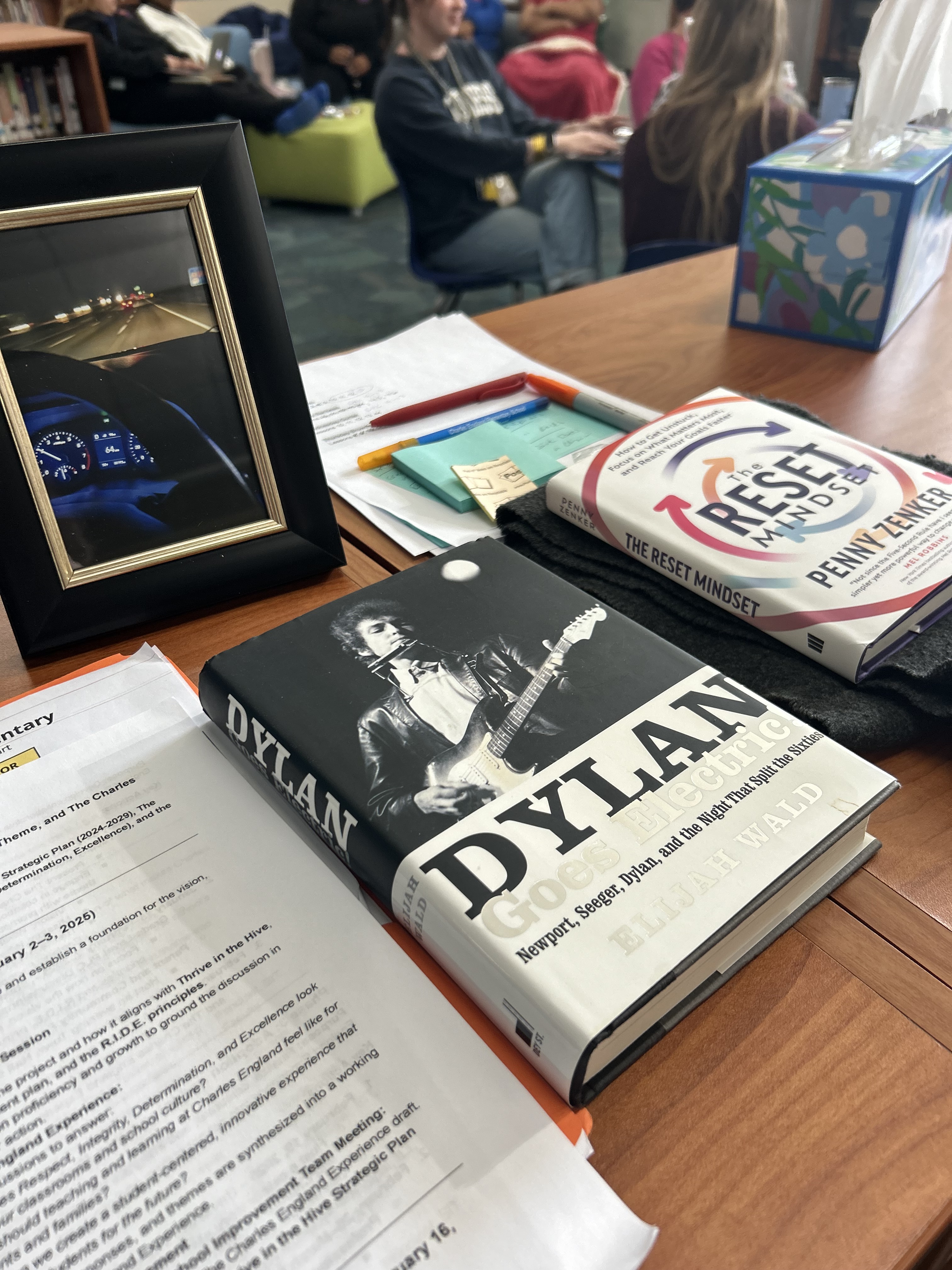
    During a recent faculty meeting, I introduced a new approach to teaching and learning. I’ll admit, I was nervous about how it would be received. To ground myself, I brought along my copy of Wald’s Dylan Goes Electric. On the cover was Dylan, guitar in hand, staring down the crowd with quiet resolve. That image reminded me to stay steadfast, to “play on” even when the riffs might not land perfectly with everyone. (See picture below.)

    Going electric is about more than innovation. It’s about embodying the courage to grow, to inspire others, and to stay true to our vision. It’s a reminder that, as leaders, we have the responsibility to model resilience and boldness for those we serve.

    A Legacy of Creative Courage

    Dylan’s 1965 performance is more than a legendary moment in music—it’s a blueprint for leadership. After Newport, Dylan continued to push boundaries, recording groundbreaking albums, earning accolades, and even winning the Nobel Prize for Literature. He didn’t let the boos define him; he let his vision propel him forward.

    His story inspires us to embrace creative courage. When we face the naysayers or wrestle with self-doubt, we can hold our heads high, just as Dylan did, and press forward with conviction.

    Four Ways Leaders Can “Go Electric”

    1. Stay True to Your Vision: Know your core values and let them guide your actions, even when facing resistance.
    2. Embrace Growth: Innovation often means stepping into the unknown. Take bold steps to evolve and improve.
    3. Play On Through Adversity: Be prepared for challenges. Stay resilient and committed to your vision, even when others push back.
    4. Inspire Others Through Action: Your courage can empower those around you to embrace their own growth and creativity.

    Dylan’s journey reminds us that leadership is not about avoiding the boos but about playing on, louder and prouder. So, let’s go electric—and inspire those we lead to do the same.

    Link to my “Go Electric” episode of Principal Liner Notes

    Creative Escapes: How Bold Breaks Spark Leadership Brilliance

    Embrace the Wichita Train Whistle: Taking a Creative Leap for Leadership Growth

    In the frenetic pace of our daily leadership roles, it’s all too easy to become ensnared in the routine, the predictable, and the safe. However, summer presents a unique opportunity to break free from these confines and embark on a journey of creativity and innovation. Just as Mike Nesmith of The Monkees did with his audacious project, “The Wichita Train Whistle Sings,” leaders today can benefit immensely from taking a radical step away from their normal gigs. Let’s delve into how this seemingly offbeat album can inspire us to break away, iterate, reflect, and ultimately grow.

    The Audacious Experiment of Mike Nesmith

    In 1968, Mike Nesmith, best known as a member of The Monkees, embarked on a creative odyssey that was as bold as it was unconventional. He created “The Wichita Train Whistle Sings,” an album that was a commercial failure but a personal triumph. This instrumental album, filled with orchestral renditions of Nesmith’s compositions performed by members of the 1960s studio hired guns known as The Wrecking Crew, was a radical departure from his work with The Monkees. Despite its lack of commercial success, this project was a testament to Nesmith’s willingness to explore and innovate. It was a stepping stone that likely fueled his later creative endeavors, both with The Monkees and in his solo career.

    Nesmith’s willingness to take this creative risk highlights an essential truth for leaders: sometimes, stepping away from the norm can ignite the spark of innovation and courage necessary for future success.

    A Personal Journey: Teaching English at Governor’s School

    Reflecting on my own experience, I recall the summers I spent teaching English at Governor’s School. This was a significant departure from my regular responsibilities as an educator and administrator. Immersing myself in this unique educational environment allowed me to view teaching and leadership through a new lens. It reinvigorated my passion for education and provided fresh perspectives that I could bring back to my usual role. I was ensconced with kindred spirits who truly wanted to collaborate and innovate. I was seen and valued by my colleagues for my gifts. I felt a true sense of belonging during this innovative teaching experience. This break from routine was not just refreshing but also instrumental in my professional growth.

    Why Leaders Should Take a Creative Leap

    Taking a break from your regular routine to engage in something entirely different is not merely a retreat; it’s a strategic move. Here’s why:

    1. Fostering Innovation: Stepping into a new realm can break the cycle of conventional thinking, fostering a more innovative mindset.
    2. Building Resilience: Embracing the unknown and overcoming new challenges builds resilience and adaptability.
    3. Gaining Perspective: New experiences provide fresh perspectives, enabling leaders to approach their usual roles with renewed insight and creativity. Plus, we are always learning and growing and new experiences ignite that drive.

    The Power of Stepping Away

    Sometimes, we need a break from our usual grind to be away from ourselves and the usual people. This break is not an escape but a strategic pause. It’s a breath of fresh air that allows us to connect with new people, scenarios, and locales, ultimately making us better leaders, creators, and innovators. Leaders must take intentional steps to protect well-being and ignite creativity.

    Four Action Steps for Leaders

    To harness the power of stepping away and embracing the creative unknown, consider these four suggested action steps. Keep in mind that these are just suggestions. You are the captain of your journey towards more creativity and reflection. Don’t let these steps limit your creative pursuits.

    1. Create a Personal Innovation Lab: Dedicate a week to immerse yourself in a field outside your expertise. For instance, experiment with virtual reality, explore robotics, or delve into advanced culinary arts. Document your journey, challenges, and breakthroughs.
    2. Design a Community Project: Initiate a community-based project that combines your leadership skills with an entirely new setting. Whether it’s organizing a local art festival, starting an urban garden, or setting up a pop-up science fair, engage with new collaborators and diverse ideas.
    3. Embark on a Creative Retreat: Plan a retreat that focuses on creative practices. Join a writer’s workshop in a different part of the world, take a silent meditation retreat, or enroll in a week-long immersive theater experience. This intensive focus on a singular creative pursuit can lead to profound personal and professional insights.
    4. Explore AI: Plan intentional time to explore different modes of AI. Swivl has created an AI-generated reflection tool known as Mirror which is breaking new ground in a compelling and thoughtful way. AudioPen is another AI tool designed to help capture your words and reflections on a simple to use app. Magic School is a dynamic platform for educators and students that is saving time and generating creativity in a compelling way.

    Conclusion

    As leaders, the summer months offer a prime opportunity to step away from the ordinary and immerse ourselves in the extraordinary. Actively seek out creative pursuits this summer and use that time for learning, reflection, and growth. Channel your inner Mike Nesmith and embark on a creative venture that, while it may not yield immediate commercial success, will undoubtedly enrich your professional and personal growth. Embrace the Wichita Train Whistle philosophy: take bold, creative risks, and watch as your capacity for innovation and resilience flourishes.

    Take this summer to connect with new people, explore unfamiliar locales, and dive into new scenarios. Bring back the invaluable experiences to your organization, which is lucky to have your dynamic leadership. Modeling and sharing your learning as a leader helps to build a culture of growth in your organization. That culture of growth will ignite others to take giant steps beyond their realm which only makes the organization better. What radical, creative leap will you take this summer? Dare to innovate, and let the journey transform you.

    Check out a track from “The Wichita Train Whistle Sings” album: