Leadership Riffs: Jamming for Impact

In music, a riff is a heartfelt, memorable melody—like the opening chords Keith Richards plays on The Rolling Stones’ “Satisfaction.” But riffs aren’t limited to music alone; they’re found in those spontaneous, soulful exchanges we have as leaders after faculty meetings, in hallway conversations, or during inspiring conferences.

At the recent North Carolina Association for Middle Level Education (NCMLE) conference in Charlotte, NC, I experienced some deeply moving “Leadership Riffs.” Visionary leaders like Dr. Darrin Peppard opened my mind to fresh possibilities about cultivating vibrant leadership teams. Dr. Marie Moreno shared her heartfelt passion for an upcoming book, igniting an inspired dialogue that still resonates. These beautiful exchanges reminded me that leadership, like music, thrives on improvisation, authenticity, and the power of human connection.

Leadership Riffs aren’t about playing the same old notes—they’re about courageously pushing boundaries, creating harmonies, and passionately innovating together.

Here are a few heartfelt “Leadership Riffs” that underscore why our impact truly matters:

1. “A Throwaway Line in a Beatles Epic”

Paul McCartney nearly tossed out the lyric, “The movement you need is on your shoulder,” from the timeless Beatles’ classic “Hey Jude.” He saw it merely as a temporary placeholder, lacking clarity. But when John Lennon passionately insisted the line remain, Paul recognized something deeper—a powerful moment of trust and affirmation between friends. Now, every time Paul sings that lyric, he holds tightly to the memory of John’s insight, a bond made even more poignant by John’s absence. Lesson: The seemingly small details, moments, and gestures in our leadership carry profound significance and lasting impact.

2. “A Word of Thanks”

After a challenging and exhausting day filled with meetings, decisions, and the weight of responsibility, a teacher quietly appeared at my office door. Bracing myself for another issue to solve, I was instead met with a gentle smile and sincere words: “I just wanted to say thank you. You probably don’t hear it enough.” Her unexpected gratitude moved me deeply, serving as a gentle, transformative reminder of how kindness and acknowledgment can lift our spirits and renew our sense of purpose. Lesson: Every word of appreciation we speak has the potential to uplift and sustain those around us.

3. “The Words of a Child”

During a parent conference discussing support strategies, their first-grade child quietly explored the books on my office shelf, eventually selecting Green Eggs and Ham. As he confidently read aloud, his enthusiasm and ability amazed me. Inspired by his joy, I offered him a book from my collection, and with a smile, he whispered, “You’re my hero.” In truth, his words profoundly touched my heart and reminded me of the true heroes in our schools—our students, whose growth and potential inspire us daily. Lesson: Every interaction with a child echoes profoundly, reminding us why our roles in education matter.

4. “A Heart in the Wild”

My dear friend, Maria Galanis, recently shared a poignant image on X—a heart carefully crafted from seashells by an unknown stranger on a serene beach. Maria’s simple act of sharing this discovery instantly sparked joy and reflection in those who saw it. This beautiful moment powerfully illustrates how our intentional actions, even small gestures left anonymously, leave trails of positivity, hope, and inspiration that uplift others far beyond our immediate circle. Lesson: As leaders, we are called to intentionally leave pieces of our hearts behind, illuminating paths of connection and possibility.

How to Host Your Own Leadership Riffs Jam Session

Looking to cultivate deeper connections, creativity, and heartfelt impact in your school community? Consider hosting a “Leadership Riffs Jam Session”:

  1. Create a Welcoming Space: Offer an inviting, relaxed, 15-minute gathering after school—no pressure, just meaningful conversations.
  2. Invite Everyone to the Table: Emphasize inclusivity, encouraging participation from every role and level.
  3. Lead with Openness: Share your own authentic stories or pose a meaningful question to inspire genuine dialogue.
  4. Encourage Improvisation: Let ideas flow freely, embracing spontaneity to spark innovative and meaningful exchanges.
  5. Reflect and Empower: Conclude with clear insights and actionable steps, empowering everyone to bring their inspired “riffs” to life.

Heartfelt gratitude to Darrin Peppard, Marie Moreno, and Maria Galanis for their invaluable friendship, inspiration, and thought partnership.

Let’s keep riffing from the heart—because the songs we create together truly matter.

Go Electric: A Lesson from Bob Dylan

I didn’t expect the tears.

But there I was, sitting in a dimly lit theater, tears streaming down my face as Bob Dylan defiantly sang “Maggie’s Farm” to an audience torn between boos and cheers. I was watching A Complete Unknown with my oldest daughter, Maddie—a thoughtful Christmas gift she knew I’d treasure.

The scene that stopped me in my tracks was Dylan’s iconic performance at the 1965 Newport Folk Festival. Armed with a Fender Stratocaster, he boldly plugged in and “went electric,” breaking away from the acoustic traditions revered by the folk community. The reaction was a mix of outrage and elation. Boos echoed from the purists, but Dylan, backed by members of the Paul Butterfield Blues Band and organist Al Kooper, played on.

As a lifelong fan of the Butterfield Blues Band, seeing actors portray my music heroes—Mike Bloomfield on guitar, Sam Lay on drums, and Jerome Arnold on bass—deeply moved me. Their musicianship had always resonated with me, and witnessing their essence captured on screen added another layer of emotion to an already powerful moment.

This scene, beautifully brought to life by Timothée Chalamet as Dylan, is more than just a snapshot in music history. It’s a testament to creative courage.

Resonating with Dylan’s Defiance

I’ve watched the documentaries, taught this moment in my high school English classes, and pored over Elijah Wald’s Dylan Goes Electric. I even dedicated an episode of my Principal Liner Notes podcast to it. Yet, seeing it unfold on the big screen hit differently.

Dylan’s act of “going electric” wasn’t just about plugging in an electric guitar; it was about rejecting the status quo, staying true to his evolving vision, and embracing the risk of change. The boos, the backlash—none of it stopped him. He knew that growth required stepping out of the safe and into the bold.

That lesson transcends the 1960s. For leaders, it’s a call to innovate, to embrace challenges, and to stay true to our core values, even when met with resistance.

The Courage to Play On

As leaders, we often face our own “Newport moments.” Whether it’s introducing a new initiative, rethinking old practices, or simply challenging the comfort of the status quo, there’s always a risk of pushback. People may not immediately understand—or embrace—our vision.

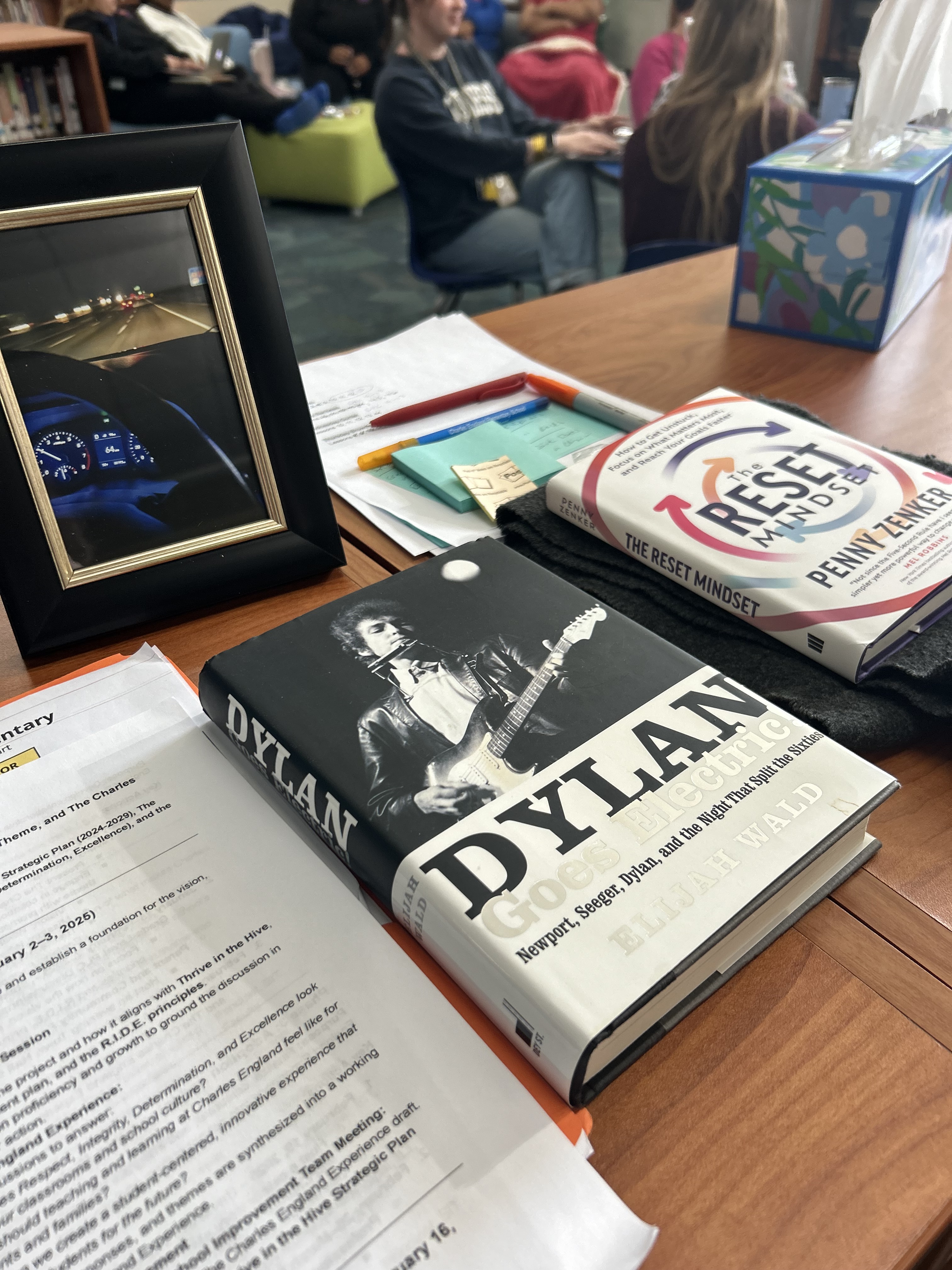
During a recent faculty meeting, I introduced a new approach to teaching and learning. I’ll admit, I was nervous about how it would be received. To ground myself, I brought along my copy of Wald’s Dylan Goes Electric. On the cover was Dylan, guitar in hand, staring down the crowd with quiet resolve. That image reminded me to stay steadfast, to “play on” even when the riffs might not land perfectly with everyone. (See picture below.)

Going electric is about more than innovation. It’s about embodying the courage to grow, to inspire others, and to stay true to our vision. It’s a reminder that, as leaders, we have the responsibility to model resilience and boldness for those we serve.

A Legacy of Creative Courage

Dylan’s 1965 performance is more than a legendary moment in music—it’s a blueprint for leadership. After Newport, Dylan continued to push boundaries, recording groundbreaking albums, earning accolades, and even winning the Nobel Prize for Literature. He didn’t let the boos define him; he let his vision propel him forward.

His story inspires us to embrace creative courage. When we face the naysayers or wrestle with self-doubt, we can hold our heads high, just as Dylan did, and press forward with conviction.

Four Ways Leaders Can “Go Electric”

  1. Stay True to Your Vision: Know your core values and let them guide your actions, even when facing resistance.
  2. Embrace Growth: Innovation often means stepping into the unknown. Take bold steps to evolve and improve.
  3. Play On Through Adversity: Be prepared for challenges. Stay resilient and committed to your vision, even when others push back.
  4. Inspire Others Through Action: Your courage can empower those around you to embrace their own growth and creativity.

Dylan’s journey reminds us that leadership is not about avoiding the boos but about playing on, louder and prouder. So, let’s go electric—and inspire those we lead to do the same.

Link to my “Go Electric” episode of Principal Liner Notes

Magical Mystery Tweet: A Journey of Gratitude and Creativity

Boxing Day holds a special place in my heart. While it’s not widely celebrated in the United States, it marks a moment of reflection, creativity, and gratitude in my life. It’s a day that intertwines two of my great passions: my love of The Beatles and the power of small, intentional moves that ripple into something greater.

On December 26, 1967, The Beatles unveiled their BBC-TV film Magical Mystery Tour. At the time, critics dismissed the project as an odd misstep in the band’s otherwise stellar career. Yet, over the decades, it has transformed into a beloved piece of their psychedelic era—a testament to their willingness to embrace creativity and collaboration, undeterred by the opinions of naysayers.

This day also marks what I call my “Magical Mystery Tweet,” a small action that changed the course of my life. About eight years ago, while observing my personal Boxing Day tradition of watching Magical Mystery Tour, I posted a simple tweet:

“Happy Boxing Day. Happy Magical Mystery Tour Day.”

I included a picture of my well-loved DVD copy of the film, celebrating my fandom and connection to the enduring magic of The Beatles. It was a small, seemingly inconsequential act of sharing.

But something extraordinary happened. Nicole Michael of 910 Public Relations noticed that tweet and responded to it. That response ignited a journey that ultimately led to the publication of my first book, #ThePepperEffect, through the incredible vision of Dave Burgess. What began as a casual celebration of The Beatles evolved into an opportunity to share my ideas with educators worldwide.

Since its release in 2018, #ThePepperEffect has inspired educators to “think outside the box” and create collaborative, Beatles-inspired magic in their schools. I’ve had the honor of sharing its message as a keynote speaker at conferences and have even seen it adapted into a stage production by a school drama club in Canada. One small tweet sparked a movement that continues to connect, inspire, and transform.

This experience taught me a valuable lesson: you never know what impact your creative expression will have when you share it with the world. The Beatles, despite criticism, embraced their creative impulses, and their willingness to take risks gave us masterpieces that resonate across generations. We can do the same when we dare to share our gifts, no matter how small they may seem.

Four Actions to Embrace Creativity and Share Your Voice

  1. Celebrate Your Passions
    Honor the things that bring you joy and inspire you. Whether it’s music, art, or storytelling, your enthusiasm can spark connections and creativity in others.
  2. Take Small Steps
    Share a tweet, write a blog post, or create something that reflects your authentic self. It doesn’t have to be perfect—it just has to be real.
  3. Seek Collaboration
    The Beatles created their masterpieces through collaboration. Surround yourself with others who uplift and challenge you. Great things happen when we build together.
  4. Ignore the Critics
    Like Magical Mystery Tour, your work might not resonate with everyone at first. That’s okay. Stay true to your vision and trust in the process.

As educators and leaders, we have the power to inspire those around us through our creativity and vulnerability. We all have a masterpiece within us waiting to be shared. My journey, sparked by a single tweet, is proof that even the smallest action can create waves of change.

This Boxing Day, as I watch Magical Mystery Tour again, I’ll reflect on the gratitude I have for that tweet, for the connections it brought, and for the inspiration it continues to provide.

Dare to share your voice. You never know whose life you might change—including your own.

Why The Beatles Matter

Earlier this week, the world marked a somber anniversary—44 years since the tragic loss of John Lennon. For me, this day always stirs vivid memories. It was around this time that I first discovered The Beatles, embarking on a journey into a world of creativity, harmony, and collaboration that continues to shape my life and career. The Beatles have left an indelible mark on me, not only as a fan of their groundbreaking music but as someone who sees their legacy as a model for leadership, culture, and collaboration.

The Beatles’ story offers profound lessons for educators and leaders. Their journey is a testament to excellence, creativity, and innovation—qualities we all strive to cultivate in our schools and organizations. By nature, I am a storyteller, and I’ve always believed in the power of stories to build connections, foster belonging, and create psychological safety. In my years as a teacher and principal, I often found myself drawing comparisons to The Beatles, using their journey as a metaphor for teamwork and innovation. While I don’t expect everyone to love The Beatles as much as I do, I believe in sharing our passions as leaders. It’s a vehicle for hope, and education is a field that thrives on hope in abundance.

The Beatles didn’t invent creativity or collaboration, but they redefined it. They reinvented music, setting a standard for excellence that still resonates today. Imagine if we embraced their mindset in education—pushing boundaries, seeking new ideas, and innovating for the betterment of our students and communities. Steve Jobs, the visionary behind Apple, once credited The Beatles as his model for innovation and teamwork. He admired how the band’s chemistry and ability to balance each other’s strengths led to extraordinary accomplishments. Whether or not you’re a Beatles fan, every leader can appreciate the value of fostering a culture of excellence and innovation.

Next semester, I have the privilege of teaching a course on The Beatles at High Point University. It’s an opportunity to delve deeper into the band’s cultural impact and explore how their music and legacy continue to influence the world. Preparing for this course has inspired me to think about how The Beatles’ story resonates with others. Their music, recorded over a mere seven years, remains a staple on playlists and soundtracks across generations. The enduring relevance of their work speaks to their unparalleled ability to connect with people on a human level.

This reflection has also inspired the launch of my new podcast, Why The Beatles Matter, debuting December 12. Through this podcast, I aim to explore the band’s profound impact and why their music and legacy still matter today. I’m eager to hear and share stories from others who have been touched by The Beatles—whether as fans, creatives, or leaders. This podcast is a space to celebrate their influence and to discuss how their spirit of innovation and collaboration can inspire us in our own lives and work. I invite you to join the conversation by using the hashtag #WhyTheBeatlesMatter and share on the social media channel of your choice. Let’s connect, share, and celebrate the stories that bind us together.

As some of you may know, I am the author of The Pepper Effect, a book that explores how The Beatles’ timeless lessons can inspire creativity and collaboration in schools. If you’re interested, you can order a copy on Amazon. I hope the book serves as another bridge for connection and inspiration.

The Beatles matter because they remind us that we matter. They show us that we all have gifts to share, ideas to spark, and the potential to create something extraordinary. As we reflect on their legacy, let’s take a page from their story and embrace our own potential to innovate, collaborate, and make a lasting impact. I hope you’ll tune in to the podcast, join the conversation, and, together, let’s discover why The Beatles truly matter.