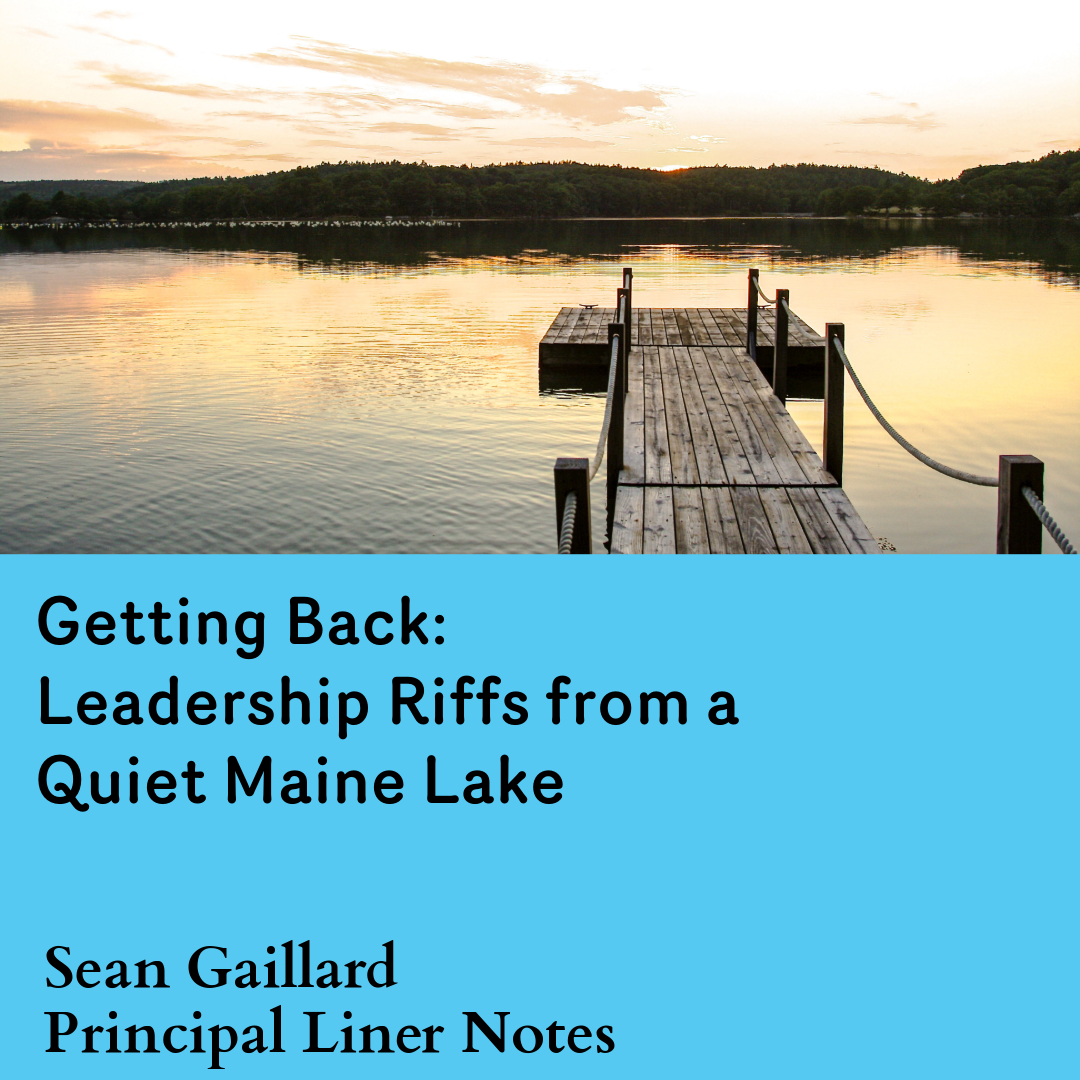
Getting Back: Leadership Riffs from a Quiet Maine Lake

Current State

I’m writing this on a still, cool summer morning beside a lake in Maine. Loons call across the water, pine needles perfume the air, and sunlight pirouettes on gentle waves. After the year-end whirlwind of school life, this New England retreat feels like hitting the reset button; an invitation to get back to what matters.

Nature’s Prompt to “Lead”

A few minutes of etymology searching reminded me that “lead” comes from the Old English lǣdan—“to guide” or “to bring forth.” Add the suffix “-ship,” meaning “state or quality,” and leadership becomes the state of bringing forth. That phrase reframes my job description: draw out the gifts, voice, and brilliance already living inside the people I serve.

The Beatles’ Blueprint

Getting back isn’t a new idea; The Beatles modeled it in January 1969. They shelved overdubs, circled their instruments, and vowed to play live in the studio: just four bandmates and a friend (thank you, Billy Preston on keyboards). The result was the rooftop concert and the album that still centers me: Let It Be. Their back-to-basics experiment birthed fresh energy, trust, and a legendary final act. I call that ripple The Let It Be Effect—and it’s the heartbeat of my Leadership Riffs mantra.

When “Innovation” Becomes Noise

Scroll any feed and you’ll find viral clips of table-top dances, choreographed high-fives, and selfie spectacles masquerading as leadership. Fun has its place, but hype is not the same as guidance. Authentic leaders serve others; they don’t stage-manage them. The Beatles didn’t grab headlines by stunts—they plugged in, faced each other, and played. The best leaders do the same by being present in the marrow of each moment in the schoolhouse and empowering others to share their gifts.

My Own Get-Back Move

Before leaving for vacation I hand-wrote a note to every colleague at Charles England. No templates, no mass email—just ink, gratitude, and belief in their gifts. It took hours and cramped my hand, yet each card was a little rooftop concert: proof that I see them, trust them, and am ready to make music together next year.

Your Lakeside Challenge

This summer, carve out your version of lakeside stillness:

  • Re-read the book that first lit your leadership fire.
  • Phone the mentor whose wisdom steadies you.
  • Gather teammates around a whiteboard and ask, “How might we…?”
  • Write one genuine note of thanks—no emojis necessary.

These simple riffs spark innovation while stitching the fabric of belonging and trust that every schoolhouse and every team needs.

Take the time to get back.
Get back to what called you.
Get back to your purpose.
Get back to the people you serve.

When we get back to our core, we lead with clarity, conviction, and heart. That’s the gig. That’s the work. Let’s get to it.


Special thanks to Lauren Kaufman for helping to inspire this blog post! Be sure to check out her amazing and insightful blog site: https://laurenmkaufman.com/.

A very special thanks to Deb Gaillard for inspiring our visit to Maine! She’s my favorite human and the best person I know!

Coach. Mentor. Lead. Empowering the Assistant Principal with Dr. Sonia Matthew

The Summer Series of The Principal Liner Notes Podcast continues with an inspiring and heartfelt conversation featuring Dr. Sonia Matthew, the 2025 Maryland Assistant Principal of the Year.

Dr. Matthew brings deep insight, clarity, and joy to this conversation. We explore the essential role of the assistant principal and the importance of school leaders being intentional about mentoring and empowering their APs. Our discussion was more than a reflection, it was a call to action. As principals, we are called to create space for leadership to grow and thrive at every level.

One of my favorite moments in this episode is the mention by Sonia of Lauren Kaufman and her amazing book, The Leader Inside. As many of you know, Lauren is a frequent guest on my podcast. Her book is a great resource for mentorship and inspiration that is worthwhile for several revisitations. The impact of the book on Sonia is definitely compelling and you will get an opportunity to experience that impact in this episode.

What you’ll also hear in this episode is just the beginning. Dr. Matthew and I are already planting seeds for a new collaboration that will shine a spotlight on the assistant principalship and provide meaningful support and coaching resources for those who serve in that vital role.

Listen and join us in this reflection on purpose, leadership, and the power of lifting each other up. I would love to hear your comments on this episode. Please feel free to share here or on one of the podcast platforms shared here.

🎧 Listen or Watch:
Spotify: https://open.spotify.com/episode/33lnp3fkVlZxSlafdeloqO?si=L5Z9fjL-Sfq-BdLlnkFTQQ
Apple: https://podcasts.apple.com/us/podcast/coach-mentor-lead-empowering-the-assistant-principal/id1438352351?i=1000714105008
YouTube: https://www.youtube.com/watch?v=5Ob7Zw2Gy6s

Let’s continue to lead, uplift, and believe.

—Sean

#PrincipalLinerNotes #LeadershipRiffs #EmpowerTheAP #SchoolLeadership #EdLeadership #ThoughtPartners

Light Our Fire: Leadership, Problem-Solving, and the Sound of Collaboration

Recently, I came across a clip on YouTube of the late Ray Manzarek of The Doors telling the origin story of their 1967 hit Light My Fire. It’s one of those creative origin stories that just sticks. Ray talked about how each band member added a unique musical flavor that transformed the song into something iconic.

Guitarist Robby Krieger brought his flamenco background and wrote the core of the tune. John Densmore layered in a Latin beat on drums. Jim Morrison added a poetic and haunting verse about a funeral pyre. Ray himself took a page from Bach to create that unforgettable keyboard intro. All these ingredients came together like a great jam session, different parts working in harmony to create something innovative, inspired, and bold.

The Doors didn’t play it safe. They took a leap. They trusted each other. And they built something greater than the sum of their parts. That story got me thinking about what it means to lead and solve problems in a school.

When it came time to revise our master schedule at the school I serve as principal, the challenge was real. We needed to maximize instructional time and expand opportunities for intervention. But we didn’t tackle it in isolation. We did it together.

Over two weeks, I brought the challenge to our Instructional Leadership Team, the School Improvement Team, and several staff and teacher partners. These weren’t just quick drop-ins or top-down mandates. These were real conversations, one-on-one meetings, small group huddles, and full team sessions. I started each one with a simple design thinking prompt: How Might We…?

I’ll never forget one particular session with the School Improvement Team. We were all gathered around the same table. Teachers led the discussion. We weighed pros and cons. Ideas flew. Everyone added a perspective, and each voice mattered. There was no single author of the final schedule. Just like The Doors building Light My Fire, each person added a line, a beat, a riff.

Once we landed on a draft, I shared we’d treat it as a trial run. That removed pressure and opened space for feedback. We gave it a shot, came back, reflected, and adjusted. And here’s the best part—it worked. Not because it was perfect, but because it was owned. Teachers had skin in the game. Everyone contributed. Everyone collaborated. Everyone made it better.

This process reminded me that these collaborative moments between teachers and school leaders must echo what we want our students to experience. According to the World Economic Forum, one of the top job skills for 2025 is complex problem solving. Our students won’t master that skill from worksheets alone. They’ll learn it because we model it. Because we live it. Because we solve problems together.


3 Action Steps To Take Build A Collaborative Problem Solving Culture

Leadership is about making space for others to create. It’s about asking How Might We instead of You Must. It’s about letting teachers jam. Here are three ways schools can start building that kind of collaborative problem-solving culture:

1. Create Solution Building Time
Set aside time during the month for small, creative think tanks. Bring together teachers, staff, and leaders in a low-pressure space to brainstorm, ideate, and prototype solutions. Use design thinking prompts. Use sticky notes. Use music. Just make it fun and focused.

2. Launch #InstantPD Moments
Give teachers the mic. Once a week, host a 15-minute pop-up PD session where a teacher shares a strategy that works. These micro-sessions build confidence, spread great practice, and create the conditions for more teacher-led innovation.

3. Use the Power of the Trial Run
When testing something new, give permission to try without pressure. Frame it as a pilot. Invite feedback. Circle back. This builds trust and opens the door for authentic input that shapes real change.


Whether it’s jamming with colleagues on a new idea or leading a full schedule redesign, when we bring people together, we get better. We build trust. We spark creativity. We light fires.

Let’s keep jamming. Let’s keep solving. Let’s keep leading like it matters.

This is your latest #LeadershipRiffs moment from the desk of a school principal who still believes in the power of collaboration, creativity, and the beautiful noise we make when we lead together.

Keep leading with rhythm. Keep building with heart.
Watch the Ray Manzarek Clip

Keeping Your Beat: The Power of Impact Visits for School Leaders

A reflection inspired by John Bonham, legacy, and the rhythm of leadership
#PrincipalLinerNotes

Special Thanks to Jimmy Casas and Lainie Rowell for their respective missions inspiring my gig! I am grateful that our PLN connections have evolved into sincere, lifelong friendships.

A very special thanks to my amazing wife, Deb, for being that constant source of love, inspiration, and strength every day! Thanks for inspiring Impact Visits!


A Soundcheck at Knebworth

It was just a soundcheck.
August 1979. Knebworth. A wide open field waiting to be filled with music. Led Zeppelin was preparing for a monumental return to the British stage. But as the band warmed up, it wasn’t John Bonham—the thunderous backbone of the band—behind the drum kit. It was his 13-year-old son, Jason.

In a rare and touching moment, Bonham stepped away from the drums and wandered into the field. He didn’t just want to hear the band; he wanted to listen from a distance. He stood alone, away from the stage, and let the sound wash over him. The rhythm of his legacy. His son’s rhythm.

There were no headlines. No fanfare. But there was something sacred in that quiet act: a father making space for the next generation, a rock legend becoming an audience member. Trust. Love. Legacy. It was all there in that field of amplifiers and dreams.

As a teenager, I remember reading about that moment in one of the many music biographies I devoured. It stuck with me. Especially knowing that John Bonham would pass away just over a year later. His son, Jason, would grow up to carry the torch—eventually joining surviving members of Led Zeppelin for reunion shows, most notably in the legendary 2007 performance captured on Celebration Day.

That soundcheck was more than rehearsal. It was legacy in action. It was impact. It was a leader stepping back—so something deeper could move forward.


Stepping Back for Impact

The response to my recent blog post, The Loneliness of Leadership, has been both humbling and healing. I wrote it to name and navigate the isolation I’ve felt in leadership—and to extend a hand to others who may be feeling the same. The heartfelt messages and outreach reminded me that we’re not as alone as we think. There is resonance when we share our truth.

This morning, I had the sincere honor of being a guest on Jimmy Casas’ podcast, The Interview Chair.
You can listen to that episode soon, but here’s what struck me during our conversation: Jimmy asked how I maintain mental health in leadership—especially after sharing my heart episode experience from last year. My answer came quickly: Impact Visits.


What Are Impact Visits?

Impact Visits are intentional moments carved out of the chaos. They’re brief detours in your day where you go and witness your leadership in motion—where the fingerprints of your work are making a difference.

Over the years of my principalship, my wife Deb would often tell me, especially on the hard days, “Go visit a classroom where you know it’s working.” She’d say it gently but with urgency—usually on the days when I was feeling discouraged, disconnected, or alienated. I didn’t always listen. I’d get swept up in the whirlwind of tasks and to-dos. But since my heart episode and my renewed focus on mental health, I’ve made it a point to follow her advice.

So, thank you, Deb. I know to listen to you now.

These are not evaluative visits. They’re not walk-throughs with clipboards and checklists. They’re personal moments—to be reminded, to be renewed. A time to refuel your spirit and reconnect to why you said yes to this work in the first place.

If you can, use these visits as a chance to connect. To offer a word of thanks. A fist bump. A simple “You’re doing great.” As my friend Lainie Rowell reminds us in her #EvolvingWithGratitude mission—gratitude is a powerful act of leadership. A little goes a long way.


Four Ways to Make Impact Visits Happen

  1. Schedule Intentionally
    Block time on your calendar each week. Just 10–15 minutes to step into a classroom, a hallway, or the front line of your impact.
  2. Make It Routine
    Ritual turns into rhythm. If you make Impact Visits a part of your leadership practice, they’ll become the pause that powers your next move.
  3. Share the Visit
    Reflect on your visits with a thought partner or friend. If you don’t have someone, you’re welcome to reach out to me. I’d be honored to be that listening ear: sgaillard84@gmail.com
  4. Encourage Others
    Inspire your team, your assistant principals, or even colleagues in your PLN to create their own version of Impact Visits. Help build a culture of reflection and renewal.

Your Beat Still Matters

Leadership is not a sprint of perfection. It’s a series of riffs—some raw, some refined. We owe it to ourselves and those we serve to keep our rhythm aligned with our core values.

So, take that walk. Stand in that hallway. Listen to the beat that’s still echoing from something you once helped shape.

Because even in the quiet moments—maybe especially in the quiet moments—we find proof that we’re still making a difference.

Keep your beat.

The Power of a Check-In

“So, what’s on your turntable?”

That question was a daily gift during my final year of teaching at Bedford High School. It came from my colleague and kindred spirit, Barry Low, our brilliant music teacher. Barry had a way of showing up with his warmth, wisdom, and that irresistible curiosity for all things music.

Back then, it was 2003. I had a small boombox perched in the corner of my English classroom. CDs were still king, and there was always one queued up and ready to play—usually something from The Beatles, Sinatra, or a little Bossa Nova to soundtrack the morning.

Barry would pop in between classes and ask that now-legendary question: “So, what’s on your turntable?”

Those moments felt like sacred mini-sessions—a spontaneous graduate seminar in music. We riffed on everything from Sergio Mendes to Frank Sinatra to Brazilian jazz. Barry always had a new artist to share, a bootleg CD to lend, or a story that made both of us laugh. My students waiting for class would often catch a glimpse of our camaraderie, and they were drawn in by his wit and warmth.

What Barry didn’t know at the time was how much I needed those check-ins. I was carrying some heavy emotional weight. I’d taken an ethical stand in my department and found myself increasingly isolated. There were days when the silence from others felt deafening. But Barry’s daily drop-ins cut through that fog. His kindness, his curiosity, his way of being present—it all reminded me that I wasn’t alone.

And isn’t that the thing? We never really know what someone is carrying when they walk through the doors of the schoolhouse. But one simple check-in can shift everything.

That’s the lesson Barry gave me—and it’s a lesson that’s stayed with me for over 20 years.

In my last blog post, I shared about being rushed to the hospital after a heart episode that occurred at school. I believe now more than ever in the power of a check-in. A few friends reached out after that moment. Their words, texts, phone calls, and prayers helped guide me back to healing. That experience reminded me again that compassion is not complicated. We just need to ask, “How are you really doing?” And mean it.

We live in an era where emojis and likes are often mistaken for connection. But real connection—life-giving connection—happens when we extend our arm, when we lean in, when we show up. As my good friend Max Pizarro says, “Arm extended.” That phrase carries a quiet power. It’s a posture of empathy. A stance of solidarity. An invitation to belong.

Lauren Kaufman recently wrote, “You don’t have to carry it all alone.” That line struck a deep chord. It reminded me of the invisible loads we all carry and the ways we can lighten each other’s burdens just by being present.

Belonging isn’t just a buzzword—it’s essential. Dr. Susie Wise puts it best in her book Design for Belonging: “Being accepted and invited to participate; being a part of something and having the opportunity to show up as yourself.”

That’s the heart of it. Create spaces where others can show up as themselves. Be the colleague who tunes into others. Be the leader who notices. Be the friend who checks in. Because that’s the gig—that’s the leadership jam that transforms classrooms, staff rooms, and lives.

We are the entry points for belonging. Let’s carry that with purpose and with rhythm.

So, what’s on your turntable today? Maybe it’s kindness. Maybe it’s courage. Maybe it’s simply showing up for someone. Whatever it is, press play and let it echo.


Further Reading:

🎧 Design for Belonging by Dr. Susie Wise — Purchase the book here

📝 Lauren Kaufman’s blog post, “Shine A Light, Share A Load” — Read it here


A Special Note of Gratitude on My Last Blog Post:

A special thanks to for the overwhelming response for my last blog post, “A Principal’s Rebirth: Finding Life, Love, & Leadership Again.” That post came from a deep place in my heart and I am humbled by the outreach many of you shared. I want my words to help others and this post serves a salve for others who are struggling. Please feel free to share that post linked HERE. Mental Health is so important and my hope is that this blog is a support for all who need it. I am here for you and I am glad that the world has you in it.

The Ripple Effect of Belonging

The other day, I found myself in pre-production mode for an ASCD Expert Webinar I’m co-facilitating with Dr. Andrea Trudeau. We were just moments away from going live—an exciting milestone in our partnership with ISTE-ASCD to explore the power of principal-librarian collaboration.

Despite having delivered keynotes, facilitated countless meetings, and never being one to run out of words, I felt a twinge of nervous energy. Andrea and I had carefully planned this series, designed to help principals and librarians cultivate belonging through meaningful partnerships. Still, the unknown had me teetering on the edge of speechlessness.

Then, as our “executive producer,” ISTE-ASCD Senior Manager for Community Engagement Margaret McGuinness, prepared to hit the button to go live, I centered myself in a simple truth and voiced the following: If we connect just one principal with one librarian, we’ve done our job. Andrea and Margaret nodded in agreement, and together, we stepped into uncharted territory. The webinar was a success and I believe both Andrea and I were able to help others build some bridges that day.

That’s the thing about belonging—it starts with a single step. A single connection. A single moment of shared purpose.

The Power of a Ripple

It’s easy to hesitate when stepping into something new. But what if The Beatles had given up when they played to an audience of just 18 people early in their career? Instead of letting the small crowd deter them, they leaned into the moment. They played their hearts out, laughed at the absurdity, and kept going. That spirit of persistence and joy shaped their journey—and, in turn, has inspired mine.

The same principle applies to leadership. Impact isn’t measured in likes, viral moments, or fleeting trends. It’s about connection. It’s about the quiet, intentional moves that build belonging—moves that ripple outward in ways we may never fully see.

I think of my fifth-grade teacher, Mrs. McMonagle, who saw something in me before I saw it in myself. With a single conversation, she opened my world to literature, art, critical thinking—and yes, The Beatles. That moment still echoes in my leadership today.

Tuning into Belonging

As school leaders, our role isn’t to chase the spotlight. It’s to cultivate an environment where every student, every teacher, and every staff member feels seen, heard, and valued. That kind of belonging isn’t built in grand gestures but in the everyday moments:

🎸 A handwritten note on a teacher’s desk reminding them that their work matters.
🎸 A lunchtime conversation with a student that shows them they belong.
🎸 A simple high-five in the hallway that lets someone know they are valued.
🎸 An intentional partnership that strengthens the fabric of a school community.

These small moves create big ripples.

Join the Conversation

That’s exactly what Andrea and I are exploring in our ongoing webinar series, The Power of Partnership: Enhancing School Success Through Principal and Librarian Collaboration. Through these 30-minute sessions, we’re diving into practical ways to align goals, foster communication, and leverage library resources to support student success. This journey will culminate at ISTELive 25 and ASCD Annual Conference 25 in San Antonio where we will present our work.

Let’s keep the conversation going. Join us, engage in the dialogue, and lean into the work that truly lasts.

The Heart of Leadership: Humility and Belonging

Earlier this week, our country lost a remarkable leader in former President Jimmy Carter. The tributes that followed didn’t focus on grand speeches or flashy displays of power. Instead, they celebrated Carter’s unwavering faith, his steadfast dedication to community, and his lifelong commitment to making the world a better place for others. His leadership wasn’t about being the center of attention or staging photo-ops; it was about rolling up his sleeves and humbly serving those around him.

As educators, we must ask ourselves: What kind of leaders are we striving to be? Are we chasing the spotlight or building the light in others? For too long, I’ve seen school leaders drawn to performative leadership—the standing on tables, the viral stunts, the costumes designed for “likes” rather than lasting impact. While these acts may entertain for a moment, they often fail to empower others or build the foundation of belonging that our students, teachers, and families need.

Leadership isn’t about gimmicks or self-promotion. True leadership lies in tuning into the gifts of others and encouraging them to follow their unique paths. It’s about listening more than speaking, serving more than being served, and building a culture where everyone feels valued, seen, and capable of greatness.

Jimmy Carter once said, “We must adjust to changing times and still hold to unchanging principles.” His words remind us that the principles of humility, service, and community are timeless in leadership. Humble leadership is a quiet force that lifts others without fanfare. It builds cultures of belonging, not through stunts, but through consistency, care, and compassion.

For many years, my father instilled in me the idea that greatness comes not from being on a stage but from being in service to others. He taught me to dare to be great by encouraging others to step off the sidelines and into their potential. As leaders, it’s our calling to help others “kick off the bench” and take those daring steps toward their own greatness.

Four Leadership Moves to Build a Culture of Belonging with Humility

1. Listen With Purpose

Create opportunities to listen to the voices of students, teachers, and families. Regularly ask, “What do you need?” or “How can I support you?” and act on what you hear. Listening isn’t just hearing—it’s responding with action and intention.

2. Celebrate Others’ Gifts

Leadership isn’t about being the hero of every story. Shine the spotlight on your team. Recognize the unique talents and achievements of those you serve. Build platforms where others can share their brilliance.

3. Serve Quietly and Consistently

Leadership is often found in the small, unseen moments. Show up early to greet students. Pitch in during tough times without announcing it. Let your actions speak louder than your words.

4. Model Humility in Every Interaction

Humility isn’t weakness; it’s strength in understanding that leadership is about others, not ourselves. Admit mistakes, ask for feedback, and be willing to learn alongside your team.

Let us step away from the noise of performative leadership and into the quiet power of service. Leadership isn’t standing on a table or staging antics that distract from our core mission. It’s about humbly helping others discover their greatness.

As I reflect on Jimmy Carter’s legacy and the lessons my father taught me, I’m reminded of the simple truth: Leadership is not about being in the spotlight—it’s about igniting the light in others. Dare to be great by building a culture where everyone belongs and is empowered to lead.

Let’s get to work, sleeves rolled up, hearts full of humility, and hands ready to serve.

Go Electric: A Lesson from Bob Dylan

I didn’t expect the tears.

But there I was, sitting in a dimly lit theater, tears streaming down my face as Bob Dylan defiantly sang “Maggie’s Farm” to an audience torn between boos and cheers. I was watching A Complete Unknown with my oldest daughter, Maddie—a thoughtful Christmas gift she knew I’d treasure.

The scene that stopped me in my tracks was Dylan’s iconic performance at the 1965 Newport Folk Festival. Armed with a Fender Stratocaster, he boldly plugged in and “went electric,” breaking away from the acoustic traditions revered by the folk community. The reaction was a mix of outrage and elation. Boos echoed from the purists, but Dylan, backed by members of the Paul Butterfield Blues Band and organist Al Kooper, played on.

As a lifelong fan of the Butterfield Blues Band, seeing actors portray my music heroes—Mike Bloomfield on guitar, Sam Lay on drums, and Jerome Arnold on bass—deeply moved me. Their musicianship had always resonated with me, and witnessing their essence captured on screen added another layer of emotion to an already powerful moment.

This scene, beautifully brought to life by Timothée Chalamet as Dylan, is more than just a snapshot in music history. It’s a testament to creative courage.

Resonating with Dylan’s Defiance

I’ve watched the documentaries, taught this moment in my high school English classes, and pored over Elijah Wald’s Dylan Goes Electric. I even dedicated an episode of my Principal Liner Notes podcast to it. Yet, seeing it unfold on the big screen hit differently.

Dylan’s act of “going electric” wasn’t just about plugging in an electric guitar; it was about rejecting the status quo, staying true to his evolving vision, and embracing the risk of change. The boos, the backlash—none of it stopped him. He knew that growth required stepping out of the safe and into the bold.

That lesson transcends the 1960s. For leaders, it’s a call to innovate, to embrace challenges, and to stay true to our core values, even when met with resistance.

The Courage to Play On

As leaders, we often face our own “Newport moments.” Whether it’s introducing a new initiative, rethinking old practices, or simply challenging the comfort of the status quo, there’s always a risk of pushback. People may not immediately understand—or embrace—our vision.

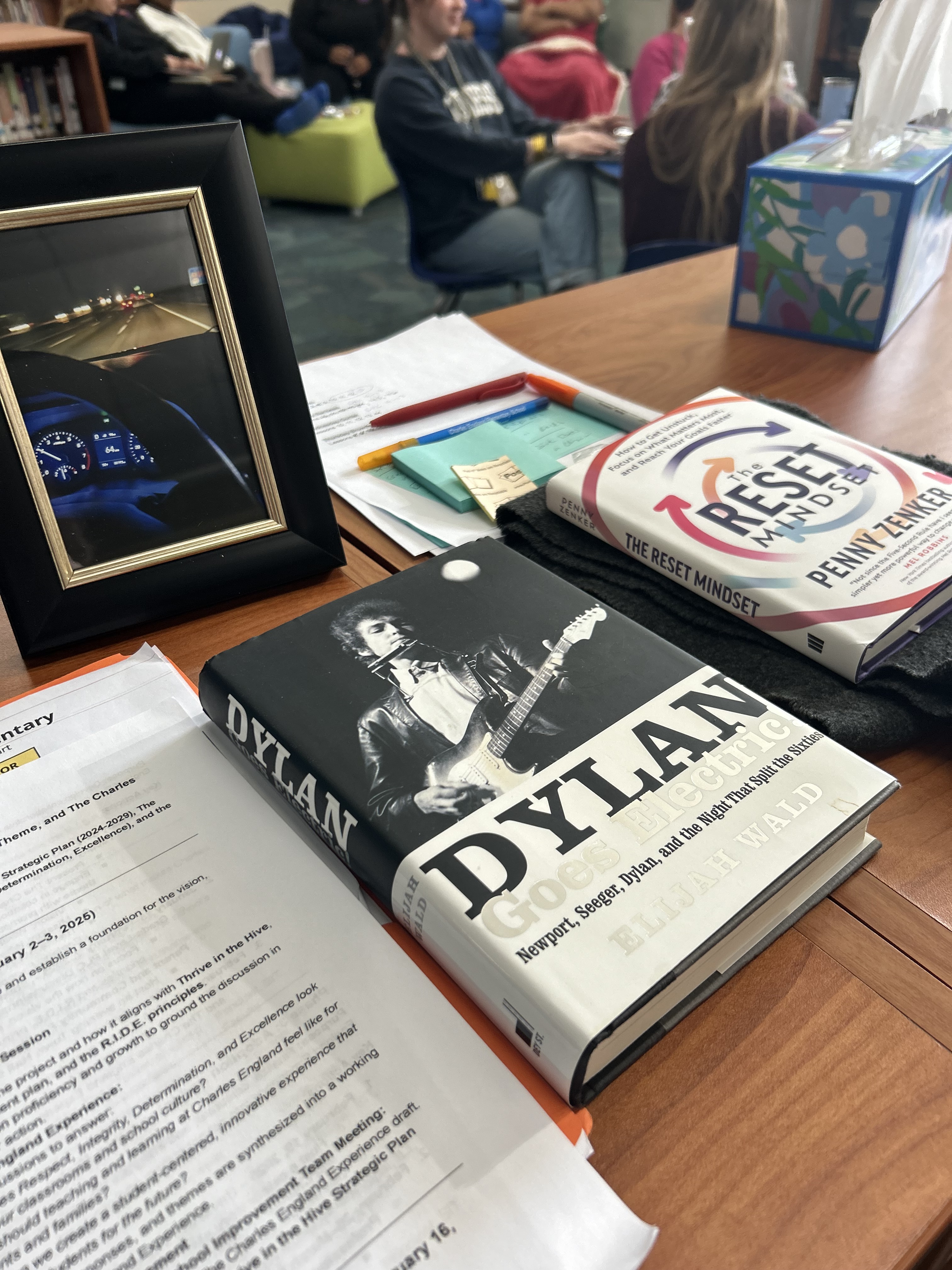
During a recent faculty meeting, I introduced a new approach to teaching and learning. I’ll admit, I was nervous about how it would be received. To ground myself, I brought along my copy of Wald’s Dylan Goes Electric. On the cover was Dylan, guitar in hand, staring down the crowd with quiet resolve. That image reminded me to stay steadfast, to “play on” even when the riffs might not land perfectly with everyone. (See picture below.)

Going electric is about more than innovation. It’s about embodying the courage to grow, to inspire others, and to stay true to our vision. It’s a reminder that, as leaders, we have the responsibility to model resilience and boldness for those we serve.

A Legacy of Creative Courage

Dylan’s 1965 performance is more than a legendary moment in music—it’s a blueprint for leadership. After Newport, Dylan continued to push boundaries, recording groundbreaking albums, earning accolades, and even winning the Nobel Prize for Literature. He didn’t let the boos define him; he let his vision propel him forward.

His story inspires us to embrace creative courage. When we face the naysayers or wrestle with self-doubt, we can hold our heads high, just as Dylan did, and press forward with conviction.

Four Ways Leaders Can “Go Electric”

  1. Stay True to Your Vision: Know your core values and let them guide your actions, even when facing resistance.
  2. Embrace Growth: Innovation often means stepping into the unknown. Take bold steps to evolve and improve.
  3. Play On Through Adversity: Be prepared for challenges. Stay resilient and committed to your vision, even when others push back.
  4. Inspire Others Through Action: Your courage can empower those around you to embrace their own growth and creativity.

Dylan’s journey reminds us that leadership is not about avoiding the boos but about playing on, louder and prouder. So, let’s go electric—and inspire those we lead to do the same.

Link to my “Go Electric” episode of Principal Liner Notes

Magical Mystery Tweet: A Journey of Gratitude and Creativity

Boxing Day holds a special place in my heart. While it’s not widely celebrated in the United States, it marks a moment of reflection, creativity, and gratitude in my life. It’s a day that intertwines two of my great passions: my love of The Beatles and the power of small, intentional moves that ripple into something greater.

On December 26, 1967, The Beatles unveiled their BBC-TV film Magical Mystery Tour. At the time, critics dismissed the project as an odd misstep in the band’s otherwise stellar career. Yet, over the decades, it has transformed into a beloved piece of their psychedelic era—a testament to their willingness to embrace creativity and collaboration, undeterred by the opinions of naysayers.

This day also marks what I call my “Magical Mystery Tweet,” a small action that changed the course of my life. About eight years ago, while observing my personal Boxing Day tradition of watching Magical Mystery Tour, I posted a simple tweet:

“Happy Boxing Day. Happy Magical Mystery Tour Day.”

I included a picture of my well-loved DVD copy of the film, celebrating my fandom and connection to the enduring magic of The Beatles. It was a small, seemingly inconsequential act of sharing.

But something extraordinary happened. Nicole Michael of 910 Public Relations noticed that tweet and responded to it. That response ignited a journey that ultimately led to the publication of my first book, #ThePepperEffect, through the incredible vision of Dave Burgess. What began as a casual celebration of The Beatles evolved into an opportunity to share my ideas with educators worldwide.

Since its release in 2018, #ThePepperEffect has inspired educators to “think outside the box” and create collaborative, Beatles-inspired magic in their schools. I’ve had the honor of sharing its message as a keynote speaker at conferences and have even seen it adapted into a stage production by a school drama club in Canada. One small tweet sparked a movement that continues to connect, inspire, and transform.

This experience taught me a valuable lesson: you never know what impact your creative expression will have when you share it with the world. The Beatles, despite criticism, embraced their creative impulses, and their willingness to take risks gave us masterpieces that resonate across generations. We can do the same when we dare to share our gifts, no matter how small they may seem.

Four Actions to Embrace Creativity and Share Your Voice

  1. Celebrate Your Passions
    Honor the things that bring you joy and inspire you. Whether it’s music, art, or storytelling, your enthusiasm can spark connections and creativity in others.
  2. Take Small Steps
    Share a tweet, write a blog post, or create something that reflects your authentic self. It doesn’t have to be perfect—it just has to be real.
  3. Seek Collaboration
    The Beatles created their masterpieces through collaboration. Surround yourself with others who uplift and challenge you. Great things happen when we build together.
  4. Ignore the Critics
    Like Magical Mystery Tour, your work might not resonate with everyone at first. That’s okay. Stay true to your vision and trust in the process.

As educators and leaders, we have the power to inspire those around us through our creativity and vulnerability. We all have a masterpiece within us waiting to be shared. My journey, sparked by a single tweet, is proof that even the smallest action can create waves of change.

This Boxing Day, as I watch Magical Mystery Tour again, I’ll reflect on the gratitude I have for that tweet, for the connections it brought, and for the inspiration it continues to provide.

Dare to share your voice. You never know whose life you might change—including your own.

Reflect and Reset for the New Year

Reflect and Reset for the New Year

As the year winds down and the calendar inches closer to 2025, I invite you to take a meaningful pause. My hope is that these words reach you during a moment of restoration, where you are embracing time with loved ones, reflecting on your journey, and finding opportunities to recharge physically, emotionally, mentally, and spiritually. Winter Break is a gift—a time to clear the noise and center ourselves as we prepare to lead with purpose into the new year.

This past year has been a challenging yet transformative one for me. I reflect on a pivotal moment back in February when a heart episode led to an ambulance ride and a stark reminder of life’s fragility. That experience set me on a path of healing, physically and emotionally. Renewing my dedication to fitness has been a much needed salve. Therapy has helped me confront and overcome anxiety, and the unwavering support of family and friends has kept me grounded. These challenges have not only renewed my faith but have also strengthened my resolve to serve with clarity and gratitude.

In 2024, I rediscovered the beauty of creation and connection. I launched three new podcast series (“Hope Amplified,” “Why The Beatles Matter,” and the upcoming “Chords of Connection”) and overcame my writer’s block to return to this blog, laying the groundwork for a new book. I also concluded “The Principal Liner Notes Podcast” with the feeling of satisfying closure and the hope of exploring new territories of expression. Most importantly, I learned to savor life’s small moments—the ones that weave together into a tapestry of hope, joy, and connection. Letting go of toxic ties and re-embracing meaningful relationships has been a powerful act of resetting my personal and professional compass.

The word “reset” has emerged as my guiding star for 2025. It first resonated with me during a professional development session on leadership, where I encountered Penny Zenker’s The Reset Mindset. Her definition of a reset mindset—“a way of thinking that focuses on dynamic reassessment and the willingness to reinvent”—perfectly encapsulates what leaders need to navigate challenges and inspire reinvention within their teams. The concept reappeared during a keynote at a leadership conference, and a trusted thought partner encouraged me to dive deeper into Zenker’s work. I’m savoring the insights from this book, which validates my journey and offers actionable steps for growth and leadership.

As we prepare to embrace 2025, I encourage us to adopt a Reset Mindset—one that empowers us to pause, reassess, and reinvent with intentionality. Here are four action steps for leaders to reset and lead with renewed purpose:

1. Take Intentional Time to Recharge Daily

Leadership can be all-consuming, but it’s essential to carve out moments each day to refuel. Whether through meditation, exercise, or simply a quiet moment with a cup of coffee, these intentional pauses restore our energy and focus. As Zenker notes, “recharge time” is not a luxury—it’s a necessity for clarity and effectiveness.

2. Revisit Your School’s Vision and Mission with the Faculty

The new year is an ideal time to recalibrate and ensure alignment with your team. Engage your faculty in meaningful conversations about your school’s vision and mission. Reflect together on what’s working, what needs reimagining, and how you can collaboratively set the course for a thriving 2025.

3. Read The Reset Mindset by Penny Zenker with a Thought Partner

Growth is amplified when shared. Invite a trusted colleague or thought partner to join you in reading The Reset Mindset. Use it as a springboard for dialogue, reflection, and the co-creation of strategies to navigate challenges and inspire reinvention within your school community. Discover The Reset Mindset here.

4. Pursue Personal Passions

Leaders are at their best when they bring their whole, authentic selves to the table. Dedicate time to personal pursuits that ignite your joy—whether it’s workouts, exploring new hobbies, or simply trying something new. These moments of personal fulfillment recharge our spirits and fuel our leadership.

Reflecting on 2024, I’m reminded of how my favorite band, The Beatles, exemplified the art of the reset. After the tumultuous 1966 World Tour, they reinvented themselves as “Sgt. Pepper’s Lonely Hearts Club Band,” creating a timeless masterpiece. Later, during the “Get Back/Let It Be” sessions, they overcame discord to perform live once again, rediscovering their connection as a band. These moments of reinvention hold lessons for us as leaders—to embrace change, foster collaboration, and find new possibilities amid challenges. Explore these stories in The Pepper Effect: Tap into the Magic of Creativity, Collaboration, and Innovation.

As I step into 2025, I carry forward the lessons of intentional resetting—a process that has given me clarity, optimism, and purpose. I look forward to the opportunities ahead, both in my personal journey and within the schoolhouse I am privileged to serve. Together, let’s reset, reassess, and reimagine a brighter future for ourselves and our school communities.

Here’s to 2025—a year of reinvention, resilience, and renewal.