If School Leadership Had a Wrapped List

As the year winds down, our inboxes begin to tell a familiar story.

Year-end notices arrive in waves. Deadlines stack up. Checklists multiply. There is an understandable push toward closure, accountability, and tying up loose ends. Much of it is necessary. Much of it is also draining, especially in a profession where the emotional labor rarely slows down.

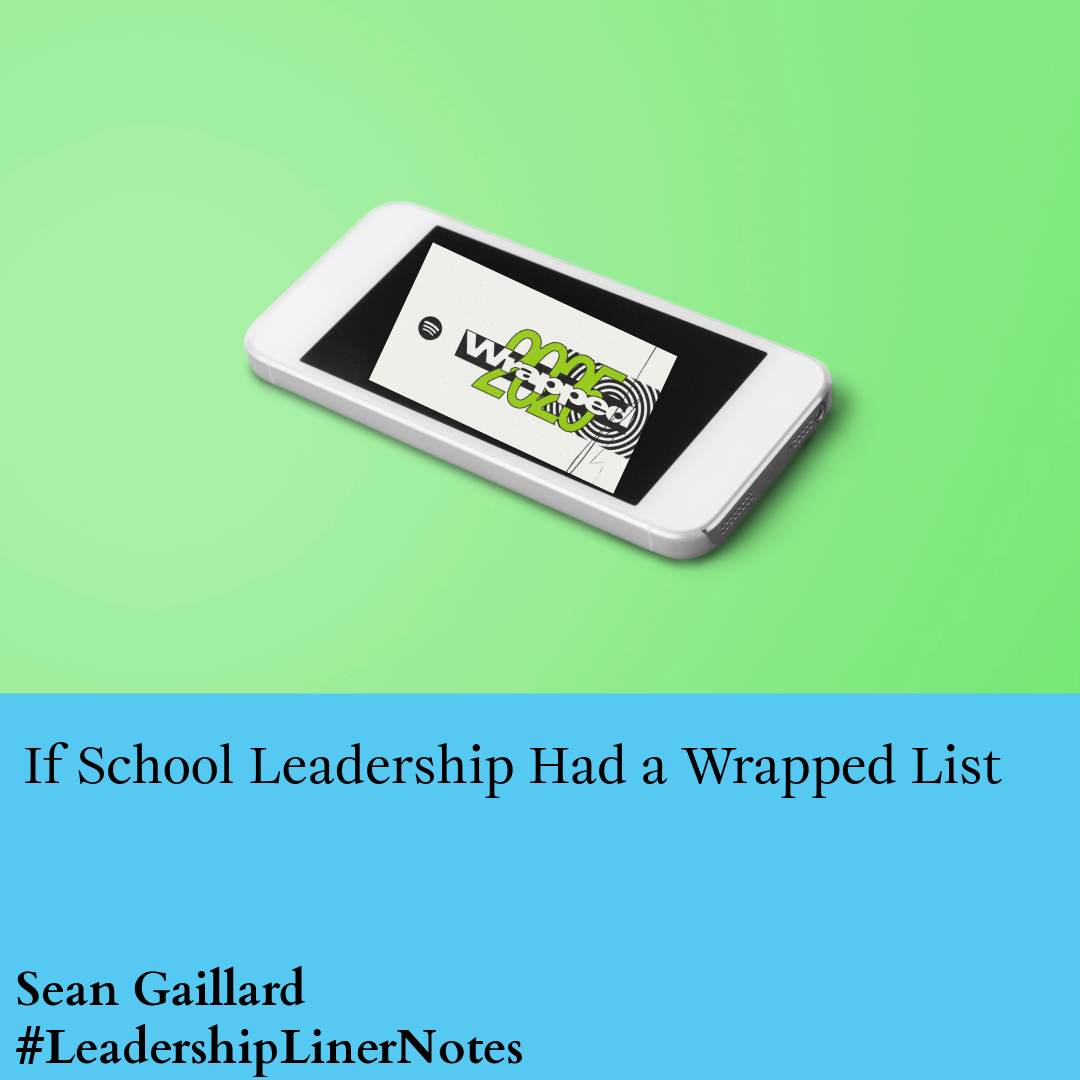
Then, there is Spotify Wrapped.

Every year, I look forward to it in a way that surprises me. Wrapped does not ask me to prove anything. It does not measure me against anyone else. Instead, it reflects back what I returned to over time. It names patterns. It celebrates consistency. It turns data into story.

No surprise that The Beatles were once again at the top of my list. It also did not surprise me to see that I landed in the top point five percent of listeners globally. That statistic is fun, but what matters more is what sits beneath it. These are the songs I go back to when I need grounding. The music that meets me where I am and helps me remember who I am.

That contrast stayed with me.

Wrapped invites reflection. School systems often rush toward evaluation. Both look back, but they do so with very different intentions.

The Leadership Reset That Sparked the Idea

This idea began to take shape during a Leadership Reset I have been practicing and sharing with others. You can see an earlier blog post on The Leadership Reset here. It is intentionally simple and designed to fit into real days, not ideal ones. It does not need special materials or extended time. Just a few minutes of presence.

The 3 Minute Leadership Reset

Step 1. Take a Breath for 30 seconds
Close your eyes if you can. Inhale slowly and say to yourself, I am still here.
Exhale and say, I am enough.
Repeat this three times. Let your shoulders drop and your breathing slow. This is the act of reclaiming your space in the moment.

Step 2. Anchor in Gratitude for 1 minute
Ask yourself quietly:
What one small moment today reminded me I am alive?
What one connection, a smile, a song, a student, gave me a spark?
What one thing am I proud of, even if no one noticed it
?
Write it down or say it aloud. These moments are leadership echoes that ripple outward even when they feel small.

Step 3. Affirm and Reframe for 1 minute
Say these words out loud, slowly and intentionally:
I am not invisible. I am building something that lasts beyond applause.
My work is meaningful, even when it is quiet.
The music I make through service, kindness, and creativity still plays, whether or not the crowd is listening.
Let these words settle. This is the act of tuning yourself back to the right frequency.

Step 4. Reconnect for 30 seconds
Before moving on with your day, take one small action to reconnect:
Send a brief message to a friend or colleague.
Offer a kind word to a student or staff member.
Play a song that brings you joy.
These micro moments rebuild our leadership core from the inside out.

As I reached this final step, I pressed play on “Now and Then” by The Beatles. It was my number one song again for the second year in a row on my Spotify Wrapped List.

There was something deeply fitting about that moment.

The song carries themes of time, memory, and continuity. It reminds us that voices can still be heard long after the room grows quiet. That truth feels especially relevant in schools, where so much meaningful work happens without applause or recognition.

Leadership is not always loud. Teaching is not always visible. Learning does not always announce itself on a dashboard.

But the work still plays.

What If Schools Had a Wrapped Moment?

Spotify Wrapped works because it tells a story of return. It shows us what we came back to again and again when no one was watching. It honors presence over perfection and patterns over isolated moments. It gives language to what sustained us.

What if we borrowed that spirit in our classrooms and schoolhouses?

Not as another initiative. Not as something to hand in or score. Not as a tool for comparison.

But as an invitation.

A moment to pause. A chance to reflect on the year through a human lens. A way to help students, teachers, and leaders feel seen in a season that often feels rushed.


Your Year Wrapped

A Reflection Template for Classrooms, Teams, and School Communities

This reflection can be used in many ways. It serves as a journaling activity. It can spark a classroom conversation. It can act as a PLC opener. It can also be a quiet end-of-year pause during a staff meeting. There are no right answers and no expectations for sharing. The goal is reflection, not performance.

Most Revisited Moment
What moment from this year did you find yourself returning to in your thoughts or conversations? What made it stay with you?

Most Meaningful Connection
Who made this year better simply by being part of it? This could be a student, a colleague, a mentor, or someone outside of school who helped you keep perspective.

The Song That Carried You
What song, quote, book, prayer, or moment gave you comfort? What gave you energy when you needed it most? Why did it matter?

A Quiet Win
What is something you are proud of that did not receive recognition or attention? What does that say about the kind of work you value?

Your Growth Genre
In what ways did you grow this year, even if it felt uncomfortable, unfinished, or messy? What did you learn about yourself?

Your Comeback Track
On hard days, what helped you reset and keep going? What practices, people, or routines supported you?

Your Hope for What Comes Next
What do you want to carry forward into the next season with intention and care?

This kind of reflection helps us name what often goes unnoticed. It gives dignity to effort, presence, and perseverance.

Why This Matters

In education, we spend a lot of time focusing on gaps and goals. We analyze what is missing, what needs to improve, and what did not move fast enough. That work has its place, but it cannot be the only story we tell.

Reflection like this builds belonging. It helps people feel valued for who they are, not just what they produce. It reminds students that their experiences matter. It helps teachers reconnect with purpose. It allows leaders to remember why they chose this work in the first place.

Most importantly, it creates space for humanity in systems that often move too quickly to notice it.

Press Play Before the Year Ends

Before we close the year with another notice or checklist, perhaps we take an intentional pause.

We take a breath.
We reflect on what carried us.
We press play on what still brings us joy and meaning.

The music we make through service, kindness, and creativity still plays whether or not the crowd is listening. That work echoes in ways we may never fully see.

And sometimes, that is exactly enough.

If you try a Year Wrapped reflection in your classroom or school, I would love to hear how it goes. Please feel free to leave a comment here or tag me on social media. This work is better when we share the music that keeps us grounded and moving ahead.

Keep listening.
Keep reflecting.
Keep believing.

When the Impossible Finds Its Voice: How a Beatles Song Taught Me About Hope and Carrying On

There is a phrase I keep coming back to: the impossible becomes possible.

Recently, I had another health scare that resulted in a visit to the hospital. I am alright and recuperating, but in the days that followed, I found myself searching for something to hold onto. A remix of a Beatles reunion song sent me on a journey to re-embrace hope and belief.

When The Beatles broke up in 1970, the world declared it over. Headlines announced the end of the most influential band of all time. In the years that followed, reunion rumors surfaced constantly, often fueled by money, charity, or fan speculation. Yet, The Beatles remained steadfast: no reunion. Even after John Lennon’s senseless murder in 1980, people still asked if the three surviving members might somehow return, with John’s sons stepping in. It seemed impossible.

And yet in 1995, a demo tape of John Lennon’s rough home recording was dusted off. With the steady guidance of Jeff Lynne, Paul, George, and Ringo added their voices and instruments. Out of grief, absence, and fractured history came something astonishing: “Free As A Bird.”

For me, it was a moment of awe. I was a young teacher then, two years into my career. When I read a small article about the surviving Beatles reuniting for Anthology, I ran off copies for every teacher’s mailbox in my school. I wanted everyone to feel the electricity I felt: this is really happening. When the song finally aired on television, I remember tearing up. It was not just about music, it was about reconciliation, healing, and the audacity of creating something new out of what seemed broken forever. I wrote about this event and its personal meaning to me in my book, The Pepper Effect.

In my office today, I still keep a tattered photocopy of Linda McCartney’s photo of Paul, George, and Ringo together from that era. Above it, I have written: “The Impossible Becomes Possible.” Because that is what the reunion meant to me then, and what it still means now.

And now, nearly 30 years later, “Free As A Bird” returns in a brand new mix. Thanks to modern audio restoration, John Lennon’s voice emerges clearer, closer, more present. It feels as if all four Beatles are back in the studio together. Each time I play it, I feel renewal. I feel hope.


Hope as a Leadership Catalyst

Hope is a word often dismissed in leadership circles. Some see it as naïve or impractical, a soft idea in a world that demands hard results. But I believe hope is not a weakness. Hope is a catalyst. It is the ignition that sparks vision into action.

As Casey Gwinn and Chan Hellman remind us in Hope Rising, hope is the belief that “your future can be brighter and better than your past and that you actually have a role to play in making it better.” That belief matters, especially when the weight of challenges threatens to crush our momentum.

The space between vision and action is leadership. Hope and belief have to be in that vision as catalysts.

As leaders, we do not always need a grand plan or sweeping solution in every moment. Sometimes, we just need an entry point. A reminder that even the hardest, most impossible-seeming work can move forward. For me, that entry point is hearing John Lennon’s voice stitched back into the fabric of his bandmates’ music. It is a symbol of reconciliation, resilience, and possibility.


Belief Made Real

The truth is, leadership often feels like trying to reunite what has been broken. It is messy. It is emotional. It is full of skeptics. But the work is also full of potential. When we model belief for our students, for our teachers, for ourselves, we give others permission to believe too.

“Free As A Bird” reminds me daily that impossible things can be made possible. For The Beatles, it was a reunion across decades and even death. For us, it might be turning around a struggling school, reigniting a team’s confidence, or building something new when resources seem scarce.

Whatever the context, hope can be the spark. And belief, when it is shared, nurtured, and lived, can make it real.

So when the days are heavy and the obstacles feel immovable, I return to that song. I hear the reunion of four bandmates who found a way. And I am reminded: if The Beatles could find harmony after all they endured, then maybe we can find our way, too.

As leaders, we have to believe that the impossible becomes possible. That is the gig. We must be relentless in that belief, even when the naysayers gather and the narratives say it cannot be done. Hope gives us the entry point. Belief carries us the rest of the way.

Our calling as leaders is to believe when others doubt, and to carry hope when the weight feels too heavy. When the impossible finds its voice, leaders must believe enough for others to join in the song.


Check out “Free As A Bird” (2025 Mix) by The Beatles:

Now and Then, There Is Hope

Now and Then, There Is Hope

Hope is something we all need. Whether we’re leading a school, guiding a team, or simply navigating the ups and downs of daily life, hope serves as our compass. It’s the whisper that reminds us we’re on the right path, that our vision matters, and that our efforts have the potential to create something meaningful.

But let’s be real—there are days when the compass feels broken. Days when we question our choices, when doubt creeps in, and Imposter Syndrome casts a shadow over our accomplishments. I’ve been there. We all have. And in those moments, I’ve learned that it’s the small, unexpected flashes of hope that keep us going: the spontaneous smile from a student as I walk down the hallway, the moment a teacher’s lesson hits its stride, or even a kind text from a loved one reminding me I’m not alone in this work.

Sometimes, hope arrives in the form of a song. As many of you know, I’m an unabashed Beatles fan. From The Pepper Effect to #ThePepperEffect, to countless references in talks, blog posts, and podcasts, The Beatles are my creative wellspring. My book, The Pepper Effect, explores the lessons of collaboration, creativity, and leadership that can be drawn from The Beatles’ groundbreaking Sgt. Pepper’s Lonely Hearts Club Band. If you’d like to learn more about it, you can check it out here.

Last year, I had the privilege of writing a piece for Culture Sonar about Now and Then, the “last” Beatles song. The story behind this song resonates deeply with me as a testament to the power of hope. You can read that full piece here.

The story of Now and Then is itself a lesson in hope and perseverance. John Lennon recorded a rough demo at his piano in 1977. When the surviving Beatles—Paul McCartney, George Harrison, and Ringo Starr—tried to finish it in the mid-90s, the project hit a wall. The synergy wasn’t there, and the technical limitations made it impossible to isolate John’s vocal clearly. The song was shelved, unfinished, but Paul never let it go. He believed there was something special in John’s demo—a spark waiting to ignite.

Decades later, in 2022, Paul and Ringo revisited Now and Then. With the help of advances in AI and the brilliant production skills of Giles Martin (son of George Martin, The Beatles’ original producer), they were able to clean up John’s vocal and add new musical elements. In 2023, the song was released, and for me, it felt like the world was witnessing a small miracle—a moment when something lost was found again. It was a triumph of hope, a testament to the belief that the impossible can become possible.

Earlier this week, I heard the news: Now and Then has been nominated for a Grammy Award for Record of the Year. It’s a powerful reminder that music—like hope—has the power to change the world. This song, born from a rough demo and sustained by Paul McCartney’s unwavering belief, is a symbol of what can happen when we refuse to give up on something that matters. It’s a lesson for all of us as leaders: sometimes, our vision won’t be embraced right away. There will be times when our ideas are met with polite nods or silence. But that doesn’t mean the idea isn’t worth pursuing. It just means we need to persevere and trust in the process.

Hope isn’t just a feeling; it’s a leadership move. It’s the quiet persistence to revisit ideas, to keep communicating, to invite others to collaborate and play together in the sandbox of possibility. I think about my latest initiative at school—the Principal Read Aloud. As a new leader, I wanted to find a way to connect with our students and teachers, to build trust and community. I proposed giving teachers a 30-minute break while I read aloud to their classes. It’s a simple idea, but it’s grounded in hope and the desire to show our school community that I’m here for them.

So far, only two teachers have signed up, and that’s okay. I’m hanging in there, just like Paul McCartney did with Now and Then. I believe in this small act of connection, and I’m willing to wait for it to grow, one read-aloud session at a time. Because that’s what hope looks like—it’s the willingness to keep showing up, to keep believing in the possibility of something beautiful taking shape.

As leaders, we have to hold onto hope like a North Star. It’s our guiding light, helping us navigate through challenges and inspiring others to do the same. Whether it’s in our school hallways, our team meetings, or even in the quiet moments of reflection, we have to keep hope in the foreground. It’s not always easy, but it’s always worth it.

And as The Beatles remind us in their final song, hope is the thread that ties the past, present, and future together. Now and then, there is hope. It’s what brings us back, time and time again, to believe in the magic of possibility and the power of collaboration.

Let’s keep hope alive in our leadership moves. Let’s embrace the small moments that spark joy and connection. Let’s take the time to revisit old ideas, to share our vision with others, and to trust that, in the end, something beautiful will emerge.

Tune in to Hope:

  • Embrace Small Acts of Connection: Like my Principal Read Aloud, find simple ways to show your heart and commitment to your school community.
  • Persevere with Your Ideas: Even if your vision isn’t immediately accepted, keep refining and revisiting it. Trust that it has the potential to resonate with others over time.
  • Invite Others to Collaborate: Hope grows when we invite others to join us on the journey. Create space for shared ownership and creative contributions.

The journey of Now and Then is a reminder that we’re all part of something bigger. When we lead with hope, we open the door for new possibilities to enter, and that’s when the real magic happens.

Listen to Now and Then by The Beatles here.

#NowAndThen #LeadershipRiffs #TuneIntoHope


Links:

Remember Your Purpose

In the grand tapestry of music history, there’s a chapter that resonates deeply with those of us seeking inspiration in our own journeys. It’s the story of The Beatles, that legendary band whose rise to stardom seemed like a fairytale, but whose beginnings were marked by struggle and rejection.

Before they were hailed as icons of Beatlemania, before their records flew off the shelves and stadiums echoed with the screams of adoring fans, The Beatles were just four lads trying to make their mark. They faced empty venues, disinterested audiences, and the harsh sting of rejection from record labels. Yet, amidst these challenges, they clung to a shared vision, a dream that propelled them forward despite the odds.

One particular anecdote from their early days shines brightly as a beacon of leadership and resilience. Picture this: John Lennon, the soulful voice and guiding force of the band, rallying his comrades with a simple call and response:

John: “Where are we going, fellas?”

The Band: “To the top, Johnny!”

John: “And where’s that, fellas?”

The Band: “To the toppermost of the poppermost!”

In those moments of doubt and adversity, Lennon embodied the essence of leadership – a potent blend of motivation, compassion, and unwavering vision. They shared what Eric Jensen aptly terms a “gaudy goal,” an audacious dream to transcend boundaries and become the very best.

Reflecting on this story, I’m reminded of my own journey as a leader. Like The Beatles, we all encounter setbacks and moments of uncertainty. It’s easy to lose sight of our purpose, to succumb to the weight of despair. Yet, in those dark moments, we must summon the courage to fix our gaze upon the horizon and press onward.

I recall a pivotal moment when a wise colleague shook me from my reverie of doubt. With a gentle yet firm reminder of my purpose, she urged me to lift my head high and embrace the mantle of leadership. It was a wake-up call I sorely needed, a beacon of light cutting through the fog of self-doubt.

This wise colleague was our school secretary. She gave me a very much needed quick wake-up call when I was facing a setback and I was wearing every bit of it on my sleeve. I was walking into her office with my head hanging low and looking like a poster child for The Blues. She simply told me:

“Remember your purpose. Fix your face and go be our principal.”

It was truly a stark moment, but it was the moment I needed. I had a responsibility to not only get out of my doldrums, but I had to remember that I had others relying upon me. It is totally acceptable to pause in the moment and be human. I also needed that verbal kick in the pants to get back into my core as a leader and remember why I started the gig there in the first place. Her words energized me, and I ended up having a better rest of the day.

Later that day, I made it a point to thank our school secretary. I shared my gratitude at her sincere honesty and comfort with calling her principal out in a good way. I really needed that. I shared and I asked her to never hesitate for calling me out again. She was modest in her acceptance of my thanks. I did ask that she continue to give me that motivating push if she ever caught me slipping into the leadership blues. She smiled and gladly acquiesced to my request. It’s important to express our gratitude but to also find trusted colleagues who will take the time to motivate and help us stay focused on our purpose.

Gratitude, too, plays a crucial role in our journey. We must acknowledge those who uplift us, who lend a helping hand when the path grows rocky. In expressing our thanks, we foster a culture of support and encouragement, one where each member plays a vital role in the collective pursuit of greatness.

Leadership, I’ve come to realize, extends far beyond titles and accolades. It resides in the depths of our being, in the unwavering commitment to empower and uplift those around us. It’s a journey of self-discovery, of embracing our humanity and vulnerability, even as we strive to inspire others to reach new heights.

So, as we navigate the winding road of leadership, let us remember the lessons of The Beatles – the power of shared vision, the resilience in the face of adversity, and the importance of staying true to our purpose. Together, let us soar to the toppermost of our own poppermost, igniting the flames of inspiration in every heart we touch.

Tuning into Possibilities: A Lesson in Leadership from The Beatles

As someone who proudly wears the badge of a “Beatles Encyclopedia,” my journey in music appreciation is a perpetual adventure. The joy I derive from delving into the world of music, particularly the legendary band that holds a special place in my heart, knows no bounds. If you were to step into my home office, you’d find it adorned with shelves filled to the brim with books dedicated to none other than “The Beatles.” I’ve devoured so many books over the years on this iconic band that I could probably recite passages from memory. (I’d likely be of little help in the book refuge depicted in Fahrenheit 451!)

Currently, my literary journey has led me to “The Lyrics” by Paul McCartney. Released just last year in hardcover, I couldn’t resist adding the paperback edition to my collection. This remarkable book sees McCartney opening up about the stories and personal anecdotes behind the songs that defined his tenure with The Beatles and his solo career. In the book’s introduction, McCartney shares an anecdote from the early days of The Beatles that, surprisingly, I had never encountered before.

Let me share a quick recap. Picture the scene: The Beatles, in the nascent stages of their career, find themselves on a wintry night journeying between gigs. Suddenly, their van skids on ice, careening off the road and down an embankment. Miraculously, no one is hurt, but they’re left stranded. Amidst the chaos, McCartney recalls a pivotal statement uttered by someone in the band: “Something will happen.” This simple phrase quickly became a rallying cry for The Beatles whenever faced with adversity or uncertainty. I try to envision when this statement would echo at various stages during The Beatles trajectory as a band. It is a tantalizing game to play in imagining when this line would be appropriate.

The profound simplicity of this statement struck a chord with me as I immersed myself in McCartney’s book. It served as a poignant reminder that even the idols we admire are, at their core, human. “Something will happen” encapsulates a resolute hope, reminding us that amidst seemingly insurmountable odds, the realm of possibility remains wide open.

Reflecting on this mantra, I couldn’t help but draw parallels to my own journey as a principal and school leader. In the face of daunting challenges, “Something will happen” embodies a steadfast belief in the power of resilience and perseverance. It speaks to the essence of our roles as leaders, tasked with navigating complex landscapes against all odds. We have to tune into possibilities on a daily basis. Additionally, we have to encourage others to tune into possibilities as we educate and empower the kids we serve.

Recently, our team encountered a situation demanding swift action and collaboration. In its aftermath, I found myself echoing a similar mantra to reassure my colleagues: “We responded. We were there for others.” I have echoed this statement many times as a leader to serve as a salve for others who support during a crisis. This instance brought to mind The Beatles and their mantra, reinforcing the notion that amidst uncertainty, hope prevails.

My mantra, “We responded,” shares the same essence and intention as The Beatles’ rallying cry. As leaders, it’s our responsibility to provide comfort and empowerment through compassionate words and actions. Whether serving as a soothing balm in times of crisis or bringing clarity to chaos, our words hold the power to inspire and uplift. Being intentional with our words is a necessary move as a leader. We are the navigators of our narrative and we must choose our words with care, compassion, and intention.

Stepping back and reflecting on our experiences is not just advisable; it’s imperative for effective leadership. Taking stock of our decisions and actions allows us to glean valuable insights and pave the way for growth. In the end, it’s the simple yet profound words—whether “Something will happen” or “We responded”—that ignite the spark of hope and resilience in those we lead.

Next Moves for Dynamic Leadership Action: Reflection on Communication

-Reflect: Find intentional time to reflect on the words you use as a leader to comfort or inspire during a crisis.
-Write: Jot down those words and statements you use. Reflect upon the meaning and intention in each of those words. Do they empower? Do they avoid judgement or placing blame?
-Share: Find a trusted thought partner and share words to gain feedback and growth.
-Connect: With people you serve and collaborate, take time as a group to discuss words used during a crisis. Establish kinship and understanding along with ensuring that meanings are understood.

Whether serving as a soothing balm in times of crisis or bringing clarity to chaos, our words hold the power to inspire and uplift. Being intentional with our words is a necessary move as a leader. We are the navigators of our narrative and we must choose our words with care, compassion, and intention.

Spreading Wings

I missed my band.

We never picked up a single instrument nor wrote a song together. There was not some godforsaken one-night stand of a gig at a decrepit Ramada Inn or the classic arguments over musical direction.

This band was a trio line-up. Some of the great power trios like The Police and Cream have their share of the sublime and wretched. We had our moments, too. Through those moments, the school admin. team that was my band inspired me to be a better educator, collaborator and dreamer. Our shared vision to make our school a place of inspiration for students, teachers and families is what bonded us together in the same key.

Now we are broken up and pursuing other paths in our individual career trajectories. I am proud to have played with Leigh and Ian. They were supportive assistant principals and I am grateful for the many lessons I have learned from both of them. Both made me a better person and leader.

Approaching the schoolhouse through the lens of music, it is easier for me sometimes to have a niche to carve out understanding and perspective as a school leader. For me, that niche involves what Beatles Producer George Martin termed as “thinking symphonically.” My past and current colleagues patiently put up with many references to obscure bands, set list jargon and hep cat allusions. Step into my office sometime and you will see Beatles ephemera, framed album covers and possibly hear an obscure alternate take from Miles Davis’ “Kind of Blue” album.

Yet, it was a band in my mind that consisted of a three-member administrative team during my first stint as a principal. We were bonded by a clear, school-wide vision to inspire innovative minds. Our gig was to serve and support students, teachers and families experiencing the sweet symphony of school transformation in the key of magnet school theme implementation of STEAM. The odds were seemingly against us with a community that had abandoned our school with negative perceptions, grapevine talk machinations and all kinds of flight from the marrow of educational purpose. There were a few stalwarts hanging onto the gem of school change that we were arranging together.

It was our band and we were unified in the key of school transformation fueled by a collaborative purpose. Every one was invited to play in the band. Every one was called to share gifts and challenged to play outside their respective comfort zones. This band could play amidst discord and cacophony. We could blend harmonies together strewn in loving notes in our sincere attempt to change the world for kids.

Now, two school principalships later and a few years since that first band performed, I am missing my two colleagues. This happens in organizations. The team moves on without various members due to a myriad of reasons: individuals seek out new challenges, shifts in leadership, or the mission is accomplished. In my case, I believed that my mission was completed for my first principalship and I was itching to move other gigs and play with new bands. It was time to spread my wings.

Paul McCartney had a similar move when The Beatles dissolved in 1970. The dream of the band had faded away and it was time for John, Paul, George and Ringo to express themselves as solo, independent artists. Their split was fueled with pain, miscommunication and lawsuits. McCartney pulled drastic manuevers to free himself from a band that he loved. Those actions involved legal actions that spun itself into an apocalyptic ending for the band that took years from the individual members to arrive at peaceful terms.

Prior to the shattering end of the Beatles, Paul McCartney attempted to rally the band back to being a band again during the “Get Back”/”Let It Be” Album Sessions. He felt that the band needed to get back to being a live band again and falling in love with the music that formed their collective vision. His efforts did result in one last final, impromptu rooftop performance but the band was never the same again after that event and dissolved within a year.

McCartney created two solo albums in the wake of The Beatles. One was a total solo affair and the other was a collaboration with his wife, Linda. Even though both of those albums resounded with hits and success, I surmise that Paul missed the concept of being in a band. A concept that is rooted sometimes in misery and euphoria. Bands fight. Bands break-up. Bands reform. Bands compromise. Bands take risks. Bands band together and lock protective arms around their shared vision.

Missing those above-mentioned sparks is my interpretation for why Paul McCartney formed Wings. He wanted to create music in a collaborative environment that was not quite like The Beatles. He wanted to move forward with his inspiration and learn, grow and experiment with a new set of bandmates.

I am sure he initially felt loss in the wake of the Beatles acrimonious divorce. They had conquered all kinds of heights and forged new musical expressions that were unprecedented. It is difficult to capture lightning in a bottle twice when you are in a band like The Beatles.

The other day I had the opportunity to run into one of my old bandmates. We picked up where we left off without missing a beat. The conversation was rich and witty. It was just like the old days. Walking away from my yesteryear colleague, my emotions quickly devolved into a melancholic nostalgia. I felt adrift as I began to miss the support from which I derived much energy.

There have been a few moments of this melancholy which have buzzed around me the last few months. I missed the riffs of being able to collaborate with past friends. My attempts to re-create that collectivity buzz to work like my old bandmates had fizzled–invitations to new colleagues for a CoffeeEdu or Book Study had been politely declined. It seemed like there was no time for a quick cup of coffee or even a movie from new bandmates. I was falling into a pitiful display of self-doubt. I had no one to play with anymore. I was cursing the heavens bemoaning that fact that I could never go back to my old school like Steely Dan.

One recent evening, my beloved wife Deb had to endure another riff bemoaning my homesickness for old friends. I made the over reach of a comparison to Paul McCartney. Placing myself in his post-Beatles state, I overestimated my self-importance and arrayed myself as one of the greatest pop composers of all-time.

Deb heard my overglorified metaphor and simply said, “Didn’t Paul McCartney make music after the Beatles? He kept going on, you know. You can do the same thing. Focus on those new people you collaborate with.”

The statement rightly cut me down to perspective and renewed a new awareness. Paul kept on after The Beatles split and discovered renewed purpose in collaborating with new members. He did not rest on the past and kept moving forward even as Wings, his new band, changed line-ups. If Paul did not persevere with Wings, then we would not have a masterpiece like the “Band on the Run” album. He discovered new musical lands with a new crew of collaborators as the expedition with Wings flourished throughout the 1970s. His records with Wings established McCartney as an enduring musical force and his success resulted in more hits, gold records and universal musical statements still resonating today.

As educators, we are called to dance to the beat of collaboration. It yields greatness when we are able to harness the synergy embedded in collaboration. We have many faces before us in the schoolhouse who are connected with us for various reasons. The vision binds and sometimes not everyone is able to hear the music. When this happens, we cannot dismiss those who are not playing at Beatlesque proportions. Rather, we need to tune into the goodness that is embedded in all of those we have the chance to work with under one schoolhouse. We are called to sincerely discover those gifts in our colleagues in a positive way so that those gifts may be illuminated. By embracing the present moment with those in our immediate work world, we are being good stewards for the students we serve. Collaboration cannot be ignored be the old bandmates from past glories are no longer there.

I can imagine Paul McCartney doing the same thing with Wings bandmates like Denny Laine and Jimmy McCullough. Paul does call Jimmy out in the middle of the “Junior’s Farm, ” a 1974 classic hit for Wings. Listen carefully for Paul to shoutout to Jimmy before an amazing guitar solo.

Instead of pouring over the loss of collaborators from days passed, we need to take the value they added to our lives and share those lessons with present colleagues. Taking a move from Paul McCartney as he morphed from being a Beatle to spreading his Wings is a lesson for all educators to emulate. Moving forward with vision emboldened with new ideas and a growth mindset will provide the basis for new adventures in collaboration.

Spreading our own wings as educators and looking for opportunities in new collaborative pursuits will transform present colleagues into lifelong bandmates.

I still miss my band but I am looking forward to future adventures with new colleagues. It is important to keep the gaze in forward dynamic motion when sowing the seeds for next collaborations. Our music as educators is far too important and exciting.

As I conclude this and share this post with Deb (my best and most honest collaborator), she challenges me to take my own advice. I am gladly spreading my wings and looking forward to new collaborations with an open heart cherishing the lessons from old bandmates.

Or as Wings frontman Paul McCartney says to his new guitarist in “Junior’s Farm,” that incredible collaborative hit from a band discovering its voice and taking bold steps from the shadow of The Beatles:

“Take me down, Jimmy!”


In Celebration of The Fifth Beatles in the Schoolhouse

Imagine being in Billy Preston’s shoes. It is January of 1969 and Winter reigns relentlessly. A cold, gray air seeps into the ethos of London.

You are a 22 year-old prodigy keyboardist touring the world with the legendary Ray Charles. The Genius of Ray Charles has a gig in London and you decide to pound the British pavement. Your footsteps take you to Apple Headquarters, the current nerve center of The Beatles. Before you wander too far into the epicenter of Beatlemania, an old friend of yours you met years ago during a performance stint in Hamburg, Germany grabs you by the arm.

This particular friend, who turns out to be George Harrison,  asks if you have some time to sit in with his band. Recording sessions are being filmed for a future documentary film that will highlight the band’s return to public performance. Malaise has taken over these sessions. The band is arguing and emotions are mixed for their impending concert.

Immediately, you agree to join the band for these sessions. Later, you sitting in with The Beatles on electric keyboard. The band is attempting to get back to its roots in an intentional way by regarding live without studio trickery. Your contributions are welcomed. The band is happy to have an additional member dwelling within their musical inner sanctum. The new songs are coalescing and The Beatles “as nature intended” gather their vision to the rooftop of Apple Headquarters to perform in public one final time. Billy Preston is invited to sit in with his smoldering keyboard on that rooftop. His keyboard stylings add a funky soulfulness to The Beatles.

Billy Preston’s musical support is welcomed and invited by the rest of the band. It resonates so well with The Beatles that he is given credit on the “Get Back”/”Don’t Let Me Down” single. Billy Preston is the first musician outside of The Beatles to receive this level of credit. It’s a testament to the freshness and faithfulness of his support. No Beatles song at that time or since then has credit been extended at that level.

In the wake of the Beatles break-up over the years, Billy Preston was identified by fans and critics as “The Fifth Beatle.” His musical services resonated so well with the band that Preston was called upon at various intervals during the solo years of the former Beatles. That is how is supportive resonance and musical mastery was appreciated by The Beatles. He was more than just a hired gun called in to add uncredited flourishes. His contributions were valued because he made the band better and added value to the collective vision.

Every band has some version of a Fifth Beatle. This person is not necessarily an official member of the band, but she or he adds a certain value-added dimension. The same connection extends to any team, organization and a Schoolhouse. Each individual has gifts and talents that provide a missing necessary ingredient of goodness.

In a Schoolhouse, we have various professional teams and groupings ranging from departmental, grade level house, administration, leadership, etc. Teams are solidified with each member of the team fulfilling a certain role. Sometimes the team needs an added ingredient to ignite collaborative action or rekindle the vision. The tragic trap of some Schoolhouse teams is the failure to not see beyond the membership when a certain block of stagnation arises. We prone ourselves to inertia and resentment if there is an unwillingness to change or move forward.

What if we had the foresight like George Harrison during the “Get Back” Sessions and faced the honest truth that a new voice was needed? Consider it akin to “having another set of eyes.” Pulling in that needed emollient takes leadership and courage. It is also vital to be in tune with the gifts of others in the Schoolhouse. Most importantly, everyone in the Schoolhouse must remember that everyone plays. We build our strength in serving and empowering kids by the doing the exact same for each other in the Schoolhouse as educators.

Who are those that stand as “The Fifth Beatle” in your professional life? Who are those educator bandmates that add soulfulness and support to the core of your band? Who are those individuals like Billy Preston that humbly add a new depth to the collaborative framework of your Schoolhouse?  Let them know that their role is pivotal to the strength and flow of your team. Invite accolades to shower on these individuals from others in an intentional and sincere way.

The inclusion of the value-added unexpected can always stir a team to fresh heights in the Schoolhouse. Adding a new element from an either unsung colleague in the Schoolhouse is a game changer for transforming the tried and true into something more meaningful. Take a note from The Beatles and add the unexpected but needed contribution from an unsung hero in your Schoolhouse.