The Leadership I Lived and The Human-Centered Leadership I Choose Now

There is a place I often call Principal School. It is the imaginary training ground where we believe all the lessons of leadership will be handed to us before we ever step into the role. Over time, I have learned that some of the most important lessons are never taught there at all. They are learned the hard way, often quietly, and sometimes at great cost.

One of the biggest myths perpetuated in school leadership is that there is a single way to lead well. I bought into that myth for far too long. I watched other principals on social media and began to believe that if my style did not look like theirs, then I must not be good enough. I measured myself against highlight reels instead of my own values. That comparison and pressure sent me to the emergency room twice. It took a toll on my body, my mind, and my spirit.

Another lesson they do not teach you in Principal School is that leadership can slowly pull you away from the very relationships that sustain you. I regret not investing the time I once did in friendships. I regret choosing email replies and late night work over phone calls and shared meals. I felt the weight of that loss deeply over the last few years when the invitations stopped coming. I am grateful for the meaningful friendships I still have, even though many of them live far away. Today, I cherish every text message, every phone call, and every Zoom conversation because I know how easily those connections can fade when duty becomes all consuming.

I also regret the moments I missed with my wife and daughters. There were times when I chose the principalship over being fully present with them. That truth is hard to name, but it matters. You blink, and your children are grown and moving out of the house. You do not get that time back. Now, I cherish my family even more, and I hold our time together with greater care and intention than ever before.

For my physical and mental health, I made the decision to step away from the principalship. I returned to my assistant principal roots and found something I had lost along the way. I found myself again. I am happier, healthier, and more grounded. I have grown in my therapy work and remain deeply committed to it. That commitment has helped me reconnect with my core, my purpose, and my humanity. The version of leadership I was living was not aligned with who I am or how I want to live. In trying to be everything for everyone at school, I lost sight of who I needed to be for myself and for the people who love me.

Recently, in a conversation with Dr. Andrea Trudeau, a phrase stayed with me. We need to rescript the narrative. Human Centered Leadership is not widely accepted in some spaces, and I am fully aware of that. Still, I am determined to disrupt the conversation in a good way. Leadership does not have to cost you your health. It does not have to require the sacrifice of your family or your friendships. Human Centered Leadership is not only about how you serve others. It is also about how you care for yourself and how you show up for those who cherish you as a spouse, a parent, and a friend.

I learned these lessons the hard way. I do not want others to have to do the same. My purpose now is simple and deeply personal. If these words help one leader put their phone down and spend time with their child, then I have done my job. If they help one leader step away from email long enough to call a friend, then I have done my job. If they help one person avoid being rushed to the hospital from the schoolhouse like I was, then I have done my job.

This post will not go viral. It will not collect metrics or applause. That is not the point. Leadership does not have to be lonely. Leadership does not have to break you. You can lead with love. You can protect your humanity. You can serve others well without losing yourself along the way.

This reflection is not the end of the conversation for me. It is the beginning of a deeper commitment to naming what matters and creating space for a more human way to lead. One of the ways I am continuing this work is through a new podcast series I am co- hosting with Dr. Sonia Matthew called Leading While Human.

Our first episode drops on February 1 and features a powerful conversation with Dr. Rachel Edoho-Eket. Throughout February, we will release a new episode every Sunday with guests including Lauren Kaufman, Dr. Donya Ball, and Principal Kafele. Each voice brings wisdom, honesty, and lived experience to the question of what it truly means to lead while human.

Leading While Human will be a quarterly podcast. Each series will feature four guests and four conversations designed to slow us down, ground us, and remind us that leadership does not have to cost us our health, our relationships, or our humanity.

I am grateful for the opportunity to learn alongside these voices and to invite others into this space. Stay tuned for what comes next as we continue to rescript the narrative on leadership together, one human centered conversation at a time.

Finding Your Voice in the Silence: A Leader’s Reflection

Some mornings arrive heavier than others. You wake up carrying more than you expected, unsure where the weight came from, only knowing that it is there. In those moments, the quiet around your work, your words, and your efforts can feel louder than any criticism. This reflection comes from one of those mornings.

This blog post is a form of self-talk for me. It is equally written for anyone else who is struggling quietly right now.

Leadership can be deeply meaningful, but it can also be profoundly lonely. We are encouraged to share our thinking, our learning, and our growth. We are reminded that vulnerability builds trust and that authenticity matters. Still, there are times when we share something heartfelt. We direct it toward others or put it into the world with care, and nothing comes back. That absence can hurt in ways that are hard to explain.

I have learned that sometimes our ideas are not heard in our own backyard. That realization can sting, especially when the words came from a sincere and hopeful place. It is also why it is essential to find spaces and platforms where your voice can breathe. For me, that space is writing. It is blogging. It is podcasting. These are the places where I process, reflect, and continue learning out loud.

It is easy to fall into the trap of measuring impact by numbers. Views. Downloads. Likes. Shares. Over time, those metrics can quietly convince us that our work only matters if it reaches a certain volume. I am still unlearning that thinking. Today, I remind myself of something simple and grounding. If one person finds what they need in something I share, then the work has meaning. If one person feels seen or steadied for a moment, then the effort was worth it.

This reflection is a reminder to keep showing up anyway. It is an invitation to keep sharing your thoughts even when the response is uneven or delayed. It is a quiet act of trust in the belief that someone is listening, even when you cannot see them. The work of leadership is not about being the loudest voice in the room. It is about being a steady one.

I am writing this to remind myself that my voice still matters on the days when it feels unseen. I am also writing it for anyone else who needs permission to keep going without guarantees. The quiet does not mean you failed. Sometimes it simply means your words are traveling, settling, and finding their way to the right person at the right moment.

Hope does not always arrive with applause. Sometimes it shows up as resolve. Sometimes it shows up as consistency. Sometimes it shows up as choosing to center people over metrics and meaning over momentum.

For today, choosing to stay human in the work is enough.

Still Learning: Lessons from Inc. Magazine

I just read this great leadership article in Inc. Magazine. I’m really impressed because it looks at leadership in ways that feel fresh. These perspectives are relevant outside of the typical education leadership lens.

As someone who is an unabashed geek and reader, I am committed as a leader to enlarging my learning. I want to use this blog platform to share my learning. It will also hold me accountable to consistent growth as a leader. You are invited to join on this journey with me. I hope you’ll get a lot out of it, too:
👉 https://bit.ly/3L05k7h

Why it’s worth your time:

The piece highlights that the best leaders don’t just manage. They behave differently. Their actions build trust, enhance performance, and create real connections with their teams. These aren’t complicated tricks or buzzwords they’re simple behaviors that most leaders actually skip.

Here’s the core of what it shows:

• Great leaders model servant leadership. They put people first focus on clarity and support and prioritize team success over ego.
• These actions build trust and performance not just productivity.
• The article comes from Marcel Schwantes a seasoned leadership coach and Inc. contributing editor so the ideas are practical and grounded in real world experience.

I always appreciate the learning from Inc. Magazine especially when it intersects with leadership in ways that resonate outside traditional education circles.

Let me know what stood out to you most.

Still Spinning Toward What Matters

I keep returning to the same conviction lately. Leadership is not supposed to cost us our humanity.

That belief feels more urgent now than ever. Human centered leadership is not a slogan or a presentation slide. It is a way of being that honors dignity, presence, and care. It resists the temptation to reduce people to metrics, optics, or short term performance. It recognizes the unseen weight others carry and chooses compassion anyway.

This season has tested me in ways I did not anticipate. The pressure to produce test scores has felt relentless and narrow. Health scares forced me to stop and confront my own limits without avoidance. Failure has spoken loudly at times and left me questioning my impact and my place. There were moments when leadership felt less like calling and more like endurance.

Over time, I have begun to see that failure does not always signal an ending. Sometimes it offers an invitation.

Stepping away from a role I once loved because my health required it was hard. That decision still aches occasionally, but I know that I am a better person for my family. At the same time, it created space for a new beginning. I could not see it at first. It has helped me realize I was not a failure in that gig. I was holding on too tightly to the demands of the gig that I could not see straight. I experienced another new beginning. I reached out to start a book study in my current gig. Unfortunately, no one joined. That disappointment lingered, yet the act of reaching out still mattered. My account on X was hacked and ultimately deactivated. What initially felt like loss became an unexpected redirection toward platforms where connection feels more personal and more grounded.

This season reminds me often of Paul McCartney in the immediate aftermath of The Beatles’ breakup.

McCartney did not emerge from that moment with certainty or acclaim. His first solo album, “McCartney,” was raw, homemade, and introspective. Critics dismissed it as unfinished and small. What they missed was the deeper truth. McCartney was not chasing relevance. He was healing. He was rebuilding quietly. He was making music not for applause, but for survival and clarity.

That period was not a collapse. It was a recalibration.

That analogy resonates deeply with me right now. I am not trying to recreate a past version of myself or chase a louder stage. I am learning how to rebuild in a way that is sustainable, honest, and aligned with who I am becoming. The work has become quieter, but it has also become truer.

That sense of recalibration followed me recently while watching “CBS Sunday Morning.” A segment on an upcoming book by Dr. Ezekiel Emanuel titled Eat More Ice Cream stayed with me, particularly his advice for 2026. He spoke about the importance of developing social relationships for well being and longevity. That message landed deeply. I know I need to invest more intentionally in connection. I know there may be times when invitations do not come. That possibility still stings. The commitment to reaching out remains because isolation is not sustainable for any of us. I didn’t get any takers on that book study I mentioned. But I did take a giant step to reach out to others, and that is o.k.

Leadership can be lonely. I want to name that for anyone who feels unseen or alienated right now. I have been there. I still visit that place at times. Reaching out can feel vulnerable and risky, yet it remains essential. No one should feel invisible while carrying responsibility for others.

I was reminded again of what human centered leadership looks like through my three adult daughters. Watching them lead with empathy, courage, and quiet awareness in different capacities affirmed this kind of leadership. It shows what leadership looks like when it is lived rather than announced. That moment grounded me. It also reinforced my belief that the future deserves better models than the ones we often elevate today.

There is still an ache present in my life on occasion. Gratitude and struggle exist side by side. I remain deeply thankful for the steady support of my wife and for the ongoing work of therapy. Healing continues to teach me patience, humility, and honesty. Leadership demands the same posture.

Frank Sinatra’s “Cycles” has been playing often in my space lately. The message of that particular song feels fitting. Life moves in seasons. Endings and beginnings overlap more than we like to admit. Growth rarely arrives without discomfort. As leaders, it is important for us to strive for that constant path towards growth. 

As I continue writing my upcoming second book, Leadership Riffs, clarity keeps emerging as wrestle with the ideas shared here. This work is not about spotlighting me. It is about amplifying others. I want my platforms to honor educators and leaders who show up quietly, consistently, and with courage. I want to praise those doing the real work of human-centered leadership. I also want to gently drown out the noise of performative leadership. This noise is loud, fleeting, and hollow.

There is no One Word guiding me this year. There is no formal New Year’s Resolution.

There is simply a commitment.

A commitment to purpose. A commitment to humanity. A commitment to reaching out even when the response is uncertain. A commitment to acknowledging and celebrating those who lead with sincerity, care, and belonging.

That is where I am right now. Still spinning. Still rebuilding. Still choosing what matters.

Rediscovering the Heart of Leadership: A Call for a Human Centered Renaissance

The other day, I had the privilege of speaking with a former superintendent from the early days of my principalship in Winston-Salem. It was one of those conversations that stays with you long after it ends. I felt deeply grateful for her wisdom, for the lessons she shared years ago, and for the way she continues to lead with humility and care.

At one point, our conversation turned to belonging. We did not speak of it as a buzzword or a program. We spoke of it as a fundamental human need in schools and in leadership. That moment mattered. It affirmed something that has been awakening in me over the past year and a half, a journey that began after my heart episode and has been deepened through therapy, reflection, and honest reckoning with myself. That conversation did not begin this journey, but it reignited it. It reminded me that leadership, at its best, is rooted in humanity.

That conversation also made something painfully clear.

The leadership we are currently celebrating in too many spaces is missing the mark.

Many systems have become overly reliant on noise, metrics, programs, and performance. Visibility is often mistaken for value. Activity is often mistaken for impact. Standing on tables, creating a staged video, or chasing what is trending is frequently confused with leadership. In the process, we are losing sight of what actually sustains schools and the people inside them.

A line from Dr. Donya Ball has been echoing in my mind ever since that conversation: “One of the biggest leadership turn offs is the leader who chases public recognition instead of private excellence.”

That distinction matters now more than ever.

Private excellence is where real leadership lives. It lives in quiet conversations. It lives in trust built over time. It lives in making people feel seen, heard, and valued when no one is watching. That is where belonging is cultivated, not performed. I am grateful for the inspiring words and thought partnership of Dr. Donya Ball. She is definitely a worthwhile addition to any Professional Learning Network.

Greater care is also required in choosing the voices we amplify. Many voices offer quick solutions and so-called fixes to deeply complex problems of practice. Some of those voices have not been in a classroom or schoolhouse doing the work in years. Others sell packaged answers designed more for self promotion than service. Discernment matters, because what we consume shapes what we believe leadership is supposed to look like.

There are sincere voices doing this work with integrity. These are leaders who stay close to schools, who listen more than they sell, and who center belonging over branding. That sincerity feels harder to find than it once was, which makes intentional discernment even more important.

The voices worth seeking are those that foster belonging, courage, and empowerment. They honor the complexity of schools. They understand that innovation does not come in a package and that transformation cannot be rushed.

This moment calls for a return to something more human. It calls for leadership that is analog in spirit and rooted in connection rather than consumption.

I often think about The Beatles performing Hey Jude on the David Frost Show in 1968. As the song reached its closing chorus, the band invited a diverse group of audience members to gather around them. Everyone sang together. There was no hierarchy in that moment and no spotlight chasing. There was shared humanity in action. Everyone had a place in the song.

That image offers a powerful metaphor for the leadership we need now.

Belonging is not an accessory to leadership. Belonging is the entry point. It is the foundation that allows people to take risks, grow, and contribute their gifts. My father used to say, “Everybody starts, everybody plays.” That belief has never felt more urgent.

Schools are facing real challenges. Budgets are shrinking. Demands are increasing. Pipelines into teaching and leadership are fragile. Burnout is widespread and cannot be resolved through another initiative or an unfunded mandate. This is not the moment to double down on outdated leadership playbooks.

There is still reason for hope. Educators continue to make a profound difference in the lives of others. This moment invites leaders to pause and reflect. It encourages them to reimagine how school communities are served in ways that are sustainable, affirming, and deeply human. We need to change the conversation on what it means to lead in schools. We must invite everyone to the table for this much-needed crucial conversation.

A few places offer meaningful starting points:

-Leaders can create intentional space for reflection in daily practice. They should treat it as a priority rather than an add on.
-Leaders can commit to real conversations that center around listening and learning.
-Leaders can commit to building belonging first, knowing everything else grows from that foundation.

School leadership is overdue for a renaissance. That renaissance must be rooted in presence, humility, and courage. When leaders dare to lead from the heart and make belonging the work, leadership can once again be reclaimed as a human act rather than a spectacle.


Author’s Note

This piece was written as an invitation rather than an indictment. It reflects a personal and professional awakening shaped by lived experience, reflection, and honest conversations about what leadership demands in this moment. The hope is that it encourages thoughtful pause, renewed discernment, and a recommitment to leadership grounded in humanity.

The Power of Belonging and Curiosity in Schools


Inspired by “Why Curiosity Not Coding Is the Top Trait CEOs Need for the Future of Work”
https://www.inc.com/joe-galvin/why-curiosity-not-coding-is-the-top-trait-ceos-need-for-the-future-of-work/91278344

I recently read an article in Inc. that stopped me in my tracks. It argued that curiosity, not coding, is the most essential trait leaders will need for the future of work. That idea resonated deeply because it echoes what many of us in education feel but often struggle to defend. Human centeredness matters. Curiosity matters. Schools often over rely on test scores. They depend too much on canned surveys and unfunded mandates. As a result, we miss the very conditions that allow real learning to take root.

Curiosity is not an add on. Curiosity is not a kit. Curiosity is not a scripted program rolled out with fidelity checklists. Curiosity is a mindset embedded in culture. It shapes how people ask questions, how they listen, and how they engage with uncertainty. When curiosity is confined to a STEM lab or a special event, the message becomes clear. Wonder is optional. Compliance is the goal.

That is not the world our students are walking into now.

A culture of curiosity cannot exist without belonging. Students do not take intellectual risks in spaces where they do not feel seen, valued, and safe. Teachers do not model curiosity in environments where trust is fragile. Leaders cannot inspire curiosity without the conviction that belonging matters first.

Belonging is the catalyst.

When students feel they belong, they ask better questions. When teachers feel they belong, they experiment. When leaders build belonging intentionally, curiosity follows naturally. Culture is not built through slogans on the wall. Culture is built through interactions, shared experiences, and the daily signals that tell people they matter.

This belief was reinforced for me at the ISTE+ASCD Conference in San Antonio this past summer. One of the keynotes was delivered by Scott Shigeoka, author of Seek: How Curiosity Can Transform Your Life and Change the World. His message was powerful and deeply affirming. He shared research that shows deep curiosity strengthens relationships, expands empathy, and fuels innovation. Curiosity, he reminded us, is an invitation. An invitation to seek. An invitation to share what we are learning. An invitation to be open to one another.

That keynote moved me so much that I left the session and immediately bought his book for myself and for a friend. It raised questions that continue to linger. What if we inspired curiosity without inhibition? What if we were curious about each other’s gifts? What if curiosity became a shared practice rather than a private trait?

These ideas are not theoretical for me.

Years ago, when I served as principal of a STEAM Magnet Middle School, we intentionally stepped outside the schoolhouse to experience innovation in action. We formed a community partnership with the Innovation Quarter in Winston Salem, a living ecosystem of research, entrepreneurship, and collaboration. The most important decision was sending teachers first.

Teachers visited the space. Teachers listened to innovators describe their work. Teachers asked questions about how ideas move from concept to impact. No binders were handed out. No scripts were followed. Conversations emerged organically. Beliefs began to shift. Instruction changed because mindsets changed.

This work is possible in any schoolhouse.

Here are practical first steps leaders can take to build a culture of curiosity grounded in belonging.

Start with a PLC on Curiosity
Begin by naming curiosity as a shared value. Use a PLC to explore what curiosity looks like in classrooms, adult learning, and leadership practice. Invite teachers to reflect on when they feel most curious and when students seem most engaged. Anchor the conversation in real experiences rather than initiatives. Curiosity grows when people feel heard.

Lead With Questions
Model curiosity as a leader. Replace quick answers with thoughtful questions during meetings, walkthroughs, and coaching conversations. Ask students what they are wondering. Ask teachers what they are noticing. Ask teams what might happen if they tried something new. Questions communicate trust and signal that thinking matters.

Build Authentic Problem Based Experiences
Design learning experiences connected to real problems students care about. Invite students to tackle challenges in their school or community. Allow them to research, collaborate, and present solutions. Authentic problems invite ownership and deepen belonging because students see their voices matter.

Schedule Time for Curiosity
Schools protect time for silent reading because literacy matters. Curiosity deserves the same respect. Build dedicated time into the master schedule for inquiry, exploration, and passion projects. This time might look like Genius Hour, inquiry labs, or interdisciplinary exploration blocks. Time signals value.

Partner With Innovative Organizations
Seek partnerships with businesses or organizations where innovation is embedded in the culture. Invite professionals to share how curiosity drives their work. Organize site visits for staff. Allow students to see curiosity modeled beyond the classroom walls. Exposure expands possibility.

I am over test scores and canned surveys being the primary guides for the work that needs to be done in service of students. Data has a place, but humanity must lead. Human centered schools create the conditions for belonging. Belonging ignites curiosity. Curiosity fuels learning that lasts.

If schools are to prepare students for an unknown future, leaders must have the courage to protect curiosity and the conviction to build belonging. This work is bold. This work is attainable. This work is necessary.

Curiosity is not a distraction from achievement. Curiosity is the pathway.

That is the work worth doing.

A Short Leadership Riff for Carrying On

Sometimes we have to sit with the hurt. We cannot rush the healing or pretend we are fine. We acknowledge the sting we feel. We name it. We breathe through it.

And then we carry on.

We move forward with peace in our hearts. We keep showing up with love and integrity. We hold onto the belief that our story is still unfolding in ways we cannot yet see.

We walk forward with quiet strength. We choose to rise. We choose to keep playing our song.

Peace is not the absence of pain. It is the courage to continue in spite of it.

#LeadershipRiffs

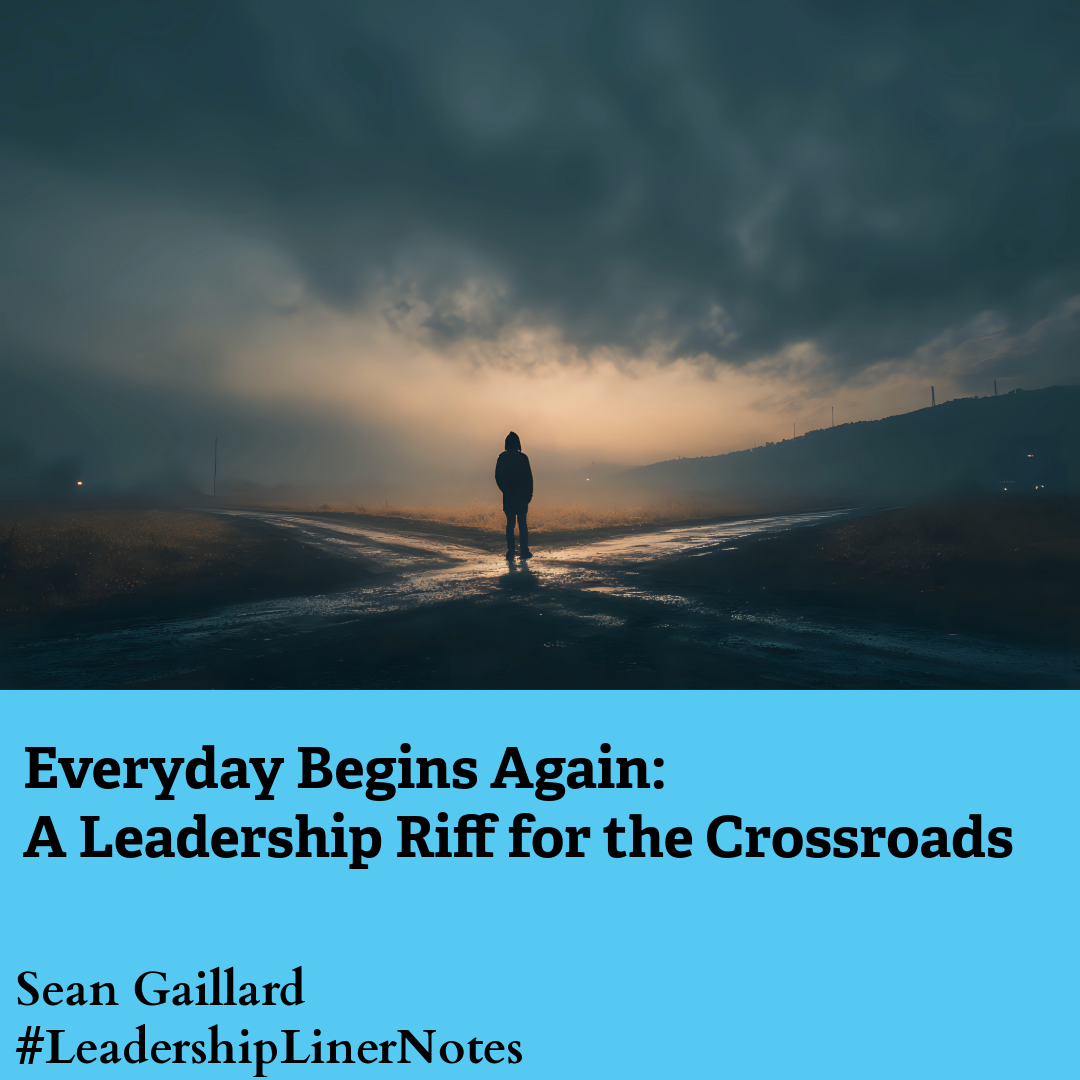
Everyday Begins Again: A Leadership Riff for the Crossroads

There is a scene near the end of Mad Men that has been living in my mind lately. It appears in “The Milk and Honey Route,” the penultimate episode of the entire series. Don Draper is sitting alone on a simple wooden bench at a literal crossroads. His past is heavy. His sense of identity is shaken. Every illusion he has held onto is slipping away.

He is not in a boardroom. He is not commanding a room or crafting the perfect pitch. He is simply a human being at a crossroads waiting for a bus. Two roads stretch away from him. The world around him is still and quiet. Then Buddy Holly’s song, “Everyday,” begins to play. It is light and gentle almost innocent against the weight of everything happening in his life. Don does not say a word. He simply smiles. It is small and worn but it is real.

And in that moment the crossroads becomes something else entirely. It is not a sign of failure. It is a place of possibility. A reminder that endings are also invitations. A signal that a new chapter might be waiting just beyond the next turn. That scene has always stayed with me and it echoes especially whenever I reach crossroads. The crossroads can sometimes be a place where I feel like a castaway from my own story. It sometimes resonates as place where the past feels louder than the future.

But crossroads are also moments of choice. They remind us that the narrative is not over.


Leaders Are Human First

Leadership can trick us into believing that we need to be composed and clear at all times. But human centeredness asks us to stop pretending. It reminds us that we can feel discouraged. We can feel disconnected. We can feel unsure. We can feel deeply human.

We cannot foster belonging for others if we ignore our own longing.
We cannot create connection for others if we are afraid to name the disconnection inside of us.
We cannot invite others to honor their gifts if we forget the gifts we carry.

When we forget our humanity leadership becomes empty.
When we honor our humanity belonging begins to grow.


Taking Back the Narrative

Lately, I have been wrestling with my narrative. The old version no longer fits yet the new one has not appeared in full shape. That in-between space can make even the strongest leader feel small. It can stir up doubt. It can amplify old wounds. It can convince us that we have failed.

But the narrative is not fixed. It is alive. It breathes.
We have the ability to reclaim it.
We have the ability to reinterpret the past.
We have the ability to decide what comes with us into the next chapter.

Reclaiming a narrative does not require us to erase pain.
It requires us to believe that we are still in the story.


How Might We Move Forward

I have been sitting with a set of big questions. Quiet questions. Honest questions that come from a place of wanting to understand what comes next.

How might we create belonging when we feel lost?
How might we honor our gifts when doubt feels heavy?
How might we acknowledge the seasons that humbled us?
How might we carry on when the path does not reveal itself?

Maybe the answer is simpler than we think.
We choose the next small step that moves us forward.
Not the perfect step.
Not the loudest or most impressive step.
Just the one that points toward healing and growth and connection.

Forward is not about speed. Forward is about intention. There is always a way forward at a crossroads.


A New Narrative Begins With One Step

Crossroads do not require us to know the entire map. They only require us to breathe to rise and to choose. Leaders carry the responsibility of illuminating a future path for others. That same responsibility calls us to illuminate a future path inside ourselves.

We keep showing up.
We keep tuning into the gifts that are still there.
We keep noticing the gifts others bring.
We keep giving ourselves permission to change.
We keep claiming belonging even when we feel like castaways.

Most of all we keep writing the next sentence of our narrative with honest hope and steady courage trusting that more of the story is still waiting to be revealed.


Your Move at the Crossroads

If you find yourself at your own crossroads I hope you remember this. You are not alone. You have not failed. You have not reached the end. You are standing in a place where your narrative can open into something new and meaningful. A place where the horizon stretches in every direction. A place where you get to choose the next chapter.

There is a future waiting that you cannot yet see. But it will meet you as soon as you take the next step toward it.

The Leadership Reset

Every great song needs a pause between the notes. The same is true for leadership. Take a moment, breathe, and tune your heart back to harmony.

As leaders, we have our days. I am talking about the days where we feel our humanity and gaze at our limits. Sometimes that limit gazing leads to doubt. We doubt our purpose. We question our impact. We embrace our blunders and define them as reasons why we don’t matter.

There are times when self doubt takes the stage.
We begin to question our purpose.
We wonder if we make a difference.
We replay our mistakes and convince ourselves they define us.

Leadership can be lonely. I can certainly attest to that after almost twenty years in school administration. It is a loneliness that gnaws at you, the kind that can box you into becoming a castaway who is adrift, rudderless, isolated.

That is the irony of leadership. We are surrounded by people every day, students, teachers, families, and community members, yet the weight of decisions, the scrutiny, and the responsibility can still leave us feeling alone. There are joyful days, of course, but there are also those days when you must make the hard call, stand by your principles even when they are unpopular, and face the quiet stares that question your choices.

Those are the Am I Cut Out for This? days, echoing the title of my good friend Elizabeth Dampf’s recently published, powerful book.


When Doubt Knocks

Every leader faces those moments that stir imposter syndrome, stress, or even depression. It is easy to forget that leadership, as meaningful as it can be, does not define who we are.

Yes, the work might be a calling or vocation, but at its core, it is still a job. What truly defines us is the why behind what we do, our passions, dreams, and values that form the center of who we are.

The work can also be beautiful, impactful, and world changing.

Just the other day, I sat in a parent teacher conference with a parent I had once served years ago at another school. She smiled through tears as she said she was grateful her child was in a place where I could help. That simple moment reminded me that the echoes of our leadership often reach further than we realize. Those moments when we feel seen, valued, and appreciated are the quiet affirmations that we have helped others feel the same.


The Power of the Pause

We are human. We will doubt. We will stumble. But we must also give ourselves permission to pause.

We must be intentional about being present, especially with the people who loved us before we ever had a leadership title. Sometimes, the most courageous move we can make is to take a moment to reset.

Last year, I came across an insightful book, The Reset Mindset by Penny Zenker. It is filled with practical, grounded steps for slowing down, refocusing, and rediscovering purpose. The concept of “reset” has stuck with me ever since, not just as a leadership practice but as a way of living.

Here is my own adaptation, a simple reflection I call The 3 Minute Leadership Reset.


🎧 The 3 Minute Leadership Reset

1. Take a Breath (30 seconds)

Close your eyes.
Inhale slowly and say to yourself:

“I am still here.”

Exhale and say:

“I am enough.”

Do this three times. Feel your shoulders drop. Feel your pulse slow. You have just reclaimed your space in the moment.


2. Anchor in Gratitude (1 minute)

Ask yourself quietly:

  • What one small moment today reminded me I am alive?
  • What one connection, a smile, a song, a student, gave me a spark?
  • What one thing am I proud of, even if no one noticed it?

Write it down in a notebook or say it aloud. That is your leadership echo, a reminder that small actions still ripple outward.


3. Affirm and Reframe (1 minute)

Say these words out loud, slowly and intentionally:

“I am not invisible. I am building something that lasts beyond applause.”
“My work is meaningful, even when it is quiet.”
“The music I make through service, kindness, and creativity still plays, whether or not the crowd is listening.”

Let those words live in your breath. You have just tuned your soul back to the right frequency.


4. Reconnect (30 seconds)

Before moving on with your day, take one small action to reconnect:

  • Send a short message to a friend or colleague.
  • Share a kind word with a student or staff member.
  • Play a song that brings you joy.

These micro moments rebuild our leadership core from the inside out.


One More Thing

Remember this truth: Your presence matters.
There are people, family, friends, and colleagues, who love you simply for who you are. You are never truly alone.

There will be days when the gig feels heavy, isolating, and uncertain. But even in those moments, you have got this. And I believe in you.

As I often say on my podcast:

“Do not forget to share your dreams with the world. The world needs them, and you help make it a better place.”

Leadership Echoes: Small Moments, Big Legacy

A Lesson from Administrator School

During my days in “administrator school,” I was fortunate to have our superintendent, where I was employed as a teacher, instruct one of our courses. The course was Strategic Planning, and I gained much wisdom from his years as a seasoned district leader. The class happened to land on the final day of the semester for our cohort. Looking back, it was a meaningful milestone as it marked the last class on the last day of my entire Master’s in School Administration program.

A moment from that day has stayed with me throughout my career. At the time, I did not realize how deeply it would echo through my leadership journey.

A Moment That Still Resonates

We were wrapping up the final review before exams when our superintendent began to share parting wisdom. I do not know what moved him to do so, but his reflections were powerful. He began to riff on lessons from his own career, weaving together aphorisms, stories, and insights.

Then came the moment I will never forget. He said, “Remember those conversations you had about your principal or even about me after a faculty meeting? Remember those meetings after the meetings where you shared your thoughts about leadership decisions? Maybe you complained and maybe you didn’t. Well, someday soon, you will be the topic of those conversations in the parking lot. How will you respond to that?”

He paused and looked at each of us. The room fell silent. We all sat in the weight of his words.

At the time, those words felt heavy and unsettling. Over the years, I have come to understand their profound truth about leadership and influence.

The Power of the Leadership Echo

All leaders have what I call a leadership echo. This is the way our tone, actions, empathy, and integrity ripple beyond our presence. It is the resonance of the legacy we create for others. Each of us has a leadership echo, and we are the composers of the melody it leaves behind.

Music and the Subtle Notes That Stay

As a lifelong music fan, I am always drawn to the small details in a song that stay with you. One of my favorite moments in music is the bridge of “Here Comes the Sun” by The Beatles. The sequence of handclaps adds a percussive joy that lingers long after the song ends.

Leadership works the same way. The small, intentional acts: kind word, a listening ear, a thoughtful pause before reacting—create lasting harmony. They resonate across classrooms and communities.

I still remember the high five I received from my principal after he observed my American Literature class. I was teaching “Richard Cory” and playing Simon and Garfunkel’s musical version. That simple gesture not only encouraged me, but I could see my students respond to it, too. It was a cool moment, one that continues to echo for me.

Echoes in Action

Leadership echoes take many forms. A leader checking in on a struggling teacher. A principal celebrating small wins during a tough week. A colleague modeling grace under pressure. A teacher calling home to share a moment of student success.

These gestures may seem small, but they often become the stories others tell later. When we amplify these positive echoes, they build the shared culture that defines our schools.

Hearing the Unflattering Echo

Sometimes, the echoes we hear are not flattering. Thinking back to what my superintendent said that day, leaders will always be the subject of conversation. Those conversations are sometimes positive and sometimes not.

As leaders, we must approach those moments with reflection, not fear. Even when the echo is critical, it can still reveal purpose and integrity. I recently reviewed survey data about my leadership. Some of it stung, but I chose to use it as a mirror for growth rather than a judgment.

Listening to your leadership echo takes humility and curiosity. It is an opportunity to grow, not to defend.

Three Ways to Strengthen Your Leadership Echo

Here are three reflective strategies for tuning your leadership echo into a source of growth and impact:

  1. Tune Your Tone:
    Pause before responding. Speak as if your words might echo in someone’s memory tomorrow.
  2. Play Small Notes Loud:
    Celebrate micro moments with either a handwritten note, a hallway check-in, or a quick “thank you.” Small gestures can carry great resonance.
  3. Listen for Resonance:
    Ask for feedback, reflect often, and be open to what comes back, even when it is uncomfortable.

The Last Chord

Just like the handclaps in “Here Comes the Sun,” your leadership will ring on long after you have turned the page to a new chapter. Think of the final chord in “A Day in the Life” by The Beatles. It sustains, fades, and lingers with an unforgettable sound that carries on long after the needle travels off the record.

Leadership is the same way. The decisions we make, the tone we set, and the kindness we extend all continue to reverberate through others long after we leave the room. Every word, action, and choice becomes part of our echo.

Each of us has the power to shape what that echo sounds like. We can choose to create an echo that uplifts, inspires, and builds others. The more we lead with intention, empathy, and grace, the more beautiful that resonance becomes.

My father often reminded me to lead with humility and to hold my head high. His words, much like that chord in “A Day in the Life,” continue to echo in my life and in my leadership.

May your echo be one of kindness, courage, and grace. May it be the kind that reminds others of the good they carry within. And may it continue to resonate long after the music fades.


One More Thing

This reflection is part of my ongoing Leadership Liner Notes blog, where I explore the harmony between music and leadership. The idea of the leadership echo reminds me that every interaction carries a note of influence, just like every chord in a great song contributes to the melody.

As I continue to write and learn, I’m inspired by the small moments that form the soundtrack of leadership. Every conversation, every decision, and every high five in the hallway becomes part of the echo we leave behind.

If this reflection resonates with you, share your own leadership echo story on social media using #LeadershipRiffs and #LeadershipLinerNotes, and tag me in your post. Let’s keep the conversation. and the echoes going.