The Summer Series of The Principal Liner Notes Podcast continues with an inspiring and heartfelt conversation featuring Dr. Sonia Matthew, the 2025 Maryland Assistant Principal of the Year.
Dr. Matthew brings deep insight, clarity, and joy to this conversation. We explore the essential role of the assistant principal and the importance of school leaders being intentional about mentoring and empowering their APs. Our discussion was more than a reflection, it was a call to action. As principals, we are called to create space for leadership to grow and thrive at every level.
One of my favorite moments in this episode is the mention by Sonia of Lauren Kaufman and her amazing book, The Leader Inside. As many of you know, Lauren is a frequent guest on my podcast. Her book is a great resource for mentorship and inspiration that is worthwhile for several revisitations. The impact of the book on Sonia is definitely compelling and you will get an opportunity to experience that impact in this episode.
What you’ll also hear in this episode is just the beginning. Dr. Matthew and I are already planting seeds for a new collaboration that will shine a spotlight on the assistant principalship and provide meaningful support and coaching resources for those who serve in that vital role.
Listen and join us in this reflection on purpose, leadership, and the power of lifting each other up. I would love to hear your comments on this episode. Please feel free to share here or on one of the podcast platforms shared here.
Recently, I came across a clip on YouTube of the late Ray Manzarek of The Doors telling the origin story of their 1967 hit Light My Fire. It’s one of those creative origin stories that just sticks. Ray talked about how each band member added a unique musical flavor that transformed the song into something iconic.
Guitarist Robby Krieger brought his flamenco background and wrote the core of the tune. John Densmore layered in a Latin beat on drums. Jim Morrison added a poetic and haunting verse about a funeral pyre. Ray himself took a page from Bach to create that unforgettable keyboard intro. All these ingredients came together like a great jam session, different parts working in harmony to create something innovative, inspired, and bold.
The Doors didn’t play it safe. They took a leap. They trusted each other. And they built something greater than the sum of their parts. That story got me thinking about what it means to lead and solve problems in a school.
When it came time to revise our master schedule at the school I serve as principal, the challenge was real. We needed to maximize instructional time and expand opportunities for intervention. But we didn’t tackle it in isolation. We did it together.
Over two weeks, I brought the challenge to our Instructional Leadership Team, the School Improvement Team, and several staff and teacher partners. These weren’t just quick drop-ins or top-down mandates. These were real conversations, one-on-one meetings, small group huddles, and full team sessions. I started each one with a simple design thinking prompt: How Might We…?
I’ll never forget one particular session with the School Improvement Team. We were all gathered around the same table. Teachers led the discussion. We weighed pros and cons. Ideas flew. Everyone added a perspective, and each voice mattered. There was no single author of the final schedule. Just like The Doors building Light My Fire, each person added a line, a beat, a riff.
Once we landed on a draft, I shared we’d treat it as a trial run. That removed pressure and opened space for feedback. We gave it a shot, came back, reflected, and adjusted. And here’s the best part—it worked. Not because it was perfect, but because it was owned. Teachers had skin in the game. Everyone contributed. Everyone collaborated. Everyone made it better.
This process reminded me that these collaborative moments between teachers and school leaders must echo what we want our students to experience. According to the World Economic Forum, one of the top job skills for 2025 is complex problem solving. Our students won’t master that skill from worksheets alone. They’ll learn it because we model it. Because we live it. Because we solve problems together.
3 Action Steps To Take Build A Collaborative Problem Solving Culture
Leadership is about making space for others to create. It’s about asking How Might We instead of You Must. It’s about letting teachers jam. Here are three ways schools can start building that kind of collaborative problem-solving culture:
1. Create Solution Building Time Set aside time during the month for small, creative think tanks. Bring together teachers, staff, and leaders in a low-pressure space to brainstorm, ideate, and prototype solutions. Use design thinking prompts. Use sticky notes. Use music. Just make it fun and focused.
2. Launch #InstantPD Moments Give teachers the mic. Once a week, host a 15-minute pop-up PD session where a teacher shares a strategy that works. These micro-sessions build confidence, spread great practice, and create the conditions for more teacher-led innovation.
3. Use the Power of the Trial Run When testing something new, give permission to try without pressure. Frame it as a pilot. Invite feedback. Circle back. This builds trust and opens the door for authentic input that shapes real change.
Whether it’s jamming with colleagues on a new idea or leading a full schedule redesign, when we bring people together, we get better. We build trust. We spark creativity. We light fires.
Let’s keep jamming. Let’s keep solving. Let’s keep leading like it matters.
This is your latest #LeadershipRiffs moment from the desk of a school principal who still believes in the power of collaboration, creativity, and the beautiful noise we make when we lead together.
How Brian Wilson’s Music Taught Me About Leadership, Vulnerability, and the Courage to Keep Going
Devastated.
Brian Wilson is gone.
The news hit me hard today. Brian wasn’t just a musical genius. He was a spiritual guide, a quiet architect of harmony, and the voice behind songs that shaped my life. His music—those symphonies of soul, longing, and joy—have been my compass through the loud and quiet moments of living.
Just last week, I was basking in the joy of a surprise Father’s Day gift from my wife and daugthers: tickets to see The Beach Boys live. Brian had long since retired from performing, but his presence was felt. It always is. It lingers in the harmonies. It rises in the arrangements. It pulses in every chorus sung by a crowd of strangers suddenly made family by melody.
I was fortunate to see Brian perform live several times in the late 1990s and early 2000s during his remarkable comeback. It was more than a concert. It was a rebirth.
Brian’s music has accompanied the milestones of my life.
I remember pressing my ear to a clock radio 45 years ago, trying to catch every layered nuance of Good Vibrations. I didn’t understand the complexity of what I was hearing yet—but I felt it. I was entranced.
I remember watching a Beach Boys concert on HBO in the 1980s with my dad. He loved R&B and soul, and yet there we were—grooving, smiling, singing along to Fun, Fun, Fun like it was gospel.
I remember hearing the opening chords of California Girls in the delivery room as my twin daughters were being born. That mini-symphony played while new life entered the world, and in that moment, I felt the rush of peace. God was with us. Everything was going to be okay.
I remember not gettingPet Sounds, in its first when I first heard it in 1990. But I grew into it—and came to see it for what it is: the greatest album of all time. A masterpiece of heart, soul, and innovation.
I remember hearing Cabin Essence from a bootleg copy of SMiLE on vinyl in a record store. I looked around in stunned silence. A clerk caught my gaze and nodded as if to silently say, “We get it, don’t we?” No words. Just knowing.
I remember driving my oldest daughter home from daycare, both of us singing Heroes and Villains at the top of our lungs. Laughter and joy spilling through the car like sunshine.
But Brian Wilson didn’t just give us songs. He gave us strength.
Through Pet Sounds, he showed me that vulnerability isn’t weakness—it’s strength in its purest form. Through SMiLE, he taught me that unfinished dreams can be resurrected with grace, imagination, and perseverance. Through his life, he reminded us that the creative process is messy, sacred, and worth the fight.
Brian Wilson’s willingness to face his mental health struggles publicly—amidst a whirlwind of fame and pressure—changed how I view courage. He didn’t hide his pain. He didn’t pretend it wasn’t there. He just kept going. Kept writing. Kept harmonizing. That quiet, determined bravery became a guiding light for me.
Last year, when I experienced a heart episode that resulted in me being rushed to the hospital, I found myself in one of the most vulnerable seasons of my life. Alongside the physical recovery came emotional weight—mental health struggles I didn’t always know how to name. In that difficult stretch, I thought of Brian. I revisited his story. I played Pet Sounds and SMiLE. His music gave me permission to slow down, to feel, to heal. His example reminded me that we don’t have to be perfect to keep going—we just have to keep showing up, one note at a time.
Brian Wilson’s quote, “Music is God’s voice,” echoes eternally in my mind.
As a school leader, that idea centers me. It reminds me that learning is sacred. That harmony matters. That love, when set to rhythm, can move hearts and minds in ways nothing else can.
For those who’ve followed this blog or listened to the Principal Liner Notes podcast, you’ve heard me talk about Creative Courage. That’s Brian Wilson to the core. The courage to innovate. To feel deeply. To fail. To rise. To try again.
Today, I mourn. But I also give thanks.
I give thanks for the peace his songs brought me in a delivery room. I give thanks for the laughter his melodies brought into my car. I give thanks for the strength his life gave me when I needed it most.
Brian Wilson changed my life.
His harmonies still ring. His spirit still sings. And for those of us willing to listen, his legacy keeps leading us forward—in the key of empathy, in the tempo of grace.
Thank you, Brian. You gave us harmony. You gave us honesty. You gave us your heart.
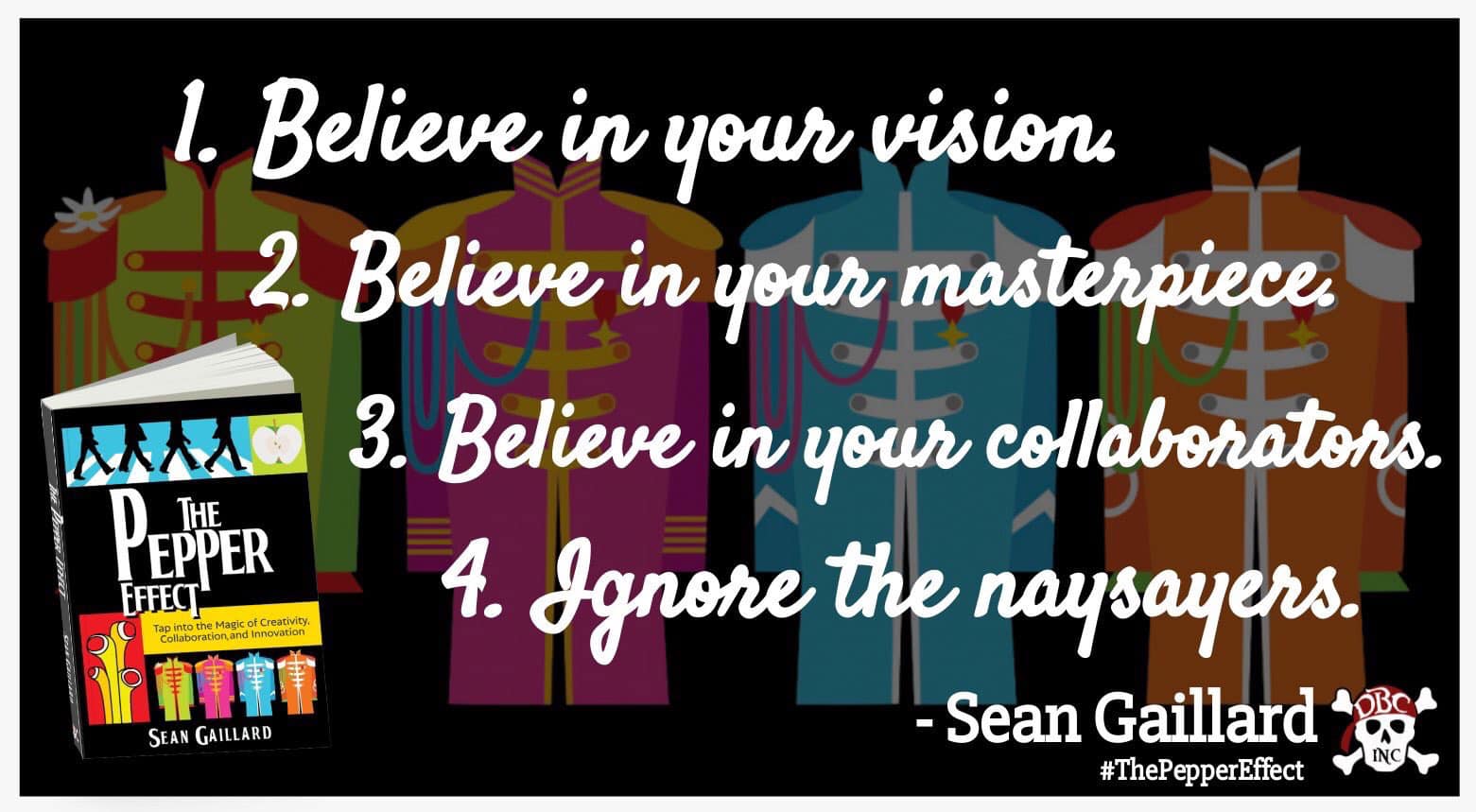
Seven years ago today, a lifelong dream came true—I became a published author.
The Pepper Effect was more than a book. It was a love letter to The Beatles, to education, and to believing in the impossible. I’ll never forget the moving moments that surrounded its publication: — My daughter Maddie finding my book on the shelf at Barnes & Noble—the first time I ever saw it in a bookstore. — Hugging my parents and seeing the joy and pride on their faces when I handed them their copy. — My true Fab Four—my wife and daughters—by my side at my first book signing at Underdog Records. — Watching a stage adaptation of The Pepper Effect performed at a school in Canada.
I’m forever grateful for those moments and for every reader who took the time to read the book, share it, and apply its message in classrooms and schools around the world. If you haven’t read it yet, it’s available here: Order on Amazon.
Today, something serendipitous happened. On the book birthday of The Pepper Effect, I released a new episode of the #PrincipalLinerNotes podcast—featuring none other than Dave Burgess, the publisher who believed in me and gave my book its wings.
Our conversation is a celebration of creativity, connection, and passion for education. It’s also the beginning of a short summer season of the podcast, where I’ll be amplifying the voices of those who continue to inspire and lead.
I’m currently working on another book—fingers crossed that it gets the nod for publication. Until then, thank you for being in the band. Your encouragement, listens, reads, and reflections mean more than I can ever express.
Feel free to drop me a line at sean@seangaillard.com to share your thoughts on the podcast, the blog, or The Pepper Effect. I’d love to connect.
I’m excited to share that Principal Liner Notes now has a new home on the web: 🎶 seangaillard.com 🎶
This new site is where you can find all of my blog posts, reflections, podcast updates, and more. You’ll also be the first to hear a big announcement (or two) coming soon—things I’m really excited about and can’t wait to share.
To those who have followed, subscribed, shared, or just quietly read along—thank you. Your support fuels the creative spark and reminds me that this journey matters.
Please take a moment to subscribe at seangaillard.com and share it with a friend or fellow educator. I hope it continues to be a place of inspiration, connection, and purpose.
Today also marks the anniversary of an album that changed the world—Sgt. Pepper’s Lonely Hearts Club Band. That album didn’t just change music, it changed my life. It lit the fire that led to my first book, The Pepper Effect, a celebration of belief, collaboration, and educational leadership.
There are checklists to check off. Boxes to move. Emails to answer. Meetings to attend. Conversations to wrap. It can feel like you’re racing a clock with no hands—just noise, motion, and that persistent push toward “done.” As school leaders, we often wear this urgency like a badge of honor. But somewhere in the frenzy, we lose sight of something vital:
The pause.
The other day, our custodian was out, and I had to stay late to close the building. Alone. I walked the halls, locking doors and preparing to set the alarm. The building was still. No laughter echoing down the halls. No rush of students heading to the buses. Just me and the walls that had witnessed a school year’s worth of highs, lows, pivots, and quiet victories.
That simple rhythm—step, door, lock, breathe—became something sacred. I wasn’t just closing a building. I was closing a chapter. In that silence, the year spoke back to me. I remembered the breakthroughs. The bruises. The bounce-backs. The beauty of what we had built together.
And I realized something all over again: reflection is not a luxury. It’s a necessity.
Since my heart episode last year—a moment that forced me to recharge not just physically, but mentally and spiritually—I’ve come to believe even more deeply in the power of pause. I spent too many years avoiding it. Confusing the speed of leadership with the strength of leadership. I mistook checklists for vision. And it nearly broke me.
Innovation doesn’t come from being in constant motion. It comes from being still enough to listen to what the year has been teaching us all along.
So I offer this, not just as a fellow school leader, but as someone who had to learn the hard way: Make reflection part of your leadership practice. Not later. Now.
Here are three ways I’m leaning into reflection, even in the middle of the end-of-year mania:
🎧 1. Schedule 15 Minutes of Stillness
Block out 15 minutes this week—no email, no meetings, no phone. Find a quiet corner of your school. Sit. Breathe. Let the silence remind you of your why.
📝 2. Journal with Three Prompts
What am I most proud of this year? What did I learn from my staff? What will I do differently next year? Keep it short. Keep it honest. But write it down. Let your words catch up with your heart.
🚶♂️ 3. Take a Solo Walk Through the Building
No agenda. No checklist. Just walk. Let the sights, sounds, and stillness speak to you. Every poster, every student project, every empty seat is a story. These are the artifacts of your leadership.
If you’re reading this and feeling overwhelmed or alone, know this: you’re not. I’m walking this with you. And if you need a thought partner or a word of encouragement, I’m here.
Leadership is lonely—but it doesn’t have to be isolating. Especially when we choose to pause, reflect, and lead with presence.
There are moments in leadership—more than we care to admit—when it feels like leadership isn’t there for you.
You stand in a room and no one greets you. No one looks up. No one notices.
You offer ideas, vision, care—and it’s met with silence, or worse, indifference.
You give your best self and sometimes receive no acknowledgment in return.
The gig is tough. The gig is lonely. The gig will ask you to keep showing up, especially when the room grows quiet. And sometimes, it stays quiet.
And yet—we still walk in.
Why?
Because we’re human.
Because we crave meaning.
Because we want to belong just like anyone else.
I carry what my father taught me in these moments: Hold your head high. Even when no one seems to see you. Especially then.
And so, I look for the small things.
The fleeting glances. The quiet nods. The invisible applause.
Those moments when you know—deep in your gut—that you’re still in the groove.
I remember those moments when I played in bands. We’d be deep into a tune, and someone across the band space would catch my eye and offer a knowing smile. Just a look. A small moment that said, We’ve got this.
There’s a video I love of the Dave Brubeck Quartet performing Take Five. During Joe Morello’s legendary drum solo, Brubeck stops playing. He turns from the piano—not to take center stage, but to watch. To admire. To honor. No words. Just presence.
The Beatles did it, too. During that final rooftop concert, even amid the tension, they stole glances. Smiles. They saw each other. And they saw Billy Preston, too—playing keys right alongside them, lifting the sound, lifting the moment.
Even as the world watched from the streets below, the real audience wasn’t the crowd down there—it was amidst the band.
That’s what keeps me going in leadership—the small, true things.
A student’s unexpected smile.
A teacher’s thank-you whispered in the hallway.
A quiet moment where someone sees you—and maybe, just maybe, you see them too.
We may not always receive the applause. But we can give it.
We can be the nod.
We can be the smile.
We can be the Dave Brubeck who turns his head in full admiration.
We can be the Beatle who shares a grin in the middle of the chaos.
Those small moves? They matter.
They are leadership.
And when the room is quiet—lead anyway.
You never know who might be listening for your cue.
This post is dedicated to my true Fab Four: Deb, Maddie, Emily, & Rachel.
This past weekend, our family was called to divide and conquer. A moment we had both dreamed of and quietly feared had finally arrived: our twin daughters were graduating from college—at two different universities, with ceremonies only an hour apart.
That scheduling twist, which had loomed as a distant possibility, finally became reality. But in true fashion, our daughters made the call for us. They knew the challenge of being in two places at once, and they handled it with grace, maturity, and love. One twin would be celebrated in Boone, the other in Charlotte. My wife, Deborah, attended Emily’s ceremony, while I went to Rachel’s.
It wasn’t easy. We wanted so badly to be in the same place, to celebrate both daughters together as a complete family. But our hearts remained united, even across the miles.
As I sat in the Convocation Center at Appalachian State University, surrounded by the joyful noise of other families, I found myself scanning the sea of black caps and gowns. I was determined to catch a glimpse of Rachel. Our oldest daughter, Maddie, who had just completed her second year of law school, finally spotted her and pointed excitedly.
And then—there she was.
Waving. Smiling. Radiant in her graduation regalia.
For a moment, time folded in on itself. Her wave transported me to another milestone—the day of Rachel’s First Communion. That same smile, that same sparkle in her eye. She had looked across the church, found me in the crowd, and sent me a quiet wave. I had waved back, with the same lump in my throat that returned to me all these years later.
But something else happened, too. In Rachel’s smile, I also saw Emily’s. Her twin’s light and laughter seemed to echo in that moment. It was as if both were standing there in front of me, even though Emily was an hour away in Charlotte. I felt a powerful closeness to both daughters, woven together in that one unforgettable glance.
That’s the thing about being a parent. These moments hit you like a thunderclap. They echo from the past and resonate into the future. And suddenly, you realize the most important title you’ll ever hold isn’t “Principal” or “Author” or anything in your email signature. It’s simply “Dad.”
I am so proud of all three of my daughters—Maddie, Emily, and Rachel. They are bright, strong, kind, and wise. They are charting their own paths as young adults, and watching them step into their lives fills me with awe. I’m even more grateful for my wife, Deborah, whose quiet strength and boundless love have held the center of our family together through every season of growth.
Now, with the nest officially empty, I find myself reflecting—not with sadness, but with gratitude. The house may be quieter, but my heart is louder than ever with pride and love.
What Matters Most
It’s easy to get lost in the deadlines, testing windows, evaluations, checklists, and calendar invites. But in the rush of it all, don’t lose sight of what matters most—your people. Your family. Your loved ones.
I’ve made mistakes. I’ve put the job first far too many times. I’ve been the principal who stared at the calendar and missed moments that I can’t get back. And I’m still learning.
John Lennon said it best in “Beautiful Boy (Darling Boy),” a song he wrote for his five-year-old son, Sean. It appears on Double Fantasy, the final album Lennon released in his lifetime, just weeks before he was so senselessly killed by gunfire at the age of 40.
In that song, Lennon offers this lyric that has never left me:
“Life is what happens to you while you’re busy making other plans.”
It’s more than a line—it’s a truth that rings louder the older we get, especially when the nest starts to empty and the calendar continues to fill.
So, as the year closes and you check off your last task, I offer a few humble reminders:
Action Steps for Leaders to Thrive in Life and Work
1. Calendar Your Family First Put family time on the calendar with the same importance as meetings or walkthroughs. Block it out. Protect it.
2. Celebrate Milestones—Big and Small A graduation, a recital, a family dinner. These are not interruptions. They are the point.
3. Let Your Team In Model balance for your team. Share your family moments. Celebrate theirs. Normalize stepping away to be present.
4. Unplug With Purpose Turn off the notifications. Leave the laptop in the bag. Watch the game, take the walk, enjoy the silence.
5. Reflect Often Journal. Take a quiet moment in the car. Play a favorite song or album. Remind yourself why you do what you do—and for whom.
The nest may be empty, but the heart stays full. And at the end of the day, love is the legacy that lasts far beyond our leadership roles.
So here’s to what matters. Here’s to waving daughters, twin smiles, and a family that found a way to be in two places at once—with love as the through line.
In an old comic book from my childhood, there’s a powerful image that has always stayed with me. It was an issue of Detective Comics that told the origin story of Batman. A young Bruce Wayne walks into Wayne Manor, ready to begin his hero’s journey. As he enters, his shadow stretches behind him—not as a boy, but as the full-formed silhouette of Batman. It was a simple panel, but it carried a profound truth: even in our earliest steps, the shadows of our future potential are already taking shape.
This image made me think about our calling as educators. Every day, we walk alongside students and teachers who are living their own origin stories. Some are just starting out, unsure of who they are or where they belong. Yet within them, we can glimpse the shadows of what they may become—leaders, artists, scientists, changemakers, or quiet heroes who make the world better in unseen ways.
This week is Teacher Appreciation Week, a moment to celebrate the educators who see those shadows before anyone else does. Teachers have a remarkable gift—a kind of superpower. They tune into the potential of their students and help them believe in it, even when the students can’t yet see it for themselves. Our teachers transform the impossible into the possible. They are not just instructors; they are cultivators of hope.
As school leaders, we are called to be architects of that hope. Our job is to build cultures where teachers are empowered to do their best work—where they can create the conditions for students to discover who they are meant to be.
I’ll never forget my fifth-grade teacher, Mrs. McMonagle. I was a new student, the only Black child in the class, adjusting to a new school in a new state. I felt lost—alienated, unsure, and afraid. But Mrs. McMonagle saw something in me that I couldn’t see in myself. She created a space where I felt seen and welcomed. She introduced me to the joy of writing, literature, and even encouraged my growing love for The Beatles. She pushed me, challenged me, and inspired me. I am forever grateful for the way she believed in me and gave me a sense of belonging.
Everyone carries the shadow of future potential. Teachers have a special sense for detecting those shadows and helping students realize the greatness within them. This week, and every week, let’s honor and celebrate that gift.
Here’s to the ones who chose to build trajectories of hope in our classrooms. Here’s to the ones who see the future before it arrives.
As I write this, I’m sitting with the weight of another school year nearing its close—reflective, grateful, and searching for meaning in the midst of it all.
I’ve been a principal for 16 years. I’ve poured myself into school after school, often the ones that needed the most care. I’ve stood on stages, been a finalist for NC Principal of the Year, written a book from my heart, and still—there are moments, like now, when I wonder if it’s all making a difference.
Maybe you’ve felt that too.
Lately, I’ve been thinking about The Beatles. Specifically, August 29, 1966—their last public concert at Candlestick Park in San Francisco. They had reached a breaking point. They felt like they weren’t playing well. Between public backlash over John Lennon’s remarks about The Beatles being more popular Jesus Christ and diplomatic fallout in the Philippines from unintentionally snubbing the President and First Lady there, the pressures became too much. So they did something radical—they stepped back. No farewell tour. No grand finale. Just a quiet pause.
Each band member took time to rediscover who they were beyond the noise. John went to Spain to film How I Won the War. Paul collaborated with George Martin on a film score. George immersed himself in sitar studies with Ravi Shankar in India. Ringo stayed home to be with his family.
Then, something beautiful happened.
They returned—not to the stage, but to the studio. And from that retreat came a wave of brilliance: Strawberry Fields Forever, Penny Lane, Sgt. Pepper’s Lonely Hearts Club Band.
All of it began with a pause. A reset. A reclaiming of identity. A spark of innovation that changed the face of Music.
As leaders, we may not have world tours or screaming fans, but we do know what it feels like to carry the weight of expectations and the constant drumbeat of demands. In that rhythm, we can forget to care for ourselves in the same way we care for others.
We all crave connection. We all crave belonging. And while we work so hard to create that for our teams, our students, and our communities—we must also remember to create it for ourselves.
Take the walk. Play the record. Write what’s on your heart. Give yourself the same grace you offer to everyone else.
It’s easy to fall into the comparison trap—scrolling through highlight reels, seeing the accolades, the applause, the polished smiles. I’ve been there too. But the truth is, none of that defines your worth or your purpose.
Your worth is in the quiet moment with a student who needed someone to believe in them. It’s in the coaching conversation that sparked a teacher’s growth. It’s in the way you show up—consistently, compassionately, courageously.
You may not always see the impact. But it’s there.
If you’re at a crossroads, unsure of what’s next, or simply longing to feel grounded again, let this be your reminder:
Somewhere in the universe, someone believes in you completely.
Not for your title. Not for your credentials. But for who you are. For how you lead with heart. For how you care, even when it’s hard.
You matter.
Your leadership matters.
Your impact matters, and it will continue to do so in ways seen and unseen.



 Leadership Liner Notes: Sean Gaillard