What Bill Evans Teaches Us Music, Leadership, and Leaning Into One Another
Movement One: Put the Needle Down at the Village Vanguard
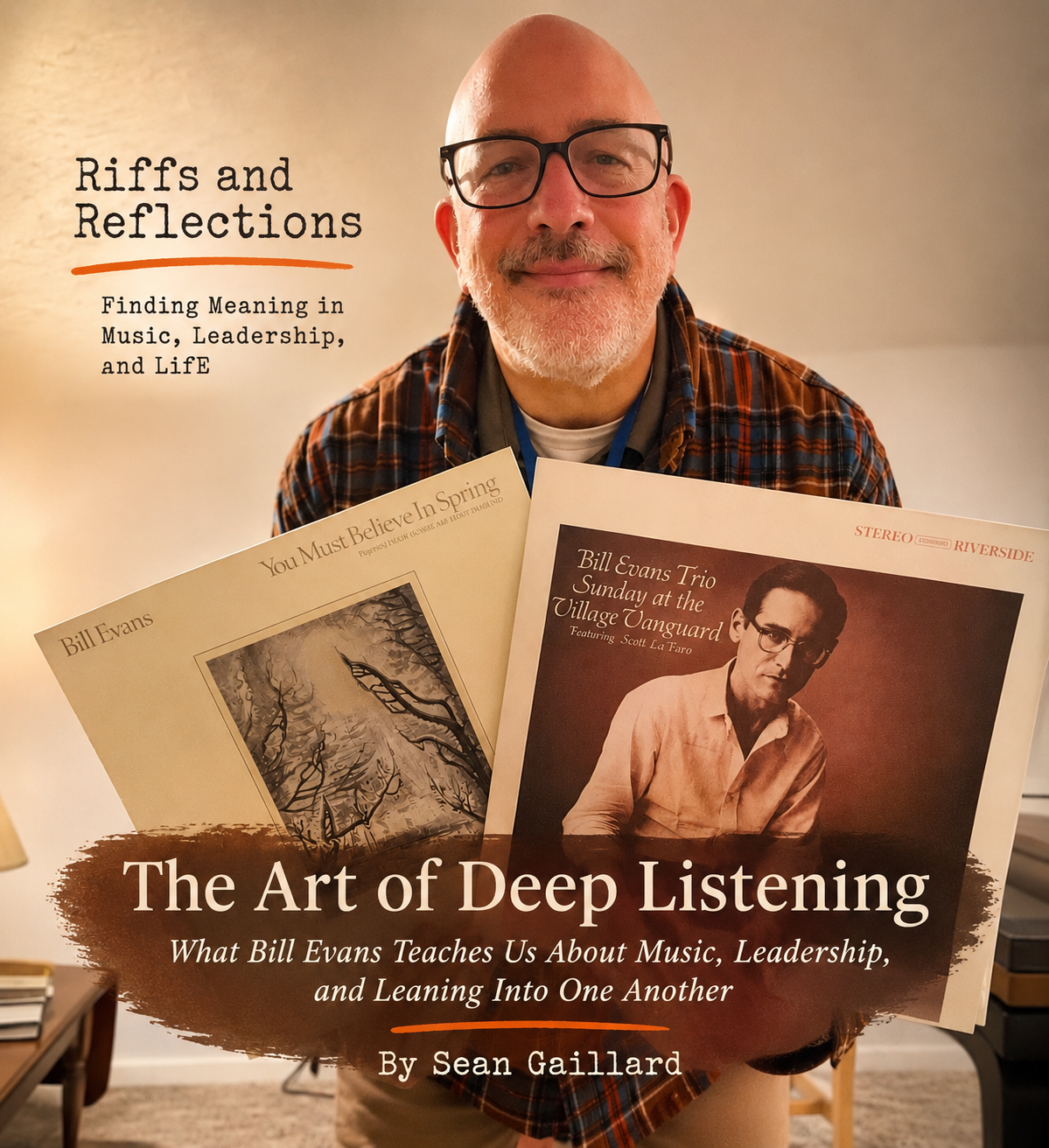
An album that continues to marinate in my imagination is Sunday at the Village Vanguard by the Bill Evans Trio. Recorded during a pivotal live performance in June 1961, this masterpiece transports me to a small jazz club in New York City. I imagine myself sitting at a table with a glass of bourbon, surrounded by the smoky atmosphere of the Village Vanguard, leaning forward as three musicians engage in a remarkable musical conversation. Nobody in that room could have known that this performance would become such an enduring part of jazz history.
Rich in subtlety, generous in space, and unassuming in its musical posture, Sunday at the Village Vanguard is widely regarded as one of the greatest jazz albums ever recorded. The album opens with “Gloria’s Step,” a composition by bassist Scott LaFaro. His bass establishes a musical conversation that invites Bill Evans to respond on piano while drummer Paul Motian contributes his own gentle, rhythmic observations. There is a remarkable sense of space throughout the performance, with each musician listening intently and responding to the shifting musical ideas of the others. The interplay is extraordinary because nobody seems interested in dominating the conversation. Each musician contributes something essential while allowing the others room to explore.
What strikes me most about this recording is the deep listening taking place among these three musicians. They are doing far more than performing a composition together. They are leaning into one another, anticipating musical possibilities, and creating something that could never emerge from any one of them playing alone. The conversation unfolds through notes, pauses, rhythmic shifts, and moments of restraint. It is a marvelous example of what becomes possible when talented people genuinely listen to one another.
There is also a heartbreaking poignancy surrounding this recording. Just ten days after the performance, Scott LaFaro died tragically in an automobile accident at the age of twenty five. His remarkable musical voice was silenced far too soon, leaving behind a recording that continues to resonate more than six decades later. Perhaps that is another reason this album stays with me. It reminds me of the beauty and fragility of the moments we share with others, especially when we are fully present and listening.
Movement Two: Tune Our Ears to One Another
Over the last several years, I have become increasingly active in podcasting. I enjoy the trapdoor it provides into learning, connection, and personal growth through conversations with others. Every guest brings a different story, perspective, and collection of experiences that expand my understanding of the human landscape. Podcasting has also taught me something essential about the value of deep listening and the responsibility that comes with inviting another person into a conversation.
When I record a podcast remotely, I make a conscious effort to tune my ears and lean toward the screen. These small gestures help compensate for the geographical distance and the absence of being physically present with another person. More importantly, they remind me to remain fully engaged with the person sharing their story. I want my guests to feel comfortable enough to be themselves, knowing that their experiences, perspectives, and voices genuinely matter. I want to create a sense of closeness and connection that makes the conversation feel less like a formal interview and more like two people sitting together in the same room.
There is a certain propinquity I hope to cultivate and steward in these conversations. Physical proximity may not always be possible, but emotional closeness can still emerge when we listen with intention, curiosity, and care. Some of my most meaningful podcast conversations have taken unexpected turns because I allowed myself to follow something a guest shared rather than remain attached to a predetermined question. Those moments remind me that genuine listening requires more than simply waiting for our opportunity to speak. It requires the willingness to be present, respond thoughtfully, and allow another person’s voice to influence the direction of the conversation.
I hear something similar whenever I return to the Bill Evans Trio. Evans, LaFaro, and Motian demonstrate that listening is not a passive exercise. It is an active contribution to the collective experience. Each musician brings something distinctive to the performance while remaining attentive to what the others are communicating. Their musical dialogue reminds me that the most meaningful conversations often emerge when we loosen our grip on the direction we expect them to take and allow something new to develop.
Movement Three: Leadership Is a Conversation, Not a Solo
My years in education have reinforced the importance of listening as an essential part of teaching, learning, and leadership. Some of my most meaningful experiences as an English teacher occurred when students offered interpretations of literature that challenged or expanded my own thinking. I could return to a familiar novel year after year and still discover something new because my students brought their own experiences, questions, and perspectives into our classroom conversations. Their voices enriched the learning experience and reminded me that teaching was never meant to be a solo performance.
I believe the same principle applies to leadership. We sometimes become so consumed with providing direction, solving problems, and responding to the demands of our work that we forget to make room for the people around us. We may hear their words without genuinely listening to their ideas, concerns, or aspirations. The opportunity to create something meaningful together can become lost when one voice dominates the conversation or when others feel their contributions are neither invited nor valued.
The Bill Evans Trio offers a different possibility. Evans does not need to occupy every musical moment to demonstrate his artistry. LaFaro and Motian are not merely supporting players waiting for their next assignment. They are essential contributors whose musical gifts help shape the collective experience. Their interplay reminds me that leadership should involve recognizing the talents of others, creating opportunities for those talents to emerge, and trusting that the collective result can become something greater than any individual contribution.
There is also an important element of reciprocity in this musical conversation. Deep listening cannot be the responsibility of only one person. Meaningful collaboration requires everyone to participate in creating an environment where people feel comfortable sharing their ideas and responding to one another. When we listen with humility and curiosity, we acknowledge that we do not possess every answer or perspective. We make room for growth, discovery, and the possibility that someone else’s contribution might lead us somewhere we never anticipated.
Movement Four: You Must Believe in Spring
Sixteen years after the Village Vanguard performance, Bill Evans entered the studio with bassist Eddie Gomez and drummer Eliot Zigmund to record You Must Believe in Spring. Recorded in 1977 and released after Evans’s death, the album represents another extraordinary chapter in his musical journey. The musicians are different, the circumstances have changed, and the emotional landscape feels more reflective. Yet the spirit of musical conversation remains beautifully present throughout the recording.
I have been spending time with this album lately, finding myself drawn to its tenderness, emotional depth, and quiet sense of possibility. There is a beautiful coexistence of sadness and hope within these performances. The music seems to acknowledge the weight of life’s experiences without surrendering the possibility of renewal. When I listen to the title track, I hear musicians creating space for one another while contributing to something deeply moving. Their musical conversation feels intimate, thoughtful, and profoundly human.
Perhaps that is what connects these two remarkable albums for me. Despite the passage of time, the changes in personnel, and the experiences that shaped Evans’s life, the importance of listening remains. The music continues to evolve because the musicians remain willing to respond to one another. Each brings a distinctive voice to the conversation, contributing to a shared experience that reflects both individuality and connection.
There is a lesson here that extends far beyond the grooves of these records. We need to take the time to listen intentionally to one another, especially in a world that often rewards the loudest voices and the quickest responses. We need to create space for others to share their gifts, perspectives, and ideas without feeling that they must compete for our attention. Deep listening should be something we encourage, model, and support in our classrooms, workplaces, relationships, and communities. It should become part of how we demonstrate that people genuinely matter.
Sometimes the simple act of tuning our ears to another person’s voice can ignite an entirely new conversation. An unexpected idea emerges, a connection deepens, or someone discovers the confidence to share a gift that might otherwise have remained unheard. Those moments can move us toward a greater sense of mattering, belonging, and growth. They remind us that listening is not simply about receiving another person’s words. It is about recognizing their humanity and creating the conditions for something meaningful to flourish.
As I return to You Must Believe in Spring, I find myself thinking about the enduring power of these musical conversations. Bill Evans reminds me that we do not have to play every note or command every moment to make a meaningful contribution. Sometimes our greatest contribution comes from listening carefully, leaning toward one another, and making room for someone else’s music to emerge. Perhaps that is where the possibility of spring begins, in our willingness to hear one another and discover what beautiful things we might create together.

