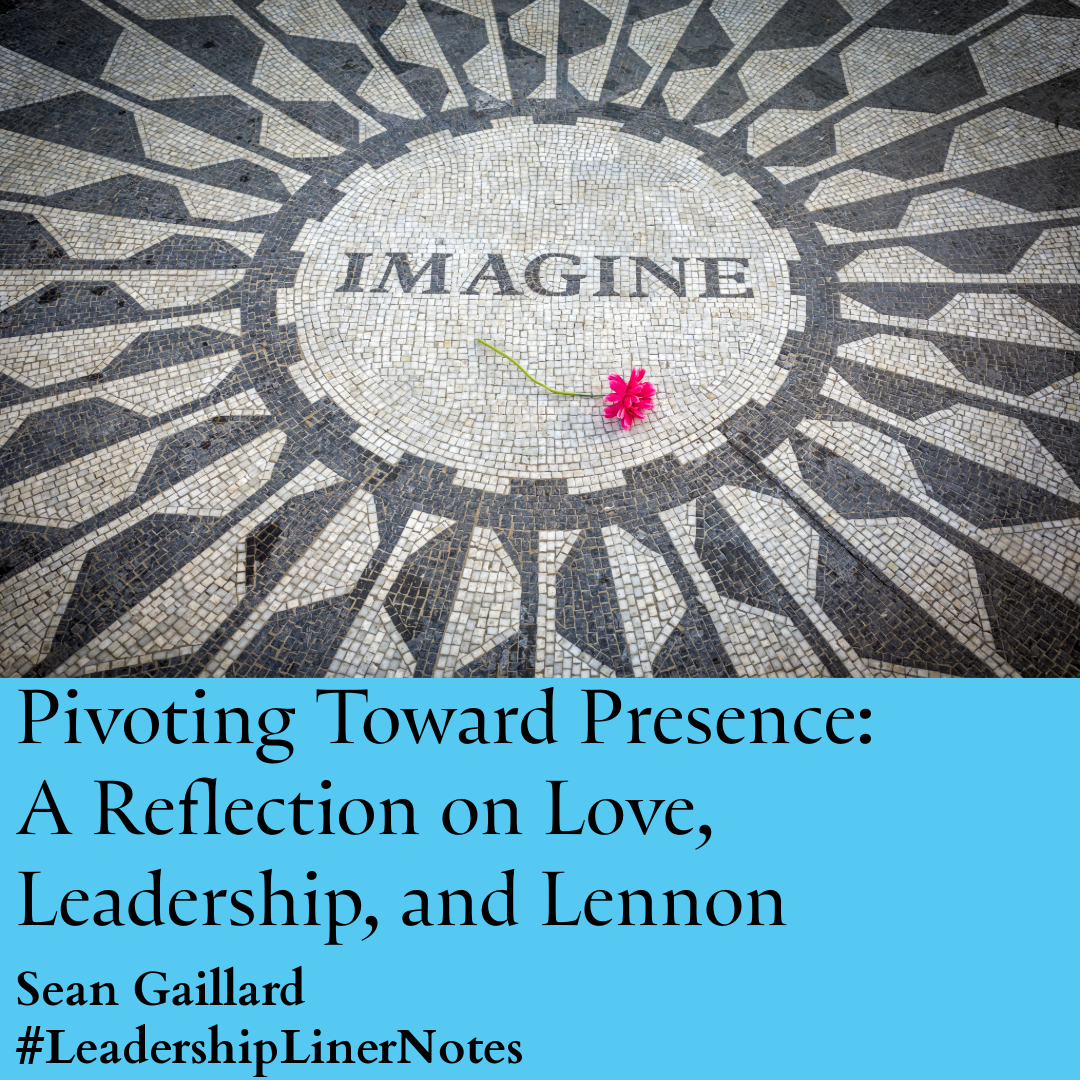
Pivoting Toward Presence: A Reflection on Love, Leadership, and Lennon

Today marks what would have been John Lennon’s 85th birthday. Had he not been so cruelly taken from the world, I imagine him surrounded by love, his wife, his sons, and perhaps a few close friends gathered around a cake. I can almost see John smiling, glasses glinting in the candlelight, grateful for another revolution around the sun. Grateful simply to be a husband and father.

Of course, this is a dream, a what if forever suspended in time. John Lennon is not with us. Yet every time we hear Imagine, or spin a Beatles record that once lifted the world, his spirit continues to sing. His ideas, his courage, and his music are eternal.

As I think about John’s life today, I am reminded of the profound pivot he made in his final years, a pivot that leaders, including myself, can learn from. After a painful separation from Yoko Ono, John chose to retreat from the spotlight. He became a stay at home father. He walked away from fame, record contracts, and the demands of celebrity life to raise his young son, Sean. He called this period his “househusband years.” Five years of seclusion. Five years of being present.

In that quiet season, John found peace. He cooked, baked bread, and rediscovered the small joys of daily life. He walked through Central Park and strolled with Yoko and Sean, savoring the moments that so many of us rush past. He wrote songs again, not for charts or critics, but from the heart. When he finally returned to the studio in 1980, he released Double Fantasy, a musical conversation between himself and Yoko celebrating love, family, and renewal. The album earned a Grammy for Album of the Year, a posthumous echo of his artistry at its most honest.

One song from that record, Beautiful Boy, contains a line that has haunted and guided me for years:
“Life is what happens to you while you’re busy making other plans.”

That lyric hits harder as I get older. I have lived its truth. As a husband, father, and leader, I have had moments when my presence was only partial, physically there but mentally buried in a phone, a to do list, or the next big initiative. When I faced my first serious health setback a year and a half ago, lying in a hospital room with machines beeping around me, I thought of all the moments I had missed. I remember wondering: Would I get to tell my children I loved them again? Would I see my wife’s beautiful smile? Would I have another chance to simply be, not as a principal, not as a leader, but as a husband, father, son, brother, and friend?

Thankfully, I was granted another chance. I am still learning and growing even as those health setbacks keep coming. That experience in the hospital room changed me. It reminded me that leadership is not just about impact, innovation, or outcomes. It is about love. It is about being present for the people who give your life meaning.

As leaders, we can lose ourselves in the rhythm of meetings, emails, and deadlines. The work matters, but so do the quiet moments that recharge our hearts. The people who know us beyond our title need us, not the version that is always on, but the one that listens, laughs, and lingers a little longer at the dinner table.

John Lennon’s decision to step away from the noise and focus on family was not an escape. It was an act of courage. It was his pivot into something beautiful.

So, what does that mean for us?


Leadership Action Steps: Simple Pivots into Something Beautiful

  1. Write for five minutes.
    End your day with a brief journal reflection, one sentence of gratitude or one small victory that made you smile.
  2. Call someone who matters.
    Reach out to a friend or loved one, not with an agenda, but simply to say, I’m thinking of you.
  3. Schedule sacred time.
    Block out 30 minutes this week for uninterrupted family time, a walk, or a shared meal. Treat it like your most important meeting and protect it.
  4. Be fully present.
    Put the phone away. Turn off notifications. Look into the eyes of the people you love and listen with your whole self.
  5. Revisit Your Pivot Song.
    Choose a song that helps you pause and reconnect with what truly matters. For me, it is Beautiful Boy by John Lennon, a reminder that love, presence, and purpose are the greatest compositions of all. John wrote that song for his youngest son and it serves as reminder that I must always pivot into fatherhood and being there for my three daughters.

John Lennon did not know that his five year retreat would be the last chapter of his life. Yet in those years, he created the most meaningful work of all: love, presence, and peace. His story challenges us to do the same. To pause. To connect. To pivot into something beautiful before life happens while we are busy making other plans.

Leadership Riffs: Jamming for Impact

In music, a riff is a heartfelt, memorable melody—like the opening chords Keith Richards plays on The Rolling Stones’ “Satisfaction.” But riffs aren’t limited to music alone; they’re found in those spontaneous, soulful exchanges we have as leaders after faculty meetings, in hallway conversations, or during inspiring conferences.

At the recent North Carolina Association for Middle Level Education (NCMLE) conference in Charlotte, NC, I experienced some deeply moving “Leadership Riffs.” Visionary leaders like Dr. Darrin Peppard opened my mind to fresh possibilities about cultivating vibrant leadership teams. Dr. Marie Moreno shared her heartfelt passion for an upcoming book, igniting an inspired dialogue that still resonates. These beautiful exchanges reminded me that leadership, like music, thrives on improvisation, authenticity, and the power of human connection.

Leadership Riffs aren’t about playing the same old notes—they’re about courageously pushing boundaries, creating harmonies, and passionately innovating together.

Here are a few heartfelt “Leadership Riffs” that underscore why our impact truly matters:

1. “A Throwaway Line in a Beatles Epic”

Paul McCartney nearly tossed out the lyric, “The movement you need is on your shoulder,” from the timeless Beatles’ classic “Hey Jude.” He saw it merely as a temporary placeholder, lacking clarity. But when John Lennon passionately insisted the line remain, Paul recognized something deeper—a powerful moment of trust and affirmation between friends. Now, every time Paul sings that lyric, he holds tightly to the memory of John’s insight, a bond made even more poignant by John’s absence. Lesson: The seemingly small details, moments, and gestures in our leadership carry profound significance and lasting impact.

2. “A Word of Thanks”

After a challenging and exhausting day filled with meetings, decisions, and the weight of responsibility, a teacher quietly appeared at my office door. Bracing myself for another issue to solve, I was instead met with a gentle smile and sincere words: “I just wanted to say thank you. You probably don’t hear it enough.” Her unexpected gratitude moved me deeply, serving as a gentle, transformative reminder of how kindness and acknowledgment can lift our spirits and renew our sense of purpose. Lesson: Every word of appreciation we speak has the potential to uplift and sustain those around us.

3. “The Words of a Child”

During a parent conference discussing support strategies, their first-grade child quietly explored the books on my office shelf, eventually selecting Green Eggs and Ham. As he confidently read aloud, his enthusiasm and ability amazed me. Inspired by his joy, I offered him a book from my collection, and with a smile, he whispered, “You’re my hero.” In truth, his words profoundly touched my heart and reminded me of the true heroes in our schools—our students, whose growth and potential inspire us daily. Lesson: Every interaction with a child echoes profoundly, reminding us why our roles in education matter.

4. “A Heart in the Wild”

My dear friend, Maria Galanis, recently shared a poignant image on X—a heart carefully crafted from seashells by an unknown stranger on a serene beach. Maria’s simple act of sharing this discovery instantly sparked joy and reflection in those who saw it. This beautiful moment powerfully illustrates how our intentional actions, even small gestures left anonymously, leave trails of positivity, hope, and inspiration that uplift others far beyond our immediate circle. Lesson: As leaders, we are called to intentionally leave pieces of our hearts behind, illuminating paths of connection and possibility.

How to Host Your Own Leadership Riffs Jam Session

Looking to cultivate deeper connections, creativity, and heartfelt impact in your school community? Consider hosting a “Leadership Riffs Jam Session”:

  1. Create a Welcoming Space: Offer an inviting, relaxed, 15-minute gathering after school—no pressure, just meaningful conversations.
  2. Invite Everyone to the Table: Emphasize inclusivity, encouraging participation from every role and level.
  3. Lead with Openness: Share your own authentic stories or pose a meaningful question to inspire genuine dialogue.
  4. Encourage Improvisation: Let ideas flow freely, embracing spontaneity to spark innovative and meaningful exchanges.
  5. Reflect and Empower: Conclude with clear insights and actionable steps, empowering everyone to bring their inspired “riffs” to life.

Heartfelt gratitude to Darrin Peppard, Marie Moreno, and Maria Galanis for their invaluable friendship, inspiration, and thought partnership.

Let’s keep riffing from the heart—because the songs we create together truly matter.

The Rooftop Moment: Embracing Creative Courage Amidst Doubt

I’ve written and rewritten this blog post countless times in my mind. It has been weighing on my heart, especially after navigating a week filled with a few setbacks. Nothing catastrophic, but still moments of dejection that linger. One of those moments was particularly difficult: an idea I had for a collaborative book was taken in a new direction—without me.

As someone who values collaboration and the joy it brings, I’ve learned that I need to be more mindful of whom I choose to collaborate with. Seeing my work and ideas rebranded as someone else’s originality hurt deeply. It stung because the creative journey is already fraught with battles against Imposter Syndrome and anxiety. These emotions creep in especially when I venture into new creative territory: Will it be good enough? Will people understand what I’m trying to do? When someone else quickly disinvites you from a project and takes it solo, it’s a painful reminder of the delicate steps needed to protect your own creative vision.

Late last year, I thought I had cracked the code on a follow-up to my first book, The Pepper Effect. I had an outline, a vision, and an unshakable drive. But that momentum fizzled as life threw its challenges my way. Stress, high blood pressure, and self-doubt culminated in a health scare that landed me in the hospital. It was a wake-up call. With the support of my incredible wife, my family, my therapist, and my faith, I began to rebuild—both physically and emotionally. Part of that rebuilding process involved reconnecting with my writing. Blogging weekly became my creative anchor, a way to keep my writing muscles intact and grooving. Each blog post has been a step forward, a way to regain confidence and prepare myself for the marathon of writing another book.

The recent letdown with the collaborative book idea is a chapter I’m reframing not as failure, but as a lesson learned. It’s a reminder to trust my vision, something I wrote about extensively in The Pepper Effect. Sure, it stings to see accolades being given for an idea that I helped shape, but as Mel Robbins writes in The Let Them Theory, I can’t let other people’s actions control my journey. Let them take their version of the idea, I tell myself. Let me move forward with my vision. And as my therapist often reminds me, “…and that’s okay.”

When I need inspiration, I return to The Beatles. They are my creative North Star. My first book explored how their story is a template for creativity, collaboration, and innovation. My follow-up book, which I’m calling The Let It Be Effect, will continue in that vein, diving into the Get Back/Let It Be era. If you’ve followed me on social media, read my blogs, or listened to my podcasts, you’ve seen glimpses of this concept. The Let It Be Effect will build on the four tenets of The Pepper Effect (Believe in your vision, Believe in your masterpiece, Believe in your collaborators, Ignore the Naysayers), but it will also introduce something new: the idea of the Rooftop Moment.

The Rooftop Moment is inspired by the Beatles’ legendary final live performance in January 1969. During the recording of what would become the Let It Be album, the band faced immense challenges. They hadn’t performed live in three years, there were creative differences, and at one point, George Harrison even quit the band. Despite all this, they decided to perform—not in a grand concert hall, but on the rooftop of their Apple Corps headquarters in London. It was a cold January day, and the decision to perform wasn’t finalized until the last minute. According to director Michael Lindsay-Hogg, John Lennon’s decisive words were, “F— it—let’s go do it.”

And they did. The Beatles, joined by keyboardist Billy Preston, walked up to the rooftop and made history. That performance became their iconic Rooftop Concert, a moment of creative triumph amidst doubt and adversity. It was the final time they performed live together, and it remains a testament to the power of taking bold action despite uncertainty.

The Rooftop Moment is about just that: taking a dynamic leap of creative courage when the odds feel overwhelming. It’s about playing your gig, painting your masterpiece, or writing your book, even when doubt tries to hold you back. The Beatles ignored convention and their own self-doubts to create something unforgettable. I know I need to do the same with my follow-up book.

Let the critics and naysayers have their opinions. Let them. As for me, I’ll aim for my Rooftop Moment—that decisive act of putting my creativity into the world, no matter what. I’ll let the inspiration flow and trust that what I create will resonate with those who need it most. And that’s okay.

I hope this inspires you to find your own Rooftop Moment. Whether it’s a project you’ve been hesitant to start, a challenge you’re ready to face, or a dream you’ve been quietly nurturing, remember: the world is waiting for your masterpiece. Let it be.


Four Moves to Create Your Rooftop Moment:

  1. Lead with Vulnerability: Share your passion or a creative idea with your team or community, even if it feels risky. Vulnerability fosters connection and courage. For me, this was bringing my guitar to school and sharing a song I wrote based on our school’s core values during grade-level assemblies. It was risky, but it created a memorable and inspiring moment for my students and staff.
  2. Model Risk-Taking: Show your team that it’s okay to step outside their comfort zones by doing it yourself. Whether it’s trying a new teaching strategy or presenting an innovative idea, your example can inspire others to embrace risks.
  3. Create Space for Creativity: Provide opportunities for your staff and students to experiment and express their ideas. This could be through collaborative brainstorming sessions, innovation labs, or simply encouraging them to bring their unique talents to the table.
  4. Celebrate the Journey: Acknowledge the effort and courage it takes to create something new, even if the outcome isn’t perfect. Recognizing progress builds momentum and reinforces the value of the creative process.

Sometimes you have to aim for what I call that Rooftop Moment—that moment where you take a move for dynamic creative action amidst overwhelming odds and you simply play your gig, paint your masterpiece, write your book. The Beatles ignored convention and their own self-doubts and applied the Let Them theory in their own way. I know I have to do the same in writing my book follow-up because I know I have another book in me and that’s ok.

Magical Mystery Tweet: A Journey of Gratitude and Creativity

Boxing Day holds a special place in my heart. While it’s not widely celebrated in the United States, it marks a moment of reflection, creativity, and gratitude in my life. It’s a day that intertwines two of my great passions: my love of The Beatles and the power of small, intentional moves that ripple into something greater.

On December 26, 1967, The Beatles unveiled their BBC-TV film Magical Mystery Tour. At the time, critics dismissed the project as an odd misstep in the band’s otherwise stellar career. Yet, over the decades, it has transformed into a beloved piece of their psychedelic era—a testament to their willingness to embrace creativity and collaboration, undeterred by the opinions of naysayers.

This day also marks what I call my “Magical Mystery Tweet,” a small action that changed the course of my life. About eight years ago, while observing my personal Boxing Day tradition of watching Magical Mystery Tour, I posted a simple tweet:

“Happy Boxing Day. Happy Magical Mystery Tour Day.”

I included a picture of my well-loved DVD copy of the film, celebrating my fandom and connection to the enduring magic of The Beatles. It was a small, seemingly inconsequential act of sharing.

But something extraordinary happened. Nicole Michael of 910 Public Relations noticed that tweet and responded to it. That response ignited a journey that ultimately led to the publication of my first book, #ThePepperEffect, through the incredible vision of Dave Burgess. What began as a casual celebration of The Beatles evolved into an opportunity to share my ideas with educators worldwide.

Since its release in 2018, #ThePepperEffect has inspired educators to “think outside the box” and create collaborative, Beatles-inspired magic in their schools. I’ve had the honor of sharing its message as a keynote speaker at conferences and have even seen it adapted into a stage production by a school drama club in Canada. One small tweet sparked a movement that continues to connect, inspire, and transform.

This experience taught me a valuable lesson: you never know what impact your creative expression will have when you share it with the world. The Beatles, despite criticism, embraced their creative impulses, and their willingness to take risks gave us masterpieces that resonate across generations. We can do the same when we dare to share our gifts, no matter how small they may seem.

Four Actions to Embrace Creativity and Share Your Voice

  1. Celebrate Your Passions
    Honor the things that bring you joy and inspire you. Whether it’s music, art, or storytelling, your enthusiasm can spark connections and creativity in others.
  2. Take Small Steps
    Share a tweet, write a blog post, or create something that reflects your authentic self. It doesn’t have to be perfect—it just has to be real.
  3. Seek Collaboration
    The Beatles created their masterpieces through collaboration. Surround yourself with others who uplift and challenge you. Great things happen when we build together.
  4. Ignore the Critics
    Like Magical Mystery Tour, your work might not resonate with everyone at first. That’s okay. Stay true to your vision and trust in the process.

As educators and leaders, we have the power to inspire those around us through our creativity and vulnerability. We all have a masterpiece within us waiting to be shared. My journey, sparked by a single tweet, is proof that even the smallest action can create waves of change.

This Boxing Day, as I watch Magical Mystery Tour again, I’ll reflect on the gratitude I have for that tweet, for the connections it brought, and for the inspiration it continues to provide.

Dare to share your voice. You never know whose life you might change—including your own.

Building the Band: Cultivating Collaboration in the Schoolhouse

The principalship is a calling steeped in paradox. It is a role of service, yet it can often feel isolating. As leaders, we navigate the balance of vision and strategy while seeking connection and collaboration. We crave the kind of creative partnership that defined the great songwriting duos—like Lennon and McCartney, Ann and Nancy Wilson, or Stevie Nicks and Christine McVie. These partnerships thrived on synergy, mutual respect, and a shared goal of creating something timeless.

For me, The Beatles’ creative dynamic has always been a source of inspiration. I’ve long yearned to be the Lennon to someone’s McCartney or the McCartney to someone’s Lennon, building something extraordinary with a thought partner. That kind of collaboration can feel like a salve for the loneliness that sometimes accompanies leadership. But as I reflected the other day, I realized I might not be destined to be part of the duo. My role is to ensure the conditions are right for these partnerships to thrive.

This epiphany came as I watched two teachers collaborate on a shared vision for our school’s culture. They were bouncing ideas off one another, refining strategies, and creating something beautiful in the process. In that moment, I realized: they were Lennon and McCartney. My role wasn’t to join their duo but to ensure they had the space, encouragement, and support to succeed.

George Martin, reflecting on his work with Lennon and McCartney, once said: “My job was to make it easier for them to express themselves and to capture that in the best way possible.” That wisdom resonates deeply with me as a principal. Leaders must recognize that collaboration is not about claiming the spotlight but about amplifying the voices of others. It’s about creating the conditions where creativity and synergy can flourish.

Every school faculty has the potential to be a great collaborative band like The Beatles. The role of the leader is to help that band find its rhythm and create its best work. This realization brought both clarity and peace. I may not be in the band, but I can help the band I serve become something extraordinary—a group defined by its collaboration, creativity, and profound impact.

Leaders must tune into these moments and reflect on the ways we cultivate collaboration in our schools. It’s not always about being part of the duo or the band. Sometimes, the most meaningful contribution is ensuring the band can play its best.

Four Ways Leaders Can Foster a Culture of Collaboration

1. Create a Shared Vision

Collaboration thrives when everyone rallies around a common goal. Build a vision that is clear, compelling, and rooted in the needs of your school community. Like Will Guidara’s team in Unreasonable Hospitality, bring people together to align their work with a shared purpose.

2. Honor and Empower Partnerships

Seek out and celebrate the Lennon-and-McCartney-like duos in your building. Create opportunities for those partnerships to deepen, whether through shared leadership roles, co-teaching models, or collaborative projects.

3. Provide Tools and Time

Collaboration doesn’t happen by chance; it requires intentional structures. Build time into schedules for teams to meet, reflect, and create together. Provide resources—whether it’s professional learning, materials, or guidance—that remove barriers to teamwork.

4. Reflect, Celebrate, and Elevate

Regularly highlight collaborative wins, both big and small. Reflection helps us learn and grow, while celebration fuels the energy to keep creating. Whether through shout-outs in staff meetings or sharing stories in a blog post, elevate those moments where synergy shines.

The bands we serve have the potential to be like The Beatles, and with thoughtful leadership, it can become a force for something extraordinary. And at the heart of it all is the belief that collaboration is the foundation of every masterpiece.

Let’s help our schools find their rhythm, their harmony, and their shared purpose. Together, we can lead the band and inspire greatness for the kids we serve.