The In-Between Moments: Finding the Groove of Connection at ISTE + ASCD

I’m dancing.

The groove is on the move in San Antonio, and Marvin Gaye’s “Got To Give It Up” is pulling me into the aisle at the end of an unforgettable MainStage experience at the ISTE + ASCD Conference. DJ Catwalk is spinning the exit music. The room is clearing out after being inspired by the beautiful voices and stories of Sabba Quidwai, Scott Shigeoka, and Jason Reynolds. And there I am—dancing alone. No choreography. No cool moves. Just me, caught in the joy of the moment.

This was one of those in-between moments—the kind you don’t plan for but end up meaning the most. The kind that happens off-script, off-schedule, and sometimes even offbeat. It’s like a classroom teachable moment or when a band falls into an unexpected groove and something beautiful just… happens.

I hadn’t been to ISTE in six years. I had never been to an ASCD event. I have been a member of both organizations for years. But this first combined experience didn’t feel like two worlds crashing together—it felt like home. It reminded me of The Brady Bunch hitting its stride: unless you were paying attention to the lyrics or the first season, you forgot it was a blended family. It was seamless, like when the Brady kids became a singing group and belted out “It’s A Sunshine Day.”

There were many moments that filled my heart.

I was honored to be named an ISTE-ASCD 20 to Watch Award recipient. (Grateful for to meet Lauren Richardson!) It was humbling beyond words. I was also privileged to co-present with my friend and thought-partner, Dr. Andrea Trudeau, on the partnership between principals and librarians—a project that has grown from our year-long ISTE-ASCD Expert Webinar Series. That presentation was special, no doubt.

But the moments in between—those moments between sessions, in the aisles, on bookstore strolls, and even in hurried walks through the Expo Hall—are the ones that have stayed with me. Like meeting finally, Jacie Maslyk, an amazing author and expert on STEM and Literacy, was akin to meeting a member of The Beatles. Or even meeting Jen Rafferty, an inspiring voice and friend in my PLN, was so meaningful.

I had the joy of finally meeting my longtime friend and collaborator, Meghan Lawson, in person. Walking the bookstore with her, sharing sessions, and learning side-by-side filled my soul. We made sure to share learning and send love to our mutual friend Lauren Kaufman, whose presence was deeply missed. And it was incredible to reconnect with some of my North Carolina PLN band—Brian Whitson, Lindsey Sipe, and Ashley McBride. Seeing familiar faces from home made it all the more meaningful.

I’ll never forget the rush of moving through the Expo Hall with Andrea as we tried to find one of our longtime inspirations, Jennifer Gonzalez. We’ve admired her work through her Cult of Pedagogy podcast and blog for years. When we finally met, the moment turned into a conversation about music, vinyl, and what’s on our respective turntables. It felt like family.

I had the honor of seeing my mentor, Todd Whitaker, co-present with Steve Gruenert. They are the co-authors of School Culture Rewired, a book that sparked the beginning of #CelebrateMonday for me years ago. During their session, Todd spotted me from the audience and invited me to share a quick story from my seat. That was another in-between moment I won’t forget.

There were so many others. Seeing Danny Steele drop the mic in a session on instructional leadership. Sitting in awe during Suzanne Dailey’s powerful Turbo Talk on happiness. One line in particular stuck with me: “Instead of asking someone how their day was, ask them, ‘Tell me something good.’” That simple shift reframed how I want to connect with others—whether in the hallway, in PLCs, or with students at dismissal. Of course, the uplifting symphony of the words of Baruti Kafele during his session on his book, What Is My Value Instructionally to the Teachers I Supervise? resonated with me deeply.

And perhaps one of the most unexpected and humbling moments? During a roundtable discussion hosted by Educational Leadership magazine, someone referenced this very blog—Principal Liner Notes—as a resource. That meant more to me than I can express. It was one of those quiet nods that affirms you’re doing something that matters.


Bringing It Home: Six In-Between Moves for Meaningful Momentum

When a conference like this ends, it’s easy to slip into the post-event blues. But I choose to stay in the groove—to keep the connection and meaning alive in small but powerful ways. Here are six moves I’m bringing back to the schoolhouse:

MoveWhat to TryWhy It Matters
1. Share One TrackDon’t overwhelm: just share one idea or resource with your team.Simple focus leads to deeper conversation.
2. Ask Better QuestionsReplace “How was your day?” with “Tell me something good.”Invites joy, not just information.
3. Cue the TurntableAsk someone what’s on their playlist, book stack, or lesson plan.Sparks connection beyond the surface.
4. Micro-PD MomentsHost a 15-minute “conference spark” PD during planning or lunch.Small doses of big ideas go a long way.
5. Partner Up with PurposeTry a principal-librarian collaboration or cross-role project.Creativity thrives in unlikely pairings.
6. Keep the Groove GoingSchedule a reconnection call with someone you met at ISTE-ASCD.Keeps momentum rolling beyond the swag bag.

Final Riff

This conference reminded me that the work we do is about people. It’s about presence. It’s about staying in rhythm with the learners, teachers, mentors, and friends who help us write our leadership song.

To everyone I met, hugged, high-fived, or learned with in San Antonio: thank you. You filled my heart. You reminded me of the beauty in the in-between.

So keep asking what’s on someone’s turntable. Keep dancing in the aisle. And most of all—keep leading without limits. .

Learn More About ISTE + ASCD here:
https://www.ascd.org/

https://iste.org/

A Principal’s Rebirth: Finding Life, Love, and Leadership Again

“Call 911.”

These were the last words I heard from our SRO before everything went dark and I fell to the ground.

This was not just a sudden medical emergency—it was the culmination of years spent silently carrying anxiety, stress, and deepening depression. It was the moment my body forced me onto a new path, the first steps toward rebirth.

Last year, I experienced a traumatic health crisis, what doctors described as a cardiac episode triggered by years of relentless anxiety, chronic chest pains, and suffocating Imposter Syndrome. It happened at school, amid the daily chaos and pressures we face as leaders. My body simply gave out.

When I regained consciousness, I was surrounded by paramedics and the incredible members of my office staff, working rapidly to keep me alive. Tears filled my eyes as fear overtook me—I genuinely believed I might never see my wife and our three beautiful daughters again. Breathing was impossible, and the chest pains intensified.

As they rolled me into the ambulance, a flood of thoughts rushed in. I saw my family—moments missed, memories sacrificed. My heart ached thinking of the countless times I’d prioritized my work over my loved ones, placing duty to my school ahead of duty to my family and, ultimately, myself. I called out to God, and then darkness returned.

When I awoke in the hospital, tethered to various medical devices, my heart eased the moment I met my wife’s calming eyes. My oldest daughter was already there, confidently navigating conversations with doctors, demonstrating remarkable strength and poise. Pride overwhelmed me—but so did shame. As her father, I should have been protecting her, not the other way around.

It’s been a full year since that fateful day—a journey of healing, renewal, and rediscovery. My physical health and blood pressure are now managed carefully. Regular therapy sessions every other week have transformed my outlook, grounded in the love and unwavering support of my family and a few deeply cherished friends who check in weekly. Every day, I practice intentional self-care, finally understanding that my identity as a principal should never overshadow my humanity.

As the creator of #CelebrateMonday, I recognize now that I wasn’t celebrating myself. I leaned too heavily on fleeting PLN connections, seeking external validation while overlooking the unconditional, immediate love from my family. While my PLN gifted me a handful of true friendships, I realize my greatest strength comes from being fully present with those who truly cherish me. In pursuit of acceptance, I had unknowingly compromised my core values as a leader.

This past year has gifted me profound clarity and growth. I’ve learned to distinguish between genuine leadership and the seductive illusion often sold through polished selfies, viral gimmicks, and ego-driven platforms. I now seek authenticity, humility, and depth, distancing myself from empty slogans and superficial validations. I am grateful being at a new assignment returning to a school district I truly love and feel sincere support, empowerment, and belonging.

This month marks a year since my rebirth—a new birthday I honor with deep gratitude. My perspective is forever changed. I embrace each moment ahead with my family and true friends, choosing authenticity over illusion, presence over performance, and self-care over self-neglect.

Here’s to life renewed, leadership redefined, and love fully embraced.

Momentary Awareness: Leadership Riffs for Belonging

The other day, I had a text conversation with a friend who was transitioning to a new job opportunity. While my friend was leaving on good terms, it saddened me to hear that the departure went unacknowledged—no farewell, no simple goodbye. This person, whom I hold in high regard, experienced a silent exit. It struck me deeply and reminded me of the power of moments in our professional lives.

As a principal, I believe in the significance of building intentional bookends in service to others. These bookends, moments that begin and conclude a journey, are crucial in creating a tapestry of experiences that resonate. I developed this habit from my days in a band, where I would help arrange setlists to craft an experience for the audience. We’d start strong, set the tone, and build to a powerful conclusion that lingered long after the final note. I carried the same approach into my lesson planning as an English teacher.

As leaders, we are called to foster a culture of belonging for the people we serve. One key to building that sense of belonging is being mindful of the moments. How we welcome our people is just as important as how we conclude things. In the midst of the day’s chaos—meetings, deadlines, hurried communications—it’s easy to lose sight of this. But nothing is more important than investing time in making sure moments are meaningful for those we serve.

Whether we’re creating an upbeat orientation for new team members or wishing someone well as they move on to a new opportunity, it’s essential to be intentional. These interactions should be personal and meaningful, honoring the role that person played in our organization. We want them to leave with a positive narrative about their experience. More importantly, as leaders, we want to be decent, kind, and supportive.

Several years ago, I was captivated by The Power of Moments by Chip Heath and Dan Heath. The book emphasizes the impact of meaningful experiences in organizations, making it a must-read for any leader. One quote that resonates with me is, “Our lives are measured in moments, and defining moments are the ones that endure in our memories.” As school leaders, we must invest in creating moments that will echo in the lives of those we serve, ensuring that our teachers and students walk away from our schools feeling connected and a true sense of belonging. How we welcome is just as important as how we bid farewell.

Here are four ways school leaders can build meaningful moments that serve as bookends for the teachers and students they serve:

  1. Morning Meetings: Start the day with intention by hosting Morning Meetings. This time can be used to set a positive tone, share goals, and build a sense of community. It’s a moment where everyone can feel seen and heard, setting the stage for a productive and connected day.
  2. #CelebrateMonday: Kick off the week with #CelebrateMonday. This initiative is about starting each week on a positive and inviting note for all stakeholders. Recognize achievements, share uplifting stories, and set the tone for the days ahead. It’s a simple yet powerful way to create an environment where everyone feels valued and motivated.
  3. Closing Meetings for Students: As the school day ends, hold a Closing Meeting for Students. This is an opportunity to reflect on the day’s successes, address any challenges, and leave students with an empowering message. It ensures that they leave on an uplifting note, carrying that positive energy into their homes and communities.
  4. Personalized Farewells: When someone leaves your school, whether a student, teacher, or staff member, make it a point to acknowledge their departure in a meaningful way. A personalized farewell, whether it’s a small gathering, a handwritten note, or a simple but sincere goodbye, honors their contributions and ensures they leave with a sense of closure and appreciation.

Moments are intentional moves that must align with the vision and mission but must also resonate with the hearts of the people we get to serve and support. As leaders, let’s commit to creating those defining moments that will endure in the memories of those we lead

Tuning into Possibilities: A Lesson in Leadership from The Beatles

As someone who proudly wears the badge of a “Beatles Encyclopedia,” my journey in music appreciation is a perpetual adventure. The joy I derive from delving into the world of music, particularly the legendary band that holds a special place in my heart, knows no bounds. If you were to step into my home office, you’d find it adorned with shelves filled to the brim with books dedicated to none other than “The Beatles.” I’ve devoured so many books over the years on this iconic band that I could probably recite passages from memory. (I’d likely be of little help in the book refuge depicted in Fahrenheit 451!)

Currently, my literary journey has led me to “The Lyrics” by Paul McCartney. Released just last year in hardcover, I couldn’t resist adding the paperback edition to my collection. This remarkable book sees McCartney opening up about the stories and personal anecdotes behind the songs that defined his tenure with The Beatles and his solo career. In the book’s introduction, McCartney shares an anecdote from the early days of The Beatles that, surprisingly, I had never encountered before.

Let me share a quick recap. Picture the scene: The Beatles, in the nascent stages of their career, find themselves on a wintry night journeying between gigs. Suddenly, their van skids on ice, careening off the road and down an embankment. Miraculously, no one is hurt, but they’re left stranded. Amidst the chaos, McCartney recalls a pivotal statement uttered by someone in the band: “Something will happen.” This simple phrase quickly became a rallying cry for The Beatles whenever faced with adversity or uncertainty. I try to envision when this statement would echo at various stages during The Beatles trajectory as a band. It is a tantalizing game to play in imagining when this line would be appropriate.

The profound simplicity of this statement struck a chord with me as I immersed myself in McCartney’s book. It served as a poignant reminder that even the idols we admire are, at their core, human. “Something will happen” encapsulates a resolute hope, reminding us that amidst seemingly insurmountable odds, the realm of possibility remains wide open.

Reflecting on this mantra, I couldn’t help but draw parallels to my own journey as a principal and school leader. In the face of daunting challenges, “Something will happen” embodies a steadfast belief in the power of resilience and perseverance. It speaks to the essence of our roles as leaders, tasked with navigating complex landscapes against all odds. We have to tune into possibilities on a daily basis. Additionally, we have to encourage others to tune into possibilities as we educate and empower the kids we serve.

Recently, our team encountered a situation demanding swift action and collaboration. In its aftermath, I found myself echoing a similar mantra to reassure my colleagues: “We responded. We were there for others.” I have echoed this statement many times as a leader to serve as a salve for others who support during a crisis. This instance brought to mind The Beatles and their mantra, reinforcing the notion that amidst uncertainty, hope prevails.

My mantra, “We responded,” shares the same essence and intention as The Beatles’ rallying cry. As leaders, it’s our responsibility to provide comfort and empowerment through compassionate words and actions. Whether serving as a soothing balm in times of crisis or bringing clarity to chaos, our words hold the power to inspire and uplift. Being intentional with our words is a necessary move as a leader. We are the navigators of our narrative and we must choose our words with care, compassion, and intention.

Stepping back and reflecting on our experiences is not just advisable; it’s imperative for effective leadership. Taking stock of our decisions and actions allows us to glean valuable insights and pave the way for growth. In the end, it’s the simple yet profound words—whether “Something will happen” or “We responded”—that ignite the spark of hope and resilience in those we lead.

Next Moves for Dynamic Leadership Action: Reflection on Communication

-Reflect: Find intentional time to reflect on the words you use as a leader to comfort or inspire during a crisis.
-Write: Jot down those words and statements you use. Reflect upon the meaning and intention in each of those words. Do they empower? Do they avoid judgement or placing blame?
-Share: Find a trusted thought partner and share words to gain feedback and growth.
-Connect: With people you serve and collaborate, take time as a group to discuss words used during a crisis. Establish kinship and understanding along with ensuring that meanings are understood.

Whether serving as a soothing balm in times of crisis or bringing clarity to chaos, our words hold the power to inspire and uplift. Being intentional with our words is a necessary move as a leader. We are the navigators of our narrative and we must choose our words with care, compassion, and intention.

Leading with Harmony: Fostering Belonging Through Collaboration

This past weekend, I found myself engaged in a collaborative conversation with two friends. As we explored ideas and shared perspectives, there was an undeniable sense of belonging in the air. It felt like we were in tune with each other’s strengths, creating a harmonious space that fueled our creativity. This experience made me reflect on the significance of sustaining a sense of belonging, especially for leaders, and how tapping into the strengths and gifts of others is a powerful way to achieve this.

In the realm of leadership, one trait stands out as essential: the ability to foster a sense of belonging. A leader who understands the importance of creating an environment where every individual feels valued, appreciated, and empowered is destined to cultivate a thriving community. One effective strategy for achieving this is to recognize and tap into the strengths and gifts of those around you, allowing them the space to shine.

A captivating example of this leadership approach can be found in the world of jazz music, a genre built on collaboration and improvisation. Consider the iconic rendition of “My Favorite Things” by John Coltrane and his quartet. In this performance, Coltrane, a legendary saxophonist, showcased a profound understanding of fostering belonging by stepping away from the spotlight.

As the melody unfolded, Coltrane gracefully stepped back, creating a space for his pianist and collaborator, McCoy Tyner, to take center stage. Tyner, known for his brilliant and innovative piano playing, seized the opportunity to stretch out and deliver a transcendent solo. Coltrane’s decision to give Tyner the spotlight not only highlighted Tyner’s strengths but also contributed to the overall beauty of the performance. It was a harmonious collaboration that showcased the power of recognizing and celebrating the unique talents within a team.

This jazz analogy holds valuable lessons for leaders in any setting, including the schoolhouse. A leader must possess an acute awareness of the people they serve and a deep understanding of the strengths that each individual brings to the table. By creating a culture that allows these strengths to thrive, leaders can foster a sense of belonging that goes beyond mere inclusion.

In the school environment, leaders must recognize and celebrate the diverse talents of teachers, students, and staff. Just as Coltrane allowed Tyner’s brilliance to shine in their musical collaboration, leaders should provide opportunities for educators to showcase their strengths in the classroom, whether it be through innovative teaching methods, mentorship programs, or collaborative projects.

Moreover, leaders should be attuned to the needs of the school community and actively seek out opportunities for collaboration. By tapping into the collective strengths of the team, leaders can create a culture of belonging where everyone feels heard, valued, and empowered to contribute to the success of the school.

In conclusion, sustaining a sense of belonging is a crucial aspect of effective leadership. Leaders who understand the importance of recognizing and tapping into the strengths and gifts of others can create a harmonious and thriving community. The example of John Coltrane stepping back to let McCoy Tyner shine serves as a powerful illustration of how leaders can foster a culture where the strengths of every individual are celebrated. As we navigate the complex world of leadership, let us strive to lead with harmony, creating spaces where everyone’s strengths can contribute to the beautiful melody of success.

Check out John Coltrane’s “My Favorite Things” featuring that transcendent piano solo by McCoy Tyner

Embrace the Crossroads

Here’s the latest episode of “The Principal Liner Notes Podcast.” It’s entitled “Embrace the Crossroads.” I explore how a pivotal moment in the “Mad Men” television series coupled with a song by Buddy Holly connects to the infinite possibilities at the end of a school year.

Here’s the link for the podcast: Click HERE.

Please feel free to share the podcast with friends and colleagues. Thanks for listening!

Visible Listening: #ThePepperMindset in Action

Every band has a template for the creative process. These are the pivotal steps taken to either remain inside or outside the proverbial box. Recording a song for a band can take on many approaches and the path is not always the same. For The Beatles, there was one step they often took along the way in their studio recording creation. It involved auditioning a new song in the studio to George Martin, their producer and sounding board.

There are many pictures documented of The Beatles pitching their song ideas to their producer. Early studio session photos usually depict George Martin perched on a stool with his head bowed down and his hands placed on his knees. He is arrayed in a crisply starched white dress shirt and an immaculately thin tie dangling in time to the music. John Lennon and Paul McCartney are standing on either side of George Martin. Their guitars are slung over their shoulders with voices harmonizing. George Harrison may be slightly off to the side picking out lead guitar riffs and studying the chord formations on John and Paul’s respective guitars. Ringo Starr is in the background listening intently to the lyrics and perhaps imagining how his future percussive beats will compliment the lyrics of “Another Lennon-McCartney Original.”

Producer Martin would listen intently to the tune and then provide direct feedback to the songwriters. His opinion was highly valued by the band and they at first viewed him as a kind of schoolteacher. He may have suggested an arrangement idea or technical suggestion. Perhaps, George Martin was looking for a teachable moment for the band to take them down a new path in songwriting and recording. Perhaps, he was tuning into an innovative and whimsical idea a songwriter suggested and looking to build upon it.

The Beatles had a gift of being open to the best idea regardless of who shared it. Martin’s direct and timely feedback coupled with the songwriting genius of The Beatles led each song to embark on a creative journey that would eventually impact generations of listeners. The collaboration of The Beatles and George Martin was always rooted in this first step of auditioning a song before recording. It began with the simple act of listening.

In starting my new assignment as principal at Lexington Middle School, I find myself taking a few pages from George Martin’s playbook as a leader, educator and collaborator. It is easy for a principal to leap into a school full of vigor and ideas in the name of change and innovation. I made a similar move in my first principal assignment. Thinking I was going to single-handedly save the school with the simple wave of a smile and a quote from a well-thumbed book on change leadership, I stumbled hard over my ego and stubbornness. I am still learning and striving to hit the same universal notes as The Beatles did.

For the first two weeks in the new school, I am making an intentional effort to practice what I call Visible Listening. This practice takes on many permutations, but the aim is still the same in service and support of kids, teachers and the school community. Visible Listening means visiting classrooms and engaging with students and teacher. It means sitting down and being open to learning more about the pulse of the school. Visible Listening means sitting down with each team member (whether they are a student, teacher or family member) and setting up time for an intentional conversation by asking three simple questions:

  • What is great about our school?
  • What do we need to work on together to grow our school?
  • How may I serve and support you as your principal/lead learner?

I imagine myself as George Martin sitting on that stool in Abbey Road Studios and the teachers are my Beatles. I am listening to their words and music. Looking for ways to learn more about our school. I am in tune with those teachable moments and hoping to share what I can with them. In turn, I am looking for those teachable moments so they may edify me about our school. We are sketching out plans to build a masterpiece for our students so that they may add to the tapestry of our school culture. We are building the blueprint for our students to create their own respective masterpieces.

During one of these chats with my some of my new bandmates, I noticed that I was talking too much. My excitement for our collaboration was droning on too long and I could sense that I was spiraling into that nonsensical “Charlie Brown Teacher Voice.” Stopping immediately, I asked them what their dreams were for our time together. The barometer of the conversation changed and we were able to learn more on building our collaboration to new heights. I am so happy that I took the time to stop my ramblings so that I could tune into the dreams of my colleagues.

Beatles Producer George Martin knew that active listening to The Beatles was a crucial element in the recording process. Tuning into his clients provided a necessary foundation for the band to create the timeless and universal songs that still inspire us today. His simple act of Visible Listening led to a world-changing musical canon.

The creative and collaborative focus that is The Pepper Mindset helped The Beatles build an innovative album which still challenges and motivates. “Sgt. Pepper’s Lonely Hearts Club Band” could not have happened with dismissive or rushed listening. 50 years after its release, “Sgt. Pepper” still stands as a pinnacle of recording achievement.

Principals are called to practice Visible Listening in service and support of our students, teachers and families. Stopping for those intentional pauses and inviting those whom we serve into the collaborative marrow will lead to world-changing music in the schoolhouse. Visible Listening is a pivotal move in building The Pepper Mindset and we can adopt that same action to enact bold and creative innovations for our school communities. Visible Listening is one of many notes any educator can use to compose a majestic schoolhouse symphony.


Unplugged

During the mid-1990s, MTV aired a very popular series entitled “Unplugged.” The premise was to display the natural prowess of musicians in an acoustic setting. Famous artists from the Rolling Stones to LLCool J  stripped down their various hits and stadium anthems to its aural essence. It was like seeing a trapeze artist soar in the air without a net. I remember marveling at bands like Nirvana shift their musical paradigm sitting on stools amidst flowers and a cello player as they played hard-hitting tune like “All Apologies” without loud amplifiers and power chords. I garnered a new appreciation for bands like Kiss who placed a pause on Heavy Metal and emphasized harmony and acoustic rhythm guitars. It was inspiring to see Robert Plant and Jimmy Page reunite on “Unplugged” and re-discover their musical canon in a whole new setting. MTV’s “Unplugged” proved to be a good excuse for musicians to demolish their electric walls of their respective comfort zones and embrace a new audio challenge.

What if all schools had the “Unplugged” Mindset? I am not referencing powering down technology? In other words, what if we could strip away the distractions and create a culture where the focus is on the essence of teaching and learning in a positive and inviting school culture? This takes courage, support and leadership. Education sometimes succumbs to being a magnet for misguided initiatives and negative mindsets. The freedom to “unplug” and focus on what is essential is viewed as being an exercise in futility. With the constant and tired given of high-stakes accountability, low educator morale and unfunded mandates, taking giants steps to embrace the Unplugged in Education is easier said than done.

During Paul McCartney’s stint on “Unplugged,” he famously forgot the words to The Beatles’ classic, “We Can Work It Out.” He stopped the song with this wry comment, “Hang on, hang on. I got the words wrong.” At that moment the band  gently careened off course, but McCartney’s sincere and amusing transparency saved the day and he simply started the song again with the band. The band carried on and the audience cheered. How was this musical icon able to get away with this? I don’t think simply being a former Beatle gave McCartney a pass. He has been the subject of much critical ridicule and disdain over the year in some cases. (Check out the reviews of his album, “Press to Play to see what I mean.) I believe it was the positive culture that drove a mindset of support and acceptance to flub the pivotal opening of a classic Beatles song.

Imagine that happening in the classroom or schoolhouse as the norm. Envision a school or a district where it is accepted every day to focus on the essential in an atmosphere of  professional acceptance. I do not want to take away from the places where this does happen. It is inspiring to hear about the authentic experiences students and educators have thanks to things like STEAM, Mystery Skypes, SketchNotes, Makerspaces, etc. We hear about pockets of this happening in very visceral and valiant ways thanks to educators blogging, tweeting and connecting within the positive neighborhood of a PLN. How might we create a collective culture where it is acceptable to do this without fear as a whole profession of Educators?

Recently, I was reading Mike Schmoker’s latest book entitled Leading with Focus: Elevating the Essentials for School and District Improvement (ASCD, 2016). This book energized me with its clear, call to arms for a collective focus on the essentials in the schoolhouse. Schmoker contends that schools should simply focus on three things and become great at them in a relentless and cooperative fashion. These three things are a coherent curriculum, traditional literacy tasks embedded in every class and effective planned lessons (Schmoker, 2016). Although, these things may not sound like a hip episode of “MTV’s Unplugged,” it is the stripped down journey towards focus that matters most. A compelling focus is refreshing, renewing and necessary. Schmoker makes a convincing argument in this recent book. I highly recommend adding it your reading playlist. The book is truly a great conversation starter on what is essential in Education.

I believe it takes a shared, compelling vision where school administrators and teachers are placing students at the center of that focus for the common good. As a principal, I have to promote, model and encourage that mindset. It is important for me to pause and prevent as many distractions as possible for seeping into the marrow of the schoolhouse. Sometimes, we simply have to tune up and lean into a clear path of focus in a  bold, courageous and innovative manner.

These types of fearless steps encouraged Eric Clapton to unveil on “MTV’s Unplugged” his most poignant song. “Tears In Heaven” was written as an elegy to Clapton’s son. His four-year old son had died in a truly tragic accident. The song is unlike anything Eric Clapton had written and it was debuted in a live performance on “MTV’s Unplugged in 1992. The live album of this performance garnered three Grammy Awards for Clapton and it sold over 20 million copies worldwide. Literally, unplugging his electric guitar paid off for Eric Clapton and took his career into another renewed pathway. His courageous performance of “Tears In Heaven” is a healing anthem which still inspires and soothes today.

Being Unplugged in the Schoolhouse is risky, scary and daunting. It demands being fearless and focused within a supportive atmosphere. We can overcome the monoliths of mandates and initiatives if we all encourage each other to embrace being Unplugged in the Schoolhouse. A positive resonance awaits us moving forward within the Schoolhouse.


Why Remind?-Lead Learner Presence Matters

A couple of weeks ago, I was in attendance at yet another meeting. In this case, it was a required Title I Meeting. This particular meeting demanded my presence away from my school. I was an hour away. An hour away from connecting in real time with the people whom I serve led me to a path towards reflection. I felt removed in a room full of other school leaders and educators. I was missing that buzz occurs when things are happening within a schoolhouse: the teachable moment, the smile on a student’s face when mastering a concept, the invitational wave of a teacher as I walk into a classroom. The isolation I was experiencing in this particular meeting marinaded in my mind and I began to seek space for connecting back home. Simply put, I wanted to be present in the positive moments occurring in the schoolhouse.  

My role as principal requires me to present for many obligatory meetings. Now, all meetings are not necessarily a walk along the precipice of disaster, but this one felt like a barrier to my purpose as an educator.

In fact, I was feeling somewhat homesick for the school I serve. I wanted to be there and feel the synergy of our school community. I wanted to experience the inner groove of teaching and learning in our school. Meetings are important, but being present with my community is essential to my role as a lead learner.

Leading is service: That’s the core of my philosophy as a principal. To me, service means connecting meaningfully with the people I serve, and that’s one of my joys as a principal. On any given day, I can visit a classroom filled with collaboration and creativity. I have had the privilege of observing students engaged in a myriad of activities, from coding for a social studies research project to creating masonry monuments for an interdisciplinary unit on the Holocaust.

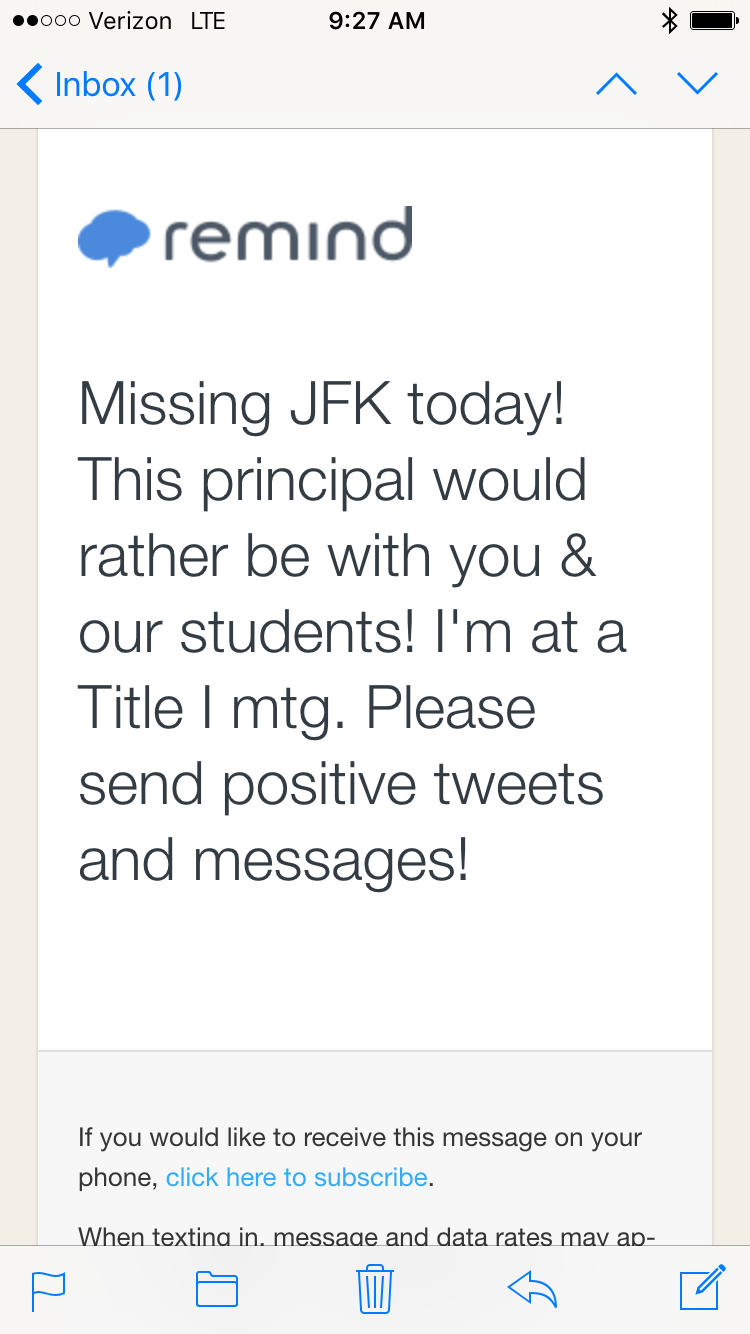
My mind was wandering to those moments during this meeting. Missing the joy of the schoolhouse, I reached for my phone and sent out this message to my staff via Remind:

IMG_2043 (1)

What followed was a cascade of positive tweets from an amazing team of #EduHeroes at John F. Kennedy High School. Although I was not physically present, I felt a sense of connection to the community—and this all started with a simple Remind message that all of our teachers at JFK received.

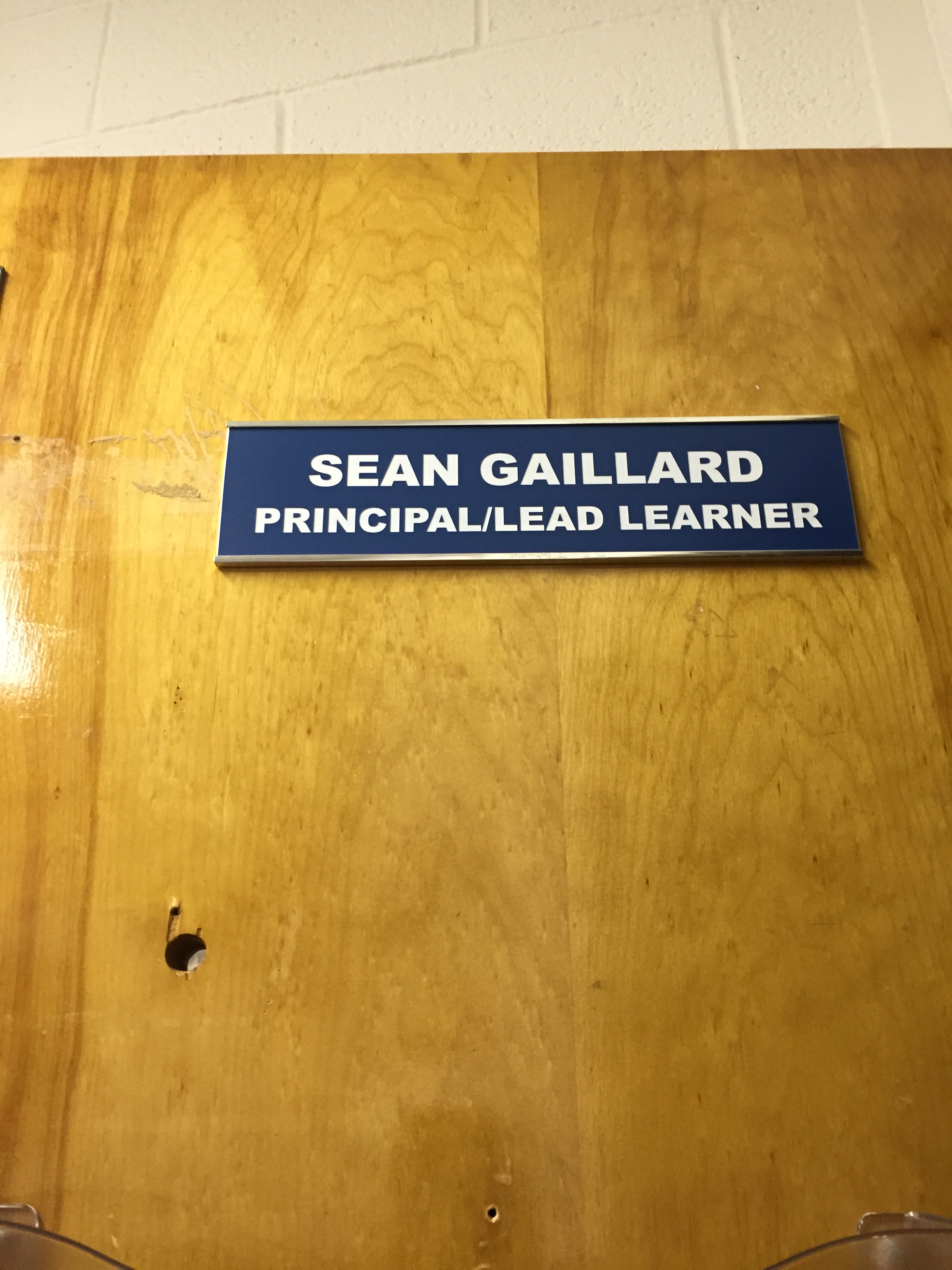
If you visit my office, you will be greeted by a doorplate with my name engraved along with my school role. Alongside the title of “Principal” is my true role: “Lead Learner.”

Lead Learner Door

It is my role to model, challenge, and encourage learning in the schoolhouse. That role demands for me to stay connected to the beat of the schoolhouse, even if being visible means moving beyond the wall of an office or meeting.

There are many tools that support the virtual connectivity we all need as educators, and Remind is one of the entry points that helps me stay connected and within the moment as a lead learner. I am grateful for the flexibility and ease Remind provides to support my efforts to stay connected with my school community. I am more grateful for the return Tweets I received showing the positive and meaningful things occurring in our school. For I am proud to be a small part of the inspiration happening for our kids at JFK. One simple text can be a game changer.