Here’s a thought to share from my reflection and writing this morning.
I hope you know that your sound matters and any band is lucky to have you. I sure do believe in you. Thanks for being in the band!
Here’s a thought to share from my reflection and writing this morning.
I hope you know that your sound matters and any band is lucky to have you. I sure do believe in you. Thanks for being in the band!
In an old comic book from my childhood, there’s a powerful image that has always stayed with me. It was an issue of Detective Comics that told the origin story of Batman. A young Bruce Wayne walks into Wayne Manor, ready to begin his hero’s journey. As he enters, his shadow stretches behind him—not as a boy, but as the full-formed silhouette of Batman. It was a simple panel, but it carried a profound truth: even in our earliest steps, the shadows of our future potential are already taking shape.
This image made me think about our calling as educators. Every day, we walk alongside students and teachers who are living their own origin stories. Some are just starting out, unsure of who they are or where they belong. Yet within them, we can glimpse the shadows of what they may become—leaders, artists, scientists, changemakers, or quiet heroes who make the world better in unseen ways.
This week is Teacher Appreciation Week, a moment to celebrate the educators who see those shadows before anyone else does. Teachers have a remarkable gift—a kind of superpower. They tune into the potential of their students and help them believe in it, even when the students can’t yet see it for themselves. Our teachers transform the impossible into the possible. They are not just instructors; they are cultivators of hope.
As school leaders, we are called to be architects of that hope. Our job is to build cultures where teachers are empowered to do their best work—where they can create the conditions for students to discover who they are meant to be.
I’ll never forget my fifth-grade teacher, Mrs. McMonagle. I was a new student, the only Black child in the class, adjusting to a new school in a new state. I felt lost—alienated, unsure, and afraid. But Mrs. McMonagle saw something in me that I couldn’t see in myself. She created a space where I felt seen and welcomed. She introduced me to the joy of writing, literature, and even encouraged my growing love for The Beatles. She pushed me, challenged me, and inspired me. I am forever grateful for the way she believed in me and gave me a sense of belonging.
Everyone carries the shadow of future potential. Teachers have a special sense for detecting those shadows and helping students realize the greatness within them. This week, and every week, let’s honor and celebrate that gift.
Here’s to the ones who chose to build trajectories of hope in our classrooms. Here’s to the ones who see the future before it arrives.

As I write this, I’m sitting with the weight of another school year nearing its close—reflective, grateful, and searching for meaning in the midst of it all.
I’ve been a principal for 16 years. I’ve poured myself into school after school, often the ones that needed the most care. I’ve stood on stages, been a finalist for NC Principal of the Year, written a book from my heart, and still—there are moments, like now, when I wonder if it’s all making a difference.
Maybe you’ve felt that too.
Lately, I’ve been thinking about The Beatles.
Specifically, August 29, 1966—their last public concert at Candlestick Park in San Francisco. They had reached a breaking point. They felt like they weren’t playing well. Between public backlash over John Lennon’s remarks about The Beatles being more popular Jesus Christ and diplomatic fallout in the Philippines from unintentionally snubbing the President and First Lady there, the pressures became too much. So they did something radical—they stepped back. No farewell tour. No grand finale. Just a quiet pause.
Each band member took time to rediscover who they were beyond the noise. John went to Spain to film How I Won the War. Paul collaborated with George Martin on a film score. George immersed himself in sitar studies with Ravi Shankar in India. Ringo stayed home to be with his family.
Then, something beautiful happened.
They returned—not to the stage, but to the studio. And from that retreat came a wave of brilliance: Strawberry Fields Forever, Penny Lane, Sgt. Pepper’s Lonely Hearts Club Band.
All of it began with a pause. A reset. A reclaiming of identity. A spark of innovation that changed the face of Music.
As leaders, we may not have world tours or screaming fans, but we do know what it feels like to carry the weight of expectations and the constant drumbeat of demands. In that rhythm, we can forget to care for ourselves in the same way we care for others.
We all crave connection. We all crave belonging.
And while we work so hard to create that for our teams, our students, and our communities—we must also remember to create it for ourselves.
Take the walk.
Play the record.
Write what’s on your heart.
Give yourself the same grace you offer to everyone else.
It’s easy to fall into the comparison trap—scrolling through highlight reels, seeing the accolades, the applause, the polished smiles. I’ve been there too. But the truth is, none of that defines your worth or your purpose.
Your worth is in the quiet moment with a student who needed someone to believe in them.
It’s in the coaching conversation that sparked a teacher’s growth.
It’s in the way you show up—consistently, compassionately, courageously.
You may not always see the impact. But it’s there.
If you’re at a crossroads, unsure of what’s next, or simply longing to feel grounded again, let this be your reminder:
Somewhere in the universe, someone believes in you completely.
Not for your title.
Not for your credentials.
But for who you are. For how you lead with heart. For how you care, even when it’s hard.
You matter.
Your leadership matters.
Your impact matters, and it will continue to do so in ways seen and unseen.
The other day, I found myself in pre-production mode for an ASCD Expert Webinar I’m co-facilitating with Dr. Andrea Trudeau. We were just moments away from going live—an exciting milestone in our partnership with ISTE-ASCD to explore the power of principal-librarian collaboration.
Despite having delivered keynotes, facilitated countless meetings, and never being one to run out of words, I felt a twinge of nervous energy. Andrea and I had carefully planned this series, designed to help principals and librarians cultivate belonging through meaningful partnerships. Still, the unknown had me teetering on the edge of speechlessness.
Then, as our “executive producer,” ISTE-ASCD Senior Manager for Community Engagement Margaret McGuinness, prepared to hit the button to go live, I centered myself in a simple truth and voiced the following: If we connect just one principal with one librarian, we’ve done our job. Andrea and Margaret nodded in agreement, and together, we stepped into uncharted territory. The webinar was a success and I believe both Andrea and I were able to help others build some bridges that day.
That’s the thing about belonging—it starts with a single step. A single connection. A single moment of shared purpose.
It’s easy to hesitate when stepping into something new. But what if The Beatles had given up when they played to an audience of just 18 people early in their career? Instead of letting the small crowd deter them, they leaned into the moment. They played their hearts out, laughed at the absurdity, and kept going. That spirit of persistence and joy shaped their journey—and, in turn, has inspired mine.
The same principle applies to leadership. Impact isn’t measured in likes, viral moments, or fleeting trends. It’s about connection. It’s about the quiet, intentional moves that build belonging—moves that ripple outward in ways we may never fully see.
I think of my fifth-grade teacher, Mrs. McMonagle, who saw something in me before I saw it in myself. With a single conversation, she opened my world to literature, art, critical thinking—and yes, The Beatles. That moment still echoes in my leadership today.
As school leaders, our role isn’t to chase the spotlight. It’s to cultivate an environment where every student, every teacher, and every staff member feels seen, heard, and valued. That kind of belonging isn’t built in grand gestures but in the everyday moments:
🎸 A handwritten note on a teacher’s desk reminding them that their work matters.
🎸 A lunchtime conversation with a student that shows them they belong.
🎸 A simple high-five in the hallway that lets someone know they are valued.
🎸 An intentional partnership that strengthens the fabric of a school community.
These small moves create big ripples.
That’s exactly what Andrea and I are exploring in our ongoing webinar series, The Power of Partnership: Enhancing School Success Through Principal and Librarian Collaboration. Through these 30-minute sessions, we’re diving into practical ways to align goals, foster communication, and leverage library resources to support student success. This journey will culminate at ISTELive 25 and ASCD Annual Conference 25 in San Antonio where we will present our work.
Let’s keep the conversation going. Join us, engage in the dialogue, and lean into the work that truly lasts.
Earlier this week, Beatles fans around the world commemorated the 56th anniversary of their final live performance—the legendary rooftop concert atop Apple Records. Captured in Get Back and memorialized in Let It Be, this moment was their live swan song, a testament to creative courage and collaboration.
Last week, I wrote about Rooftop Moments—the bold, defining moments that school leaders should cultivate with their teams. But there’s another, lesser-known moment in Beatles history that happened the day after that performance. A simple yet profound leadership move.
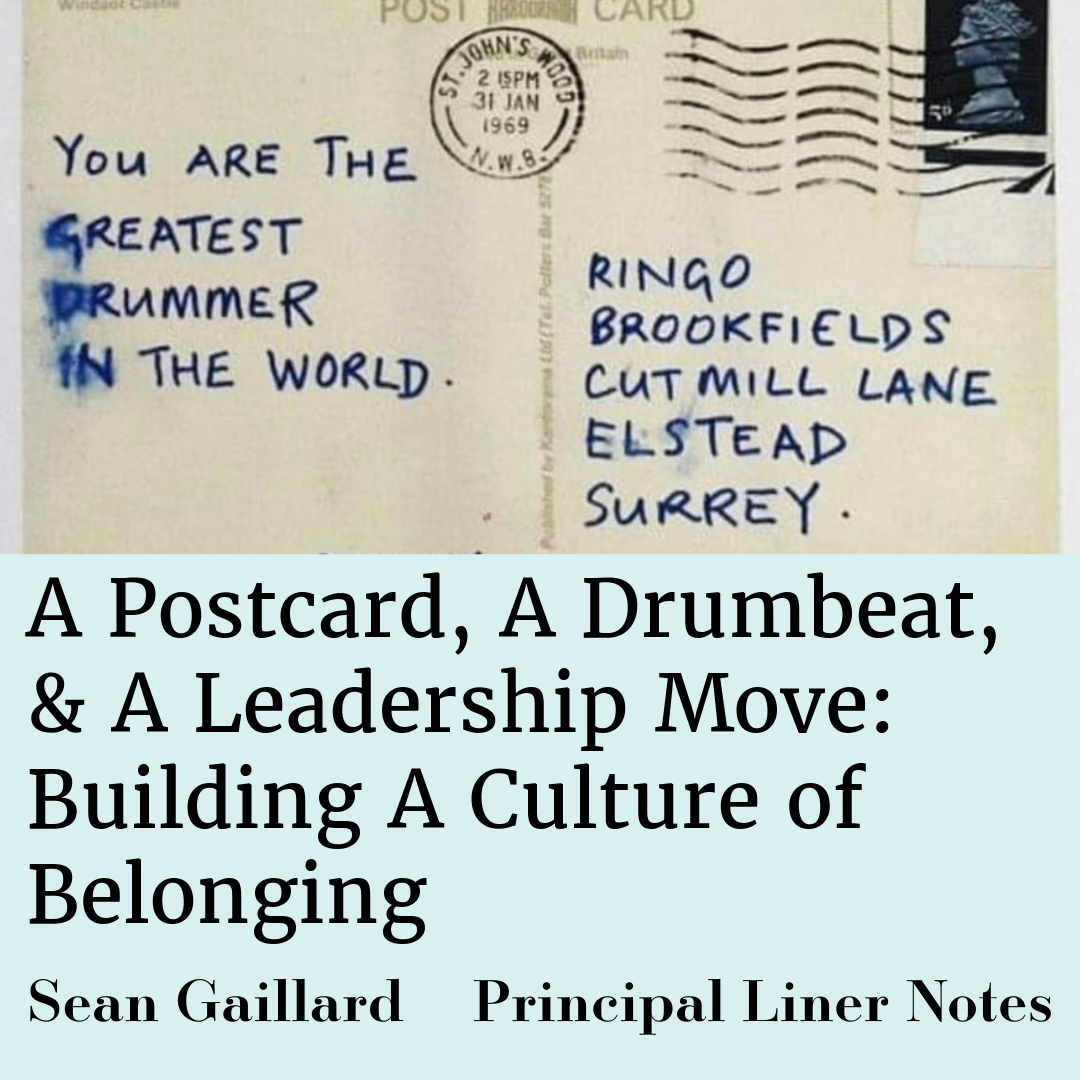
On January 31, 1969, Paul McCartney sent Ringo Starr a postcard that read:
“You are the greatest drummer in the world. Really.”
This wasn’t a public accolade or a grand gesture. It was a handwritten note—one musician reaching out to another, reinforcing connection and belonging. A small moment, but a significant one.
As school leaders, we talk about culture-building, trust, and recognition. Shoutouts in memos or emails are a start, but I’ve come to realize they often feel transactional, fleeting. Teachers deserve more than a quick mention in a newsletter that might be skimmed and forgotten. True belonging is built in the quiet, intentional moments—through handwritten notes and meaningful feedback.
At Charles England Elementary, we start each faculty meeting with Praise and Thanks—a time to share shoutouts and gratitude. It sets a positive tone and creates psychological safety. But not everyone feels comfortable speaking in a large group, and exhaustion can sometimes make participation hard.
At a recent meeting, I placed blank Energy Bus-themed notes (inspired by Jon Gordon’s book) on tables and asked staff to write a message of gratitude to a colleague. No prompts, no pressure—just a moment to reflect and uplift. As I looked around, I saw teachers smiling, some wiping away tears, completely immersed in the moment. The next day, those notes found their way into mailboxes, and the ripple effect of encouragement began.
A handwritten note isn’t just ink on paper—it’s a tangible reminder that someone sees you. That your work matters. That you belong.
Another way we are reinforcing belonging is through 30-second feedback, a practice inspired by Mike Rutherford’s Seven Tools for Developing Teachers and Teaching (link). This simple but powerful strategy involves stopping into a classroom, identifying one specific positive thing, and sharing that feedback—either verbally or in a quick note.
Here’s what makes it work:
I keep a pocketful of blank Post-its and make it a goal to visit at least three classrooms a day, leaving behind 30-second feedback. It’s transformed how teachers feel about their work. They light up, just like I imagine Ringo did when he read Paul’s postcard.
Think about the impact: just 90 seconds a day dedicated to 30-second feedback builds a culture where teachers feel seen, valued, and empowered. Multiply that over a school year, and you’ve created an environment where trust and belonging flourish.
As Meghan Lawson (link) reminds us in Legacy of Learning, these small wins shape the culture of a school. They’re the moments that keep teachers inspired and engaged.
56 years later, I’m still moved by a simple postcard between bandmates. It reminds me that leadership isn’t always about the big moves—it’s about the small, consistent moments of connection that build something lasting. Just like The Beatles, our legacy as educators is one of collaboration, impact, and belonging.
What’s your next leadership move? Maybe it’s as simple as writing a note.

Earlier this week, our country lost a remarkable leader in former President Jimmy Carter. The tributes that followed didn’t focus on grand speeches or flashy displays of power. Instead, they celebrated Carter’s unwavering faith, his steadfast dedication to community, and his lifelong commitment to making the world a better place for others. His leadership wasn’t about being the center of attention or staging photo-ops; it was about rolling up his sleeves and humbly serving those around him.
As educators, we must ask ourselves: What kind of leaders are we striving to be? Are we chasing the spotlight or building the light in others? For too long, I’ve seen school leaders drawn to performative leadership—the standing on tables, the viral stunts, the costumes designed for “likes” rather than lasting impact. While these acts may entertain for a moment, they often fail to empower others or build the foundation of belonging that our students, teachers, and families need.
Leadership isn’t about gimmicks or self-promotion. True leadership lies in tuning into the gifts of others and encouraging them to follow their unique paths. It’s about listening more than speaking, serving more than being served, and building a culture where everyone feels valued, seen, and capable of greatness.
Jimmy Carter once said, “We must adjust to changing times and still hold to unchanging principles.” His words remind us that the principles of humility, service, and community are timeless in leadership. Humble leadership is a quiet force that lifts others without fanfare. It builds cultures of belonging, not through stunts, but through consistency, care, and compassion.
For many years, my father instilled in me the idea that greatness comes not from being on a stage but from being in service to others. He taught me to dare to be great by encouraging others to step off the sidelines and into their potential. As leaders, it’s our calling to help others “kick off the bench” and take those daring steps toward their own greatness.
Four Leadership Moves to Build a Culture of Belonging with Humility
1. Listen With Purpose
Create opportunities to listen to the voices of students, teachers, and families. Regularly ask, “What do you need?” or “How can I support you?” and act on what you hear. Listening isn’t just hearing—it’s responding with action and intention.
2. Celebrate Others’ Gifts
Leadership isn’t about being the hero of every story. Shine the spotlight on your team. Recognize the unique talents and achievements of those you serve. Build platforms where others can share their brilliance.
3. Serve Quietly and Consistently
Leadership is often found in the small, unseen moments. Show up early to greet students. Pitch in during tough times without announcing it. Let your actions speak louder than your words.
4. Model Humility in Every Interaction
Humility isn’t weakness; it’s strength in understanding that leadership is about others, not ourselves. Admit mistakes, ask for feedback, and be willing to learn alongside your team.
Let us step away from the noise of performative leadership and into the quiet power of service. Leadership isn’t standing on a table or staging antics that distract from our core mission. It’s about humbly helping others discover their greatness.
As I reflect on Jimmy Carter’s legacy and the lessons my father taught me, I’m reminded of the simple truth: Leadership is not about being in the spotlight—it’s about igniting the light in others. Dare to be great by building a culture where everyone belongs and is empowered to lead.
Let’s get to work, sleeves rolled up, hearts full of humility, and hands ready to serve.

Earlier this week, the world marked a somber anniversary—44 years since the tragic loss of John Lennon. For me, this day always stirs vivid memories. It was around this time that I first discovered The Beatles, embarking on a journey into a world of creativity, harmony, and collaboration that continues to shape my life and career. The Beatles have left an indelible mark on me, not only as a fan of their groundbreaking music but as someone who sees their legacy as a model for leadership, culture, and collaboration.
The Beatles’ story offers profound lessons for educators and leaders. Their journey is a testament to excellence, creativity, and innovation—qualities we all strive to cultivate in our schools and organizations. By nature, I am a storyteller, and I’ve always believed in the power of stories to build connections, foster belonging, and create psychological safety. In my years as a teacher and principal, I often found myself drawing comparisons to The Beatles, using their journey as a metaphor for teamwork and innovation. While I don’t expect everyone to love The Beatles as much as I do, I believe in sharing our passions as leaders. It’s a vehicle for hope, and education is a field that thrives on hope in abundance.
The Beatles didn’t invent creativity or collaboration, but they redefined it. They reinvented music, setting a standard for excellence that still resonates today. Imagine if we embraced their mindset in education—pushing boundaries, seeking new ideas, and innovating for the betterment of our students and communities. Steve Jobs, the visionary behind Apple, once credited The Beatles as his model for innovation and teamwork. He admired how the band’s chemistry and ability to balance each other’s strengths led to extraordinary accomplishments. Whether or not you’re a Beatles fan, every leader can appreciate the value of fostering a culture of excellence and innovation.
Next semester, I have the privilege of teaching a course on The Beatles at High Point University. It’s an opportunity to delve deeper into the band’s cultural impact and explore how their music and legacy continue to influence the world. Preparing for this course has inspired me to think about how The Beatles’ story resonates with others. Their music, recorded over a mere seven years, remains a staple on playlists and soundtracks across generations. The enduring relevance of their work speaks to their unparalleled ability to connect with people on a human level.
This reflection has also inspired the launch of my new podcast, Why The Beatles Matter, debuting December 12. Through this podcast, I aim to explore the band’s profound impact and why their music and legacy still matter today. I’m eager to hear and share stories from others who have been touched by The Beatles—whether as fans, creatives, or leaders. This podcast is a space to celebrate their influence and to discuss how their spirit of innovation and collaboration can inspire us in our own lives and work. I invite you to join the conversation by using the hashtag #WhyTheBeatlesMatter and share on the social media channel of your choice. Let’s connect, share, and celebrate the stories that bind us together.
As some of you may know, I am the author of The Pepper Effect, a book that explores how The Beatles’ timeless lessons can inspire creativity and collaboration in schools. If you’re interested, you can order a copy on Amazon. I hope the book serves as another bridge for connection and inspiration.
The Beatles matter because they remind us that we matter. They show us that we all have gifts to share, ideas to spark, and the potential to create something extraordinary. As we reflect on their legacy, let’s take a page from their story and embrace our own potential to innovate, collaborate, and make a lasting impact. I hope you’ll tune in to the podcast, join the conversation, and, together, let’s discover why The Beatles truly matter.

As many of my close friends and family know, I am a nervous flyer. Over the years, I have had to face this fear head-on, seeking the support of a therapist and using strategies, including medication, to overcome the challenges of flying. While it hasn’t been easy, I’m proud of my ongoing efforts to confront this fear.
Flying isn’t something I do often—time and expense tend to be barriers—but recently, I had the opportunity to attend the National Education Leaders Workshop in Atlanta. It was an incredible event, full of ideas on reimagining teaching and learning in the schoolhouse. To experience it, though, I had to book a flight.
Before the trip, I reviewed my strategies with my therapist and felt optimistic. For the first time in a long while, I didn’t feel that familiar pit of anxiety in my stomach as I prepared for the flight. Instead, I felt calm anticipation.
As I sat at the gate with my colleagues, I began to notice small, powerful moments unfolding around me. At one point, a pilot walked out—likely heading for a quick coffee—and spotted two young boys playing with a toy plane. He knelt down to greet them warmly, telling them how excited he was to have them on his flight. Then, he invited them and their parents to visit the cockpit before takeoff. Later, as I boarded, the gate agent greeted each passenger—including me—by name. Touched by her effort, I made sure to thank her personally, using her name from her nametag.
These intentional acts of connection helped dissolve any lingering nervousness I had about the flight. They also served as a powerful reminder of the importance of small, meaningful gestures in leadership. Witnessing those moments inspired me to think about how such intentional actions could foster trust and belonging in the schoolhouse, reaffirming my commitment to creating a culture of connection in our community. The flight itself was smooth, and I even shared a lighthearted exchange with the pilot, who joked about our shared baldness. These small yet meaningful moments reminded me of a recent book I read, Unreasonable Hospitality by Will Guidara. It’s a must-read for leaders who want to create cultures of connection and build meaningful moments within their organizations. Check out the book here.
Delta Airlines demonstrated a commitment to humanity and empathy during that flight, and it left a profound impact on me. Their intentional gestures—from personalized greetings to creating special moments for passengers—highlight the power of thoughtful actions. As a school leader, this translates to practices like ensuring every student and teacher feels personally welcomed, celebrating achievements in visible ways, and creating opportunities for connection that make each person feel valued and supported. Their thoughtful gestures weren’t just routine—they were intentional, and they made me feel seen and valued. As a school leader, this experience reinforced my belief in the power of small yet meaningful actions to create a culture of connection in the schoolhouse.
The Delta crew had no idea I struggled with flight anxiety, but their thoughtful actions created an environment where I felt safe and at ease. Similarly, in our schools, we may not always know the struggles our students, teachers, families, and staff carry with them each day. It is our responsibility to create an atmosphere of psychological safety—a place where everyone feels supported and valued.
Each act of connection, no matter how small, sends a powerful message: “You matter. We’re glad you’re here.” When we lead with hope and belief, we create ripples of positivity that can transform our schoolhouse communities. Let’s commit to making these moments a daily practice, knowing that our words and actions have the power to uplift, inspire, and connect.
Leadership can feel like navigating the swirling chaos of a live performance—where the screams of the crowd threaten to drown out your rhythm. As school leaders, it’s easy to get lost in the noise, but it’s in these moments that we must tune into those around us. The people we lead and serve are our rhythm section, and finding the right “beat support” can make all the difference.
I’ve been reflecting on this idea recently, inspired by a moment I once shared on my podcast, #PrincipalLinerNotes. Years ago, during one of my “Impromptu Carpool Episodes,” I recorded an off-the-cuff reflection about a clip of The Beatles performing “I Feel Fine” live. Amidst the chaos of Beatlemania—where stage monitors were nonexistent and screaming fans drowned out everything—Paul McCartney stepped in with a move of pure leadership. During Ringo Starr’s incredible drum break, Paul gave a quick cue, counting Ringo back in and ensuring he nailed his return to the beat.
That moment wasn’t just about music; it was a masterclass in leadership. It demonstrated the importance of being attuned to your team, providing support when they need it, and ensuring that everyone finds their rhythm.
The Rhythm of Belonging
I explored this connection between The Beatles, leadership, and education in my book, The Pepper Effect. In it, I share lessons from the Fab Four that remind us of the power of collaboration, creativity, and connection. (You can check out the book here! The Pepper Effect on Amazon).
One of the most important lessons from both The Beatles and leadership is the role of belonging. As leaders, we need to provide the cues and support that allow our team to thrive. Whether it’s a trusted teacher who serves as your barometer or the intentional moments where you help others find their groove, belonging starts with building connections.
Four Ways Leaders Can Build Beat Support
Here are four actionable ways leaders can create their own “beat support” and foster belonging:
1. Find Your Barometer
Identify someone you trust—someone who will be honest with you—and use them as a gauge to understand how your decisions and words land with your team.
2. Be a Barometer for Others
Provide clear and supportive cues for your team. Let them know where they stand and help them feel confident in their role.
3. Celebrate Strengths
Like Paul recognizing Ringo’s brilliance, tune into the unique gifts of your team members and amplify their contributions.
4. Create Collaborative Spaces
Build opportunities for your team to share ideas, support each other, and work toward common goals. Belonging grows in the spaces where collaboration thrives.
What’s Next: Why The Beatles Matter
This reflection on leadership, belonging, and The Beatles has inspired me to launch a new podcast called “Why The Beatles Matter,”starting December 12. This podcast will explore the lasting impact of The Beatles and their legacy through conversations with people whose lives have been shaped by their music and message.
I’m looking for future guests to share their stories of how The Beatles inspired them. If you’d like to join me on this journey, email me at sgaillard84@gmail.com. Spaces are filling up fast.

The principalship is a calling steeped in paradox. It is a role of service, yet it can often feel isolating. As leaders, we navigate the balance of vision and strategy while seeking connection and collaboration. We crave the kind of creative partnership that defined the great songwriting duos—like Lennon and McCartney, Ann and Nancy Wilson, or Stevie Nicks and Christine McVie. These partnerships thrived on synergy, mutual respect, and a shared goal of creating something timeless.
For me, The Beatles’ creative dynamic has always been a source of inspiration. I’ve long yearned to be the Lennon to someone’s McCartney or the McCartney to someone’s Lennon, building something extraordinary with a thought partner. That kind of collaboration can feel like a salve for the loneliness that sometimes accompanies leadership. But as I reflected the other day, I realized I might not be destined to be part of the duo. My role is to ensure the conditions are right for these partnerships to thrive.
This epiphany came as I watched two teachers collaborate on a shared vision for our school’s culture. They were bouncing ideas off one another, refining strategies, and creating something beautiful in the process. In that moment, I realized: they were Lennon and McCartney. My role wasn’t to join their duo but to ensure they had the space, encouragement, and support to succeed.
George Martin, reflecting on his work with Lennon and McCartney, once said: “My job was to make it easier for them to express themselves and to capture that in the best way possible.” That wisdom resonates deeply with me as a principal. Leaders must recognize that collaboration is not about claiming the spotlight but about amplifying the voices of others. It’s about creating the conditions where creativity and synergy can flourish.
Every school faculty has the potential to be a great collaborative band like The Beatles. The role of the leader is to help that band find its rhythm and create its best work. This realization brought both clarity and peace. I may not be in the band, but I can help the band I serve become something extraordinary—a group defined by its collaboration, creativity, and profound impact.
Leaders must tune into these moments and reflect on the ways we cultivate collaboration in our schools. It’s not always about being part of the duo or the band. Sometimes, the most meaningful contribution is ensuring the band can play its best.
Four Ways Leaders Can Foster a Culture of Collaboration
1. Create a Shared Vision
Collaboration thrives when everyone rallies around a common goal. Build a vision that is clear, compelling, and rooted in the needs of your school community. Like Will Guidara’s team in Unreasonable Hospitality, bring people together to align their work with a shared purpose.
2. Honor and Empower Partnerships
Seek out and celebrate the Lennon-and-McCartney-like duos in your building. Create opportunities for those partnerships to deepen, whether through shared leadership roles, co-teaching models, or collaborative projects.
3. Provide Tools and Time
Collaboration doesn’t happen by chance; it requires intentional structures. Build time into schedules for teams to meet, reflect, and create together. Provide resources—whether it’s professional learning, materials, or guidance—that remove barriers to teamwork.
4. Reflect, Celebrate, and Elevate
Regularly highlight collaborative wins, both big and small. Reflection helps us learn and grow, while celebration fuels the energy to keep creating. Whether through shout-outs in staff meetings or sharing stories in a blog post, elevate those moments where synergy shines.
The bands we serve have the potential to be like The Beatles, and with thoughtful leadership, it can become a force for something extraordinary. And at the heart of it all is the belief that collaboration is the foundation of every masterpiece.
Let’s help our schools find their rhythm, their harmony, and their shared purpose. Together, we can lead the band and inspire greatness for the kids we serve.
 Leadership Liner Notes: Sean Gaillard