Hope On: Cultivating a Culture of Possibility in the Schoolhouse

I’m an unabashed fan of the television series The Bear. I’ve breezed through all three seasons, savoring the beautiful portrayal of a group of people coming together around a shared vision to make the impossible possible. The story of a humble sandwich shop transforming into a fine dining restaurant, with aspirations of becoming the world’s greatest, is nothing short of inspiring.

Without giving away spoilers for those who haven’t seen the latest season, I want to share a brief scene that recently came up in a conversation with Meghan Lawson while preparing for our new podcast, Hope Amplified. It’s no secret that Meghan and I admire the show, having discussed it at length on my other podcast, #PrincipalLinerNotes.

Talking with Meghan is always a meaningful and uplifting experience, and I’m eagerly anticipating our upcoming discussions on the art and science of hope in a new podcast we are co-creating called Hope Amplified. As we were mapping out our inaugural episode, we both recalled a powerful scene from the Season 3 finale of The Bear.

In the scene, the chefs and restaurant staff gather for an impromptu afterparty, marking the bittersweet closure of a renowned restaurant. The head chef—celebrated worldwide for her culinary brilliance—decides to prepare a midnight snack for the guests. The host, a rising chef, hesitates when the famous chef finds only a few modest ingredients, including a frozen pizza. Yet, the renowned chef isn’t deterred. With creativity and mastery, she transforms those humble ingredients into something extraordinary. It’s a moment worth watching, as she turns a frozen pizza into a culinary delight.

As we reflected on this scene, we saw it as a fitting emblem for hope. The show itself is a deep, reflective series filled with life-affirming moments of perseverance, collaboration, and innovation. In Hope Rising by Casey Gwinn and Chan Hellman, hope is defined as the belief that the future can be better than the present, combined with the understanding that we have the power to make it so.

Educators strive to embody this belief every day. Even with limited resources, they create transformative experiences in the classroom. I think of the teachers I have the privilege to support as principal at Charles England Elementary, who cultivate hope daily, opening new possibilities for our students. I’m reminded of my 5th-grade teacher, Mrs. McMonagle, who saw something in me—a young, awkward, light-skinned African American boy—that I didn’t always see in myself. She revealed the possibilities within the written word and storytelling. I also think of my first teachers, my parents, who taught me to dream big, walk with purpose, and hold my head high.

Teachers need many things, but at the core is the hope that they can make a difference in the lives of children. It’s the leader’s role to ignite that hope by fostering a sense of belonging, trust, and open communication. Leaders must call out hope and passionately embrace the possibilities it brings. It’s not just a sentiment but an essential, strategic action.

I’m thrilled to dive deeper into the art and science of hope in upcoming episodes of Hope Amplified with Meghan. Some may argue that hope is not a strategy for leaders to depend on. While I understand that perspective, I disagree. Hope isn’t merely a strategy; it’s a must. It’s an essential thread in the daily fabric of our schools, shaping the lives of those we serve. Without hope, we have nothing. With it, we have purpose, potential, and the catalyst for meaningful change. Don’t let anyone deprive you of that spark. Hope on.

Stay tuned for the debut of Hope Amplified, launching November 2nd. Meghan and I invite you to join the conversation and share your thoughts on hope using the hashtag #HopeAmplified. Here are three small moves for leaders to inspire hope in your school:

  1. Impromptu Restorative Circle: Gather colleagues and teachers for an informal circle to share what gives them hope.
  2. Hope in Action Bulletin Board: Showcase experiences from your school where hope is making a difference.
  3. Hope Playlist: Curate a playlist of songs that inspire hope and share it with your faculty.

Let’s continue amplifying hope together. #HopeAmplified

Why Not Hope?-Embracing Possibility in Leadership


The Dreamer’s Dilemma
Facing Skepticism with Vision

The other day, I found myself discussing a bold, ambitious goal with colleagues. While I was met with polite nods, I sensed hesitation. When I asked if I needed to clarify my vision, they shared that while they appreciated the dream, they believed the realities of our situation—budget constraints, time limits, and logistical barriers—would prevent it from becoming a reality.

I listened and expressed gratitude for their feedback. However, I countered that if we let impossibilities win, we’ll never achieve anything. It’s easy to accept limitations as inevitable, but when we allow that mindset to dominate, progress halts. Dreaming big requires not just vision but also the courage to challenge reality with hope.


Meeting Others Where They Are
Small Moves, Big Impact

I know dreaming big can be daunting for others. Fear, grounded in past experiences, often holds us back from stepping into uncharted territory. I must remind myself not to judge the fears of others but to empower them. Together, we can take small steps to bring the dream closer to reality.

This idea echoes the work of my friend and thought partner Meghan Lawson, whose book, Legacy of Learning: Teaching for Lasting Impact, explores the concept of “small moves.” She shows how incremental progress can sustain dreams and turn them into dynamic action that benefits everyone.


The Power of Hope
Why Leaders Must Defy Cynicism

In a recent episode of my Principal Liner Notes Podcast, I had the pleasure of speaking with Meghan Lawson for the fourth time. As always, her insights were illuminating. This time, she shared her research on the Science of Hope, a framework that fascinated me. Meghan framed hope not as a passive emotion but as a viable tool for creating change.

Too often, leaders dismiss hope, branding it as ineffective. We’ve all heard the phrase, “Hope is not a strategy.” But when did we decide that embracing hope meant abandoning strategy? Hope can be the catalyst that ignites action. It’s the foundation we need to build dynamic, transformative strategies that work.

Just think—what if John F. Kennedy hadn’t embraced hope when he delivered his famous “We Choose to Go to the Moon” speech? Without hope, there would be no Moon landing, no template for Moonshot Thinking. The impossible only became possible because someone dared to hope and challenged others to do the same.


A Beatles Lesson in Hope
Staying True to Vision

The Beatles’ classic song “Hey Jude” offers another powerful lesson in hope. When they first recorded the song, some in the music industry said it was too long at over seven minutes. Radio stations wouldn’t play it, they warned. But John Lennon famously replied, “They will if it’s us.”

And he was right. Hey Jude went on to sell over 8 million copies after its initial release and stayed at #1 on the Billboard Hot 100 chart for nine weeks. To this day, it’s been streamed over 1.5 billion times on Spotify.

The Beatles operated with hope by trusting their vision and defying the limitations imposed by industry norms. That hope led to the creation of a timeless song that still resonates today.


The Call for Hope in Education
Leading with Vision and Possibility

As school leaders, we carry enormous responsibility. Many look to us for solutions, quick fixes, and results. The pressure to meet objectives can make it tempting to dismiss hope as impractical or naive. But I believe hope is exactly what we need.

There will always be pushback—colleagues may talk about you in the parking lot, claiming you’re chasing windmills. But there’s someone in your building who needs to hear a voice rooted in hope. Remember those who saw something in you, believed in you, and called out your potential. They didn’t see you as you were; they saw you as you could be—and that’s the power of hope.

Just as JFK’s words on a Houston day in September ignited a nation to reach the Moon, we, too, can challenge our teams to strive for the stars. Think of the teacher who believed in you and stretched your learning into unknown territory, simply because they had hope.

As Martin Luther King, Jr. shares, “We must accept finite disappointment, but never lose infinite hope.” Hope is lasting, enduring, and impactful. We need Hope in the marrow of our culture and the cadence of our dialogue. We need to illuminate a compass of Hope on the teachers and students we serve.

Yes, why not hope?


Four Action Steps to Build a Culture of Hope
Transforming Leadership with Vision

  1. Research the Science of Hope
    Leverage resources on hope to ground your leadership approach in actionable, evidence-based strategies that inspire change.
  2. Start with Small Moves
    Build momentum by taking small, consistent steps toward your larger vision. Focus on small wins that create a ripple effect in your organization. Meghan Lawson writes about this in her amazing book, Legacy of Learning.
  3. Lead with Vision, Not Fear
    Acknowledge the realities, but don’t let them stifle your vision. Inspire your team to look beyond limitations and into possibilities.
  4. Amplify Success Stories
    Celebrate the achievements—both big and small—of your team and students. When others see what’s possible, they’re more likely to believe in and contribute to the bigger vision. Curate those stories using a school hashtag and creating a list with either Padlet, Canva, or Wakelet.

Hope is not just a lofty ideal; it’s the engine that powers real change. Let it be the guide that drives your leadership and inspires others to dream bigger.


Enjoy The Beatles performance of “Hey Jude.”

Belonging in the Library: A Hub of Connection and Inspiration

The Library as a Space for Everyone to Feel Seen, Heard, and Valued

As most of you know, I am an unabashed fan of The Beatles. Their music is woven into the very marrow of my being, serving as a source of solace, inspiration, and action. I’ve written extensively about John, Paul, George, and Ringo in this blog and in my book, The Pepper Effect. Even in my podcast episodes, you’ll hear some nod or reference to the band that has shaped my life. I can recite popular lyrics and arcane trivia with ease. It’s more than a hobby—it’s a part of who I am.

Many in my family and close circle have gracefully put up with my unwavering devotion. From the pleasantries exchanged when I make a Beatles reference to the polite nods when I wear a Beatles tie or hum their tunes, I sense the subtle “here he goes again” energy. And yet, no matter the reaction, I remain steadfast. The Beatles changed my life, and I carry that passion into my work as an educator and leader.

Dimming the Light of Passion

In recent years, I’ve toned down my Beatles references in professional spaces. While I haven’t abandoned my collection of Beatles memorabilia in my office, I’ve grown more selective about sharing my passion. This was a conscious decision. I didn’t want to overwhelm others or make them feel as if they had to endure trivial scraps from my world of Beatlemania. Yet, in doing so, I realized that sometimes, I was dimming a part of myself.

Last year, when the final Beatles song, “Now and Then,” was released, it was a bittersweet moment. The song brought together Paul McCartney, George Harrison, Ringo Starr, and the voice and piano of John Lennon from a 1977 demo. The emotional weight of this digital reunion with bandmates no longer here hit me deeply. But when the song was released in the middle of a busy school day, I found myself alone in my excitement. I ducked into the bathroom, put my headphones in, and listened quietly on my iPhone—just me and my music.

Looking back, I see the sadness in that moment. There was no one to share it with upon initial release. No one to celebrate with me upon its first debut. I had dimmed my own light so much that I didn’t even give myself permission to invite others in. It was a small act of joy—listening to a new Beatles song—but it’s one I wish I hadn’t done alone.

Finding Belonging in the Library

Just a week later, I found myself in the Media Center. The library is, and always has been, my favorite space in any schoolhouse. As a former high school English teacher and avid reader, I find the library to be a place of refuge, community, and peace. It’s where stories live, where curiosity is nurtured, and where connections are made.

On that particular day, the video for “Now and Then” was being released, and I was eager to watch it. I was preparing to find a quiet corner to view it on my own, but I hesitated. This time, I made a different choice. The school librarian and a retired librarian volunteering at our school were working nearby. I invited them to watch the video with me.

What happened next was a beautiful moment of shared connection. These two remarkable individuals, both so gracious and supportive, joined me in watching the video. Their interest and kind words made me feel seen, valued, and understood. It was a small act, but it reminded me of the power of belonging.

That sense of belonging, of feeling included and appreciated, is at the heart of what school librarians do. They create spaces where students, staff, and even leaders like myself can feel at home. I think back to a conversation I had with Andrea Trudeau, an inspiring school librarian, on my #PrincipalLinerNotes Podcast. Andrea has built a Learning Commons where belonging is central, and that resonates deeply with me.

The Library as a Hub of Belonging

Libraries are more than just repositories of books. They are the heartbeat of the school, a hub for connection, innovation, and, most importantly, belonging. It’s where students find refuge and where ideas take flight. The library is a space for everyone.

As principals, it’s essential that we recognize the power of the library and the invaluable role of the school librarian. Whether it’s through innovation or simply helping a student find their next favorite book, librarians are collaborators in the creation of spaces where all students can belong.

A few weeks ago, I had the chance to meet with the librarian at my new school. As we coordinated our schedules, I suggested we name our meeting something memorable. After some playful banter, I had the perfect idea. “All You Need Is The Library,” I said, drawing a smile from both of us as we savored the Beatles reference. It was a simple, joyful moment—one that reminded me of the connection between passion, collaboration, and belonging.

Four Ways Principals Can Collaborate with School Librarians

  1. Host Collaborative Meetings: Make time for regular check-ins with your librarian to brainstorm ways to integrate the library into school-wide goals.
  2. Create Library-Focused Events: Partner with your librarian to host events that bring the school community together, such as family reading nights or author visits.
  3. Support Literacy Initiatives: Encourage staff and students to utilize the library for research, reading, and inquiry-based learning by promoting library programs and resources.
  4. Celebrate Successes Together: Acknowledge the work of your librarian in school communications and meetings, highlighting the critical role they play in fostering belonging and academic success.

The Value of Embracing Square One

Simplicity in Jazz:

In 1969, during the recording of his groundbreaking album In a Silent Way, Miles Davis famously told guitarist John McLaughlin to “play the guitar like you’re picking it up for the first time.” McLaughlin, renowned for his complex, intricate solos, was likely perplexed by this direction. Jazz, after all, is a swirl of notes, harmonies, and complexities—a musical enigma. But Miles was after something else, something new. He envisioned a sound that was simple yet profound, stripped down to its core. He wanted his band to create a fresh ambience, to tap into a deeper, purer musical experience.

This wasn’t just any jazz album. It was a collaborative effort with musicians who, for many of them, were playing together for the first time. Miles led them to embrace simplicity, allowing space for discovery. The result? An album that, decades later, still influences and inspires musicians worldwide. It stands as a testament to the power of stepping into something new with fresh eyes and an open heart.

Back to School:

For school leaders, the phrase “Back to School” stirs a similar mix of emotions: joy, anticipation, maybe even a little fear. It’s the beginning of something new, a reset button. For some, this is a welcome opportunity; for others, it can be daunting, especially for those stepping into a new school or leadership role. But there’s immense value in embracing these new beginnings, or what I call “Square One.”

Square One offers the chance to rewrite, renew, and refocus. Whether you’re a brand-new principal or a seasoned leader in a new building, starting over can feel like walking into a conversation where everyone else is already laughing at an inside joke. You may not yet be in on it, but there’s an opportunity to listen, connect, and contribute. Building trust, creating relationships, and setting the tone for a collaborative culture takes time and effort—but it’s well worth it.

As a turnaround principal, I’ve lived through this over and over. Every school, every new beginning, felt like standing at the edge of something vast and uncertain. But I’ve learned that there’s beauty in Square One. It’s where connection is made, where trust is earned, and where growth is inevitable if you lean into the discomfort.

Embracing Square One:

I used to dread the awkwardness of starting fresh. It felt like a weird dance where I would stumble more than glide. But with time, I realized that Square One isn’t something to fear. It’s a unique opportunity. In Square One, you get to build from the ground up, to create a vision, and invite others to join in shaping something beautiful for your school community. This is where you can set the stage for a culture of psychological safety, where teachers and staff feel seen, heard, and valued.

As leaders, we can choose to embrace Square One not as a setback, but as a launchpad. We get to set the tone for our schools, encouraging collaboration and creativity in ways that may not have been possible before. When we invite others to see their strengths, both tapped and untapped, we unleash the power of collective potential. It’s like that band Miles Davis assembled for In a Silent Way—everyone playing together for the first time, discovering new possibilities.

Leadership Moves to Embrace Square One:

  1. Assess the Current Reality: Work with a coach, mentor, or thought partner to clearly identify where your Square One stands. What are the challenges, and where are the opportunities?
  2. Connect with Your Community: Engage with your staff, students, and families. Share the vision for this new beginning and the path forward. Build excitement around what’s possible.
  3. Create a Roadmap: Develop a timeline with actionable next steps. Break down your vision into tangible goals. This will give you and your team a clear sense of direction.
  4. Reflect Regularly: Take time each day to journal and reflect on the progress being made. These reflections will guide future decisions and help keep you grounded in your purpose.
  5. Celebrate Wins: Don’t wait for the big milestones. Celebrate small wins along the way, and do it publicly. Acknowledging progress builds momentum and fosters a positive culture.

Conclusion:

Just as Miles Davis sought a deeper sound by stripping away the complexity, we, as school leaders, can find clarity and strength in the simplicity of Square One. Embracing the beginning allows us to reset, reimagine, and reframe the possibilities for our school communities. As we step into new roles or new school years, let’s lead with intention, vulnerability, and an openness to collaboration. The beauty of Square One lies not in its uncertainty, but in its promise. Like Miles and his band on In a Silent Way, we have the opportunity to create something timeless by being fully present in the moment.

Listen to Miles Davis’ In a Silent Way here.

Every Principal Needs a Thought Partner

What They Don’t Teach You in Principal School

There are many lessons learned in the proverbial “Principal School.” I am grateful for my graduate courses in school administration. But as I near year 17 as an administrator, I reflect on those lessons that weren’t taught in class but were learned on the job and in the moment.

One of the most significant lessons I had to learn on the job is this:

Leadership can be a lonely gig.

Let that sentence sink in. As a school principal, I’ve been blessed with countless experiences where I’ve served others and had the opportunity to make a positive impact. The days filled with fist pumps, laughter at my corny jokes, beautiful moments where a student discovers the joy of learning, or when a teacher steps into a teachable moment and ignites a synergy of learning—those moments are inspiring and reassuring. Yet, there are also days when tough decisions must be made, and you’re met with resistance. The stress of leading change can be intense, especially when met with hesitation. There’s an aura of isolation that can follow the principal because you’re the lone person with that title in the schoolhouse.

I often reflect on John Fogerty’s story about performing with Creedence Clearwater Revival at Woodstock. Their late-night set followed the Grateful Dead, and much of the audience had fallen asleep. Fogerty shared how disconnected they felt from the crowd until one audience member yelled out, “Don’t worry, John, we’re with you.” Those words compelled Fogerty to play harder and persevere. In many ways, the principalship mirrors this experience. We often lead schools against the grain of the status quo, pushing forward even when we feel isolated. But just like CCR did at Woodstock, we find our groove and keep playing, leveraging good things for others.

You Are Not Alone

There are many ways principals sustain their leadership purpose. We read, attend conferences, pursue camaraderie with other school leaders, hit the gym, and connect with families. These activities are essential to maintaining our well-being as leaders. But perhaps one of the most crucial aspects of our roles is maintaining connection and rapport. Due to the intense nature of our position, isolation can creep in, making it vital for us to find our own “band” within the school—a leadership team, instructional leadership team, or PLC. This collaborative cohort within the building is essential for battling isolation.

Every principal needs a thought partner. In a recent discussion on my #PrincipalLinerNotes podcast, I had the joy of talking with School Librarian Extraordinaire, Andrea Trudeau. We discussed the unique partnership between a principal and a school librarian. Both roles often stand alone in the schoolhouse, making intentional collaboration necessary. This conversation enlarged my thinking on the essential nature of thought partnership. A principal needs someone to share ideas with, dream big with, and sometimes pull them back down to earth. A thought partner can help battle isolation and serve as a bridge for collaborative camaraderie—a reminder that you’re not the only one.

Epiphanies in the PLN

As a connected educator, I take great care to nurture my Professional Learning Network (PLN). I work to forge connections for collaboration and learning with other educators and school leaders. It’s one way I combat the isolation that can accompany the principalship. Finding kindred spirits in my PLN is invaluable; I can connect with digital thought partners who trade ideas and share resources. I also appreciate the outreach I can maintain by sharing content through my podcast and blog.

However, the other day, I faced a moment of doubt when something in my PLN caused disappointment. I considered pausing my writing and podcasting, feeling irrelevant and as if I were shouting into an echo chamber. As I lamented this with a friend, they reassured me and provided inspirational context, lifting my spirits. What sealed the deal was a brief message from someone in my PLN, expressing gratitude and support for a recent podcast episode. This reminded me that just as I need thought partners, others rely on me to be theirs. Thought partnership is a mutual exchange of ideas, rapport, and support.

It was a timely reminder to continue writing and podcasting and an essential signpost for my “why” as a leader and principal. While it’s wonderful to connect with kindred voices in the PLN, it’s equally important to remember the impact we can have on others.

Three Actionable Ideas for Principals to Connect with Thought Partners:

  1. Cultivate a Leadership Team within Your School: Identify and nurture a group of trusted colleagues who can serve as your sounding board and thought partners. This team can help you navigate challenges, brainstorm solutions, and maintain a sense of camaraderie within the building.
  2. Engage with Professional Communities: Actively participate in communities like ASCD and ISTE. These organizations offer a wealth of resources and opportunities to connect with other leaders. Engaging in these spaces allows you to find thought partners beyond your district and stay current on best practices in education.
  3. Leverage Your PLN: Make it a habit to connect with your PLN regularly. Whether through social media, virtual meetups, or collaborative projects, your PLN can be a source of inspiration, support, and fresh ideas. Don’t hesitate to reach out to others in your network when you need advice or want to share a breakthrough.

The Power of Thought Partners and Belonging

Every principal needs a thought partner. It’s not just a nice-to-have; it’s essential for thriving in our roles. The gig doesn’t have to be lonely when we intentionally seek out those connections that can uplift us, challenge us, and remind us why we do what we do. Cultivating a sense of belonging within our profession isn’t just about finding camaraderie; it’s about fortifying our leadership purpose and ensuring that we’re equipped to lead with clarity and passion.

It’s equally important to recognize the value of thought partners within our own buildings. Seek out those colleagues who, like you, are the only ones with their title in the schoolhouse. Whether it’s the school librarian, counselor, or instructional coach, these individuals can become invaluable allies in your leadership journey. Forge those connections, share your vision, and collaborate intentionally. Together, you can create a network of support that strengthens not only your leadership but also the culture of your school.

Remember, the best leaders are those who know how to connect, collaborate, and create a community where everyone feels they belong. Embrace the opportunity to grow alongside your thought partners, and let that sense of belonging fuel your drive to make a positive impact every day.

Listen to the latest episode of #PrincipalLinerNotes featuring Andrea Trudeau here.

Leadership Beyond the Podium: Lessons from Dad and the Olympic Spirit

Advice from Dad

“It’s not about you anymore.”

That was the statement my father shared with me when I sought his advice for my first leadership challenge. I was newly appointed as the English Department Chair and was grappling with a seemingly small issue. Naturally, I turned to the best leadership coach I know—my dad. He was blunt and direct, following up with, “Hold your head high like I taught you.”

It took me some time to fully understand the depth of that lesson. Leadership, I realized, isn’t about advancing my own goals; it’s about lifting others up and amplifying their strengths.

In the Olympic Spirit

The 2024 Paris Olympics have been a treasure trove of inspiring stories and moments that remind us of our shared humanity. I’ve been captivated by the Olympic Spirit—athletes from different countries embracing and encouraging each other in the face of fierce competition.

One story that stood out to me was featured in Inc. Magazine. It highlighted a powerful leadership lesson from Katie Ledecky, an Olympic medalist extraordinaire. During one of her many medal ceremonies, as she stood on the podium with her gold medal, she invited her teammate, Paige Madden, to join her. Despite Madden earning a bronze, her journey to Paris was marked by significant health challenges. Yet she persevered. Ledecky, already cemented as one of the greatest Olympians of all time, showed remarkable leadership by literally uplifting a teammate to share the glory on a global stage.

True Leadership

Leadership isn’t about titles or authority. It’s not about getting people to follow orders. True leadership is about recognizing potential in others and empowering them to shine. I’m immensely grateful for the mentors, coaches, and teachers who saw something in me that I couldn’t see in myself. They pushed me out of my comfort zone, helping me take both small and giant steps toward becoming the leader I am today. As someone who stood out in my awkwardness as a youth, I’m especially thankful for those in the schoolhouse who believed in me.

As a school principal, I see it as my duty to coach others to reach new heights, drawing on their unique strengths and talents. My heart belongs in the classroom. Even though I’m no longer assigned to one, I firmly believe that a principal’s role is to facilitate and model leadership for all teachers and staff members. I love mentoring and coaching budding leaders within the schoolhouse, which is a crucial responsibility for any principal. We are talent scouts, tuning into the strengths of others and creating an environment where those strengths can flourish and evolve into leadership.

One of the most rewarding aspects of my role has been the opportunity to coach principal interns and assistant principals. Watching their careers blossom into significant roles—whether as principals, central office directors, or even a superintendent—has been a true testament to the power of mentorship and guidance. Seeing them take what they’ve learned and apply it in their own leadership journeys fills me with pride and reinforces the importance of investing in others.

A principal’s job is to lead, manage, and supervise, but it doesn’t end there. The vision and mission of a schoolhouse rests on the principal’s shoulders, but it must be shared and modeled in order to empower others. We can’t do it alone. Part of our role is to inspire leadership within the community we serve. Too often, we see diluted versions of leadership reduced to superficial stunts—like standing on tables or staging selfies to appear innovative. But real leadership isn’t about appearances; it’s about inviting others to share their gifts, strengths, and abilities. As my father often says, “Everyone plays. Everyone is off the bench.” As leaders, our job is to call people off the bench, encouraging them to play to each other’s strengths and score points for our kids. Everyone should be invited to stand on the gold medal podium, sharing in the success and lifting others along the way.

Four Actionable Steps for Leaders:

  1. Embrace a Servant Leadership Mindset: Shift your focus from personal success to empowering others. Your role is to amplify the strengths and gifts of those around you.
  2. Be a Talent Scout: Identify and nurture the potential in your team. Create opportunities for others to step up and lead, and encourage them to take on new challenges.
  3. Model Leadership Daily: Lead by example. Show your team what true leadership looks like through your actions, whether it’s mentoring a colleague or stepping back to let others shine.
  4. Check Out #TheLeaderInside: Dive into The Leader Inside: Stories of Mentorship to Inspire the Leader Within by Lauren Kaufman. It’s a treasure trove of stories that can inspire you to cultivate leadership in yourself and others. Read more here.

True leadership is about lifting others to new heights and creating a culture where everyone plays. Let’s all stand together on that gold medal podium, celebrating each other’s successes and pushing each other to be the best we can be

Momentary Awareness: Leadership Riffs for Belonging

The other day, I had a text conversation with a friend who was transitioning to a new job opportunity. While my friend was leaving on good terms, it saddened me to hear that the departure went unacknowledged—no farewell, no simple goodbye. This person, whom I hold in high regard, experienced a silent exit. It struck me deeply and reminded me of the power of moments in our professional lives.

As a principal, I believe in the significance of building intentional bookends in service to others. These bookends, moments that begin and conclude a journey, are crucial in creating a tapestry of experiences that resonate. I developed this habit from my days in a band, where I would help arrange setlists to craft an experience for the audience. We’d start strong, set the tone, and build to a powerful conclusion that lingered long after the final note. I carried the same approach into my lesson planning as an English teacher.

As leaders, we are called to foster a culture of belonging for the people we serve. One key to building that sense of belonging is being mindful of the moments. How we welcome our people is just as important as how we conclude things. In the midst of the day’s chaos—meetings, deadlines, hurried communications—it’s easy to lose sight of this. But nothing is more important than investing time in making sure moments are meaningful for those we serve.

Whether we’re creating an upbeat orientation for new team members or wishing someone well as they move on to a new opportunity, it’s essential to be intentional. These interactions should be personal and meaningful, honoring the role that person played in our organization. We want them to leave with a positive narrative about their experience. More importantly, as leaders, we want to be decent, kind, and supportive.

Several years ago, I was captivated by The Power of Moments by Chip Heath and Dan Heath. The book emphasizes the impact of meaningful experiences in organizations, making it a must-read for any leader. One quote that resonates with me is, “Our lives are measured in moments, and defining moments are the ones that endure in our memories.” As school leaders, we must invest in creating moments that will echo in the lives of those we serve, ensuring that our teachers and students walk away from our schools feeling connected and a true sense of belonging. How we welcome is just as important as how we bid farewell.

Here are four ways school leaders can build meaningful moments that serve as bookends for the teachers and students they serve:

  1. Morning Meetings: Start the day with intention by hosting Morning Meetings. This time can be used to set a positive tone, share goals, and build a sense of community. It’s a moment where everyone can feel seen and heard, setting the stage for a productive and connected day.
  2. #CelebrateMonday: Kick off the week with #CelebrateMonday. This initiative is about starting each week on a positive and inviting note for all stakeholders. Recognize achievements, share uplifting stories, and set the tone for the days ahead. It’s a simple yet powerful way to create an environment where everyone feels valued and motivated.
  3. Closing Meetings for Students: As the school day ends, hold a Closing Meeting for Students. This is an opportunity to reflect on the day’s successes, address any challenges, and leave students with an empowering message. It ensures that they leave on an uplifting note, carrying that positive energy into their homes and communities.
  4. Personalized Farewells: When someone leaves your school, whether a student, teacher, or staff member, make it a point to acknowledge their departure in a meaningful way. A personalized farewell, whether it’s a small gathering, a handwritten note, or a simple but sincere goodbye, honors their contributions and ensures they leave with a sense of closure and appreciation.

Moments are intentional moves that must align with the vision and mission but must also resonate with the hearts of the people we get to serve and support. As leaders, let’s commit to creating those defining moments that will endure in the memories of those we lead

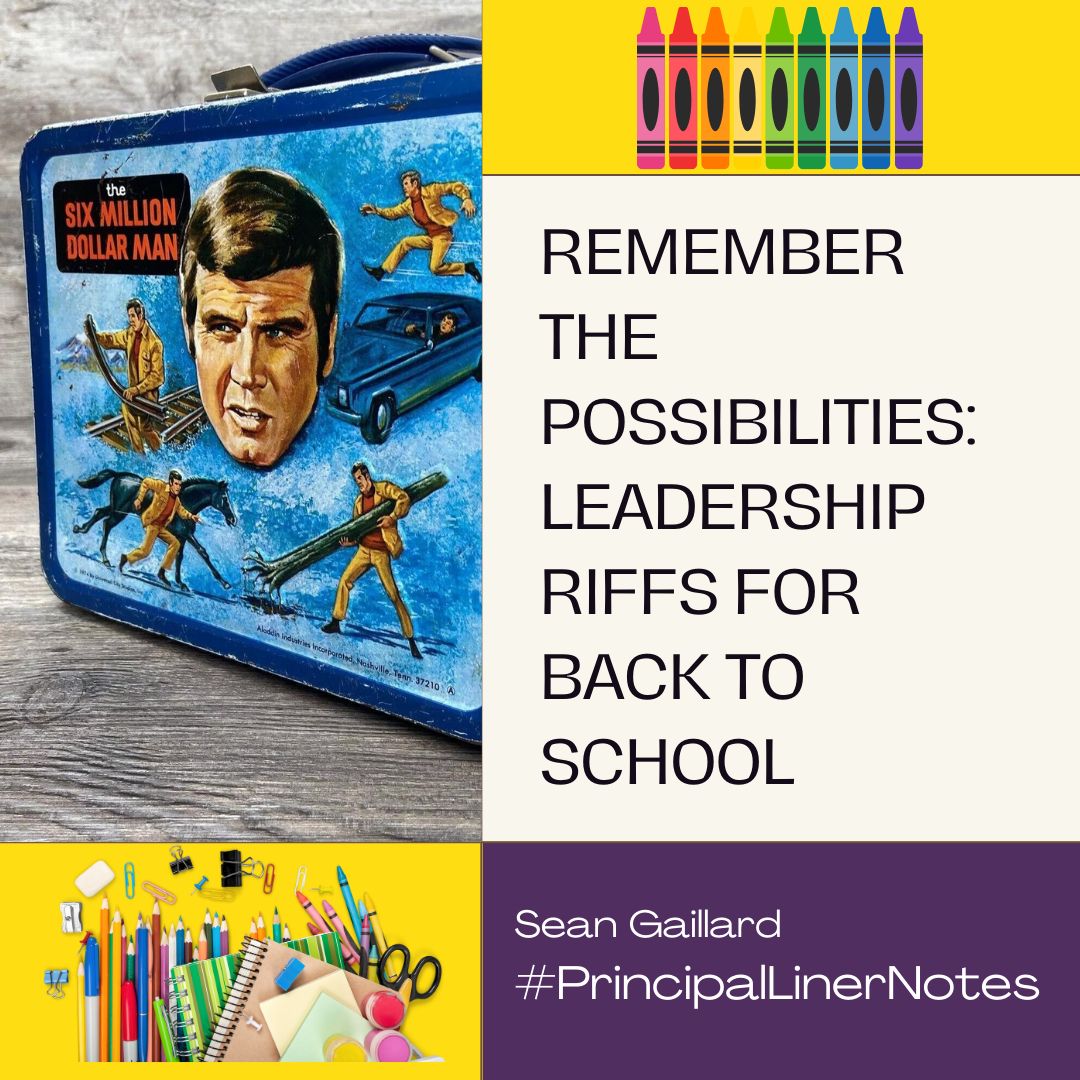
Remember the Possibilities: Leadership Riffs for Back to School

Retrospection in Love

As we embark on a new school year, I can’t help but get swept up in the waves of nostalgia. I’m dating myself a bit here, but I vividly remember those back-to-school moments: the friendly squabbles with my siblings over the “TV Guide” Fall Preview Issue, the thrill of new school supplies, the annual trip to Sears with my parents for a new pair of school shoes, and the grand task of organizing my Star Wars Trapper Keeper. But perhaps the most cherished item of all was my lunch box. In the fall of 1976, my heart was set on The Six Million Dollar Man lunchbox. As a devoted fan of that iconic television series, I held the adventures of Bionic Superhero, Colonel Steve Austin, close to my heart. When that lunchbox finally landed in my hands, my first-grade self beamed with bionic pride! I looked forward to a new year of learning, reading new books, and reconnecting with friends. There was an undeniable freshness in the air, a sense of renewal that made Back to School feel like a giant do-over, and I was ready for it.

As a father, I found myself reliving these joys through my daughters. My wife and I have a cherished tradition of leaving individual mini-signs of loving words and phrases for each of our three daughters on their first day of school. Even now, as our eldest is in law school and our twins are seniors in college, we continue this tradition. Reflecting on those early back-to-school moments with my children, I was filled with excitement and hope for them. I hoped they would have a wonderful experience and be surrounded by teachers and friends who loved them as much as we did.

First Light from the New Sunrise

There is a unique peace that comes with the quiet of a new morning before dawn. Pre-dawn is my time to exercise, and I cherish the solitude of an almost empty gym where I can focus on my routine without distraction. These early mornings offer me a moment to pause and reflect before the day begins. It’s my time to get my heart pumping, sweat out any worries, and align myself with the day’s events. Most importantly, it’s my time to greet the possibilities that await. The sunrise of a new day is a chance to restart and embrace new beginnings. Each day, we are gifted 24 hours to make small, meaningful impacts in positive ways. This feeling is remarkably like the start of a new school year—a clean slate brimming with possibilities and opportunities.

As leaders, we are called to be mindful of these possibilities not just on the first day of school, but throughout the entire year. It can be challenging to keep the excitement and joy of the first day, but it is crucial to our work for our kids. Our families trust us to not only give educational opportunities but to inspire their children with the limitless possibilities they hold.

I keep my Six Million Dollar Man lunchbox in my office as a daily reminder of the promise of a new school year. It symbolizes our mission to sustain possibilities for all our students. It reminds me of the trust I placed in others to care for my daughters at school, and I honor that trust by doing the same as a principal, educator, and helper. Every day, we are called to help our students discover their possibilities. Some days this is easier said than done, and obstacles seem insurmountable.

Yet, in those moments, we must remember why we started this journey. We must hold on to the belief in the transformative power of education and the boundless potential within each student. With hearts full of hope and dedication, let’s embark on this new school year with the spirit of endless possibilities.

Here are four solid ideas to keep that back-to-school feeling sustained and upbeat all year long:

  1. Celebrate Milestones: Recognize and celebrate achievements, big or small, throughout the year. This could be academic successes, personal growth, or acts of kindness.
  2. Create Traditions: Establish school traditions that students and staff look send to. Whether it’s a monthly assembly, a special lunch event, or a themed dress-up day, traditions create a sense of belonging and anticipation.
  3. Foster Connections: Encourage ongoing communication and relationship-building among students, teachers, and parents. Regular check-ins, community events, and open lines of communication help maintain a supportive and connected school environment.
  4. Inspire Curiosity: Keep the learning environment dynamic and engaging by incorporating new and exciting teaching methods, projects, and activities. Encouraging curiosity and creativity keeps the school experience fresh and stimulating for everyone.

Let’s keep that spirit of new beginnings alive, nurturing the dreams and possibilities of every student we are privileged to serve. Here’s to a year filled with hope, joy, and endless potential!

Inspiring Leadership Symphonies in the Keys of Culture and Trust

There is a famous moment in the history of conducting with the great Leonard Bernstein where he lowers his baton and conducts the orchestra with simply his face. This beautiful moment, which I learned about years ago from a colleague through a TED Talk on leadership and the art of conducting, continues to resonate deeply with me. Itay Talgam facilitates this TED Talk by using various clips of conductors to illustrate different leadership styles. The sequence of Bernstein conducting with just his face is highlighted by Talgam as an aspirational portrait of leadership that fosters a culture of trust and empowers others.

Seeing Bernstein loosen his hold as conductor, caught up in the realm of musical expression and trusting the orchestra to deliver the beautiful nuances of a Haydn symphony, is profoundly moving. The pride and love emanating from Bernstein’s face are palpable. He still guided and responded with his expressions, but he lowered his baton to symbolically and literally exemplify the trust he had in his musicians. This shared delight illustrates an essential aspect of leadership—it’s not about creating followers, but about empowering others to lead. Bernstein shows the humility and trust that leaders must possess to elevate their teams and organizations to new heights.

Our Gig as Leaders

When coaching or advising aspiring leaders, I emphasize that our role is not to build a following. We are called to empower others, tap into their strengths, and motivate them to lead. I have seen many leaders build a cult around their leadership persona, a detrimental move that inhibits growth, breeds toxicity, and ultimately dulls any impact on the students we serve. It is vital for leaders to foster a culture of trust, surrounded by a shared and purposeful vision. This is not a one-time event but a daily commitment that must be modeled with sincerity and led with our authentic selves.

As I near my 17th year in school administration, I am learning the essence of leading with my authentic self and tuning into the gifts of those I serve. Leadership is not about titles, staged selfies, or social media analytics; it’s about recognizing the gifts in others and helping them realize their best selves. Sometimes, we have to step off the conductor’s podium and lower our baton so the orchestra can create its music. We, as leaders, must steward a culture that inspires others to lead. That’s the gig.

My Bernstein Leadership Moment

While I am nowhere near the charismatic leadership of Leonard Bernstein, I had a moment that resonated with the love and pride he felt for his orchestra. This past week, I was immersed in our School Improvement Team Retreat at Charles England Elementary School in Lexington, NC. In my new role as principal, I have been savoring every minute, returning to this district. Although my time here has been short, I truly love the community and appreciate the direction we are heading in service of our kids.

Our retreat involved hard work planning for the year ahead and crafting the next steps to build a culture of trust and inspiration. We analyzed data, built a yearly calendar, and devised a master schedule. Each day concluded with a restorative circle where we shared strengths, learning, and praises for teammates. I cherished this intense collaboration and look forward to our future steps together. I have made intentional efforts to be open, vulnerable, and honor the gifts of others on the team. We leaned into hard conversations, but we also laughed and enjoyed each other’s company. I wanted to make sure that everyone felt psychologically safe and I kept giving voice to that. Additionally, I wanted to make sure that I was honoring their respective voices, so I was intentional in the scheduling of breaks, reflection times, and collaborative activities.

On our final day, I was exhilarated to see the team and eager for another productive day of collaborative work. Arriving early, my assistant principal shared that the team was already working on polishing our school improvement plan goals from the previous day. I hurried to our planning space and found the team deeply engaged. I was amazed and inspired, tiptoeing around the room to avoid disrupting their momentum. It felt like watching a great jazz band improvising and being in the groove of the moment. Actually, my mind wandered to the moment of Bernstein conducting the Haydn symphony and letting go. This was my Bernstein moment.

Filled with inspiration, I expressed my gratitude and joy at their leadership and collaboration. It was truly a moving moment that will be embedded in my memory forever. The energy in the room was palpable. The smiles were contagious. We had reached a mountaintop together.

As leaders, we must sometimes step back and let the momentum and learning happen. By stepping aside and guiding, we create space for learning, collaboration, and progress. Having the podium and baton doesn’t mean we must conduct with a heavy hand. We invite others on the podium with us and share the joy in conducting and composing a symphony together. By inviting others to compose the symphony with us and playing to each other’s strengths, we collectively create a beautiful and lasting sound.

Building a Culture of Trust: Four Moves for School Leaders

  1. Model Authenticity: Be genuine and transparent in your actions and decisions. Your authenticity will inspire trust and encourage others to lead with their true selves.
  2. Empower Through Delegation: Trust your team with responsibilities and opportunities to lead. This not only builds their confidence but also fosters a sense of ownership and accountability.
  3. Foster Open Communication: Create an environment where open and honest communication is valued. Encourage feedback, listen actively, and act on the insights shared by your team.
  4. Celebrate Strengths: Recognize and celebrate the strengths and achievements of your team members. Highlighting their contributions builds morale and reinforces a culture of mutual respect and trust.

For further inspiration, explore the following resources:

By embracing these principles, we can create a culture of trust and empowerment that enables everyone to lead and succeed. That’s the true symphony of leadership.

Illuminating Your Core: Leadership Moves for Authenticity

When I was a young adult, I used to shudder at the statement, “Be yourself.” It seemed like a trite sentiment, almost painfully obvious. Of course, one would want to be oneself. Why wouldn’t that advice make sense? Now, in my later years as a school principal, I have a much deeper appreciation for those words.

During my early years as a principal, I believed I had to conform to the image others had of a school leader. I modeled myself after the austere principals I saw in films like Lean On Me. I thought I needed to wear a three-piece suit, keep my shoes polished, and stride through the building with a Morgan Freeman-like swagger. For those who know me, that’s not the character I am in the story I’m writing as a leader. I quickly learned that those I served could see through the facade and empathized with my internal struggle. I was pretending to be something I wasn’t, and I needed to return to my core values as a leader.

Seeking advice from the best leader I know, my father, I was reminded to hold my head high and stay true to my values. With his guidance and the support of a leadership coach, I was able to reflect on my core values and not only articulate them but also act with authenticity. It was a long journey of reflection and discovery, but it was worth it and helped shape the leader I am today.

We all have a story we are composing that serves as the architecture for our life’s journey. Early in my leadership as a principal, I learned the importance of carrying your values with courage, passion, and humility. My good friend, Lauren Kaufman, beautifully explores the significance of storytelling in unleashing one’s leadership potential in her recent book, The Leader Inside: Stories of Mentorship to Inspire the Leader Within. The inspiring Baruti Kafele, also known as Principal Kafele, emphasizes the importance of staying true to your leadership core. Your leadership core is the DNA of your momentum as a leader. It embodies the values that drive your vision and mission.

In the latest edition of Ryan Holiday’s The Daily Stoic newsletter, Holiday underscores the absolute importance of being yourself and embracing who you are. This resonated with me and highlighted the essential move of embracing our leadership core. We must remain true to ourselves as leaders and individuals. There will be naysayers who try to divert you from your core, and sometimes you may be your own worst critic. This self-doubt cannot be tolerated. Questioning your core and the goodness within leads to a path of devastation filled with Imposter Syndrome and personal well-being fractures. Trust me, I’ve been there and know the negative effects. I’ve seen it ruin leaders.

Stephen M.R. Covey’s pivotal book, Trust and Inspire: How Truly Great Leaders Unleash Greatness in Others, talks about the need for a new type of leadership in our ever-shifting global landscape. Covey challenges leaders to shift from a “Command and Control” style to one rooted in the ethos of “Trust and Inspire.” To flow as “Trust and Inspire” leaders, we must take stock of our authentic selves and connect with others. Remember, leadership is not about getting others to follow but rather about amplifying and encouraging the unique strengths of others.

Whether you are a leader returning to an assignment or starting anew, who you are matters. Your leadership is needed for a reason. Don’t shortchange your passion or compromise what inspires you. If you are an unabashed Taylor Swift fan and that inspires your leadership, then share it and incorporate it into your daily banter. If you are an avid, amateur geologist, then let rocks and soil be part of your faculty repertoire. By embracing the light of your leadership core, you build a culture of trust and inspire others to do the same.

I often sign off on the #PrincipalLinerNotes podcast with the following thought: “Don’t forget to share with the world your dreams, ideas, and insights because the world needs them, and you help make the world a better place for others.” This rings true for leaders grappling with expressing their authentic selves. You have value, and your leadership core will ignite gifts in others, making your school or organization a place that will better our world and community. Illuminate your core and let its light inspire others to do the same.

Action Steps for Leaders

  1. Reflect on Your Core Values: Take time to deeply consider what values are most important to you as a leader. Write them down and think about how they influence your actions and decisions.
  2. Seek Authentic Feedback: Engage with a mentor or leadership coach who can provide honest feedback and help you align your actions with your core values.
  3. Embrace Your Passions: Integrate your personal interests and passions into your leadership style. This authenticity will resonate with and inspire those you lead.
  4. Create a Culture of Trust: Foster an environment where others feel safe to express their authentic selves. Encourage and amplify the unique strengths of your team members.

Links to Books Mentioned