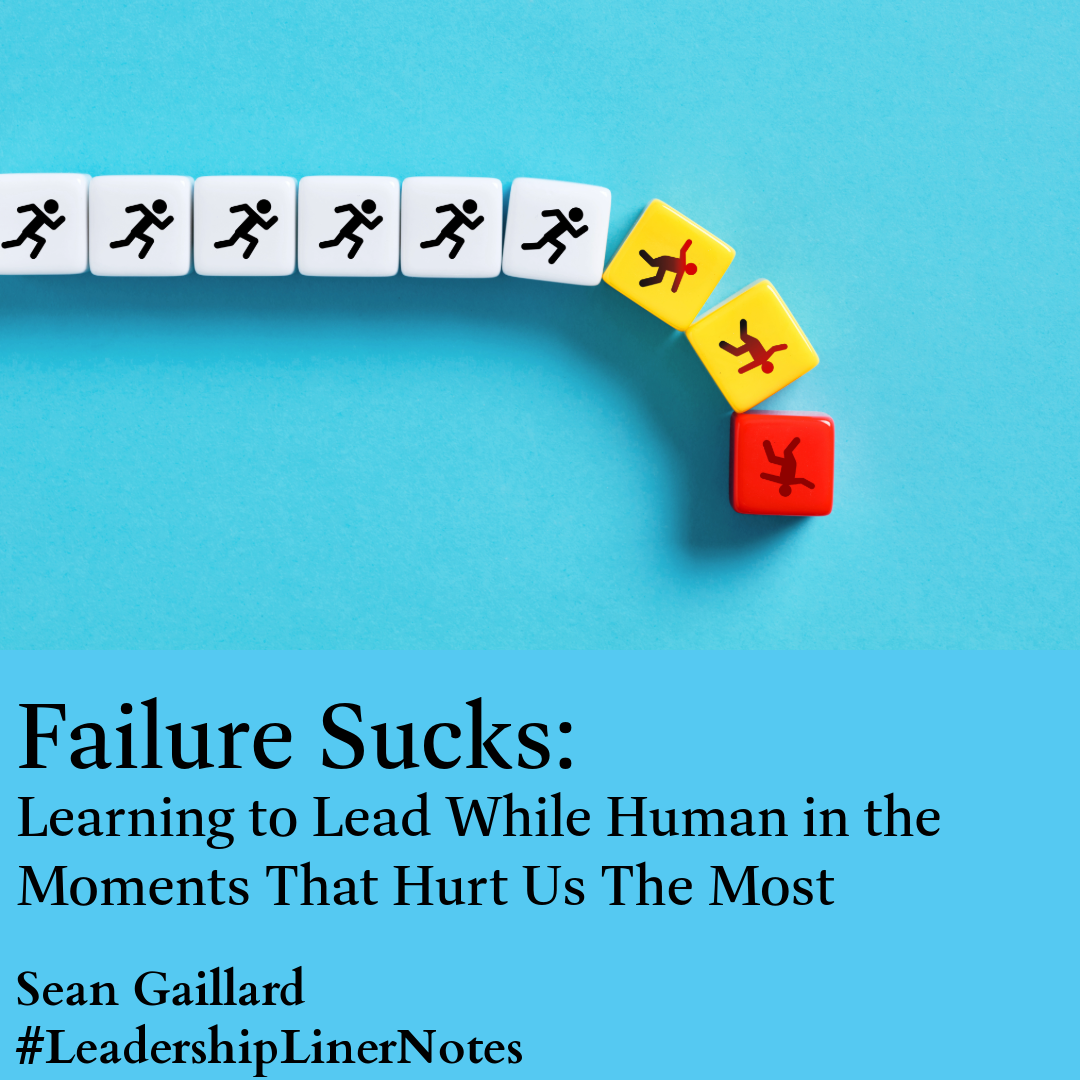
Lately I have been reflecting on past failures as a leader. In many leadership circles across social media, conferences, and professional spaces, failure is often mentioned briefly and then quickly reframed as a lesson learned. The story usually resolves neatly, much like a sitcom where the main character faces a conflict and everything wraps up by the end of the episode.
Leadership does not work that way.
Failure in leadership rarely resolves quickly. Even when we fill our days scrolling through inspirational memes about perseverance and growth, the pain still lingers. The hurt continues. Failure does not disappear simply because we choose to frame it positively.
Too often we rush to the happy ending.
Several years ago, the “Famous Failures” memes were widely shared online. I remember drawing inspiration from those images that highlighted the early setbacks of people like Michael Jordan, Oprah Winfrey, and Albert Einstein. One of the examples that resonated deeply with me was the story of The Beatles being rejected by Decca Records before becoming the most influential band in history. A Decca executive reportedly told them that guitar groups were on the way out.
I wrote about that moment in my book The Pepper Effect. I shared that story many times with faculty during my years as a principal because it offered a powerful reminder that rejection and failure often precede greatness. In recent years I have noticed that the story no longer carries the same inspirational weight for some audiences. I sometimes walk away from sharing that anecdote feeling a quiet sense of disappointment. I love The Beatles. I wrote a book about them. I have spoken about their story at conferences and leadership gatherings. At times the response has been enthusiastic. At other times it has been a collection of polite nods.
That realization stings a little. It reminds me that even the stories we believe will inspire others do not always land the way we hope.
Leadership author John Maxwell addressed this tension in his book Failure Forward: Turning Mistakes into Stepping Stones for Success. Maxwell writes, “One of the greatest problems people have with failure is that they are too quick to judge isolated situations in their lives and label them as failures.” He reminds readers that mistakes are inevitable and that mistakes only become true failures when we continually respond to them incorrectly.
Amy Edmondson, a leading voice on psychological safety, explores similar ideas in her book Right Kind of Wrong: The Science of Failing Well. Edmondson encourages leaders to rethink how organizations respond to mistakes and to recognize the potential for growth and discovery that can emerge from them.
Both perspectives resonate with me. I appreciate the wisdom behind them.
Yet the more I reflect on my own experiences, the more I arrive at a simple and honest truth.
Failure sucks.
Failure is painful. Failure can be debilitating. Failure drains energy and confidence. Failure often shows up when we step into bold and unfamiliar territory. It waits quietly beside us as we take risks, stumble, and fall short.
There is not enough honest conversation about the emotional toll of failure. Many leadership conversations focus on the research, the strategies, and the case studies. Those perspectives are important. At the same time, they often overlook the personal hurt that accompanies failure.
Leading while human requires that we acknowledge that pain.
I recently attempted to start a book study for colleagues. No one responded. That moment hurt more than I expected. I think about a conference session where only three people showed up. The room felt far too large for such a small audience. I delivered the session anyway, though the experience was both humbling and uncomfortable.
Moments like those stay with you.
Failure has a way of reaching into the deeper parts of our identity and purpose. It can leave us questioning our abilities and wondering whether we truly belong in the spaces where we serve.
I wish there were a simple antidote.
There are many inspiring stories about overcoming failure. I am curious about John Maxwell’s upcoming book How to Get a Return on Failure: Fail Smarter, Return Stronger. The title alone reflects an important mindset shift. Organizations must build cultures that offer grace, coaching, and support when people struggle or fall short. Many organizations do this well. Others do not. In some seasons of my career, authentic and humane support was inconsistent or absent.
Those seasons can feel incredibly lonely.
During this current liminal season of my life and leadership, I often revisit my own failures. Some moments invite reflection. Some invite reconsideration. Some even invite regret. Those reflections lead me to a deeper question.
How do we remain human centered leaders while staying true to our own humanity?
Perhaps the pain of failure is part of what makes us human. Perhaps the sting becomes the catalyst that pushes us toward growth and perseverance. Charlie Brown runs toward the football again and again, even though Lucy might pull it away at the last moment. He still runs forward with hope.
Leadership sometimes feels exactly like that moment.
Failure invites us to pivot. Failure invites us to step back and reflect. Failure invites us to rediscover the gifts that still live within us. Failure teaches us lessons we could not learn any other way.
Those lessons matter.
At the same time, honesty requires that we acknowledge a simple truth.
Failure still sucks.
Leaders cannot pretend that the pain does not exist. We must acknowledge the hurt. We must allow ourselves moments of reflection and even moments of sadness. We gather ourselves again, roll up our sleeves, and keep moving forward.
Our response to failure ultimately defines us far more than the failure itself.
That is the work.
That is the calling.
That is the gig.
Our response to failure ultimately defines us far more than the failure itself.
Leading while human means we acknowledge the pain, gather ourselves, and keep showing up anyway.
 Leadership Liner Notes: Sean Gaillard