The Inner Groove: Getting Back to Our Childhood

The Child is the father of the Man;
And I could wish my days to be
Bound each to each by natural piety.

–from “My Heart Leaps Up” by William Wordsworth (1807)

There is wonderful whimsical moment at the very end of the “Sgt. Pepper Lonely Hearts Club Band” by The Beatles. Following the apocalyptic ending of the album’s final song known as “A Day in the Life” (depending on what album version you own) a brief burst of The Beatles and some of their associates break into a spontaneous cacophony of gibberish.

I first heard this snippet on the now out of print compilation titled “The Beatles Rarities.” These two seconds are labeled on that particular album as  “Sgt. Pepper Inner Groove.” There was a rather mischievous intention behind this gibberish. If you had a record player in 1967 without an automatic stylus, then the needle would play infinitely until you had to manually remove it from the record. The two-second gibberish on “Sgt. Pepper” could conceivably play for eternity on a non-automated record player.

As a kid, I would place my ear up to my little cassette player speaker (I had the tape version.) and try to figure what nuttiness was being said. I could never figure it out but I always enjoyed that snippet after resonating crescendo of “A Day in the Life.” It was audio equivalent of a breath of fresh air.  (Sidenote: The Beatles also added a dog whistle as well at the end of the album. Only your friendly neighborhood canines can hear that whistle, but that’s another story for another time.)

The “Sgt. Pepper Inner Groove” mishmash following “A Day in the Life” is a powerful reminder and fascinating contrast to explore. The Beatles were very aware that they were creating a masterpiece with this particular album. The album was a calculated risk recorded by band wanting to push the boundaries of musical expression. It is filled with experimental sounds, avant-garde flavorings, Eastern-tinged instrumentation, orchestral flourishes and poetic lyrics. I always thought this particular gibberish was a reminder by the band not take one’s self seriously. It is if The Beatles are saying, “Yeah, we made this grand artistic statement, but we are still a bunch of blokes from Liverpool.”

The brief blast of Jabberwocky sounds childlike and in a way connects back to the original concept for the “Sgt. Pepper” Album.

Two of the greatest songs recorded by The Beatles were originally intended for the “Sgt. Pepper” album. “Strawberry Fields Forever” and “Penny Lane” were tracks based on real-life places in the native Liverpool of John Lennon and Paul McCartney’s life. Both songs were written for an album that was originally intended to be a celebration of the band’s childhood past. It is interesting to note that these songs rooted in nostalgic retrospection are two of the most progressive and innovative pieces of music The Beatles recorded. The concept of an album as ode to their Liverpudllian childhood stalled when the record company needed songs for the then-popular singles market and radio airplay.

Childhood nostalgia is the fuel for some of the great works of art, music, film and literature. As a former English Teacher, I loved bringing in a song like “Penny Lane” to reinforce the beauty of nostalgia in a poem like “Fern Hill” by Dylan Thomas.

Our noble profession as educators is filled with moments of bliss, challenge and grit. The schoolhouse is a place where childhood intersects with standards, compliance and policies. Sometimes, we default to the rigidity rather than valuing what we are called as educator do. The call is rooted in a support of the social and emotional well-being of the Whole Child. As an educator, I know all too well the realities burdening our noble profession. I am not calling for us to stop the bell schedule for a collective cry of gibberish like The Beatles did with “Sgt. Pepper Inner Groove.” Perhaps, we do need to tune into our own “Inner Groove” of remembering our childhood as we support and serve our students in the schoolhouse.

Collaborating with students and supporting their creative voices is steps towards tuning into that “Inner Groove.” Celebrating Monday (#CelebrateMonday), committing Random Acts of Kindness, exploring in a Makerspace are ways to promote the Whole Child by establishing a culture that is positive and inviting. These examples are planned with consideration for the unique needs and extraordinary gifts of our children. We have been entrusted as educators with the center of someone’s universe. We must not forget that our students bring inspiring wonder and gifts to our respective schoolhouse communities.

Tapping into the nostalgia of childhood helped to fuel a world-changing album by The Beatles. Following along the Inner Groove of our childhood as educators can spark waves of creative possibility in the schoolhouse.

Carving out “Here Comes the Sun” Space

Before we go any further, I want to proclaim that I am not in favor of skipping school. As a school leader, it is not my desire for this blog post to serve as a blank check for students and educators to pull a “Ferris Bueller” and to romp off the grid abandoning all semblance of responsibility.

There is a time and place for whimsical notions to transpire and we do have to give ourselves permission for the occasional escape. In the last couple of years, I learned about the concept of Whitespace from some educators I connect with on Twitter and Voxer. This is intentional time taken out of the scope and sequence of a packed day for reflection, relaxation or escape.

As a recovering workaholic principal, I was so uplifted by this idea. I knew that I needed a gut check for balance in my life between the home and the schoolhouse. Knowing that I needed training wheels to make this happen, I asked our school secretary to hold me accountable. She had access to my calendar, so she plugged in times for me take some intentional intervals of time away from the grind of the Principal’s Office to recharge. Since I am an unabashed fan of The Beatles, she titled it “White Album” Space as nod their classic 1968 double album.

If George Harrison was principal, then his secretary may have titled scheduled Whitespace as “Here Comes the Sun” Space.

“Here Comes the Sun” was written on a beautiful afternoon in an English Garden circa 1969. This oft-covered and referenced gem from the final studio album of The Beatles was written by Harrison during a business meeting he skipped. The prospect of taking time away outweighed the need to be at ponderous meeting. It just so happens that George’s hookey sidebar was spent in the English Garden of a “little known” guitarist named Eric Clapton. Mr. Clapton just so happened to have an acoustic guitar handy for his pal George.  A timeless classic was created for the soundtrack of our lives. “Here Comes the Sun” has been covered by bands and played at weddings. The song has found it way on any one of my playlists or mix tapes over the years.

I cherish “Here Comes the Sun.” It’s my #OneSong for 2017. The tune is one of my go-to anthems for hope. It is a salve that uplifts and inspires each time I listen. There are so many cool moments embedded within that song from George and Paul’s harmonies, Ringo’s shifting time signature drum fills and those hand claps during the bridge. Those supreme hand claps always speak to me as a call to embrace the eternal promise beyond the horizon.

An intentional move to gather time for renewal can stir inspiration in the most unexpected of ways. Educators are a dedicated bunch and we sometimes default to binding our moves to calendars, meetings and pacing guides. I have been guilty of forsaking balance and meaningful time with family in order to meet that district deadline or network at a ponderous meeting. Allowing ourselves the time to break away for from the grind is essential for our well-being. There are so many simple ways to accomplish it from changing up the routines of your day:

  • Ask a colleague about the last movie she or he saw.
  • Sharing with students what’s on your playlist and ask about theirs.
  • Spend time with a favorite song or quote from a life-changing book.
  • Follow a few tweets from a inspiring hashtag on Twitter like #JoyfulLeaders or #CollaborativePD.
  • Create something new!
  • Spend a few minutes savoring the silence of your thoughts.

Finding that time can be challenging. Those “other duties as assigned” in the schoolhouse pull on us relentlessly.  We at times lose sight of what is sincere and meaningful for our noble profession. As educators dedicated to the quest of serving and supporting all students, carving out “Here Comes the Sun” Space is a necessary track upon which we must move. Perhaps taking that time may lead to the creation of a timeless and universal song like George Harrison’s?


Making the Impossible Possible: A Beatles Reunion in the Schoolhouse

It just so happens that I was born on the day and in the year that The Beatles released their final studio album. The “Let It Be” Album stands as my favorite Beatles album for many reasons. The fact that I share a birthday with the final bow of The Beatles as a band in their lifetime makes it even more poignant.

The dissolution of The Beatles in 1970 was a cultural event and it made global headlines. Their break-up was the result of many reasons from financial to personal. They had simply outgrown each other and were ready to forge individual paths. The break-up was very public and bitter. For the next ten years, John, Paul, George and Ringo were hounded and pressured to reunite. There were a few close calls for a reunion but all of that reunion speculation came to an end when John Lennon was murdered in 1980.

Surprisingly in 1994, the surviving Beatles reunited in the studio for “The Beatles Anthology,” a documentary they were producing on the history of the band. Putting aside years of acrimony and bitterness, they reunited and recorded two brand-new songs.

Somehow the Impossible was made Possible because not only did the three surviving Beatles reunite they were also able to include John Lennon in the event.

Taking two rough demos John Lennon recorded before his death,  the newly reformed Beatles added music, lyrics and vocals. The songs are entitled “Free As A Bird” and “Real Love.” Both songs were worldwide hits and received Grammy Awards. It was quite an innovative practice and it was arduous in terms of the technical and musical demands of the reunion project. Somehow the world got a Beatles Reunion amidst seemingly impossible odds.

I share this anecdote not as a proud music geek, but as someone who works in a school where we embrace the Impossible. Ours is a school where we proudly register students who have been retained at some point in their academic year. My school is seen as a haven for students who want a smaller class size and a caring teacher. The school where I am the proud Lead Learner is cast on a list of Title I Schools with poor achievement test scores. Despite all of those negative odds, ours is the school that exceeds achievement growth, possesses one of the highest increases in our district’s graduation rate and overpowered our $500, 000 college scholarship goal to almost $900, 000. Most importantly, the students at the school where I stand proudly as a servant-principal feel connected, safe and loved. In a way, I feel as if I am working with The Beatles. I believe that our school will exit Title I Priority School Status and stand as a true testament to an authentic turnaround.

Daily I strive to overcome the Impossible just like the surviving Beatles did with that battered, hiss-filled cassette of an unfinished John Lennon song. I am nowhere near the musical talent of The Beatles and what they accomplished with those 1994 Reunion Sessions.

How might we embrace the Impossible collectively as educators? Sometimes there is a negative default to those who stare the Impossible down and pursue seemingly absurd quests in the service of students. This mindset is sadly evident in our noble profession as educators. There are daily stories of #EduHeroes in schools everywhere overpowering the Impossible and creating a new paradigm of possibilities for our kids. We have to spread the sparks of those #EduHeroic Stories from the rooftops within social media venues and beyond. We have to value each victory over the Impossible in the schoolhouse as we did with The Beatles Reunion of 1994.

There are many variables to plug into as exemplars of the Impossible in the Schoolhouse. I invite the conversation to address and define them. Our challenge as educators is not to give permission for the Impossible to flourish. We do give too much power to the Impossible. Sometimes we have to take the time to recognize that the Impossible has morphed into the Possible. Taking stock of those examples such as The Beatles reuniting can spark inspiration into action.

Joy in the Journey

Imagine being in world’s most successful Pop Band near the end of a storied career. “The winter of discontent” reigns supreme for The Beatles. In an attempt to literally get back to their roots as a band, The Beatles augmented with keyboardist Billy Preston are attempting their first live performance in three years. The band’s journey to this moment was marred by an impending dissolution of their musical partnership. Woes ranging from financial to creative to personal multiplied for The Beatles and they entered the studio in January 1969 attempting to “Get Back” to their Rock Roots. The mindset for these recording sessions was to avoid overdubbing and any of the technical innovations The Beatles had established in the studio. A film was being made to document the sessions which were to culminate into a rare live performance for the band. What was meant as a celebration to their musical roots transformed into the break-up of a band. A culture of sourness and apathy had permeated the band. At one point, George Harrison was so frustrated he briefly left the band. John Lennon later called it “…the most miserable session on earth.”

Flash forward to the end game for these sessions in the return to live performance for The Beatles. It is a cold, dreary January  day in London. The Beatles are giving an impromptu lunchtime live performance on the rooftop of 3 Saville Row, headquarters from their disintegrating business empire known as Apple. Armed with a set list of new music ranging from “Get Back” to “I’ve Got a Feeling” to “Dig A Pony.” Some of the old magic is starting to seep into the marrow of the band. A groove is growing and the past familiarity of being a live band naturally arises. You can see the internal band malaise dissipate into the ether as they progress with their set.

A beautiful mistake arrives within the middle of the set.

John Lennon forgets the words to “Don’t Let Me Down” and begins to sing an inspired melange of gibberish. His nonsense creates a moment of knowing levity within the band. It is evident and The Beatles take license with it and finish the song without missing a beat literally. The moment lasts just a few seconds. The joy in this mistake carries the band through a solid conclusion of the performance.

(Check out the clip here and advance to 1:20 mark. Blink and you will miss it, but it is so worthwhile:http://bit.ly/1TcUvcc)

That particular mistake reminds me of the need to tune into the joy in the journey. Even though, the band was heading towards the end of their tenure together, they were still able to find a reminder of their core and prevailed upward in their final live performance. As educators, this time of the year can be difficult to find any shred of joy in the schoolhouse. We sometimes burden ourselves with tunnel vision amidst the season of testing, observations, paper chases. Deadlines become akin to portents of doom in the schoolhouse. Our students and colleagues are viewed as speed bumps forcing us to slow down against our will as we careen towards the end of the school year. We disinvite the essence of joy from the schoolhouse and permit what is seemingly important to prevail. This unfortunately builds a barrier to our Noble Profession and ultimately all of us ending up losing direction on this schoolhouse journey.

How might we tune into the joy along the journey in the schoolhouse? How can we find inspiration in the mistakes and pitfalls we experience as educators? Where are those organic moments of inspiration?

It is vital to remember that there is indeed joy in the journey. Staying in the moment and tuning into the positive is essential within our role as educators. As a Lead Learner, I have to own the modeling and empowering for the positivity in the schoolhouse. Encouraging a collective voice of positivity amidst the mania is crucial. Promoting the positive in the schoolhouse through things like #CelebrateMonday shift culture and illuminate joy. We have to make a targeted effort to dispel negativity in our respective schoolhouses.Many schools have created their own respective hashtags in order to the trend the positive regarding their school via Social Media.

Education itself  is not a beautiful mistake but it is filled with moments which are transformative, uplifting and inspiring. The schoolhouse is a very human institution with flaws and shortcomings. Shifting those mistakes into glorious bridges towards excellence requires an evident positive culture where inspiration, change and growth are valued as transformational commodities. Our kids pick up on the negative frequency from us and the effects are detrimental. We are obligated to listen to the “…better angels of our nature” when it comes to connecting with those we serve and support in the schoolhouse. Tuning into the possibilities we have as educators is a must. Our role as Impact Makers is a game changer for our kids. There is truly joy in that.

The Beatles were masters of eroding negative power in their musical mistakes. As Educators, we are called to that same mastery. Let’s start with tuning into the joy on the journey.


Unplugged

During the mid-1990s, MTV aired a very popular series entitled “Unplugged.” The premise was to display the natural prowess of musicians in an acoustic setting. Famous artists from the Rolling Stones to LLCool J  stripped down their various hits and stadium anthems to its aural essence. It was like seeing a trapeze artist soar in the air without a net. I remember marveling at bands like Nirvana shift their musical paradigm sitting on stools amidst flowers and a cello player as they played hard-hitting tune like “All Apologies” without loud amplifiers and power chords. I garnered a new appreciation for bands like Kiss who placed a pause on Heavy Metal and emphasized harmony and acoustic rhythm guitars. It was inspiring to see Robert Plant and Jimmy Page reunite on “Unplugged” and re-discover their musical canon in a whole new setting. MTV’s “Unplugged” proved to be a good excuse for musicians to demolish their electric walls of their respective comfort zones and embrace a new audio challenge.

What if all schools had the “Unplugged” Mindset? I am not referencing powering down technology? In other words, what if we could strip away the distractions and create a culture where the focus is on the essence of teaching and learning in a positive and inviting school culture? This takes courage, support and leadership. Education sometimes succumbs to being a magnet for misguided initiatives and negative mindsets. The freedom to “unplug” and focus on what is essential is viewed as being an exercise in futility. With the constant and tired given of high-stakes accountability, low educator morale and unfunded mandates, taking giants steps to embrace the Unplugged in Education is easier said than done.

During Paul McCartney’s stint on “Unplugged,” he famously forgot the words to The Beatles’ classic, “We Can Work It Out.” He stopped the song with this wry comment, “Hang on, hang on. I got the words wrong.” At that moment the band  gently careened off course, but McCartney’s sincere and amusing transparency saved the day and he simply started the song again with the band. The band carried on and the audience cheered. How was this musical icon able to get away with this? I don’t think simply being a former Beatle gave McCartney a pass. He has been the subject of much critical ridicule and disdain over the year in some cases. (Check out the reviews of his album, “Press to Play to see what I mean.) I believe it was the positive culture that drove a mindset of support and acceptance to flub the pivotal opening of a classic Beatles song.

Imagine that happening in the classroom or schoolhouse as the norm. Envision a school or a district where it is accepted every day to focus on the essential in an atmosphere of  professional acceptance. I do not want to take away from the places where this does happen. It is inspiring to hear about the authentic experiences students and educators have thanks to things like STEAM, Mystery Skypes, SketchNotes, Makerspaces, etc. We hear about pockets of this happening in very visceral and valiant ways thanks to educators blogging, tweeting and connecting within the positive neighborhood of a PLN. How might we create a collective culture where it is acceptable to do this without fear as a whole profession of Educators?

Recently, I was reading Mike Schmoker’s latest book entitled Leading with Focus: Elevating the Essentials for School and District Improvement (ASCD, 2016). This book energized me with its clear, call to arms for a collective focus on the essentials in the schoolhouse. Schmoker contends that schools should simply focus on three things and become great at them in a relentless and cooperative fashion. These three things are a coherent curriculum, traditional literacy tasks embedded in every class and effective planned lessons (Schmoker, 2016). Although, these things may not sound like a hip episode of “MTV’s Unplugged,” it is the stripped down journey towards focus that matters most. A compelling focus is refreshing, renewing and necessary. Schmoker makes a convincing argument in this recent book. I highly recommend adding it your reading playlist. The book is truly a great conversation starter on what is essential in Education.

I believe it takes a shared, compelling vision where school administrators and teachers are placing students at the center of that focus for the common good. As a principal, I have to promote, model and encourage that mindset. It is important for me to pause and prevent as many distractions as possible for seeping into the marrow of the schoolhouse. Sometimes, we simply have to tune up and lean into a clear path of focus in a  bold, courageous and innovative manner.

These types of fearless steps encouraged Eric Clapton to unveil on “MTV’s Unplugged” his most poignant song. “Tears In Heaven” was written as an elegy to Clapton’s son. His four-year old son had died in a truly tragic accident. The song is unlike anything Eric Clapton had written and it was debuted in a live performance on “MTV’s Unplugged in 1992. The live album of this performance garnered three Grammy Awards for Clapton and it sold over 20 million copies worldwide. Literally, unplugging his electric guitar paid off for Eric Clapton and took his career into another renewed pathway. His courageous performance of “Tears In Heaven” is a healing anthem which still inspires and soothes today.

Being Unplugged in the Schoolhouse is risky, scary and daunting. It demands being fearless and focused within a supportive atmosphere. We can overcome the monoliths of mandates and initiatives if we all encourage each other to embrace being Unplugged in the Schoolhouse. A positive resonance awaits us moving forward within the Schoolhouse.


Why Remind?-Lead Learner Presence Matters

A couple of weeks ago, I was in attendance at yet another meeting. In this case, it was a required Title I Meeting. This particular meeting demanded my presence away from my school. I was an hour away. An hour away from connecting in real time with the people whom I serve led me to a path towards reflection. I felt removed in a room full of other school leaders and educators. I was missing that buzz occurs when things are happening within a schoolhouse: the teachable moment, the smile on a student’s face when mastering a concept, the invitational wave of a teacher as I walk into a classroom. The isolation I was experiencing in this particular meeting marinaded in my mind and I began to seek space for connecting back home. Simply put, I wanted to be present in the positive moments occurring in the schoolhouse.  

My role as principal requires me to present for many obligatory meetings. Now, all meetings are not necessarily a walk along the precipice of disaster, but this one felt like a barrier to my purpose as an educator.

In fact, I was feeling somewhat homesick for the school I serve. I wanted to be there and feel the synergy of our school community. I wanted to experience the inner groove of teaching and learning in our school. Meetings are important, but being present with my community is essential to my role as a lead learner.

Leading is service: That’s the core of my philosophy as a principal. To me, service means connecting meaningfully with the people I serve, and that’s one of my joys as a principal. On any given day, I can visit a classroom filled with collaboration and creativity. I have had the privilege of observing students engaged in a myriad of activities, from coding for a social studies research project to creating masonry monuments for an interdisciplinary unit on the Holocaust.

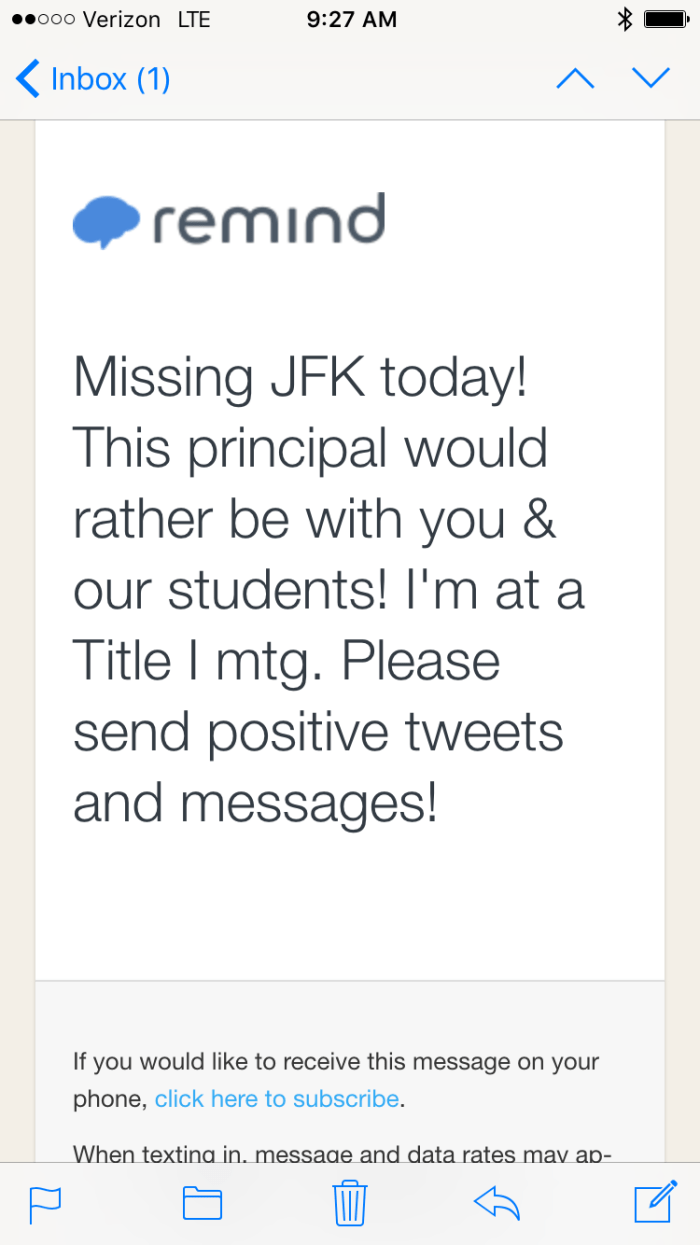
My mind was wandering to those moments during this meeting. Missing the joy of the schoolhouse, I reached for my phone and sent out this message to my staff via Remind:

IMG_2043 (1)

What followed was a cascade of positive tweets from an amazing team of #EduHeroes at John F. Kennedy High School. Although I was not physically present, I felt a sense of connection to the community—and this all started with a simple Remind message that all of our teachers at JFK received.

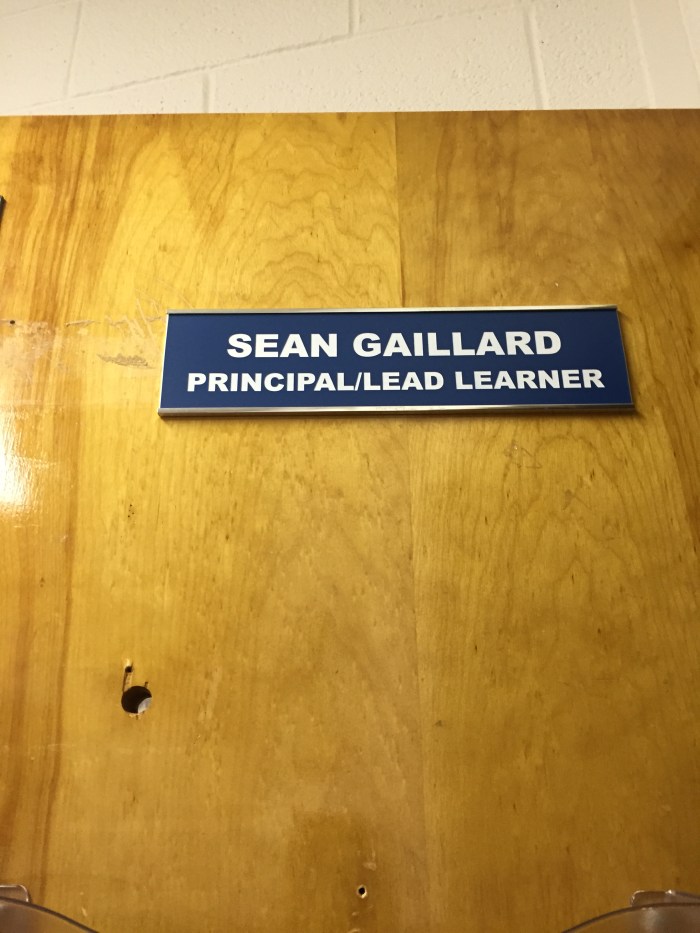
If you visit my office, you will be greeted by a doorplate with my name engraved along with my school role. Alongside the title of “Principal” is my true role: “Lead Learner.”

Lead Learner Door

It is my role to model, challenge, and encourage learning in the schoolhouse. That role demands for me to stay connected to the beat of the schoolhouse, even if being visible means moving beyond the wall of an office or meeting.

There are many tools that support the virtual connectivity we all need as educators, and Remind is one of the entry points that helps me stay connected and within the moment as a lead learner. I am grateful for the flexibility and ease Remind provides to support my efforts to stay connected with my school community. I am more grateful for the return Tweets I received showing the positive and meaningful things occurring in our school. For I am proud to be a small part of the inspiration happening for our kids at JFK. One simple text can be a game changer.