“Thank you, Apollo 8. You saved 1968.”
Astronaut Frank Borman, eyewitness to a pivotal moment in human history, eternally etched in his memory the words of this statement from a telegram.
Borman along with the other members of the Apollo 8 Crew: Jim Lovell and Bill Anders helped to briefly pause the tumult that was greeting Year 1968. This particular team of astronauts were engaged in the project to place the first human being afoot on the Moon. The Apollo 8 Mission was designed to place astronauts for the first time on a journey from the Earth to the Moon. In essence, Apollo 8 was to set the stage for the first Moon Landing that was to follow in July 1969.
The journey of Apollo 8 served as a positive bookend to a year marred with assassination, war and unrest. Ten years after the odyssey of Apollo 8, I remember as a young boy watching an ABC News documentary commemorating the impact of that year entitled “1968: A Crack in Time.” I was eight years old and I always had a love for history that was shaped by the warm world of periodicals like “Junior Scholastic” or the Saturday Morning Television Joy of “Schoolhouse Rock.” Here, I was watching a prime-time documentary filtered with news footage capturing images of the assassinations of Martin Luther King and Robert Kennedy. I watched images of war transmit from a place called Vietnam. There was anger in the streets of my parents’ hometown of Chicago. Later, I remember asking my mother what it was like to live during such a year of social and political unrest. Mom simply said, “I thought the world was going to end.”
What I don’t remember seeing from that stark documentary is anything pertaining to the inspirational journey of Apollo 8. It may be that I had to go to bed or my parents discovered that I was being exposed to some pretty harsh imagery. My guess is that they would have enjoyed watching footage with me of the Apollo 8 Crew reading from Genesis on Christmas Eve 1968 aboard their spaceship orbiting the Moon.
I can only imagine the collective universal breath that humanity took in 1968 as they witnessed through the eyes of Borman, Lovell and Anders the vision of Planet Earth rising over the Moon. Human Beings had never traveled this cosmic distance and the achievement must have brought us closer together amidst the storm and stress of 1968. Seeing the image still stirs the imagination. Gazing at our global neighborhood adrift in the vastness of space, one sees a world without borders, strife and bloodshed.

“Earthrise” from Apollo 8 (www.nasa.gov)
The words of the telegram Astronaut Frank Borman echoed for me as I experienced “Carpool Karaoke” earlier this summer.
The comedic bit on “The Late Late Show with James Corden” has always trended and placed collective smiles around water coolers and Facebook posts. The premise is achingly simple and blissful: Host James Corden literally drives around in a car with a group of celebrity guests singing songs. There may be a famous musician or two gleefully singing with an unabashed James Corden several hits. “Carpool Karaoke” Passengers have included Michelle Obama, Lin-Manuel Miranda, Stevie Wonder and Elton John.
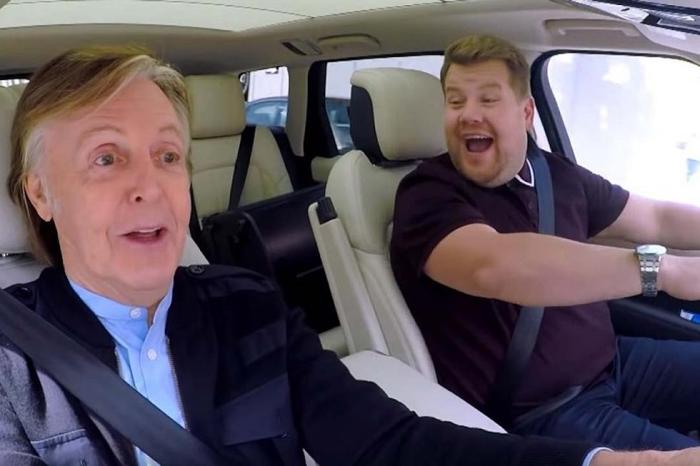
An epic pairing took place when Paul McCartney rode shotgun with James Corden for a recent episode of “Carpool Karaoke.” It was Paul’s first adventure with James. What was unique about this episode is that it took place in Paul’s hometown of Liverpool. Upon first glance, I am sure Corden and the producers sketched out an outline for the episode involving Paul McCartney revisiting his Beatle classic hits coupled with new songs from his upcoming album. I am sure there was excitement about the arrangement to have Paul visit old haunts and chance upon the actual street namesake for “Penny Lane.” My guess is that the original plan to secure a music icon did not include the cultural phenomenon that would follow. Then again, Paul McCartney as a Beatle and Solo Artist is accustomed to making a visceral global impact.
Corden and McCartney provided the expected comedic bits and sing along flavor of “Carpool Karaoke.” The Beatle Fan in James Corden probably couldn’t pass up the once-in-a lifetime opportunity to sing “Drive My Car” with Paul McCartney in tow. Walking side by side with the man responsible for composing “Penny Lane” on the actual strip was priceless. As segment progresses, a certain transcendence occurs taking us into private glimpse of two men connected by the love of music.
Our journey takes a three-fold path during this segment. An emotional triptych transpires for us as the observers into this manifestation of our humanity. First, we experience Paul McCartney walking in his boyhood home, now an official British landmark. He is taking us on a journey into his humanity. Here is an icon who has spun memories into the soundtrack of our lives for over fifty years and we see him lovingly gaze upon his living room thinking of his father providing feedback during the composition of The Beatles hit, “She Loves You.”
Another second emotional highlight is James Corden learning the origin of “Let It Be” from Paul McCartney. The song invokes “Mother Mary” who is a reference to Paul’s own mother who passed away from cancer when he was a teenager. His mother made an appearance to Paul during a time of strife with The Beatles disintegrating as a band. She simply advised him to “Let It Be.” Paul and James then belt out “Let It Be” with such vigor and song is reborn for those who were unaware of the song’s origin. Corden builds upon the moment wishing that his deceased grandfather, who had introduced him the music of The Beatles, was present in the moment for the conversation with a Beatle. Paul simply states that Corden’s grandfather’s is indeed with them.
The part of the emotional triptych is the surprise concert McCartney performs at a local Liverpudlian pub. Patrons are completely blissful at the fact that hometown hero, former Beatle and music icon is getting back to his roots for them. The response is visceral and identifiable as the impromptu audience stands on their feet in time to songs such as “A Hard Day’s Night” and “Love Me Do.” The evident joy on the faces of those patrons is contagious.
In the midst of this karaoke journey, one finds a sense of being a willing passenger in the joyride of Corden and McCartney. You can almost feel the happy electricit being in the car joining in what Paul cites as “…the power of Music.”
Music is our universal language that keeps us treading on common ground in the human experience. Regardless of political affiliation, aligned border or professed belief, Music transcends barriers and always serves as a loving bond in our humanity.
A whimsical jaunt between a British Comedian and Pop Music Composer serves as a salve in the sharp and constant melee of 2018. This particular year has been marred with the top-heaviness of 21st Century tumult and tribulation. Headlines abound with negativity wrapped in global uncertainty, political shrapnel and natural unrest. Check any social media channel for a harsh personal attack that at any given time. Channel surf along any form of news program and it is bound to lead down a road of negative and uncivil discourse. Violence is our constant companion. Negativity stands tall amidst the rubble.
Although the years of 1968 and 2018 have different layers of historical marrow in which they resonate, there are parallels in the level of global unrest. The elements of the Apollo 8 Moon Mission and Carpool Karaoke serve as cultural rest stop in our human journey. These cultural rest stops serve as reminders for us in the chaos that our world is still a positive and joyful place. Taking pause to witness the Earth rise in outer space or sharing in the divine connection that can be discovered in a Beatles song, unexpected gifts of the love inherent in our humanity are experienced.
Hopefully, these cultural moments will also serve as catalysts for other events which illuminate that there are always positive possibilities in our human experience. Tuning into the positive provides us insight into “…the better angels of our nature.” Furthermore by sharing and proclaiming those positives, we do find a connectedness that outpaces the plague of the negativity.
Skimming the pages of 1968 and 2018, we can discover other positive moments. Imagine the sunlight dancing on the faces of a group of boys in Thailand. They have been trapped in a cave for days without much solace. A diverse crew of grown-ups gathered their gifts of courage on a perilous journey of rescue as our world held their collective breath wishing for their safety.
In 1968, a young bass player is driving out to visit the soon-to-be ex-wife of his best friend. He wants to comfort their five-year old son who may not be able to cope with the understanding of divorce. The bass player is humming an impromptu song for the boy. Little does the bassist know that this song will evolve into a universal anthem of hope entitled “Hey Jude.” Also, unbeknownst to Paul McCartney in 1968 that his song written for his friend’s son would serve as a source of jubilation for the patrons at a local pub in Liverpool during an episode of “Carpool Karaoke.”
A song that would serve as a joyful rest stop for 130 million people upon first view on Facebook and YouTube.
Thank you, Paul and James. You saved 2018.
Click HERE for the epic episode of “Carpool Karoke.”
 Leadership Liner Notes: Sean Gaillard